Inequalities and Modulus – Session 1
1www.georgeprep.com
Inequalities - Basics
8/11/2016 2www.georgeprep.com
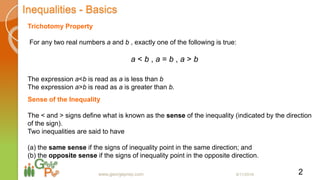
Sense of the Inequality
The < and > signs define what is known as the sense of the inequality (indicated by the direction
of the sign).
Two inequalities are said to have
(a) the same sense if the signs of inequality point in the same direction; and
(b) the opposite sense if the signs of inequality point in the opposite direction.
Trichotomy Property
For any two real numbers a and b , exactly one of the following is true:
a < b , a = b , a > b
The expression a<b is read as a is less than b
The expression a>b is read as a is greater than b.
Inequalities - Properties
8/11/2016 3www.georgeprep.com
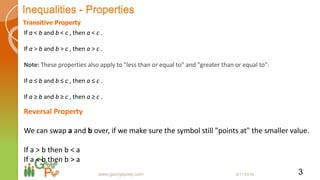
If a < b and b < c , then a < c .
If a > b and b > c , then a > c .
Note: These properties also apply to "less than or equal to" and "greater than or equal to":
If a ≤ b and b ≤ c , then a ≤ c .
If a ≥ b and b ≥ c , then a ≥ c .
Transitive Property
Reversal Property
We can swap a and b over, if we make sure the symbol still "points at" the smaller value.
If a > b then b < a
If a < b then b > a
Inequalities - Properties
8/11/2016 4www.georgeprep.com
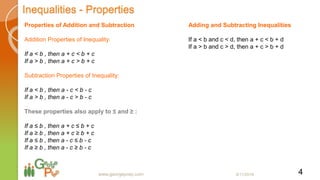
Properties of Addition and Subtraction
Addition Properties of Inequality:
If a < b , then a + c < b + c
If a > b , then a + c > b + c
Subtraction Properties of Inequality:
If a < b , then a - c < b - c
If a > b , then a - c > b - c
These properties also apply to ≤ and ≥ :
If a ≤ b , then a + c ≤ b + c
If a ≥ b , then a + c ≥ b + c
If a ≤ b , then a - c ≤ b - c
If a ≥ b , then a - c ≥ b - c
Adding and Subtracting Inequalities
If a < b and c < d, then a + c < b + d
If a > b and c > d, then a + c > b + d
Inequalities - Properties
8/11/2016 5www.georgeprep.com
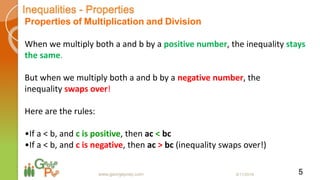
Properties of Multiplication and Division
When we multiply both a and b by a positive number, the inequality stays
the same.
But when we multiply both a and b by a negative number, the
inequality swaps over!
Here are the rules:
•If a < b, and c is positive, then ac < bc
•If a < b, and c is negative, then ac > bc (inequality swaps over!)
Inequalities - Properties
8/11/2016 6www.georgeprep.com
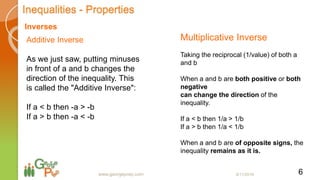
Inverses
Additive Inverse
As we just saw, putting minuses
in front of a and b changes the
direction of the inequality. This
is called the "Additive Inverse":
If a < b then -a > -b
If a > b then -a < -b
Multiplicative Inverse
Taking the reciprocal (1/value) of both a
and b
When a and b are both positive or both
negative
can change the direction of the
inequality.
If a < b then 1/a > 1/b
If a > b then 1/a < 1/b
When a and b are of opposite signs, the
inequality remains as it is.
Inequalities - Properties
8/11/2016 7www.georgeprep.com
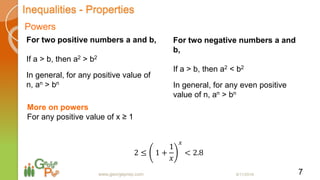
Powers
For two positive numbers a and b,
If a > b, then a2 > b2
In general, for any positive value of
n, an > bn
For two negative numbers a and
b,
If a > b, then a2 < b2
In general, for any even positive
value of n, an > bn
More on powers
For any positive value of x ≥ 1
2 ≤ 1 +
1
𝑥
𝑥
< 2.8
Problems
8/11/2016 8www.georgeprep.com
Which of the following is greater?
11^12 or 12^11
Generalisation
If a < b < e then , ab < ba
If e < a < b then ab > ba
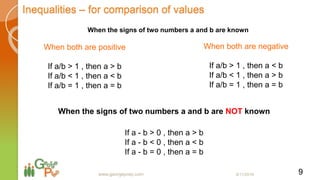
Inequalities – for comparison of values
8/11/2016 9www.georgeprep.com
When the signs of two numbers a and b are known
When both are positive
If a/b > 1 , then a > b
If a/b < 1 , then a < b
If a/b = 1 , then a = b
When both are negative
If a/b > 1 , then a < b
If a/b < 1 , then a > b
If a/b = 1 , then a = b
When the signs of two numbers a and b are NOT known
If a - b > 0 , then a > b
If a - b < 0 , then a < b
If a - b = 0 , then a = b
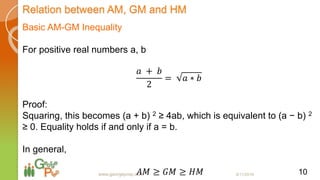
Relation between AM, GM and HM
8/11/2016 10www.georgeprep.com
Basic AM-GM Inequality
For positive real numbers a, b
𝑎 + 𝑏
2
= 𝑎 ∗ 𝑏
Proof:
Squaring, this becomes (a + b) 2 ≥ 4ab, which is equivalent to (a − b) 2
≥ 0. Equality holds if and only if a = b.
In general,
𝐴𝑀 ≥ 𝐺𝑀 ≥ 𝐻𝑀
Some applications of AM ≥ GM
1. For any positive real number x,
𝑥 +
1
𝑥
≥ 2
2. For any negative real number x,
𝑥 +
1
𝑥
≤ −2
3. When a+b is constant, ab is maximum when a = b
4. When ab is constant, a+b is minimum when a = b
8/11/2016
11
www.georgeprep.com
Problems involving AM ≥ GM
If 𝑥 + 𝑦 + 𝑧 = 19 , what is the maximum value of
(𝑥 – 2) (𝑦 – 3) (𝑧 – 2)?
1. 64
2. 16
3. 125
4. None of these
8/11/2016
12
www.georgeprep.com
Problems involving AM ≥ GM
If a, b and c are distinct positive integers, then
(𝑎 + 𝑏) ( 𝑏 + 𝑐) ( 𝑐 + 𝑎) is
1. Greater than or equal to 8
2. Greater than 8
3. Lesser than or equal to 8
4. Lesser than 8
8/11/2016
13
www.georgeprep.com
Problems involving AM ≥ GM
If p, q and r are positive real numbers, then the least value of
𝑝 + 𝑞 + 𝑟
1
𝑝
+
1
𝑞
+
1
𝑟
is
1. 1
2. 9
3. 27
4. 64
8/11/2016
14
www.georgeprep.com
Solving quadratic Inequalities
Solve 𝑥2
− 7𝑥 + 10 > 0
8/11/2016
15
www.georgeprep.com
Solving rational Inequalities
Solve for x
2𝑥 + 7
𝑥 − 4
≥ 3
8/11/2016
16
www.georgeprep.com
Answer: 4 < t ≤ 19 - in interval notation: (4; 19]

Inequalities and Modulus Session 1

  • 1.
    Inequalities and Modulus– Session 1 1www.georgeprep.com
  • 2.
    Inequalities - Basics 8/11/20162www.georgeprep.com Sense of the Inequality The < and > signs define what is known as the sense of the inequality (indicated by the direction of the sign). Two inequalities are said to have (a) the same sense if the signs of inequality point in the same direction; and (b) the opposite sense if the signs of inequality point in the opposite direction. Trichotomy Property For any two real numbers a and b , exactly one of the following is true: a < b , a = b , a > b The expression a<b is read as a is less than b The expression a>b is read as a is greater than b.
  • 3.
    Inequalities - Properties 8/11/20163www.georgeprep.com If a < b and b < c , then a < c . If a > b and b > c , then a > c . Note: These properties also apply to "less than or equal to" and "greater than or equal to": If a ≤ b and b ≤ c , then a ≤ c . If a ≥ b and b ≥ c , then a ≥ c . Transitive Property Reversal Property We can swap a and b over, if we make sure the symbol still "points at" the smaller value. If a > b then b < a If a < b then b > a
  • 4.
    Inequalities - Properties 8/11/20164www.georgeprep.com Properties of Addition and Subtraction Addition Properties of Inequality: If a < b , then a + c < b + c If a > b , then a + c > b + c Subtraction Properties of Inequality: If a < b , then a - c < b - c If a > b , then a - c > b - c These properties also apply to ≤ and ≥ : If a ≤ b , then a + c ≤ b + c If a ≥ b , then a + c ≥ b + c If a ≤ b , then a - c ≤ b - c If a ≥ b , then a - c ≥ b - c Adding and Subtracting Inequalities If a < b and c < d, then a + c < b + d If a > b and c > d, then a + c > b + d
  • 5.
    Inequalities - Properties 8/11/20165www.georgeprep.com Properties of Multiplication and Division When we multiply both a and b by a positive number, the inequality stays the same. But when we multiply both a and b by a negative number, the inequality swaps over! Here are the rules: •If a < b, and c is positive, then ac < bc •If a < b, and c is negative, then ac > bc (inequality swaps over!)
  • 6.
    Inequalities - Properties 8/11/20166www.georgeprep.com Inverses Additive Inverse As we just saw, putting minuses in front of a and b changes the direction of the inequality. This is called the "Additive Inverse": If a < b then -a > -b If a > b then -a < -b Multiplicative Inverse Taking the reciprocal (1/value) of both a and b When a and b are both positive or both negative can change the direction of the inequality. If a < b then 1/a > 1/b If a > b then 1/a < 1/b When a and b are of opposite signs, the inequality remains as it is.
  • 7.
    Inequalities - Properties 8/11/20167www.georgeprep.com Powers For two positive numbers a and b, If a > b, then a2 > b2 In general, for any positive value of n, an > bn For two negative numbers a and b, If a > b, then a2 < b2 In general, for any even positive value of n, an > bn More on powers For any positive value of x ≥ 1 2 ≤ 1 + 1 𝑥 𝑥 < 2.8
  • 8.
    Problems 8/11/2016 8www.georgeprep.com Which ofthe following is greater? 11^12 or 12^11 Generalisation If a < b < e then , ab < ba If e < a < b then ab > ba
  • 9.
    Inequalities – forcomparison of values 8/11/2016 9www.georgeprep.com When the signs of two numbers a and b are known When both are positive If a/b > 1 , then a > b If a/b < 1 , then a < b If a/b = 1 , then a = b When both are negative If a/b > 1 , then a < b If a/b < 1 , then a > b If a/b = 1 , then a = b When the signs of two numbers a and b are NOT known If a - b > 0 , then a > b If a - b < 0 , then a < b If a - b = 0 , then a = b
  • 10.
    Relation between AM,GM and HM 8/11/2016 10www.georgeprep.com Basic AM-GM Inequality For positive real numbers a, b 𝑎 + 𝑏 2 = 𝑎 ∗ 𝑏 Proof: Squaring, this becomes (a + b) 2 ≥ 4ab, which is equivalent to (a − b) 2 ≥ 0. Equality holds if and only if a = b. In general, 𝐴𝑀 ≥ 𝐺𝑀 ≥ 𝐻𝑀
  • 11.
    Some applications ofAM ≥ GM 1. For any positive real number x, 𝑥 + 1 𝑥 ≥ 2 2. For any negative real number x, 𝑥 + 1 𝑥 ≤ −2 3. When a+b is constant, ab is maximum when a = b 4. When ab is constant, a+b is minimum when a = b 8/11/2016 11 www.georgeprep.com
  • 12.
    Problems involving AM≥ GM If 𝑥 + 𝑦 + 𝑧 = 19 , what is the maximum value of (𝑥 – 2) (𝑦 – 3) (𝑧 – 2)? 1. 64 2. 16 3. 125 4. None of these 8/11/2016 12 www.georgeprep.com
  • 13.
    Problems involving AM≥ GM If a, b and c are distinct positive integers, then (𝑎 + 𝑏) ( 𝑏 + 𝑐) ( 𝑐 + 𝑎) is 1. Greater than or equal to 8 2. Greater than 8 3. Lesser than or equal to 8 4. Lesser than 8 8/11/2016 13 www.georgeprep.com
  • 14.
    Problems involving AM≥ GM If p, q and r are positive real numbers, then the least value of 𝑝 + 𝑞 + 𝑟 1 𝑝 + 1 𝑞 + 1 𝑟 is 1. 1 2. 9 3. 27 4. 64 8/11/2016 14 www.georgeprep.com
  • 15.
    Solving quadratic Inequalities Solve𝑥2 − 7𝑥 + 10 > 0 8/11/2016 15 www.georgeprep.com
  • 16.
    Solving rational Inequalities Solvefor x 2𝑥 + 7 𝑥 − 4 ≥ 3 8/11/2016 16 www.georgeprep.com Answer: 4 < t ≤ 19 - in interval notation: (4; 19]