Name – Ashwani Kumar
In Euclidean geometry, the sum of the three angles of a
triangle is 180°. How can we use this property when calculating the
angles of a triangle?
I. Proving the property
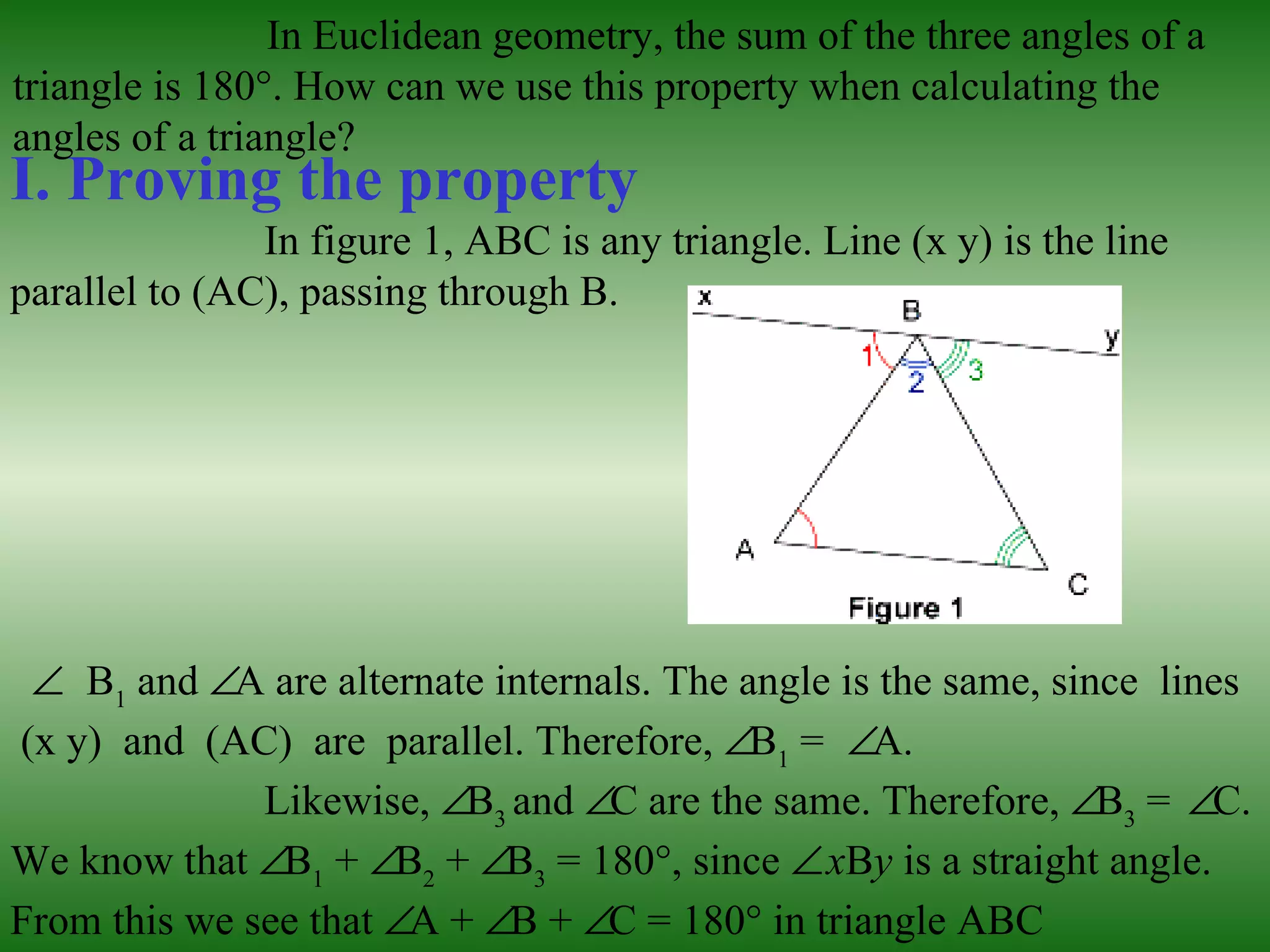
               In figure 1, ABC is any triangle. Line (x y) is the line
parallel to (AC), passing through B.


∠ B1 and ∠A are alternate internals. The angle is the same, since lines
(x y) and (AC) are parallel. Therefore, ∠B1 = ∠A.
              Likewise, ∠B3 and ∠C are the same. Therefore, ∠B3 = ∠C.
We know that ∠B1 + ∠B2 + ∠B3 = 180°, since ∠ xBy is a straight angle.
From this we see that ∠A + ∠B + ∠C = 180° in triangle ABC
II. Calculating the angles
A. In any triangle
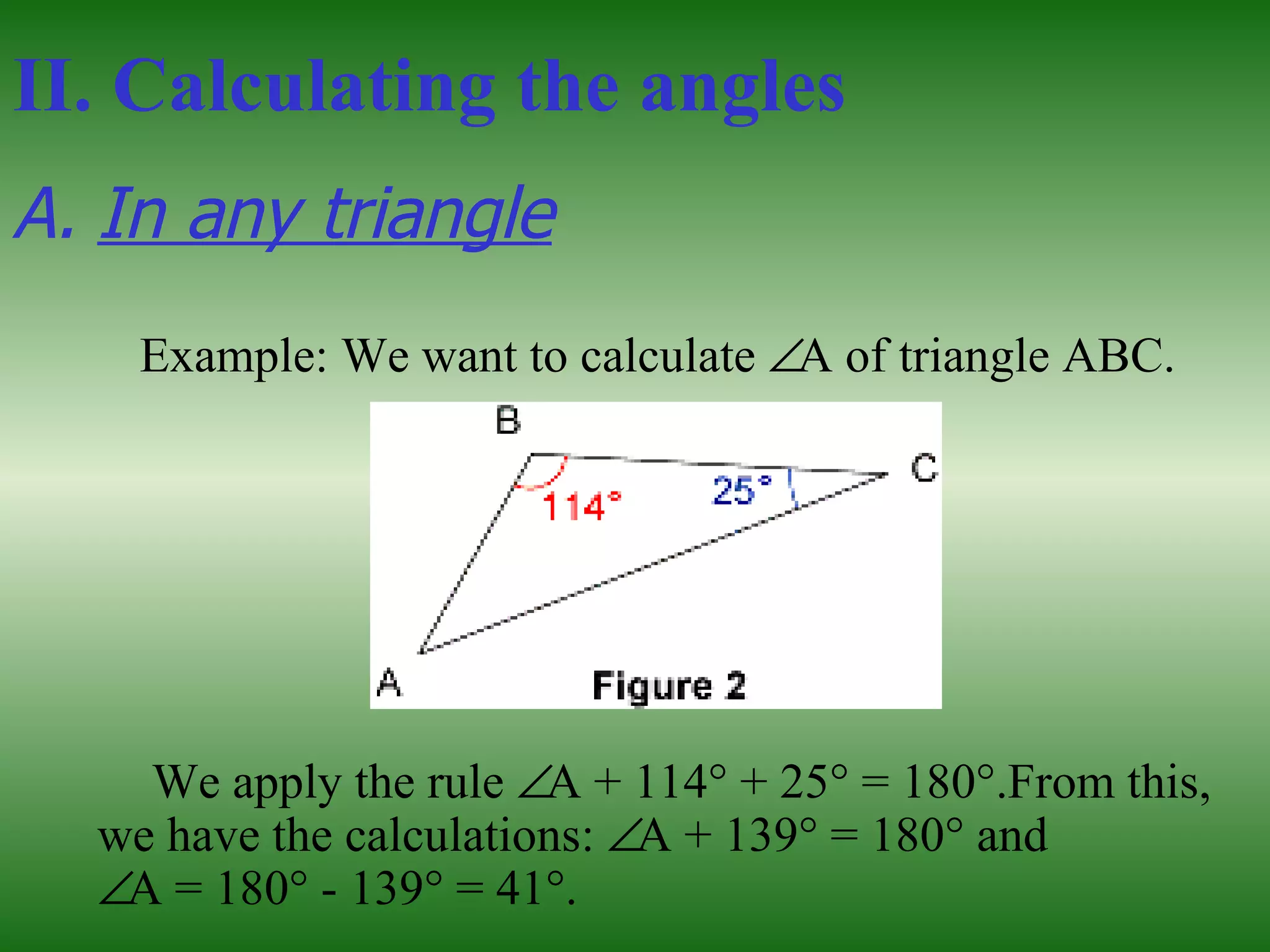
    Example: We want to calculate ∠A of triangle ABC.


    We apply the rule ∠A + 114° + 25° = 180°.From this,
  we have the calculations: ∠A + 139° = 180° and
  ∠A = 180° - 139° = 41°.
B. In a right-angled triangle
   The sum of the two acute angles in a right-angled triangle is 90°.
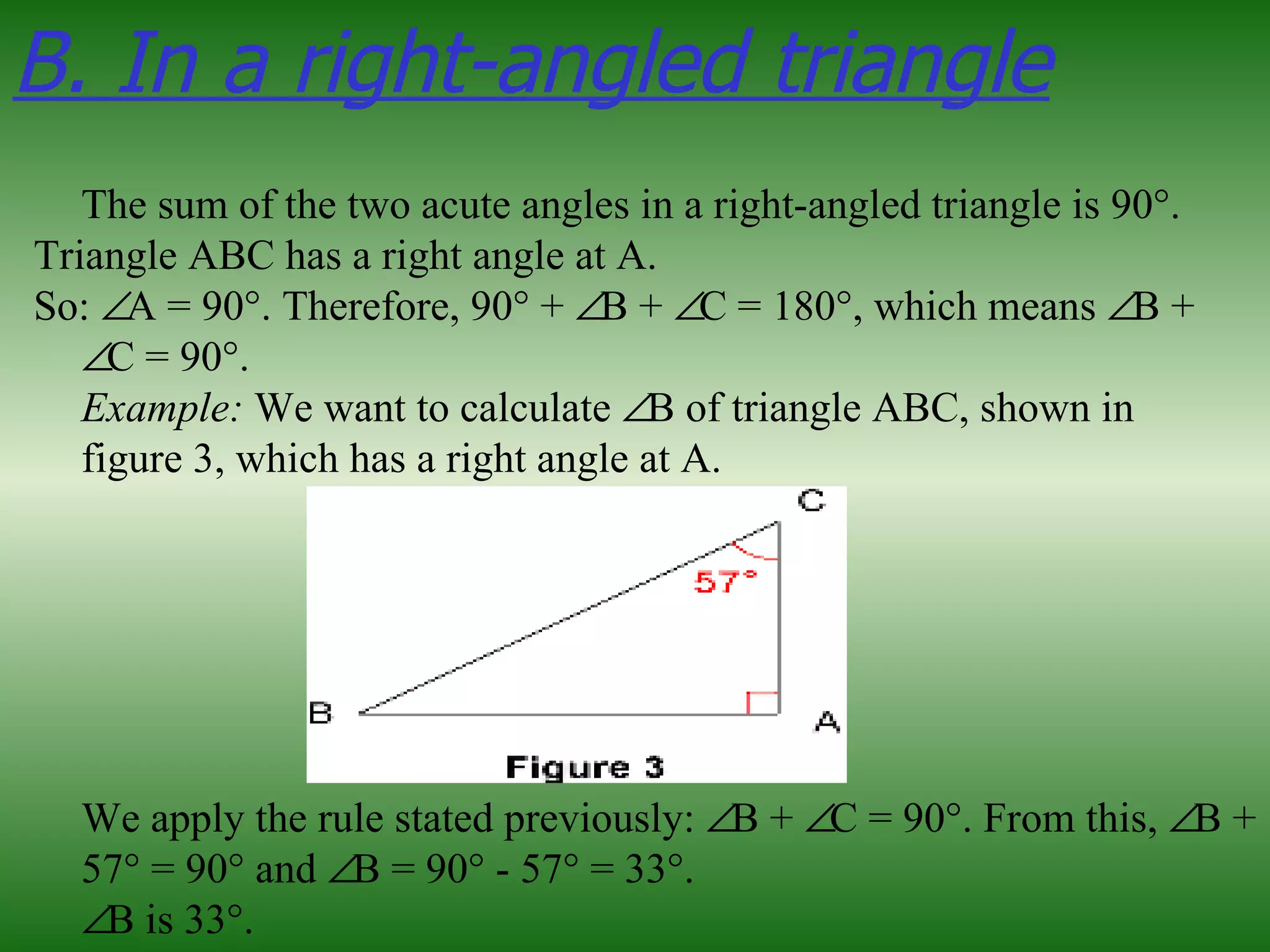
Triangle ABC has a right angle at A.
So: ∠A = 90°. Therefore, 90° + ∠B + ∠C = 180°, which means ∠B +
   ∠C = 90°.
   Example: We want to calculate ∠B of triangle ABC, shown in
   figure 3, which has a right angle at A.


  We apply the rule stated previously: ∠B + ∠C = 90°. From this, ∠B +
  57° = 90° and ∠B = 90° - 57° = 33°.
  ∠B is 33°.
C. In an isosceles triangle
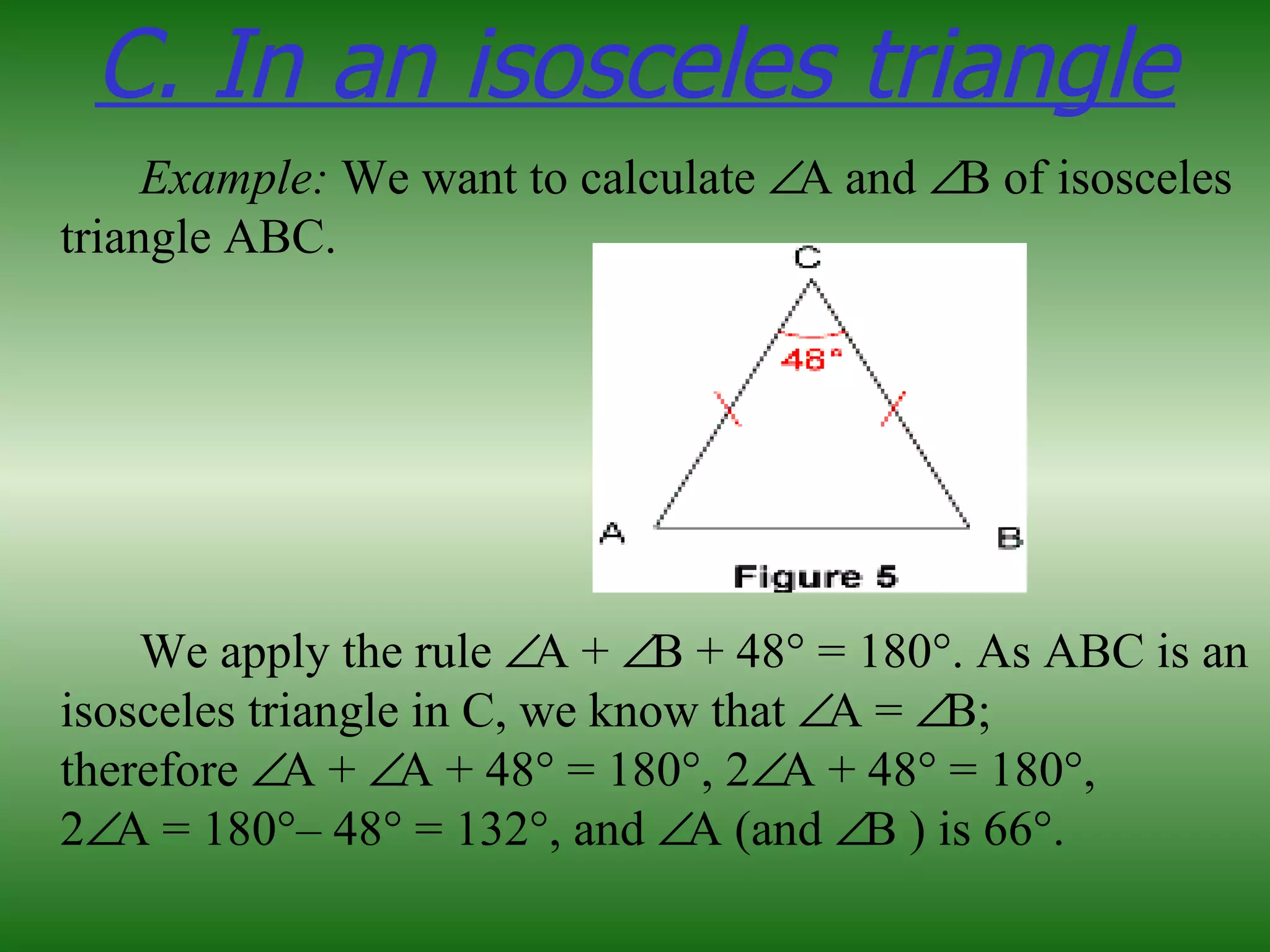
     Example: We want to calculate ∠A and ∠B of isosceles
triangle ABC.


    We apply the rule ∠A + ∠B + 48° = 180°. As ABC is an
isosceles triangle in C, we know that ∠A = ∠B;
therefore ∠A + ∠A + 48° = 180°, 2∠A + 48° = 180°,
2∠A = 180°– 48° = 132°, and ∠A (and ∠B ) is 66°.
D .In an equilateral triangle
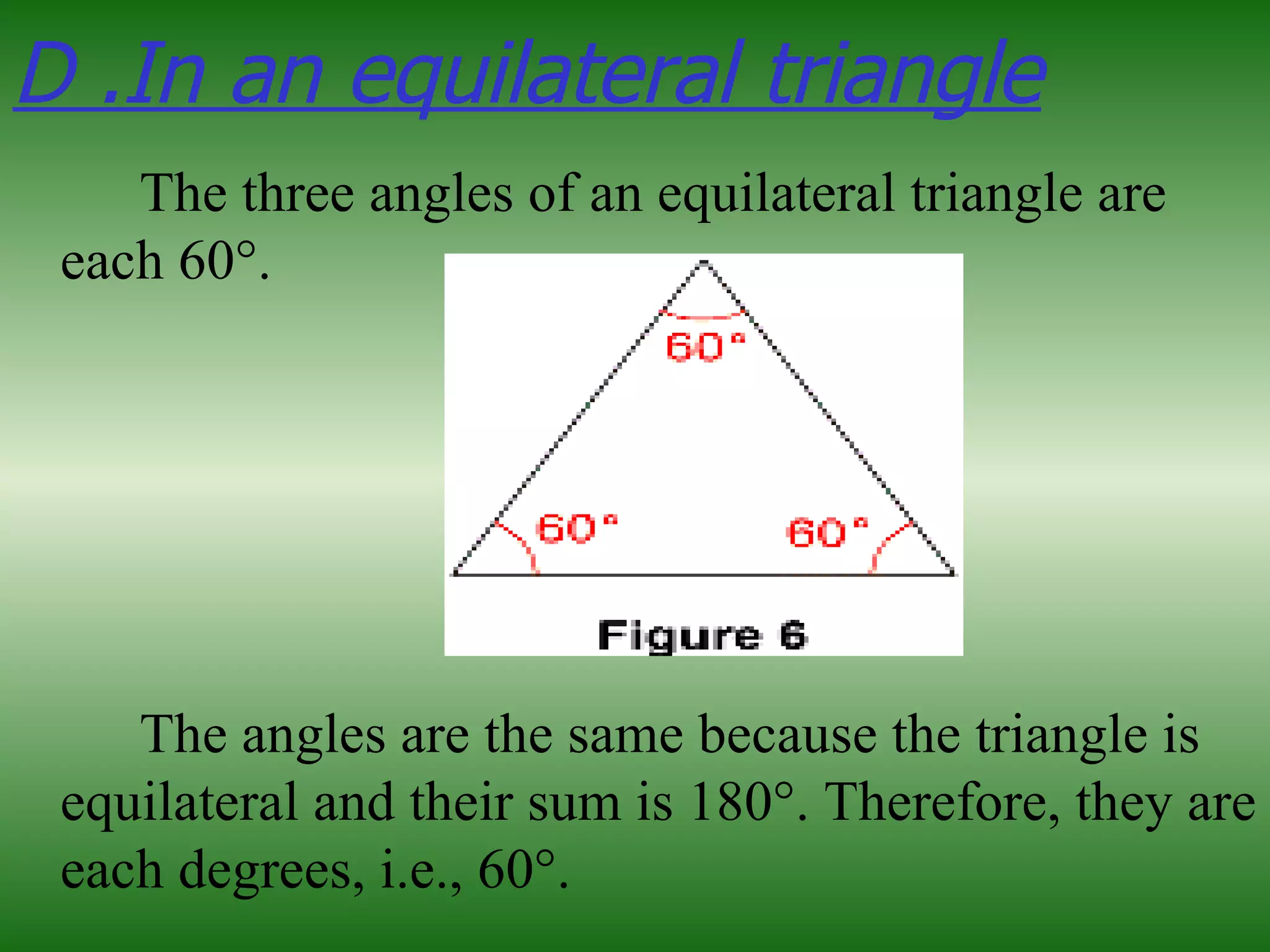
    The three angles of an equilateral triangle are
 each 60°.


    The angles are the same because the triangle is
 equilateral and their sum is 180°. Therefore, they are
 each degrees, i.e., 60°.

sum of angles of triangles

  • 1.
  • 2.
    In Euclidean geometry,the sum of the three angles of a triangle is 180°. How can we use this property when calculating the angles of a triangle? I. Proving the property In figure 1, ABC is any triangle. Line (x y) is the line parallel to (AC), passing through B. ∠ B1 and ∠A are alternate internals. The angle is the same, since lines (x y) and (AC) are parallel. Therefore, ∠B1 = ∠A. Likewise, ∠B3 and ∠C are the same. Therefore, ∠B3 = ∠C. We know that ∠B1 + ∠B2 + ∠B3 = 180°, since ∠ xBy is a straight angle. From this we see that ∠A + ∠B + ∠C = 180° in triangle ABC
  • 3.
    II. Calculating theangles A. In any triangle Example: We want to calculate ∠A of triangle ABC. We apply the rule ∠A + 114° + 25° = 180°.From this, we have the calculations: ∠A + 139° = 180° and ∠A = 180° - 139° = 41°.
  • 4.
    B. In aright-angled triangle The sum of the two acute angles in a right-angled triangle is 90°. Triangle ABC has a right angle at A. So: ∠A = 90°. Therefore, 90° + ∠B + ∠C = 180°, which means ∠B + ∠C = 90°. Example: We want to calculate ∠B of triangle ABC, shown in figure 3, which has a right angle at A. We apply the rule stated previously: ∠B + ∠C = 90°. From this, ∠B + 57° = 90° and ∠B = 90° - 57° = 33°. ∠B is 33°.
  • 5.
    C. In anisosceles triangle Example: We want to calculate ∠A and ∠B of isosceles triangle ABC. We apply the rule ∠A + ∠B + 48° = 180°. As ABC is an isosceles triangle in C, we know that ∠A = ∠B; therefore ∠A + ∠A + 48° = 180°, 2∠A + 48° = 180°, 2∠A = 180°– 48° = 132°, and ∠A (and ∠B ) is 66°.
  • 6.
    D .In anequilateral triangle The three angles of an equilateral triangle are each 60°. The angles are the same because the triangle is equilateral and their sum is 180°. Therefore, they are each degrees, i.e., 60°.