

Alosies George
IIM Calcutta
director@georgeprep.co
m
+91- 9985-372-371
Time and Distance Concept Session 2
1
www.georgeprep.com
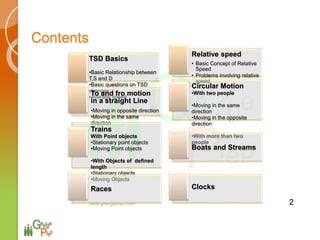
Contents
TSD Basics
•Basic Relationship between
T,S and D
•Basic questions on TSD
changes
•Average speed
Relative speed
• Basic Concept of Relative
Speed
• Problems involving relative
speed
To and fro motion
in a straight Line
•Moving in opposite direction
•Moving in the same
direction
Circular Motion
•With two people
•Moving in the same
direction
•Moving in the opposite
direction
•With more than two
people
Trains
With Point objects
•Stationary point objects
•Moving Point objects
•With Objects of defined
length
•Stationary objects
•Moving Objects
Boats and Streams
Races Clocks
2www.georgeprep.com
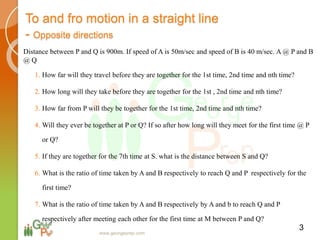
To and fro motion in a straight line
- Opposite directions
Distance between P and Q is 900m. If speed of A is 50m/sec and speed of B is 40 m/sec. A @ P and B
@ Q
1. How far will they travel before they are together for the 1st time, 2nd time and nth time?
2. How long will they take before they are together for the 1st , 2nd time and nth time?
3. How far from P will they be together for the 1st time, 2nd time and nth time?
4. Will they ever be together at P or Q? If so after how long will they meet for the first time @ P
or Q?
5. If they are together for the 7th time at S. what is the distance between S and Q?
6. What is the ratio of time taken by A and B respectively to reach Q and P respectively for the
first time?
7. What is the ratio of time taken by A and B respectively by A and b to reach Q and P
respectively after meeting each other for the first time at M between P and Q?
3
www.georgeprep.com
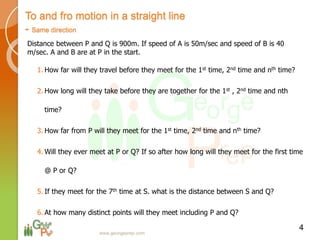
To and fro motion in a straight line
- Same direction
Distance between P and Q is 900m. If speed of A is 50m/sec and speed of B is 40
m/sec. A and B are at P in the start.
1. How far will they travel before they meet for the 1st time, 2nd time and nth time?
2. How long will they take before they are together for the 1st , 2nd time and nth
time?
3. How far from P will they meet for the 1st time, 2nd time and nth time?
4. Will they ever meet at P or Q? If so after how long will they meet for the first time
@ P or Q?
5. If they meet for the 7th time at S. what is the distance between S and Q?
6. At how many distinct points will they meet including P and Q?
4
www.georgeprep.com
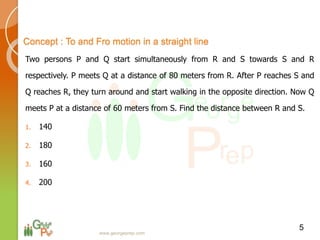
Two persons P and Q start simultaneously from R and S towards S and R
respectively. P meets Q at a distance of 80 meters from R. After P reaches S and
Q reaches R, they turn around and start walking in the opposite direction. Now Q
meets P at a distance of 60 meters from S. Find the distance between R and S.
1. 140
2. 180
3. 160
4. 200
5
Concept : To and Fro motion in a straight line
www.georgeprep.com
Page and Plant are running on a track AB of length 10 metres. They start running
simultaneously from the ends A and B respectively. The moment they reach
either of the ends, they turn around and continue running. Page and Plant run
with constant speeds of 2m/s and 5m/s respectively. How far from A (in metres)
are they, when they meet for the 23rd time?
1. 0
2. 10
3. 60/7
4. None of these
6
Concept : To and Fro motion in a straight line
www.georgeprep.com
P starts from A to B and Q starts from B towards A at the same time. After
passing each other they complete their journey in 9 hours and 16 hours
respectively. If P can cover a distance of 1000 meters in 50 sec. Who between P
and Q will win a 1km race and by what distance?
1. P by 200 meters
2. Q by 100 meters
3. P by 250 meters
4. Cannot be determined
7
Concept : To and Fro motion in a straight line
www.georgeprep.com
Circular Motion - With two people
 Circular track of length 250m. Speed of A = 30m/sec and speed of B =
20m/sec. Starting from the same point.
Moving in the opposite direction
1. Time taken to meet for the 1st time, 4th time and the nth time.
2. If A runs in the clockwise direction, How far in the clockwise direction from
the starting point is their point of meeting for the 1st time, 4th time and
nth time?
3. Will they ever meet at the starting point if so how long will they take to
meet for the 1st time at the starting point?
4. At how many distinct places on the track will they meet?
8
www.georgeprep.com
Circular Motion - With two people
 Circular track of length 250m. Speed of A = 30m/sec and speed of B =
20m/sec.
Moving in the same direction
1. Time taken to meet for the 1st time, 5th time and the nth time.
2. If A runs in the clockwise direction, How far in the clockwise direction from
the starting point is their point of meeting for the 1st time, 5th time and
nth time?
3. What is the condition for them to meet at the starting point always?
4. If the ratio of time taken by A and B to complete a round on the track is
4:1. In how many distinct points on the circular track will they meet?
5. If there are 4 runners such that the speed of the nth runner is n times the
speed of the 1st runner. In how many distinct points will the first runner be
overtaken by any of the other runners?
9
www.georgeprep.com
When three people run
Circular track of length 220m. Speed of A = 30m/sec, speed of
B = 25m/sec and speed of C = 52m/sec.
All three in the same direction
 Time taken for the 1st meeting.(all three)
 Time taken to meet at the starting point.
A and B in one direction and C in the opposite direction
 Time taken for the 1st meeting.(all three)
 Time taken to meet at the starting point.
10
www.georgeprep.com
Trains
A train and a stationary object
 Stationary object – point object
Problem: A train of length 300m crosses a pole in 1 minute.
What is the speed of the train?
 Stationary object – Platform
Problem: A train of length 200 meters crosses a platform in
14 seconds. If the speed of the train is 25m/sec, what is the
length of the platform?
11
www.georgeprep.com
Trains
A train and a moving object
 Moving object – point object
Problem: A train of length 240 meters is travelling at
a speed of 35 m/sec. if the train takes 6 seconds to
cross a cyclist who is travelling towards the train.
What is the speed of the cyclist?
 Moving object – train.
12
www.georgeprep.com
Trains
Two trains of 200m and 250m take 20 s to cross each other
when they cross each other in the opposite direction and the
faster of the two trains takes 60 seconds to overtake the slower
train. What is the speed of the faster train?
1. 22.5m/s
2. 15m/s
3. 16m/s
4. None of these
13
Answer : Option 2
www.georgeprep.com
Boats and streams
Upstream
Downstream
Speed of Boat
Speed of the River
14
www.georgeprep.com
Boats and streams
Anand rows a boat a certain distance upstream and returns to the
same place. If the time taken in going upstream is twice the time
taken in going downstream, find the ratio of the speed of the boat
in still water and the speed of the stream
1. 1:3
2. 3:1
3. 2:1
4. 3:5
15
Answer : Option 2
www.georgeprep.com
Boats and streams
A sailor can row 40 km upstream and 55 km downstream in 13
hours and 30 km upstream and 44 km downstream in 10 hours.
What is the speed of the sailor in still water?
1. 6
2. 12
3. 16
4. 8
16
Answer : Option
4
www.georgeprep.com
Boats and streams
There are two points P and Q along a stream. I took 5 hours to row
from P to Q and 3 hours to row back to P. A log of wood was left, to
float freely, at Q at 8:00 a.m. on Monday. At what time will the log of
wood reach P?
1. 9:00 p.m. on Monday
2. 11:00 p.m. on Monday
3. 9:00 a.m. on Tuesday
4. 12:00 noon on Tuesday
17
Answer : Option 2
www.georgeprep.com
Races
 Head start
 Startup
 A beats B by 20m
 A beats B by 20 seconds
 Deadheat
18
www.georgeprep.com
Races
A can beat B by 200m in a 1km race and B can beat C by 100m in
a 1km race. By what distance(in km) will A beat C in a 2 km race
if both run the 2km race the way they ran the 1 km race?
19
www.georgeprep.com
Races
 In a 200m race A beats B by 10m or 2 seconds. Find B’s speed
and A’s speed.
 If A gives B 14.28% of the total distance as head start, any race
between them would end in dead heat. If A wins a 4.2km race by
10 seconds. Find the speed of B.
20
www.georgeprep.com
Races
Karan and Arjun run a 100-meter race, where Karan beats Arjun by 10
metres. To do a favour to Arjun, Karan starts 10 metres behind the
starting line in a second 100 metre race. They both run at their
earlier speeds. Which of the following is true in connection with the
second race?
1. Karan and Arjun reach the finishing line simultaneously.
2. Arjun beats Karan by 1 metre
3. Arjun beats Karan by 11 metres.
4. Karan beats Arjun by 1 metre.
21
- CAT 2004Answer : option 4
www.georgeprep.com
Practice Problems
Excluding stoppages, the speed of a bus is 54 kmph and
including stoppages, it is 45 kmph. For how many minutes does
the bus stop per hour?
22
www.georgeprep.com
Ans: 10
Practice Problems
2 trains starting at the same time from 2 stations 200km apart
and going in opposite direction cross each other at a distance of
110km from one of the stations. What is the ratio of their
speeds?
A. 7:3
B. 11:9
C. 18:4
D. None of these
23
www.georgeprep.com
Practice Problems
Ravi takes 40 seconds to walk up on an escalator which is
moving upwards but he takes 60 seconds to walk up on an
escalator which is moving downwards. How much time will he
take to walk up if the escalator is not moving?
24
www.georgeprep.com
Ans: 48 seconds
Practice Problems
Ravi and Rakesh are climbing on a moving escalator that is
going up. Ravi takes 10 seconds to reach the top but Rakesh
takes 8 seconds to reach the top. This happens because Rakesh is
faster than Ravi. Rakesh takes 4 steps whereas Ravi can take
only 3 steps in one second. What is the total number of steps in
the escalator?
25
www.georgeprep.com
Ans: 40
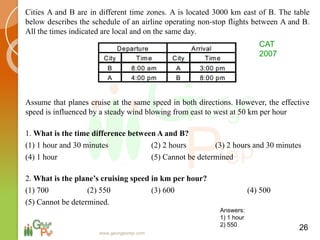
Cities A and B are in different time zones. A is located 3000 km east of B. The table
below describes the schedule of an airline operating non-stop flights between A and B.
All the times indicated are local and on the same day.
Assume that planes cruise at the same speed in both directions. However, the effective
speed is influenced by a steady wind blowing from east to west at 50 km per hour
1. What is the time difference between A and B?
(1) 1 hour and 30 minutes (2) 2 hours (3) 2 hours and 30 minutes
(4) 1 hour (5) Cannot be determined
2. What is the plane’s cruising speed in km per hour?
(1) 700 (2) 550 (3) 600 (4) 500
(5) Cannot be determined.
www.georgeprep.com
26
Answers:
1) 1 hour
2) 550
CAT
2007

CAT Time and distance session 2 and session 3

  • 1.
    Alosies George IIM Calcutta director@georgeprep.co m +91-9985-372-371 Time and Distance Concept Session 2 1 www.georgeprep.com
  • 2.
    Contents TSD Basics •Basic Relationshipbetween T,S and D •Basic questions on TSD changes •Average speed Relative speed • Basic Concept of Relative Speed • Problems involving relative speed To and fro motion in a straight Line •Moving in opposite direction •Moving in the same direction Circular Motion •With two people •Moving in the same direction •Moving in the opposite direction •With more than two people Trains With Point objects •Stationary point objects •Moving Point objects •With Objects of defined length •Stationary objects •Moving Objects Boats and Streams Races Clocks 2www.georgeprep.com
  • 3.
    To and fromotion in a straight line - Opposite directions Distance between P and Q is 900m. If speed of A is 50m/sec and speed of B is 40 m/sec. A @ P and B @ Q 1. How far will they travel before they are together for the 1st time, 2nd time and nth time? 2. How long will they take before they are together for the 1st , 2nd time and nth time? 3. How far from P will they be together for the 1st time, 2nd time and nth time? 4. Will they ever be together at P or Q? If so after how long will they meet for the first time @ P or Q? 5. If they are together for the 7th time at S. what is the distance between S and Q? 6. What is the ratio of time taken by A and B respectively to reach Q and P respectively for the first time? 7. What is the ratio of time taken by A and B respectively by A and b to reach Q and P respectively after meeting each other for the first time at M between P and Q? 3 www.georgeprep.com
  • 4.
    To and fromotion in a straight line - Same direction Distance between P and Q is 900m. If speed of A is 50m/sec and speed of B is 40 m/sec. A and B are at P in the start. 1. How far will they travel before they meet for the 1st time, 2nd time and nth time? 2. How long will they take before they are together for the 1st , 2nd time and nth time? 3. How far from P will they meet for the 1st time, 2nd time and nth time? 4. Will they ever meet at P or Q? If so after how long will they meet for the first time @ P or Q? 5. If they meet for the 7th time at S. what is the distance between S and Q? 6. At how many distinct points will they meet including P and Q? 4 www.georgeprep.com
  • 5.
    Two persons Pand Q start simultaneously from R and S towards S and R respectively. P meets Q at a distance of 80 meters from R. After P reaches S and Q reaches R, they turn around and start walking in the opposite direction. Now Q meets P at a distance of 60 meters from S. Find the distance between R and S. 1. 140 2. 180 3. 160 4. 200 5 Concept : To and Fro motion in a straight line www.georgeprep.com
  • 6.
    Page and Plantare running on a track AB of length 10 metres. They start running simultaneously from the ends A and B respectively. The moment they reach either of the ends, they turn around and continue running. Page and Plant run with constant speeds of 2m/s and 5m/s respectively. How far from A (in metres) are they, when they meet for the 23rd time? 1. 0 2. 10 3. 60/7 4. None of these 6 Concept : To and Fro motion in a straight line www.georgeprep.com
  • 7.
    P starts fromA to B and Q starts from B towards A at the same time. After passing each other they complete their journey in 9 hours and 16 hours respectively. If P can cover a distance of 1000 meters in 50 sec. Who between P and Q will win a 1km race and by what distance? 1. P by 200 meters 2. Q by 100 meters 3. P by 250 meters 4. Cannot be determined 7 Concept : To and Fro motion in a straight line www.georgeprep.com
  • 8.
    Circular Motion -With two people  Circular track of length 250m. Speed of A = 30m/sec and speed of B = 20m/sec. Starting from the same point. Moving in the opposite direction 1. Time taken to meet for the 1st time, 4th time and the nth time. 2. If A runs in the clockwise direction, How far in the clockwise direction from the starting point is their point of meeting for the 1st time, 4th time and nth time? 3. Will they ever meet at the starting point if so how long will they take to meet for the 1st time at the starting point? 4. At how many distinct places on the track will they meet? 8 www.georgeprep.com
  • 9.
    Circular Motion -With two people  Circular track of length 250m. Speed of A = 30m/sec and speed of B = 20m/sec. Moving in the same direction 1. Time taken to meet for the 1st time, 5th time and the nth time. 2. If A runs in the clockwise direction, How far in the clockwise direction from the starting point is their point of meeting for the 1st time, 5th time and nth time? 3. What is the condition for them to meet at the starting point always? 4. If the ratio of time taken by A and B to complete a round on the track is 4:1. In how many distinct points on the circular track will they meet? 5. If there are 4 runners such that the speed of the nth runner is n times the speed of the 1st runner. In how many distinct points will the first runner be overtaken by any of the other runners? 9 www.georgeprep.com
  • 10.
    When three peoplerun Circular track of length 220m. Speed of A = 30m/sec, speed of B = 25m/sec and speed of C = 52m/sec. All three in the same direction  Time taken for the 1st meeting.(all three)  Time taken to meet at the starting point. A and B in one direction and C in the opposite direction  Time taken for the 1st meeting.(all three)  Time taken to meet at the starting point. 10 www.georgeprep.com
  • 11.
    Trains A train anda stationary object  Stationary object – point object Problem: A train of length 300m crosses a pole in 1 minute. What is the speed of the train?  Stationary object – Platform Problem: A train of length 200 meters crosses a platform in 14 seconds. If the speed of the train is 25m/sec, what is the length of the platform? 11 www.georgeprep.com
  • 12.
    Trains A train anda moving object  Moving object – point object Problem: A train of length 240 meters is travelling at a speed of 35 m/sec. if the train takes 6 seconds to cross a cyclist who is travelling towards the train. What is the speed of the cyclist?  Moving object – train. 12 www.georgeprep.com
  • 13.
    Trains Two trains of200m and 250m take 20 s to cross each other when they cross each other in the opposite direction and the faster of the two trains takes 60 seconds to overtake the slower train. What is the speed of the faster train? 1. 22.5m/s 2. 15m/s 3. 16m/s 4. None of these 13 Answer : Option 2 www.georgeprep.com
  • 14.
    Boats and streams Upstream Downstream Speedof Boat Speed of the River 14 www.georgeprep.com
  • 15.
    Boats and streams Anandrows a boat a certain distance upstream and returns to the same place. If the time taken in going upstream is twice the time taken in going downstream, find the ratio of the speed of the boat in still water and the speed of the stream 1. 1:3 2. 3:1 3. 2:1 4. 3:5 15 Answer : Option 2 www.georgeprep.com
  • 16.
    Boats and streams Asailor can row 40 km upstream and 55 km downstream in 13 hours and 30 km upstream and 44 km downstream in 10 hours. What is the speed of the sailor in still water? 1. 6 2. 12 3. 16 4. 8 16 Answer : Option 4 www.georgeprep.com
  • 17.
    Boats and streams Thereare two points P and Q along a stream. I took 5 hours to row from P to Q and 3 hours to row back to P. A log of wood was left, to float freely, at Q at 8:00 a.m. on Monday. At what time will the log of wood reach P? 1. 9:00 p.m. on Monday 2. 11:00 p.m. on Monday 3. 9:00 a.m. on Tuesday 4. 12:00 noon on Tuesday 17 Answer : Option 2 www.georgeprep.com
  • 18.
    Races  Head start Startup  A beats B by 20m  A beats B by 20 seconds  Deadheat 18 www.georgeprep.com
  • 19.
    Races A can beatB by 200m in a 1km race and B can beat C by 100m in a 1km race. By what distance(in km) will A beat C in a 2 km race if both run the 2km race the way they ran the 1 km race? 19 www.georgeprep.com
  • 20.
    Races  In a200m race A beats B by 10m or 2 seconds. Find B’s speed and A’s speed.  If A gives B 14.28% of the total distance as head start, any race between them would end in dead heat. If A wins a 4.2km race by 10 seconds. Find the speed of B. 20 www.georgeprep.com
  • 21.
    Races Karan and Arjunrun a 100-meter race, where Karan beats Arjun by 10 metres. To do a favour to Arjun, Karan starts 10 metres behind the starting line in a second 100 metre race. They both run at their earlier speeds. Which of the following is true in connection with the second race? 1. Karan and Arjun reach the finishing line simultaneously. 2. Arjun beats Karan by 1 metre 3. Arjun beats Karan by 11 metres. 4. Karan beats Arjun by 1 metre. 21 - CAT 2004Answer : option 4 www.georgeprep.com
  • 22.
    Practice Problems Excluding stoppages,the speed of a bus is 54 kmph and including stoppages, it is 45 kmph. For how many minutes does the bus stop per hour? 22 www.georgeprep.com Ans: 10
  • 23.
    Practice Problems 2 trainsstarting at the same time from 2 stations 200km apart and going in opposite direction cross each other at a distance of 110km from one of the stations. What is the ratio of their speeds? A. 7:3 B. 11:9 C. 18:4 D. None of these 23 www.georgeprep.com
  • 24.
    Practice Problems Ravi takes40 seconds to walk up on an escalator which is moving upwards but he takes 60 seconds to walk up on an escalator which is moving downwards. How much time will he take to walk up if the escalator is not moving? 24 www.georgeprep.com Ans: 48 seconds
  • 25.
    Practice Problems Ravi andRakesh are climbing on a moving escalator that is going up. Ravi takes 10 seconds to reach the top but Rakesh takes 8 seconds to reach the top. This happens because Rakesh is faster than Ravi. Rakesh takes 4 steps whereas Ravi can take only 3 steps in one second. What is the total number of steps in the escalator? 25 www.georgeprep.com Ans: 40
  • 26.
    Cities A andB are in different time zones. A is located 3000 km east of B. The table below describes the schedule of an airline operating non-stop flights between A and B. All the times indicated are local and on the same day. Assume that planes cruise at the same speed in both directions. However, the effective speed is influenced by a steady wind blowing from east to west at 50 km per hour 1. What is the time difference between A and B? (1) 1 hour and 30 minutes (2) 2 hours (3) 2 hours and 30 minutes (4) 1 hour (5) Cannot be determined 2. What is the plane’s cruising speed in km per hour? (1) 700 (2) 550 (3) 600 (4) 500 (5) Cannot be determined. www.georgeprep.com 26 Answers: 1) 1 hour 2) 550 CAT 2007

Editor's Notes

  • #6 Similar to qn no 6 from 1320
  • #7 Similar to qn no 6 from 1320
  • #8 Similar to qn no 6 from 1320