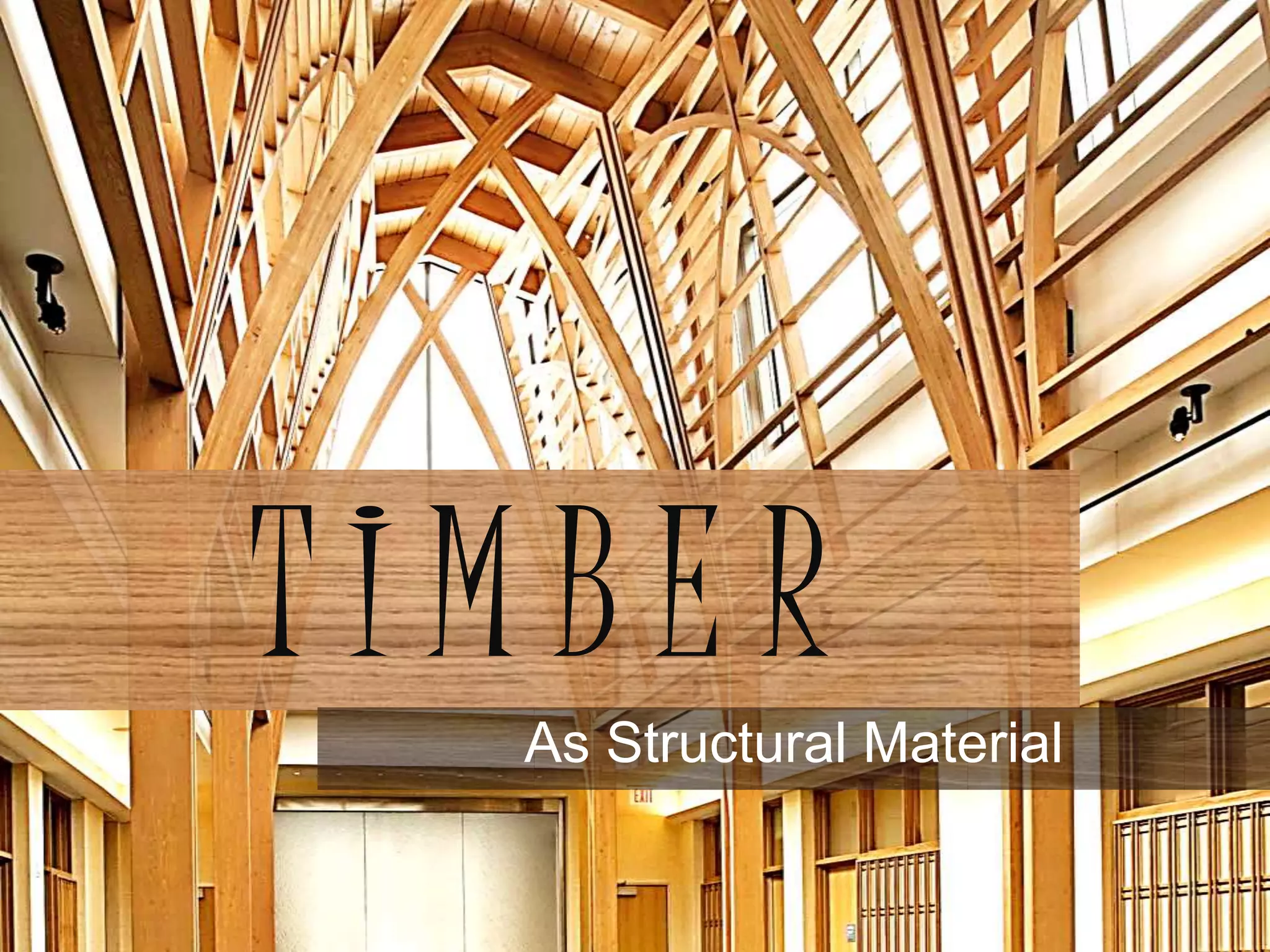
T I M B E R
As Structural Material
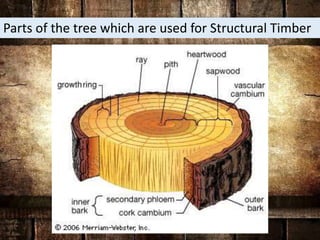
Parts of the tree which are used for Structural Timber
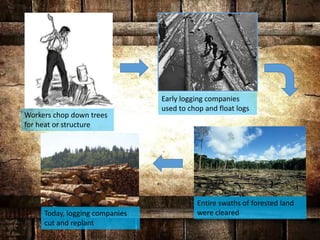
Workers chop down trees
for heat or structure
Early logging companies
used to chop and float logs
Entire swaths of forested land
were clearedToday, logging companies
cut and replant
Timber
-is wood that is at any stage
between its felling and
readiness for use as a structural
material for construction or
wood pulp for paper
production
• housing
• commercial buildings
• although most industrial buildings
are composed of either
prefabricated steel or concrete,
wood can be used to fit out the
interior offices, build stairs and
platforms, etc.
Today, the use of timber can be found in a variety of applications:
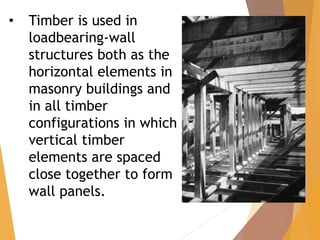
• Timber is used in
loadbearing-wall
structures both as the
horizontal elements in
masonry buildings and
in all timber
configurations in which
vertical timber
elements are spaced
close together to form
wall panels.
Two Types of Timber Products:
• ALTERNATIVE TIMBERS-
remanufactured timbers
• CONVENTIONAL WOODS-
genuine timber
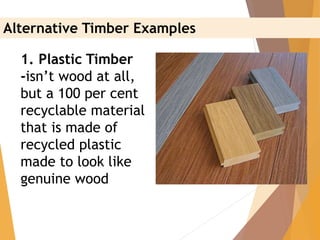
1. Plastic Timber
-isn’t wood at all,
but a 100 per cent
recyclable material
that is made of
recycled plastic
made to look like
genuine wood
Alternative Timber Examples
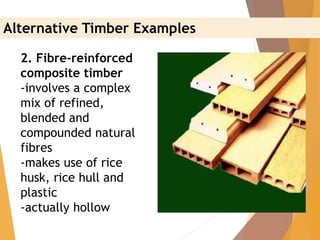
2. Fibre-reinforced
composite timber
-involves a complex
mix of refined,
blended and
compounded natural
fibres
-makes use of rice
husk, rice hull and
plastic
-actually hollow
Alternative Timber Examples
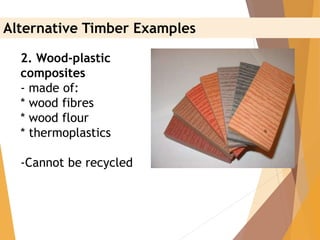
2. Wood-plastic
composites
- made of:
* wood fibres
* wood flour
* thermoplastics
-Cannot be recycled
Alternative Timber Examples
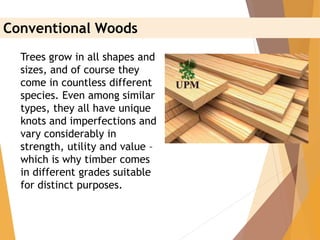
Trees grow in all shapes and
sizes, and of course they
come in countless different
species. Even among similar
types, they all have unique
knots and imperfections and
vary considerably in
strength, utility and value –
which is why timber comes
in different grades suitable
for distinct purposes.
Conventional Woods
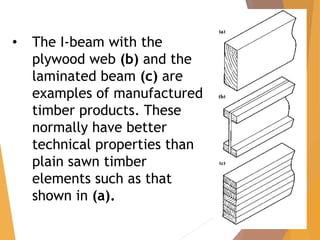
• The I-beam with the
plywood web (b) and the
laminated beam (c) are
examples of manufactured
timber products. These
normally have better
technical properties than
plain sawn timber
elements such as that
shown in (a).
• Should have uniform color and
regular annual rings.
• Should have straight fibers.
• Should be sweet to smell when
freshly cut. A disagreeable smell
indicates decay in timber.
• Should be sonorous.
Requirements of a Good Timber
• Should be free from natural
defects.
• Should not be affected by fungi
and other insects.
• Should have firm adhesion of
fibres.
• Should be durable to resist the
atmospheric effects.
Requirements of a Good Timber
• Should be tough to resist the
shocks.
• Should not be split when nail is
driven into it.
• Should be well seasoned.
Requirements of a Good Timber
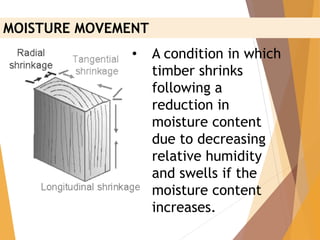
• A condition in which
timber shrinks
following a
reduction in
moisture content
due to decreasing
relative humidity
and swells if the
moisture content
increases.
MOISTURE MOVEMENT
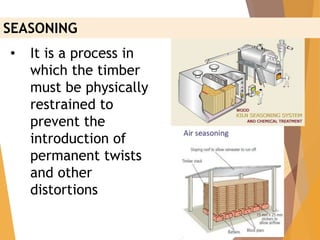
• It is a process in
which the timber
must be physically
restrained to
prevent the
introduction of
permanent twists
and other
distortions
SEASONING
TIMBER
•Timber provides for flexibility of design,
and allows modifications and tweaks to
layout during the construction process.
•Wood is a lower cost raw material than
steel.
•In solid form, wood also has significant
thermal mass properties, retaining heat
from the day and releasing it at night.
ADVANTAGES
•Wood also acts as a humidity regulator,
absorbing moisture when humid and
desorbing moisture when the air is dry.
•Wood doesn’t rust.
•Quick construction times. Builders are
familiar with using wood, and usually
prefer it. Builders report frame
construction times of two to two and a
half times longer for steel frames.
ADVANTAGES
•Wood treated with the appropriate
level of preservative, and properly
maintained, can last in service for a
hundred years or more.
•Recyclable, renewable and sustainable
•Wood is a decorative material when
considered as an aesthetic material.
•It is easy to repair and maintain wood.
ADVANTAGES
•Susceptibility to decay of timber when
exposed to excessive moisture.
Wood is a hygroscopic material. This means that it will
adsorb surrounding condensable vapors and loses
moisture to air below the fiber saturation point.
The agents causing the deterioration and destruction
of wood fall into two categories: Biotic (biological)
and abiotic (non-biological). Biotic agents include
decay and molds, fungi, bacteria and insects. Abiotic
agents include sun, wind, water, certain chemicals and
fire.
DISADVANTAGES
•Additional design and engineering time.
•Combustibility of timber requires
vigilant quality control to achieve
required fire rating of separating and
compartment walls.
•Transport from resources.
DISADVANTAGES
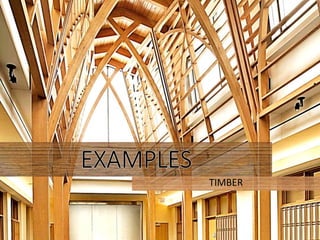
TIMBER
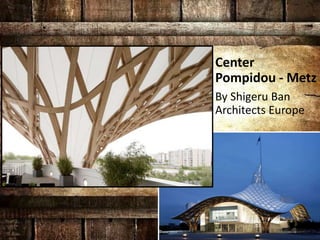
Center
Pompidou - Metz
By Shigeru Ban
Architects Europe
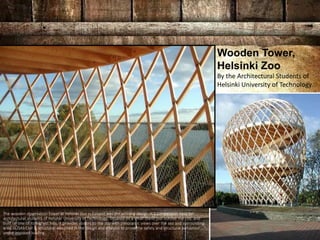
The wooden observation tower at Helsinki Zoo in Finland was the winning design in a competition held for
architectural students of Helsinki University of Technology. Situated on a small island just outside the city, and
built on one of its highest hills, it provides visitors to the zoo with panoramic views over the sea and surrounding
area. LUSAS Civil & Structural was used in the design and analysis to prove the safety and structural behaviour
under imposed loading.
Wooden Tower,
Helsinki Zoo
By the Architectural Students of
Helsinki University of Technology.
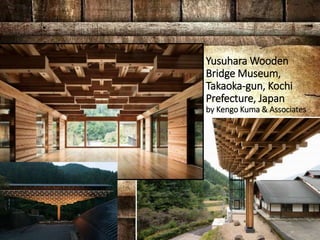
Yusuhara Wooden
Bridge Museum,
Takaoka-gun, Kochi
Prefecture, Japan
by Kengo Kuma & Associates
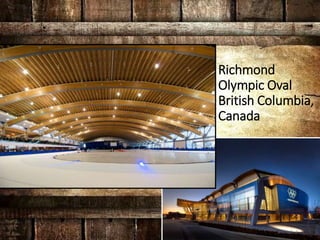
Richmond
Olympic Oval
British Columbia,
Canada
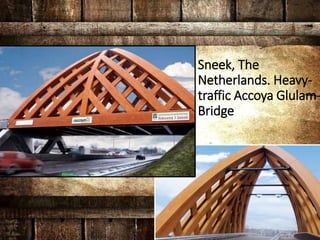
Sneek, The
Netherlands. Heavy-
traffic Accoya Glulam
Bridge
Group Members:
ROSALES, Mark Christian
AUXTERO, Ivy D.
BALTAZAR, Pauline Camille G.
PACHAO, Debbie Hope B.
REFERENCES:
 http://dab510-2014-
patricia.blogspot.com/2014/04/project-research-
timber-structure.html
 http://www.lusas.com/case/civil/wooden_tower.html
 http://www.archdaily.com/199906/yusuhara-wooden-
bridge-museum-kengo-kuma-associates/
 http://en.wikipedia.org/wiki/Glued_laminated_timber
 http://www.constructioninfocus.com.au/index.php/201
3/05/15/a-brief-history-of-timber/
 Structure and Architecture 2nd Edition
 A PARTIAL REQUIREMENT ON AR 425-B
ARCHITECTURAL STRUCTURES
 INTSTRUCTOR: ARCH. HENRY C. DESIERTO

Timber

  • 1.
    T I MB E R As Structural Material
  • 2.
    Parts of thetree which are used for Structural Timber
  • 3.
    Workers chop downtrees for heat or structure Early logging companies used to chop and float logs Entire swaths of forested land were clearedToday, logging companies cut and replant
  • 4.
    Timber -is wood thatis at any stage between its felling and readiness for use as a structural material for construction or wood pulp for paper production
  • 5.
    • housing • commercialbuildings • although most industrial buildings are composed of either prefabricated steel or concrete, wood can be used to fit out the interior offices, build stairs and platforms, etc. Today, the use of timber can be found in a variety of applications:
  • 6.
    • Timber isused in loadbearing-wall structures both as the horizontal elements in masonry buildings and in all timber configurations in which vertical timber elements are spaced close together to form wall panels.
  • 7.
    Two Types ofTimber Products: • ALTERNATIVE TIMBERS- remanufactured timbers • CONVENTIONAL WOODS- genuine timber
  • 8.
    1. Plastic Timber -isn’twood at all, but a 100 per cent recyclable material that is made of recycled plastic made to look like genuine wood Alternative Timber Examples
  • 9.
    2. Fibre-reinforced composite timber -involvesa complex mix of refined, blended and compounded natural fibres -makes use of rice husk, rice hull and plastic -actually hollow Alternative Timber Examples
  • 10.
    2. Wood-plastic composites - madeof: * wood fibres * wood flour * thermoplastics -Cannot be recycled Alternative Timber Examples
  • 11.
    Trees grow inall shapes and sizes, and of course they come in countless different species. Even among similar types, they all have unique knots and imperfections and vary considerably in strength, utility and value – which is why timber comes in different grades suitable for distinct purposes. Conventional Woods
  • 12.
    • The I-beamwith the plywood web (b) and the laminated beam (c) are examples of manufactured timber products. These normally have better technical properties than plain sawn timber elements such as that shown in (a).
  • 13.
    • Should haveuniform color and regular annual rings. • Should have straight fibers. • Should be sweet to smell when freshly cut. A disagreeable smell indicates decay in timber. • Should be sonorous. Requirements of a Good Timber
  • 14.
    • Should befree from natural defects. • Should not be affected by fungi and other insects. • Should have firm adhesion of fibres. • Should be durable to resist the atmospheric effects. Requirements of a Good Timber
  • 15.
    • Should betough to resist the shocks. • Should not be split when nail is driven into it. • Should be well seasoned. Requirements of a Good Timber
  • 16.
    • A conditionin which timber shrinks following a reduction in moisture content due to decreasing relative humidity and swells if the moisture content increases. MOISTURE MOVEMENT
  • 17.
    • It isa process in which the timber must be physically restrained to prevent the introduction of permanent twists and other distortions SEASONING
  • 18.
  • 19.
    •Timber provides forflexibility of design, and allows modifications and tweaks to layout during the construction process. •Wood is a lower cost raw material than steel. •In solid form, wood also has significant thermal mass properties, retaining heat from the day and releasing it at night. ADVANTAGES
  • 20.
    •Wood also actsas a humidity regulator, absorbing moisture when humid and desorbing moisture when the air is dry. •Wood doesn’t rust. •Quick construction times. Builders are familiar with using wood, and usually prefer it. Builders report frame construction times of two to two and a half times longer for steel frames. ADVANTAGES
  • 21.
    •Wood treated withthe appropriate level of preservative, and properly maintained, can last in service for a hundred years or more. •Recyclable, renewable and sustainable •Wood is a decorative material when considered as an aesthetic material. •It is easy to repair and maintain wood. ADVANTAGES
  • 22.
    •Susceptibility to decayof timber when exposed to excessive moisture. Wood is a hygroscopic material. This means that it will adsorb surrounding condensable vapors and loses moisture to air below the fiber saturation point. The agents causing the deterioration and destruction of wood fall into two categories: Biotic (biological) and abiotic (non-biological). Biotic agents include decay and molds, fungi, bacteria and insects. Abiotic agents include sun, wind, water, certain chemicals and fire. DISADVANTAGES
  • 23.
    •Additional design andengineering time. •Combustibility of timber requires vigilant quality control to achieve required fire rating of separating and compartment walls. •Transport from resources. DISADVANTAGES
  • 24.
  • 25.
    Center Pompidou - Metz ByShigeru Ban Architects Europe
  • 26.
    The wooden observationtower at Helsinki Zoo in Finland was the winning design in a competition held for architectural students of Helsinki University of Technology. Situated on a small island just outside the city, and built on one of its highest hills, it provides visitors to the zoo with panoramic views over the sea and surrounding area. LUSAS Civil & Structural was used in the design and analysis to prove the safety and structural behaviour under imposed loading. Wooden Tower, Helsinki Zoo By the Architectural Students of Helsinki University of Technology.
  • 27.
    Yusuhara Wooden Bridge Museum, Takaoka-gun,Kochi Prefecture, Japan by Kengo Kuma & Associates
  • 28.
  • 29.
  • 30.
    Group Members: ROSALES, MarkChristian AUXTERO, Ivy D. BALTAZAR, Pauline Camille G. PACHAO, Debbie Hope B.
  • 31.
    REFERENCES:  http://dab510-2014- patricia.blogspot.com/2014/04/project-research- timber-structure.html  http://www.lusas.com/case/civil/wooden_tower.html http://www.archdaily.com/199906/yusuhara-wooden- bridge-museum-kengo-kuma-associates/  http://en.wikipedia.org/wiki/Glued_laminated_timber  http://www.constructioninfocus.com.au/index.php/201 3/05/15/a-brief-history-of-timber/  Structure and Architecture 2nd Edition
  • 32.
     A PARTIALREQUIREMENT ON AR 425-B ARCHITECTURAL STRUCTURES  INTSTRUCTOR: ARCH. HENRY C. DESIERTO