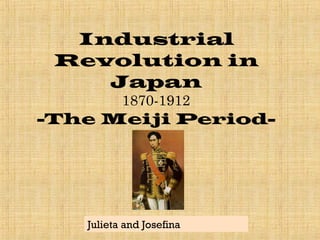
Industrial
Revolution in
Japan
1870-1912
-The Meiji Period-
Julieta and Josefina
Before the Industrial Revolution
• Feudal system, Feudal Lords had the power
over the population
• Mostly agricultural, no factories
• Little technological development
• It was commercially isolated except for
Holland and China.
All this left Japan behind, and without the
recognition of the industrialized Western
Powers
In 1853, the USA proposed Japan a commercial treaty,
named Kuro-Fune Raiko, which Japan was obliged to
accept because it was too weak to refuse.
It couldn’t refuse to sign treaties with the other Western
Countries either.
This treaties limited their control over their own
foreign trades, and crimes concerning foreigners in
Japan would be tried in Western courts only.
Social changes
• Abolition of Feudal System gave people the
freedom to move and choose their occupation
• National Educational system for the entire
population
• Constitution (only the emperor or his advisers could change
it)
• Elected parliament (but only a 1% of the population could
vote until 1925)
• Change in the legal system inspired in France
and Germany
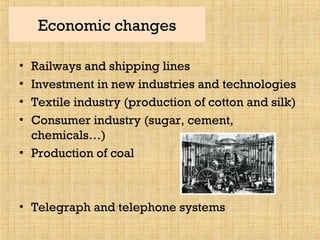
Economic changes
• Railways and shipping lines
• Investment in new industries and technologies
• Textile industry (production of cotton and silk)
• Consumer industry (sugar, cement,
chemicals…)
• Production of coal
• Telegraph and telephone systems
The most important feature of the Meiji period
was Japan's struggle for recognition of its
considerable achievement and for equality
with Western nations.
Anyways, they industrialized a lot faster, it took
half the time it took in Europe to complete the
Industrial Revolution.
Summing up..
When the Meiji period ended, with the death of the
emperor in 1912, Japan had
• a highly centralized, bureaucratic government
• a constitution establishing an elected parliament
• a well-developed transport and communication
system;
• a highly educated population free of feudal class
restrictions
• an established and rapidly growing industrial
sector based on the latest technology
• a powerful army and navy.

Industrial Revolution Japan by Josefina and Julieta

  • 1.
  • 2.
    Before the IndustrialRevolution • Feudal system, Feudal Lords had the power over the population • Mostly agricultural, no factories • Little technological development • It was commercially isolated except for Holland and China. All this left Japan behind, and without the recognition of the industrialized Western Powers
  • 3.
    In 1853, theUSA proposed Japan a commercial treaty, named Kuro-Fune Raiko, which Japan was obliged to accept because it was too weak to refuse. It couldn’t refuse to sign treaties with the other Western Countries either. This treaties limited their control over their own foreign trades, and crimes concerning foreigners in Japan would be tried in Western courts only.
  • 4.
    Social changes • Abolitionof Feudal System gave people the freedom to move and choose their occupation • National Educational system for the entire population • Constitution (only the emperor or his advisers could change it) • Elected parliament (but only a 1% of the population could vote until 1925) • Change in the legal system inspired in France and Germany
  • 5.
    Economic changes • Railwaysand shipping lines • Investment in new industries and technologies • Textile industry (production of cotton and silk) • Consumer industry (sugar, cement, chemicals…) • Production of coal • Telegraph and telephone systems
  • 6.
    The most importantfeature of the Meiji period was Japan's struggle for recognition of its considerable achievement and for equality with Western nations. Anyways, they industrialized a lot faster, it took half the time it took in Europe to complete the Industrial Revolution.
  • 7.
    Summing up.. When theMeiji period ended, with the death of the emperor in 1912, Japan had • a highly centralized, bureaucratic government • a constitution establishing an elected parliament • a well-developed transport and communication system; • a highly educated population free of feudal class restrictions • an established and rapidly growing industrial sector based on the latest technology • a powerful army and navy.