Fascist - Japan
What is fascist?? It means ‘repressive’ A group of people that is nationalistic, anti-Communist and authoritarian
Beginning of Fascism Fascist Movement in 1919 Benito Mussolini
Mussolini’s argument Democracy was bad for Italy because Ineffective Inefficient  E.g. Italy's democratically elected leaders were too weak to stop widespread unemployment and inflation Threats from Communists
His argument for Fascism Nation first under Fascism Democracy was inefficient because it limited the power of the nation and placed power in the people’s hand. Nation should grow strong and expand
Impact of Mussolini’s argument Young men and WWI veterans were drawn to Fascist ideas Glamourised action and violence Power and violence was the only way to get what they want Sense of belonging Spread to many parts of the world. E.g. Japan
The failure of the democratic government in Japan The Diet’s limited power Corruption  Failed to solve economic problems Farmers’ difficult living conditions Workers’ difficult working conditions Trade imbalance Great Depression 1929
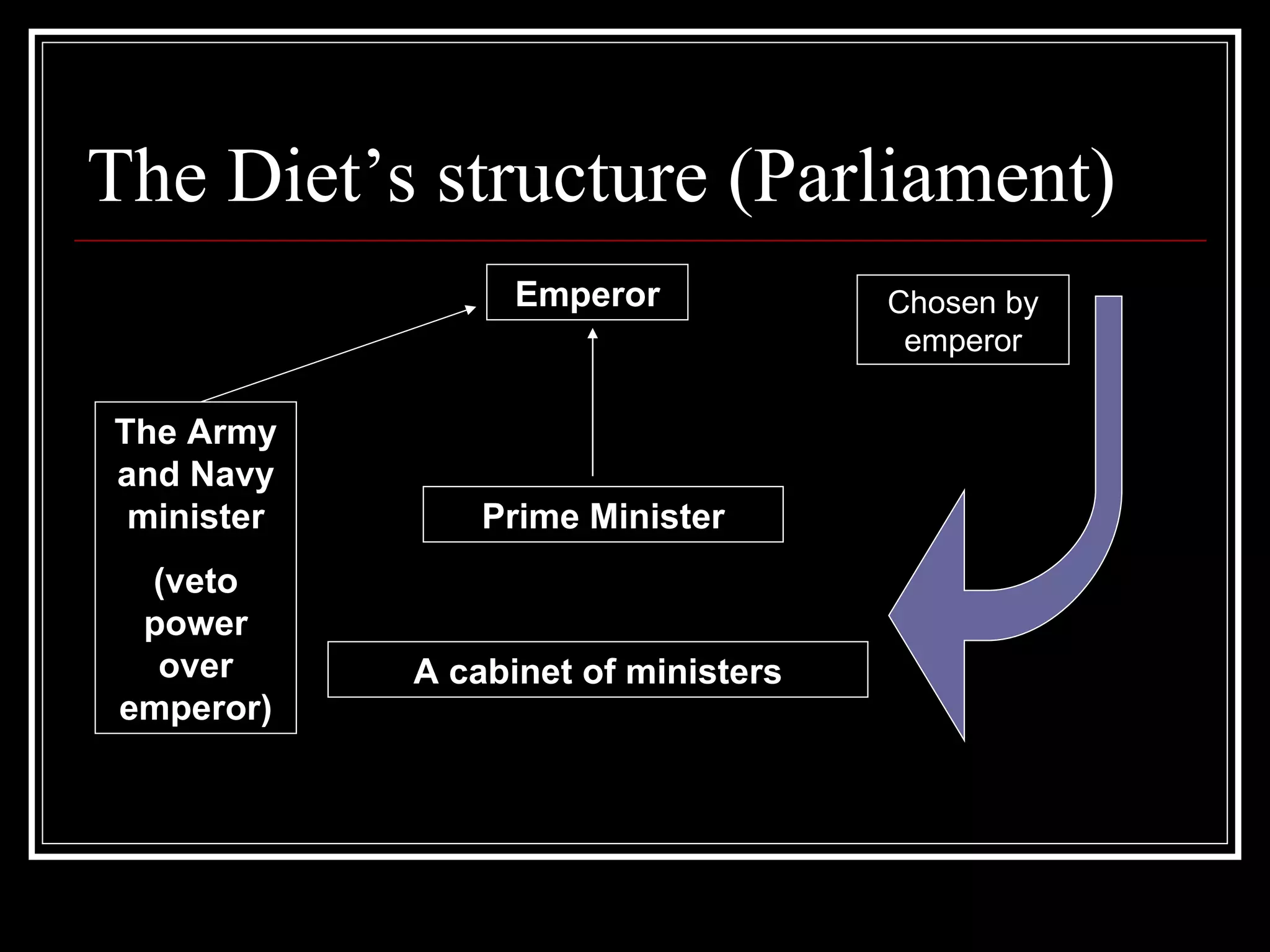
The Diet’s structure (Parliament) Emperor Prime Minister A cabinet of ministers Chosen by emperor The Army and Navy minister (veto power over emperor)
Members of Diet  (Members of Parliament) 2 chambers House of Peers Imperial family, nobles  Nominated by Emperor House of Representative  Elected by Japanese citizens Emperor reserved the right to dissolve the House
Problems with Diet Did not have the power to make decisions or policies Only question the decisions of the Cabinet Ministers Lack democratic control the nation’s budget E.g. Japanese Army’s budget
Corruption damaged democracy’s reputation Democractic leaders looked to zaibatsus to sponsor their election campaigns Zaibatsus became very powerful Mitsubishi, Mitsui, Sumitomo and Yasuda Close ties led to rumours
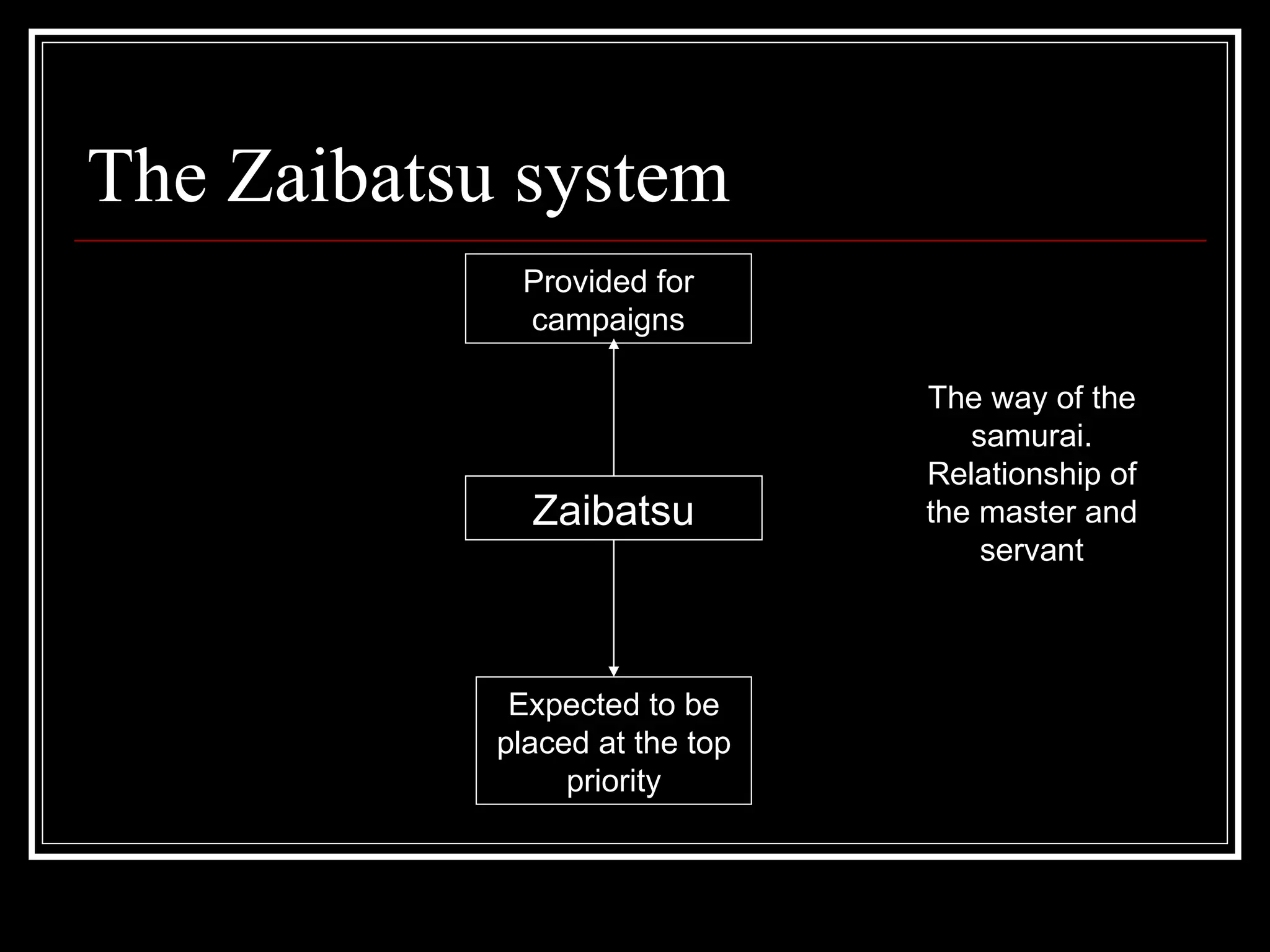
The Zaibatsu system Zaibatsu Provided for campaigns Expected to be placed at the top priority The way of the samurai. Relationship of the master and servant
Democratic leaders failed to solve economic problems Farmers’ difficult living conditions Workers’ difficult working conditions Trade imbalance Great Depression 1929
Trade imbalance Import > Export
The Great Depression or Wall Street Crash in 1929
Japan during the Great Depression or the Wall Street Crash The crash in Wall Street lead to economic problems in Japan because people no longer wanted Japanese goods E.g. Silk prices fell by 20% in 1932 Lesson : Do not depend on the west
What led to the rise of Fascism in Japan? (External Factors) American expansion in the Asia Pacific region Paris Peace Conference Washington Naval Conference London Disarmament Conference Immigration laws in the USA Resurgence of Chinese nationalism
American expansion in the Asia-Pacific region Japan plans to control the region Commodore Matthew Perry opened Japan to American trade E.g. Hawaii and the Philippines Japanese militarists believed that American was trying to take control Asia-Pacific’s economy and military power
The 3 treaties What were the 3 treaties about?
3 treaties Paris Peace Conference 1919 Japan requested that LON recognise that all races were equal – REJECTED Washington Naval Conference 1921 – 1922 Felt that it was unfair Attempt to restrict Japanese power
London Disarmament Conference 1930 Prime Minister Hamaguchi Osachi and his foreign minister Shidehara Kijuro Wanted to reduce naval arms with Britain and USA Wanted to improve ties with China The Army accused Hamaguchi and his foreign minister of betraying Japan and being too ‘soft’ in handling the West and China
Immigration laws in USA in the mid 1920s USA tried to prevent Asian immigration  Isolation and protectionist policy All Asian immigrants (except Filipinos) Immigrants cannot be a USA citizens even if Lived in USA for a long time Marry Caucasians California Alien Law in 1913
Impact of USA’s immigration law Angered Japanese Sign as the Americans considered the Japanese as inferior Many Japanese turned away from USA, democracy  Want to support an expansion of Japan’s empire
 
Resurgence of Chinese nationalism 1894 – Japan took advantage of China’s weakness Qing Dynasty Last Emperor When Qing Dynasty fell, Chinese warlords took over in 1911 Kuomintang and Chinese Communist Party (CCP)
 
China’s civil war Kuomintang – Chiang Kai Shek CCP -  Mao Zedong Chiang tried to unite China after the fall of the Qing These struggles kept China weak
In 1927, KMT and CCP joined forces to fight the warlords and Chiang led the united army He gained full control of China The Chinese demanded an  end to all ‘special concession’ to Westerners Strikes against Japanese good
Impact of China’s civil war on Japan Japanese Army (Kwantung Army) realised that a strong and united Chinese government would prevent Japan from expanding Kwantung Army stationed in Manchuria proposed to occupy Manchuria before anti Japanese feelings became too strong They urged Japanese to support military action
 
“ USA’s treatment of Asia was the main reason for the rise of Fascism in Japan.” How far do you agree with the statement?

Fascist japan

  • 1.
  • 2.
    What is fascist??It means ‘repressive’ A group of people that is nationalistic, anti-Communist and authoritarian
  • 3.
    Beginning of FascismFascist Movement in 1919 Benito Mussolini
  • 4.
    Mussolini’s argument Democracywas bad for Italy because Ineffective Inefficient E.g. Italy's democratically elected leaders were too weak to stop widespread unemployment and inflation Threats from Communists
  • 5.
    His argument forFascism Nation first under Fascism Democracy was inefficient because it limited the power of the nation and placed power in the people’s hand. Nation should grow strong and expand
  • 6.
    Impact of Mussolini’sargument Young men and WWI veterans were drawn to Fascist ideas Glamourised action and violence Power and violence was the only way to get what they want Sense of belonging Spread to many parts of the world. E.g. Japan
  • 7.
    The failure ofthe democratic government in Japan The Diet’s limited power Corruption Failed to solve economic problems Farmers’ difficult living conditions Workers’ difficult working conditions Trade imbalance Great Depression 1929
  • 8.
    The Diet’s structure(Parliament) Emperor Prime Minister A cabinet of ministers Chosen by emperor The Army and Navy minister (veto power over emperor)
  • 9.
    Members of Diet (Members of Parliament) 2 chambers House of Peers Imperial family, nobles Nominated by Emperor House of Representative Elected by Japanese citizens Emperor reserved the right to dissolve the House
  • 10.
    Problems with DietDid not have the power to make decisions or policies Only question the decisions of the Cabinet Ministers Lack democratic control the nation’s budget E.g. Japanese Army’s budget
  • 11.
    Corruption damaged democracy’sreputation Democractic leaders looked to zaibatsus to sponsor their election campaigns Zaibatsus became very powerful Mitsubishi, Mitsui, Sumitomo and Yasuda Close ties led to rumours
  • 12.
    The Zaibatsu systemZaibatsu Provided for campaigns Expected to be placed at the top priority The way of the samurai. Relationship of the master and servant
  • 13.
    Democratic leaders failedto solve economic problems Farmers’ difficult living conditions Workers’ difficult working conditions Trade imbalance Great Depression 1929
  • 14.
  • 15.
    The Great Depressionor Wall Street Crash in 1929
  • 16.
    Japan during theGreat Depression or the Wall Street Crash The crash in Wall Street lead to economic problems in Japan because people no longer wanted Japanese goods E.g. Silk prices fell by 20% in 1932 Lesson : Do not depend on the west
  • 17.
    What led tothe rise of Fascism in Japan? (External Factors) American expansion in the Asia Pacific region Paris Peace Conference Washington Naval Conference London Disarmament Conference Immigration laws in the USA Resurgence of Chinese nationalism
  • 18.
    American expansion inthe Asia-Pacific region Japan plans to control the region Commodore Matthew Perry opened Japan to American trade E.g. Hawaii and the Philippines Japanese militarists believed that American was trying to take control Asia-Pacific’s economy and military power
  • 19.
    The 3 treatiesWhat were the 3 treaties about?
  • 20.
    3 treaties ParisPeace Conference 1919 Japan requested that LON recognise that all races were equal – REJECTED Washington Naval Conference 1921 – 1922 Felt that it was unfair Attempt to restrict Japanese power
  • 21.
    London Disarmament Conference1930 Prime Minister Hamaguchi Osachi and his foreign minister Shidehara Kijuro Wanted to reduce naval arms with Britain and USA Wanted to improve ties with China The Army accused Hamaguchi and his foreign minister of betraying Japan and being too ‘soft’ in handling the West and China
  • 22.
    Immigration laws inUSA in the mid 1920s USA tried to prevent Asian immigration Isolation and protectionist policy All Asian immigrants (except Filipinos) Immigrants cannot be a USA citizens even if Lived in USA for a long time Marry Caucasians California Alien Law in 1913
  • 23.
    Impact of USA’simmigration law Angered Japanese Sign as the Americans considered the Japanese as inferior Many Japanese turned away from USA, democracy Want to support an expansion of Japan’s empire
  • 24.
  • 25.
    Resurgence of Chinesenationalism 1894 – Japan took advantage of China’s weakness Qing Dynasty Last Emperor When Qing Dynasty fell, Chinese warlords took over in 1911 Kuomintang and Chinese Communist Party (CCP)
  • 26.
  • 27.
    China’s civil warKuomintang – Chiang Kai Shek CCP - Mao Zedong Chiang tried to unite China after the fall of the Qing These struggles kept China weak
  • 28.
    In 1927, KMTand CCP joined forces to fight the warlords and Chiang led the united army He gained full control of China The Chinese demanded an end to all ‘special concession’ to Westerners Strikes against Japanese good
  • 29.
    Impact of China’scivil war on Japan Japanese Army (Kwantung Army) realised that a strong and united Chinese government would prevent Japan from expanding Kwantung Army stationed in Manchuria proposed to occupy Manchuria before anti Japanese feelings became too strong They urged Japanese to support military action
  • 30.
  • 31.
    “ USA’s treatmentof Asia was the main reason for the rise of Fascism in Japan.” How far do you agree with the statement?