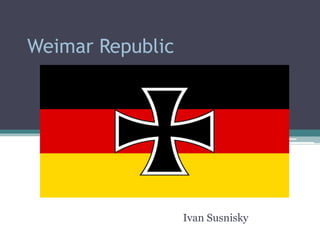
Weimar Republic
Ivan Susnisky
Brief Summary
• After Germany lost the First World War, the
Kaiser fled and a new democratic government of
Germany was declared in February 1919 at the
small town of Weimar.
• The Weimar Republic was a genuine attempt to
create a perfect democratic country.
Stab in the back myth
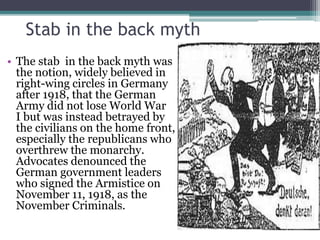
• The stab in the back myth was
the notion, widely believed in
right-wing circles in Germany
after 1918, that the German
Army did not lose World War
I but was instead betrayed by
the civilians on the home front,
especially the republicans who
overthrew the monarchy.
Advocates denounced the
German government leaders
who signed the Armistice on
November 11, 1918, as the
November Criminals.
Freikorps.
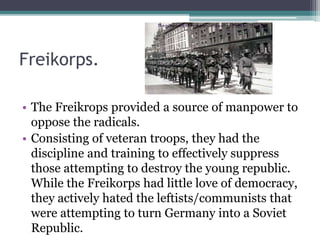
• The Freikrops provided a source of manpower to
oppose the radicals.
• Consisting of veteran troops, they had the
discipline and training to effectively suppress
those attempting to destroy the young republic.
While the Freikorps had little love of democracy,
they actively hated the leftists/communists that
were attempting to turn Germany into a Soviet
Republic.
Spartacists
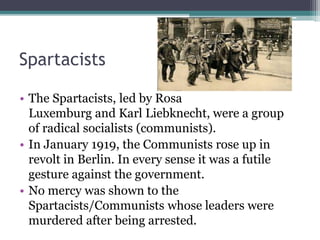
• The Spartacists, led by Rosa
Luxemburg and Karl Liebknecht, were a group
of radical socialists (communists).
• In January 1919, the Communists rose up in
revolt in Berlin. In every sense it was a futile
gesture against the government.
• No mercy was shown to the
Spartacists/Communists whose leaders were
murdered after being arrested.
Kapp Putsh
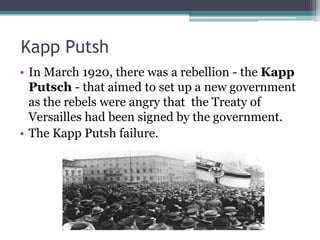
• In March 1920, there was a rebellion - the Kapp
Putsch - that aimed to set up a new government
as the rebels were angry that the Treaty of
Versailles had been signed by the government.
• The Kapp Putsh failure.
Ruhr
• In January 1923, French and Belgian troops
marched into and occupied Germany’s industrial
Ruhr region. Germany’s most valuable industrial
area.
• Such a drop in confidence also caused a crisis in
Weimar Germany itself when prices started to
rise to match inflation. Very quickly, things got
out of control and what is known
as hyperinflation set in. Prices went up
quicker than people could spend their money.
Streseman
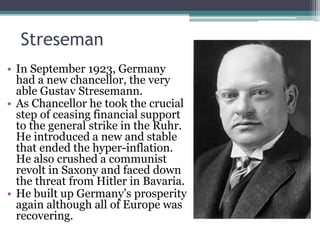
• In September 1923, Germany
had a new chancellor, the very
able Gustav Stresemann.
• As Chancellor he took the crucial
step of ceasing financial support
to the general strike in the Ruhr.
He introduced a new and stable
that ended the hyper-inflation.
He also crushed a communist
revolt in Saxony and faced down
the threat from Hitler in Bavaria.
• He built up Germany’s prosperity
again although all of Europe was
recovering.

Weimar republic ivan

  • 1.
  • 2.
    Brief Summary • AfterGermany lost the First World War, the Kaiser fled and a new democratic government of Germany was declared in February 1919 at the small town of Weimar. • The Weimar Republic was a genuine attempt to create a perfect democratic country.
  • 3.
    Stab in theback myth • The stab in the back myth was the notion, widely believed in right-wing circles in Germany after 1918, that the German Army did not lose World War I but was instead betrayed by the civilians on the home front, especially the republicans who overthrew the monarchy. Advocates denounced the German government leaders who signed the Armistice on November 11, 1918, as the November Criminals.
  • 4.
    Freikorps. • The Freikropsprovided a source of manpower to oppose the radicals. • Consisting of veteran troops, they had the discipline and training to effectively suppress those attempting to destroy the young republic. While the Freikorps had little love of democracy, they actively hated the leftists/communists that were attempting to turn Germany into a Soviet Republic.
  • 5.
    Spartacists • The Spartacists,led by Rosa Luxemburg and Karl Liebknecht, were a group of radical socialists (communists). • In January 1919, the Communists rose up in revolt in Berlin. In every sense it was a futile gesture against the government. • No mercy was shown to the Spartacists/Communists whose leaders were murdered after being arrested.
  • 6.
    Kapp Putsh • InMarch 1920, there was a rebellion - the Kapp Putsch - that aimed to set up a new government as the rebels were angry that the Treaty of Versailles had been signed by the government. • The Kapp Putsh failure.
  • 7.
    Ruhr • In January1923, French and Belgian troops marched into and occupied Germany’s industrial Ruhr region. Germany’s most valuable industrial area. • Such a drop in confidence also caused a crisis in Weimar Germany itself when prices started to rise to match inflation. Very quickly, things got out of control and what is known as hyperinflation set in. Prices went up quicker than people could spend their money.
  • 8.
    Streseman • In September1923, Germany had a new chancellor, the very able Gustav Stresemann. • As Chancellor he took the crucial step of ceasing financial support to the general strike in the Ruhr. He introduced a new and stable that ended the hyper-inflation. He also crushed a communist revolt in Saxony and faced down the threat from Hitler in Bavaria. • He built up Germany’s prosperity again although all of Europe was recovering.