Presented by:-
SHATRUGHNA CHAUDHARY
M.Pharm (1st year)
(Department of Pharmaceutics)
BIOPHARMACEUTICAL
CLASSIFICATION SYSTEM
CONTENTS
 INTRODUCTION
 FACTOR AFFECTING BIOPHARMACEUTICAL
CLASSIFICATION SYSTEM
 BIOPHARMACEUTICAL CLASSIFICATION SYSTEM
 APPLICATIONS OF BIOPHARMACEUTICAL
CLASSIFICATION SYSTEM
 CONCLUSION
 REFERENCES
2
BIOPHARMACEUTICAL CLASSIFICATION SYSTEM [BCS]
The Biopharmaceutical Classification System was first
developed by in 1995, by Amidon et. Al. & his colleagues.
Definition:
“The Biopharmaceutical Classification System is a
scientific framework for classifying a drug substance based
on its aqueous solubility & intestinal permeability &
dissolution rate”.
To saved time fast screening is required so drug substances
are classified on basis of solubility and permeability. This
classification is called Biopharmaceutical Classification
System. 3
FACTOR AFFECTING BCS
The Biopharmaceutical Classification System has been
developed to provide a scientific approach to allow for
to prediction in vivo pharmacokinetics of oral
immediate release (IR) drug product by classifying drug
compound based on their,
1. SOLUBILITY
2. PERMEABILITY
3. DISSOLUTION
4
SOLUBILITY
The Maximum Amount of solute dissolved in a
given solvent under standard conditions of
temperature, pressure and pH.
 Solubility is the ability of the drug to be solution
after dissolution.
 The higher single unit dose is completely soluble
in 250 ml at pH 1- 6.8 ( 37˚C ).
5
PERMEABILITY
Permeability of the drug to pass the biological
membrane which is the lipophilic.
Permeability is indirectly based on the extent of
absorption of a drug substance .
 Drug substance is considered to be highly
permeable, when the extent of absorption in
human determined to be 90% or more of
administered drug or compare to in vivo
reference dose.
6
DISSOLUTION
 It is process in which solid substance solubilises in
given solvent i.e. mass transfer from solid surface to
liquid phase.
 Using USP apparatus I at 100 rpm or USP apparatus II
at 50 rpm .
 Dissolution Media [900 ml],
1. 0.1 N HCl or simulated gastric fluid (pH 1.2) without
enzyme.
2. pH 4.5 buffer & pH 6.8 buffer.
3. Simulated intestinal fluid without enzyme.
7
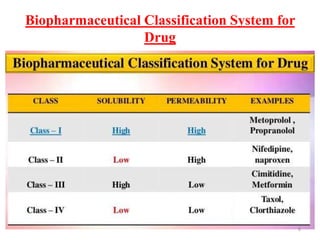
Biopharmaceutical Classification System for
Drug
8
CLASS - I
 Ideal for oral route administration.
 Drug absorbed rapidly.
 Drug dissolved rapidly.
 Rapid therapeutic action.
 Bioavailability problem not expected for immediate
release drug product.
e.g. Metoprolol , Propranolol, Diltiazem.
9
CLASS - II
Oral route for administration.
 Drug absorb rapidly.
 Drug dissolve slowly.
Bioavailability is controlled by dosage form and
rate of release of the drug substance.
e. g. Nifedipine, naproxen.
10
CLASS - III
 Oral route for administration.
 Drug absorbance is limited.
 Drug dissolve rapidly.
 Bioavailability is incomplete if drug is not
release or dissolve in absorption window.
e. g. Cimitidine, Metformin,Insulin.
11
CLASS - IV
 Poorly absorbed by orally administration.
 Both solubility & permeability limitation.
 Low dissolution rate.
 Slow or low therapeutic action.
 An alternate route of administration may be
needed.
e. g. Taxol, Chlorthiazole, Cefexime Trihydrate.
12
APPLICATIONS
 To predict in vivo performance of drug product using
solubility and permeability measurements.
 Aid in earliest stages of drug discovery research.
 To use in biowaiver considerations.
 For research scientist to decide upon which drug
delivery technology to follow or develop.
 Also for the regulation of bioequivalence of the drug
product during scale up and post approval.
13
REFERENCES
 Brahmankar, D. M and Jaiswal, Sunil. B (2009).
Biopharmaceutics and Pharmacokinetics – A Treatise. 2nd
edition. Vallabh Prakashan, Page no. 27- 29 and 332 - 335.
 Dr. Tipnis H.P. and Dr. Bajaj Amrita, Principles and
applications of Biopharmaceutics and Pharmacokinetics,
1st edition 2002, reprint 2005, career publication, Page no.
332-340.
 Leon shargel, Susanna wu-pong, Andrew B.C.Yu , Applied
Biopharmaceutics & Pharmacokinetics, 5th edition 2005,
published by the Mc Graw hills companies, page no. 431-
436 & 482-484.
14
15

Biopharmaceutical Classification System

  • 1.
    Presented by:- SHATRUGHNA CHAUDHARY M.Pharm(1st year) (Department of Pharmaceutics) BIOPHARMACEUTICAL CLASSIFICATION SYSTEM
  • 2.
    CONTENTS  INTRODUCTION  FACTORAFFECTING BIOPHARMACEUTICAL CLASSIFICATION SYSTEM  BIOPHARMACEUTICAL CLASSIFICATION SYSTEM  APPLICATIONS OF BIOPHARMACEUTICAL CLASSIFICATION SYSTEM  CONCLUSION  REFERENCES 2
  • 3.
    BIOPHARMACEUTICAL CLASSIFICATION SYSTEM[BCS] The Biopharmaceutical Classification System was first developed by in 1995, by Amidon et. Al. & his colleagues. Definition: “The Biopharmaceutical Classification System is a scientific framework for classifying a drug substance based on its aqueous solubility & intestinal permeability & dissolution rate”. To saved time fast screening is required so drug substances are classified on basis of solubility and permeability. This classification is called Biopharmaceutical Classification System. 3
  • 4.
    FACTOR AFFECTING BCS TheBiopharmaceutical Classification System has been developed to provide a scientific approach to allow for to prediction in vivo pharmacokinetics of oral immediate release (IR) drug product by classifying drug compound based on their, 1. SOLUBILITY 2. PERMEABILITY 3. DISSOLUTION 4
  • 5.
    SOLUBILITY The Maximum Amountof solute dissolved in a given solvent under standard conditions of temperature, pressure and pH.  Solubility is the ability of the drug to be solution after dissolution.  The higher single unit dose is completely soluble in 250 ml at pH 1- 6.8 ( 37˚C ). 5
  • 6.
    PERMEABILITY Permeability of thedrug to pass the biological membrane which is the lipophilic. Permeability is indirectly based on the extent of absorption of a drug substance .  Drug substance is considered to be highly permeable, when the extent of absorption in human determined to be 90% or more of administered drug or compare to in vivo reference dose. 6
  • 7.
    DISSOLUTION  It isprocess in which solid substance solubilises in given solvent i.e. mass transfer from solid surface to liquid phase.  Using USP apparatus I at 100 rpm or USP apparatus II at 50 rpm .  Dissolution Media [900 ml], 1. 0.1 N HCl or simulated gastric fluid (pH 1.2) without enzyme. 2. pH 4.5 buffer & pH 6.8 buffer. 3. Simulated intestinal fluid without enzyme. 7
  • 8.
  • 9.
    CLASS - I Ideal for oral route administration.  Drug absorbed rapidly.  Drug dissolved rapidly.  Rapid therapeutic action.  Bioavailability problem not expected for immediate release drug product. e.g. Metoprolol , Propranolol, Diltiazem. 9
  • 10.
    CLASS - II Oralroute for administration.  Drug absorb rapidly.  Drug dissolve slowly. Bioavailability is controlled by dosage form and rate of release of the drug substance. e. g. Nifedipine, naproxen. 10
  • 11.
    CLASS - III Oral route for administration.  Drug absorbance is limited.  Drug dissolve rapidly.  Bioavailability is incomplete if drug is not release or dissolve in absorption window. e. g. Cimitidine, Metformin,Insulin. 11
  • 12.
    CLASS - IV Poorly absorbed by orally administration.  Both solubility & permeability limitation.  Low dissolution rate.  Slow or low therapeutic action.  An alternate route of administration may be needed. e. g. Taxol, Chlorthiazole, Cefexime Trihydrate. 12
  • 13.
    APPLICATIONS  To predictin vivo performance of drug product using solubility and permeability measurements.  Aid in earliest stages of drug discovery research.  To use in biowaiver considerations.  For research scientist to decide upon which drug delivery technology to follow or develop.  Also for the regulation of bioequivalence of the drug product during scale up and post approval. 13
  • 14.
    REFERENCES  Brahmankar, D.M and Jaiswal, Sunil. B (2009). Biopharmaceutics and Pharmacokinetics – A Treatise. 2nd edition. Vallabh Prakashan, Page no. 27- 29 and 332 - 335.  Dr. Tipnis H.P. and Dr. Bajaj Amrita, Principles and applications of Biopharmaceutics and Pharmacokinetics, 1st edition 2002, reprint 2005, career publication, Page no. 332-340.  Leon shargel, Susanna wu-pong, Andrew B.C.Yu , Applied Biopharmaceutics & Pharmacokinetics, 5th edition 2005, published by the Mc Graw hills companies, page no. 431- 436 & 482-484. 14
  • 15.