Drugs and
Cosmetics Act
1940 and its rules
1945
Unit-2
Schedules
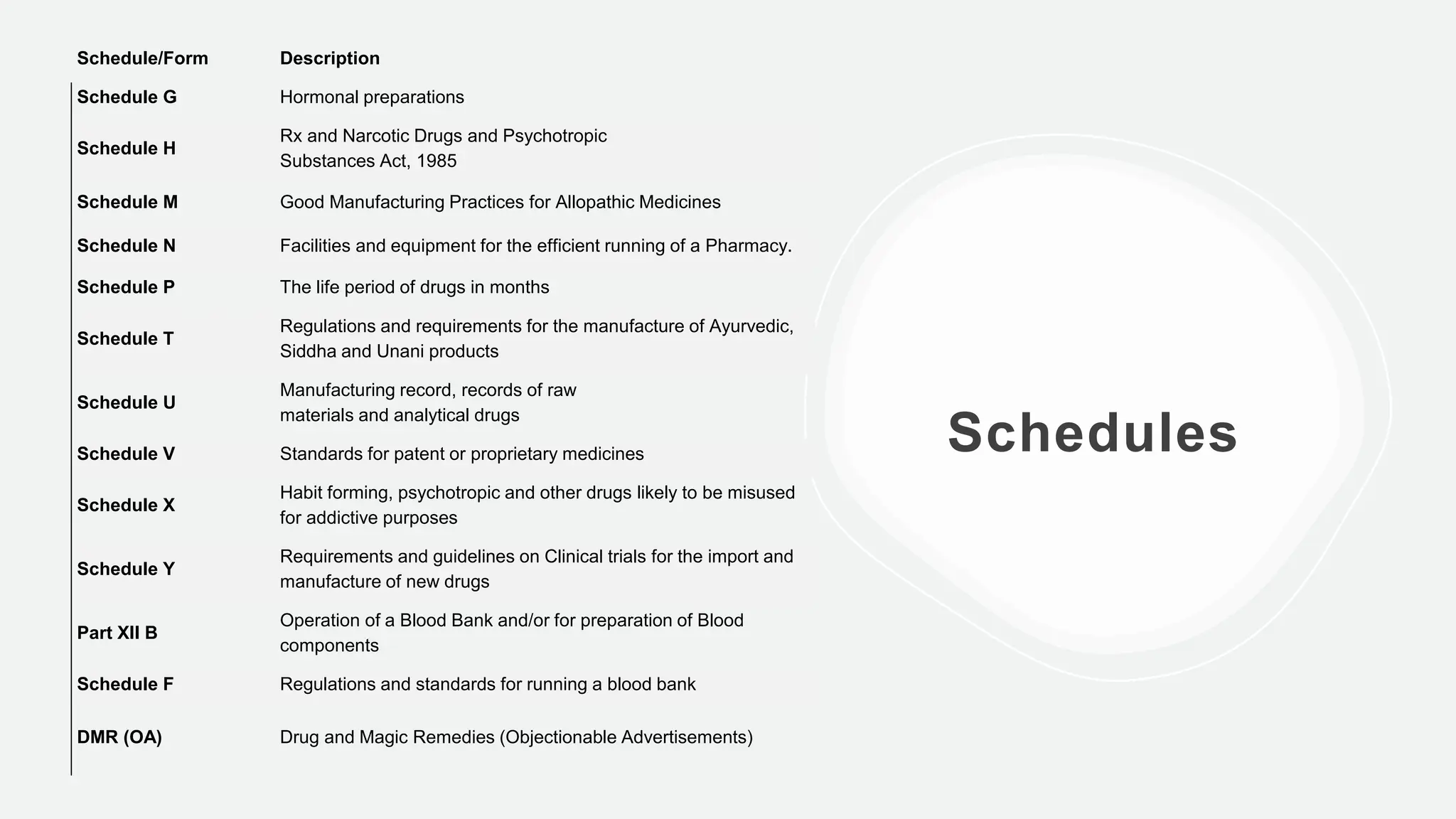
Schedule/Form Description
Schedule G Hormonal preparations
Schedule H
Rx and Narcotic Drugs and Psychotropic
Substances Act, 1985
Schedule M Good Manufacturing Practices for Allopathic Medicines
Schedule N Facilities and equipment for the efficient running of a Pharmacy.
Schedule P The life period of drugs in months
Schedule T
Regulations and requirements for the manufacture of Ayurvedic,
Siddha and Unani products
Schedule U
Manufacturing record, records of raw
materials and analytical drugs
Schedule V Standards for patent or proprietary medicines
Schedule X
Habit forming, psychotropic and other drugs likely to be misused
for addictive purposes
Schedule Y
Requirements and guidelines on Clinical trials for the import and
manufacture of new drugs
Part XII B
Operation of a Blood Bank and/or for preparation of Blood
components
Schedule F Regulations and standards for running a blood bank
DMR (OA) Drug and Magic Remedies (Objectionable Advertisements)
Mnemonics
Schedule G, H, M, N, P, T,
U, V, X, Y, Part XII B, Sch
F & DMR (OA)
"Gentle Heroes Make
New Paths To Understand
Various Xenophobes
Yearning for Particular
Scholastic Freedom and
Drug Monographs"
Schedule G Drugs - Hormonal Preparations
SCHEDULE G DRUGS
PRIMARILY CONSIST OF
HORMONAL PREPARATIONS.
THESE DRUGS REQUIRE
CAREFUL USAGE UNDER
MEDICAL SUPERVISION.
Cautionary Statement
Drug label prominently displays: "Caution:
It is dangerous to take this preparation
except under medical supervision."
Examples
Testolactone
Hydroxyurea
Carbutamide
Primidone
Mercaptopurine
Methsuximide
Thiotepa
Importance of
Hormonal
Preparations
Hormonal preparations
can have significant
effects on the body's
hormonal balance.
Medical supervision
ensures proper dosing
and reduces risks
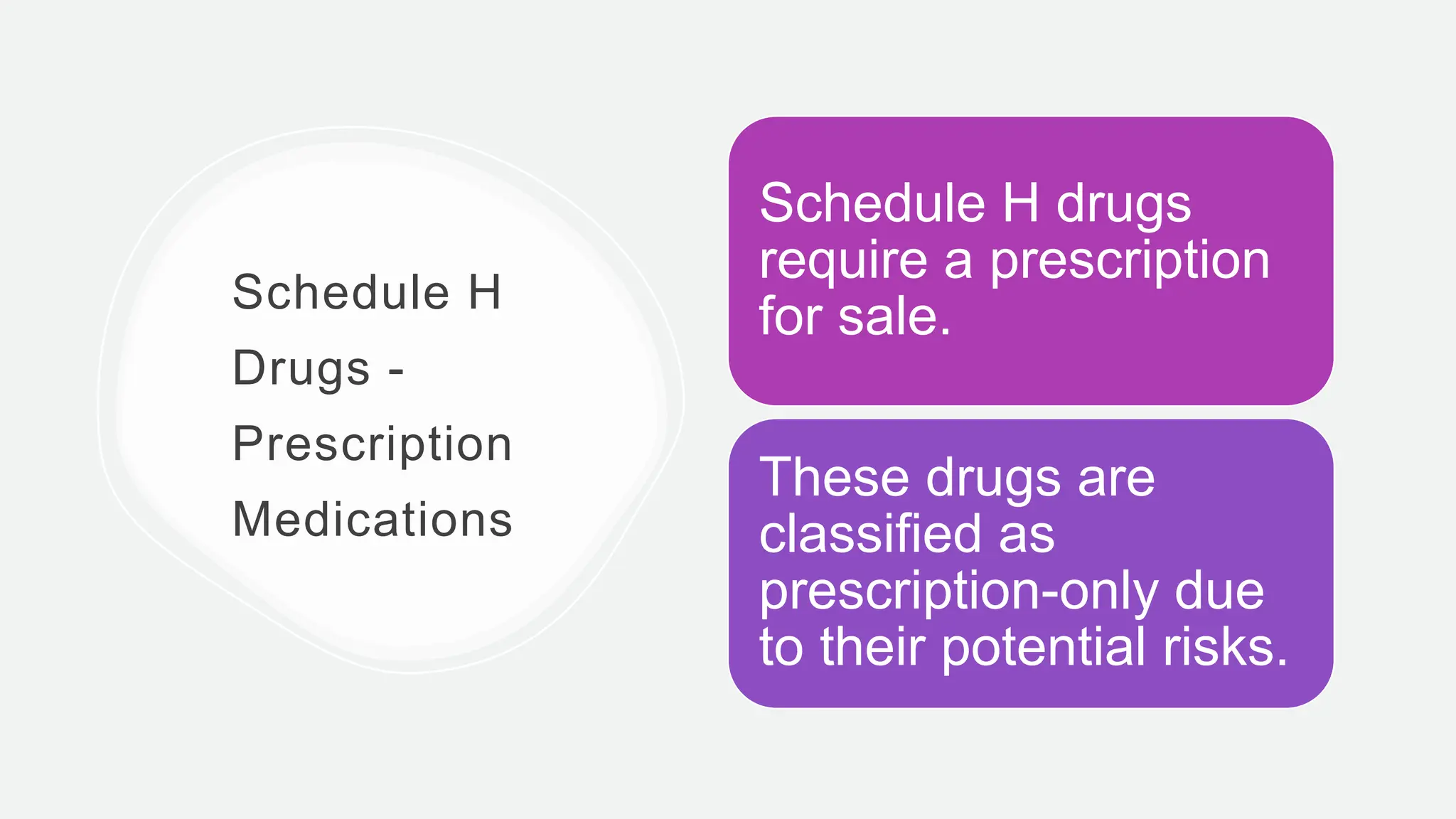
Schedule H
Drugs -
Prescription
Medications
Schedule H drugs
require a prescription
for sale.
These drugs are
classified as
prescription-only due
to their potential risks.
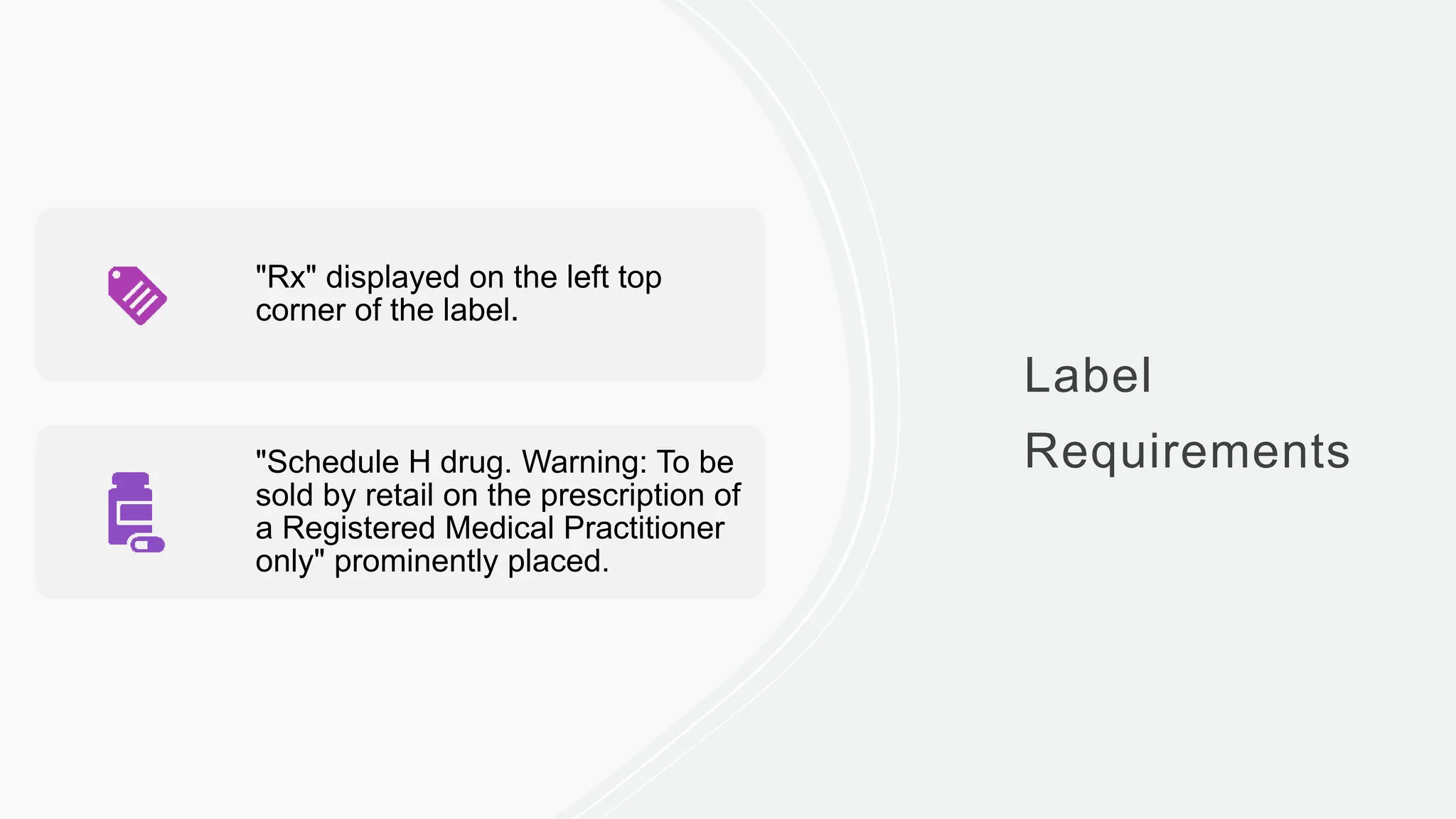
Label
Requirements
"Rx" displayed on the left top
corner of the label.
"Schedule H drug. Warning: To be
sold by retail on the prescription of
a Registered Medical Practitioner
only" prominently placed.
Supply and
Sale
Restrictions
Only supplied to licensed
parties.
Cannot be sold without a
valid prescription.
Quantity sold must match the
prescription.
Prescription Information
The time and date of the prescription
must be noted.
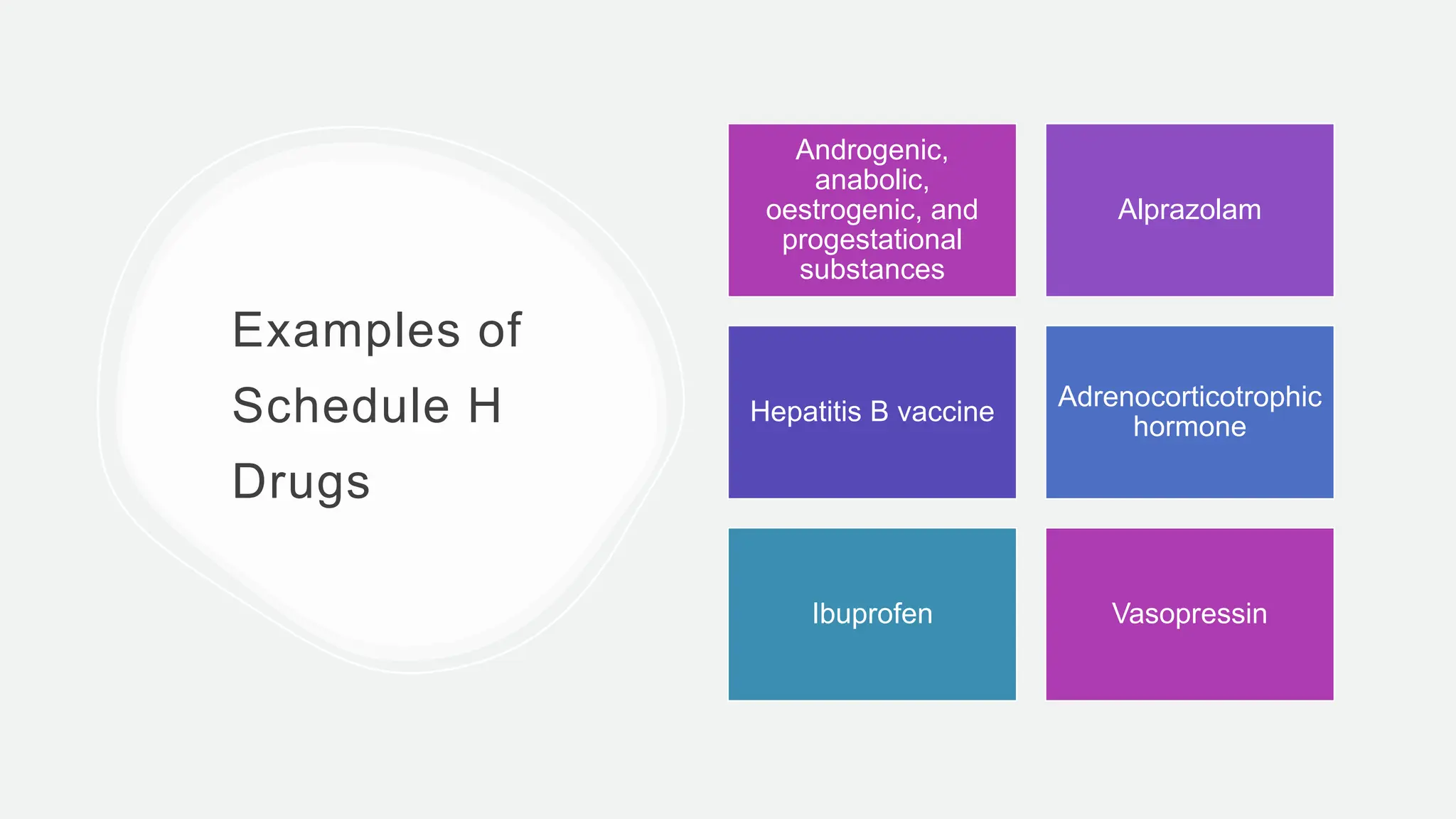
Examples of
Schedule H
Drugs
Androgenic,
anabolic,
oestrogenic, and
progestational
substances
Alprazolam
Hepatitis B vaccine
Adrenocorticotrophic
hormone
Ibuprofen Vasopressin
Schedule H
and Narcotic
Drugs
If a Schedule H drug falls under the
Narcotic Drugs and Psychotropic
Substances Act 1985, it requires
additional labeling.
Dual
Classification
Labeling
•"NRx" displayed in red on the left top
corner of the label.
•"Schedule H drug. Warning: To be sold
by retail on the prescription of a
Registered Medical Practitioner only."
prominently placed.
Importance of
Regulation
•Schedule H drugs require stricter control
due to their potential risks.
•Ensures patient safety and proper usage
Introduction to
Schedule M (GMP -
Good Manufacturing
Practices)
Definition: Ensures consistent product quality for
intended use.
Documentation: Covers manufacturing, packing,
storage, testing, and documentation.
Part 1: Requirements for Premises and Materials.
Part 2: Requirements for Plant and Equipment.
Requirements for Premises and Materials
1. Locations and Surroundings:
- Avoid contamination from odors, dust, and drainage.
2. Buildings and Premises:
- Hygienic conditions, insect-free, proper lighting, ventilation.
- Adequate space, compatible operations, smooth surfaces.
- Proper drainage, fire safety, and drying space.
3. Water Supply:
- Potable water, adequate supply.
4. Waste Disposal:
- Follow environmental regulations and handle hazardous waste.
5. Stores:
- Separate storage for raw and packaging materials.
6. Working Space:
- Adequate space for equipment and materials to prevent mix -ups.
7. Sterile Products:
- Separate enclosed areas, HEPA-filtered air, and routine microbial
counts.
Requirements for Premises and
Materials (Contd.)
8. Container Cleaning:
- Separate washing and cleaning section.
9. Machinery:
- Adequate machinery, maintenance, and calibration.
10. Raw Materials:
- Inventory, identification, testing, quality control.
11. Equipment:
- Constructed, designed, cleaned, and prevented
contamination.
12. Batch Manufacturing Record:
- Detailed records of the manufacturing process.
- Testing, approval, quality verification, and sale
clearance.
Requirements for Premises
and Materials (Contd.)
13. Worker Hygiene:
- Healthy workers, proper uniforms, sanitation facilities.
14. Medical Services:
- First aid facilities, medical check-ups.
15. Distribution Record:
- Batch distribution records for prompt recalls.
16. Market Complaints:
- Register for market complaints and investigations.
17. Quality Control:
- Establish own QC section or use approved labs.
Requirements for
Plant and Equipment
1. Area:
- Basic and ancillary installation requirements.
2. Equipment:
- Various equipment for manufacturing
processes.
Parts of Schedule M
1. Part 1: General GMP for Premises and Material.
2. Part 1A: Sterile Products - Parenteral and Ophthalmic.
3. Part 1B: Oral Solid Forms - Tablets and Capsules.
4. Part 1C: Oral Liquids - Syrups, Emulsions, Suspensions.
5. Part 1D: Topical Products - Creams, Ointments, Lotions, etc.
6. Part 1E: Metered Dose Inhalers (MDI).
Conclusion
for
Schedule M
- Schedule M (GMP)
ensures product quality.
- Covers premises,
materials, plant, and
equipment.
- Adherence leads to safe
and effective
pharmaceutical products.
Schedule N - Facilities and Equipment for Efficient Pharmacy
Operations
- Describes
pharmacy facilities
and equipment.
- Ensures safe and
organized
operations.
- Focuses on-
premises, furniture,
apparatus, and
general provisions.
Entrance and Premises
1. Entrance:
- "Pharmacy" inscription at the front.
2. Premises:
- Separated, well-built, well-lit, and ventilated.
- Proper storage for poisons.
- Adequate space for the dispensing department.
- Minimum height of 2.5 meters.
- Smooth, washable floor and walls.
- Barrier to the separate dispensing area from the public.
- Ample supply of good quality water.
Furniture and
Apparatus
- Suitable furniture, drawers, containers,
and glasses.
- Labeled containers for medicaments.
- Dispensing bench with washable top.
- Separate lockable cupboards for
poisons.
- Labeling for concentrated solutions.
- Apparatus and books for official
preparations.
Equipment and
Apparatus
- Balance
- Beakers, bottles, funnels
- Filter and litmus papers
- Mortar and pestle, glassware
- Spatula, scissors, stands
- Spirit lamp, thermometer
- Water bath, distillation apparatus
- Pill machines, suppository molds
- Essential reference books.
General Provisions
- Pharmacist Requirements:
- Clean white overalls.
- Record Keeping:
- Maintain records and registers as per regulations.
- Medicament Labeling:
- All medicaments must bear labels as per regulations.
Conclusion
- Schedule N outlines pharmacy
requirements.
- Ensures safe and efficient
pharmacy operations.
- Adherence to guidelines leads to
quality and compliance.
Schedule P
Schedule P describes the life period of drugs
in months (unless otherwise specified)
between the date of manufacture and date of
expiry, which the labeled potency period of the
drug shall not exceed under the conditions of
storage specified.
Schedule P
Schedule P1
Schedule T: Regulations and
Requirements for Ayurvedic,
Siddha, and Unani Product
Manufacturing
Part 1 - Good Manufacturing
Practice (GMP)
Adequate Space for Daily Activities
Receiving and Storage
Production Area
Quality Control Section
Finished Goods Store
Office and Administration
Rejected Products Store
Location and Surroundings
Avoiding Contamination
Building Requirements
Hygienic Conditions
Insect/Rodent-Free
Proper Light and Ventilation
Water Supply and Waste Disposal
Part 1 - Good Manufacturing
Practice (Contd.)
Container Cleaning and Stores
Working Space and Health Hygiene
Worker Health and Clothing
Lavatories and Changing Rooms
Medical Services and Machinery/Equipment
Batch Manufacturing Record
Manufacturing Process Details
Testing and Signatures
Distribution Record and Market Complaints
Part 2 - Recommended
Machinery and
Equipment
Anjana/Pisti,
Churna/Nasya/Manjan/Lepa
End Runner/Ball-Mill,
Sieves/Shifter
Pills/Vati/Gutika Matirai and
Tablets
Ball Mill, Mass Mixer, Granulator,
Drier, Tablet Compressing Machine
Part 2 - Recommended Machinery
and Equipment (Contd.)
Kupi Pakava/Ksara/Parpati/Lavana/Bhasma/Satva
Bhatti, Flask, Multani Matti/Plaster of Paris,
Copper Rod
Kajal and Capsules
Filling/Packing Room Setup, Triple Roller Mill,
Capsule Filling Machine
Ointment/Marham Pasai and
Pak/Avaleh/Khand/Modak/Lakayam
Tube Filling Machine, End Runner/Mill, Iron
Kadahi
Part 2 - Recommended Machinery and
Equipment (Contd.)
Panak, Syrup/Pravahi Kwath Manapaku
Tincture Press, Bhatti Section, Filter Press, Liquid
Filling Machine
Asava-Aristha and Sura
Fermentation Tanks, Distillation Plant
Ark Tinir and Tail/Ghrit Ney
Maceration Tank, Distillation Plant, Filling Tank
Part 2 - Recommended
Machinery and Equipment
(Contd.)
Aschyotan/Netra Malham Panir/Karn Bindu/Nasa-
bindu
Hot Air Oven, Kettle, Tube Filling Equipment,
Autoclave
Separate Areas for Bhatti, Furnace, Puta
Schedule U: manufacturing
records, raw materials, and
analytical drugs
Manufacturing
Records
(Substances
other than
Parenteral
Preparation)
Serial number, Product name, Reference of
Master formula records, Batch size, and number
Date-time-duration conditions of the process for
the manufacture
Name of all the ingredients, Specifications,
Quantity required
References to analytical report number,
theoretical yield, and actual production yield
Specimen of label, Date of release of finished
packaging, etc.
Manufacturing
Records
(Parenteral
Preparations)
All details from previous slide
Additional: Sterility tests (Leakage,
Pyrogen, Clarity, Toxicity tests),
Records of sterilization
Records of
Raw Materials
Date of receipt, Invoice number, Manufacturer/supplier details
Batch number, Quantities received, Pack size
Dates of manufacture and expiry
Date of analysis and release/rejection by quality control
Analytical report number with special remarks, Quantity, and date of
issue
Analytical
Records
(Tablets,
Capsules,
Other Drugs)
Analytical report number, Sample name,
Date of receipt, Batch number
Protocols of test applied, Signature of
analyst
Analytical
Records
(Parenteral
Preparations)
All details from previous
slide
Additional: Sterility tests
Analytical
Records (Raw
Materials)
Serial number, Number of
materials,
Manufacturer/supplier details
Quantity received,
Challan/invoice number and
date
Protocols for test applied
Analytical Records
(Container and
Packing Material)
All details from the previous
slide
Results of tests, Remarks,
Signature of the examiner
Schedule UI - Manufacturing
Record for Cosmetics
Similar to Schedule U Manufacturing Records for
cosmetics
Schedule V:
Standards for Patent/
Proprietary Medicines
Schedule V -
Standards for
Patent/
Proprietary
Medicines
Vitamin standards for
prophylactic, therapeutic, or
pediatric use
Example vitamins and their
quantities (Vitamin A, Vitamin
D, Vitamin B1, Vitamin B6)
Schedule X -
Regulation
of Habit-
Forming and
Psychotropi
c Drugs
Similar to Schedule
H regulations
Prescription retention
by the retailer,
Storage under lock
and key
Schedule Y -
Clinical Trials
Requirements
Clinical trials permission process (Form
12)
Responsibilities of Sponsor/Investigator
Schedule Y - Data Required for
New Drug Approval
Clinical and Pharmaceutical Information
Animal toxicology: Acute, chronic, reproduction studies, mutagenicity,
carcinogenicity
Animal pharmacology, Phase 1, 2, 3 trials, Special studies
Clinical Trials
Phase 1 Clinical Trials
Determining maximum tolerated dose in humans
Pharmacodynamics effects, adverse effects
Phase 2 Clinical Trials
Determining therapeutic doses, effective dose range
Safety and pharmacokinetics
Phase 3 Clinical Trials
Obtaining evidence of efficacy and safety
Submission of trial reports
Schedule F
This contains regulations and standards
for running a blood bank.
Schedule F1
This contains regulations and standards for
bacterial vaccines, viral vaccines, antisera and
diagnostic agents.
Schedule F2
This contains regulations and
standards for surgical dressing
Schedule F3
This contains regulations and standards for
umbilical tapes (polyester and cotton tapes)
Schedule FF
This contains regulations and standards for ophthalmic
preparations (solutions, suspensions, and ointments).
The label must bear the following:
(i) The statement “use the solution within one month
after opening the container”.
(ii) Name and concentration of the preservative used.
(iii) ‘’Not for Injection’’.
(iv) Storage instructions.
(v) Warning
(a) If irritation persists or increases, discontinue the use
and consult a physician.
(b) Do not touch the dropper or dispensing tip to any
surface since this
may contaminate the solution.
Part XII-B:
Requirements for
Blood Banks and
Blood Components
Blood Banks/Blood Components
General
Accommodation
for a Blood Bank
Personnel
Maintenance
Equipments and
Instruments
Equipments
and
Instruments
(a) BP Apparatus
(b) Stethoscope
(c) Blood Bags (single, double, triple, quadrapole
(d) Donor Questionnaire
(e) Weighing Device for Donors
(f) Weighing Device for Blood Bags
(g) Artery Forceps, Scissors
(h) Stripper for Blood Tubing
(i) Bed Sheets, Blankets
Equipments
and
Instruments
(Cont.)
(j) Lancets, Swab Stick/Toothpicks
(k) Glass Slides
(l) Portable Hb Meter/Copper Sulphate
(m) Test Tube (big) and 12×100 mm (small)
(n) Test Tube Stand
(o) Anti-A, Anti-B and Anti-AB, Antisera and Anti-
D
(p) Medicated Adhesive Tape
(q) Plastic Waste Basket
Equipments
and
Instruments
(Cont.)
(r) Donor Cards and Refreshments for Donors
(s) Emergency Medical Kit
(t) Insulated Blood Bag Containers (2°C to 10°C)
(u) Dielectric Sealer or Portable Tube Sealer
(v) Needle Destroyer (wherever necessary)
(vi) Supplies and Reagents
(vii) Good Manufacturing Practices (GMPs)/Standard
Operating Procedures (SOPs)
Blood Donation Camps
(i) Premises, Personnel, etc.
(ii) Personnel for Out-door Blood Donation Camp
(iii) Equipments
(iv) Testing Facilities
(v) Categories of Blood Components
(a) Concentrated Human Red Blood Corpuscles
(b) Platelets Concentration
(c) Granulocyte Concentration
(v) Categories of Blood Components (Cont.)
(d) Fresh Frozen Plasma
(e) Cryoprecipitate
Drug and
Magic
Remedies
Definition
The act defines "magic remedy" as any talisman, mantra,
kavachas or any other object which is claimed to have
miraculous powers to cure, diagnose, prevent or mitigate
a disease in humans or animal.
It also includes such devices that are claimed to have
power to influence structure or function of an organ in
humans or animals.
Prohibited Advertising of Drugs
and Remedies
The law prohibits the advertising of drugs and remedies for
(i) Inducing miscarriage or preventing conception in women.
(ii) Improving or maintaining the capacity for sexual pleasure.
(iii) Correction of menstrual disorders.
(iv) Curing, diagnosing or preventing any disease or condition
mentioned in an included
schedule.

Pharmaceutical Jurisprudence (BP505T) Unit-2 Schedules and DMR.pptx

  • 1.
    Drugs and Cosmetics Act 1940and its rules 1945 Unit-2
  • 2.
    Schedules Schedule/Form Description Schedule GHormonal preparations Schedule H Rx and Narcotic Drugs and Psychotropic Substances Act, 1985 Schedule M Good Manufacturing Practices for Allopathic Medicines Schedule N Facilities and equipment for the efficient running of a Pharmacy. Schedule P The life period of drugs in months Schedule T Regulations and requirements for the manufacture of Ayurvedic, Siddha and Unani products Schedule U Manufacturing record, records of raw materials and analytical drugs Schedule V Standards for patent or proprietary medicines Schedule X Habit forming, psychotropic and other drugs likely to be misused for addictive purposes Schedule Y Requirements and guidelines on Clinical trials for the import and manufacture of new drugs Part XII B Operation of a Blood Bank and/or for preparation of Blood components Schedule F Regulations and standards for running a blood bank DMR (OA) Drug and Magic Remedies (Objectionable Advertisements)
  • 3.
    Mnemonics Schedule G, H,M, N, P, T, U, V, X, Y, Part XII B, Sch F & DMR (OA) "Gentle Heroes Make New Paths To Understand Various Xenophobes Yearning for Particular Scholastic Freedom and Drug Monographs"
  • 4.
    Schedule G Drugs- Hormonal Preparations SCHEDULE G DRUGS PRIMARILY CONSIST OF HORMONAL PREPARATIONS. THESE DRUGS REQUIRE CAREFUL USAGE UNDER MEDICAL SUPERVISION.
  • 5.
    Cautionary Statement Drug labelprominently displays: "Caution: It is dangerous to take this preparation except under medical supervision."
  • 6.
  • 7.
    Importance of Hormonal Preparations Hormonal preparations canhave significant effects on the body's hormonal balance. Medical supervision ensures proper dosing and reduces risks
  • 8.
    Schedule H Drugs - Prescription Medications ScheduleH drugs require a prescription for sale. These drugs are classified as prescription-only due to their potential risks.
  • 9.
    Label Requirements "Rx" displayed onthe left top corner of the label. "Schedule H drug. Warning: To be sold by retail on the prescription of a Registered Medical Practitioner only" prominently placed.
  • 10.
    Supply and Sale Restrictions Only suppliedto licensed parties. Cannot be sold without a valid prescription. Quantity sold must match the prescription.
  • 11.
    Prescription Information The timeand date of the prescription must be noted.
  • 12.
    Examples of Schedule H Drugs Androgenic, anabolic, oestrogenic,and progestational substances Alprazolam Hepatitis B vaccine Adrenocorticotrophic hormone Ibuprofen Vasopressin
  • 13.
    Schedule H and Narcotic Drugs Ifa Schedule H drug falls under the Narcotic Drugs and Psychotropic Substances Act 1985, it requires additional labeling.
  • 14.
    Dual Classification Labeling •"NRx" displayed inred on the left top corner of the label. •"Schedule H drug. Warning: To be sold by retail on the prescription of a Registered Medical Practitioner only." prominently placed.
  • 15.
    Importance of Regulation •Schedule Hdrugs require stricter control due to their potential risks. •Ensures patient safety and proper usage
  • 16.
    Introduction to Schedule M(GMP - Good Manufacturing Practices) Definition: Ensures consistent product quality for intended use. Documentation: Covers manufacturing, packing, storage, testing, and documentation. Part 1: Requirements for Premises and Materials. Part 2: Requirements for Plant and Equipment.
  • 17.
    Requirements for Premisesand Materials 1. Locations and Surroundings: - Avoid contamination from odors, dust, and drainage. 2. Buildings and Premises: - Hygienic conditions, insect-free, proper lighting, ventilation. - Adequate space, compatible operations, smooth surfaces. - Proper drainage, fire safety, and drying space. 3. Water Supply: - Potable water, adequate supply. 4. Waste Disposal: - Follow environmental regulations and handle hazardous waste. 5. Stores: - Separate storage for raw and packaging materials. 6. Working Space: - Adequate space for equipment and materials to prevent mix -ups. 7. Sterile Products: - Separate enclosed areas, HEPA-filtered air, and routine microbial counts.
  • 18.
    Requirements for Premisesand Materials (Contd.) 8. Container Cleaning: - Separate washing and cleaning section. 9. Machinery: - Adequate machinery, maintenance, and calibration. 10. Raw Materials: - Inventory, identification, testing, quality control. 11. Equipment: - Constructed, designed, cleaned, and prevented contamination. 12. Batch Manufacturing Record: - Detailed records of the manufacturing process. - Testing, approval, quality verification, and sale clearance.
  • 19.
    Requirements for Premises andMaterials (Contd.) 13. Worker Hygiene: - Healthy workers, proper uniforms, sanitation facilities. 14. Medical Services: - First aid facilities, medical check-ups. 15. Distribution Record: - Batch distribution records for prompt recalls. 16. Market Complaints: - Register for market complaints and investigations. 17. Quality Control: - Establish own QC section or use approved labs.
  • 20.
    Requirements for Plant andEquipment 1. Area: - Basic and ancillary installation requirements. 2. Equipment: - Various equipment for manufacturing processes.
  • 21.
    Parts of ScheduleM 1. Part 1: General GMP for Premises and Material. 2. Part 1A: Sterile Products - Parenteral and Ophthalmic. 3. Part 1B: Oral Solid Forms - Tablets and Capsules. 4. Part 1C: Oral Liquids - Syrups, Emulsions, Suspensions. 5. Part 1D: Topical Products - Creams, Ointments, Lotions, etc. 6. Part 1E: Metered Dose Inhalers (MDI).
  • 22.
    Conclusion for Schedule M - ScheduleM (GMP) ensures product quality. - Covers premises, materials, plant, and equipment. - Adherence leads to safe and effective pharmaceutical products.
  • 23.
    Schedule N -Facilities and Equipment for Efficient Pharmacy Operations - Describes pharmacy facilities and equipment. - Ensures safe and organized operations. - Focuses on- premises, furniture, apparatus, and general provisions.
  • 24.
    Entrance and Premises 1.Entrance: - "Pharmacy" inscription at the front. 2. Premises: - Separated, well-built, well-lit, and ventilated. - Proper storage for poisons. - Adequate space for the dispensing department. - Minimum height of 2.5 meters. - Smooth, washable floor and walls. - Barrier to the separate dispensing area from the public. - Ample supply of good quality water.
  • 25.
    Furniture and Apparatus - Suitablefurniture, drawers, containers, and glasses. - Labeled containers for medicaments. - Dispensing bench with washable top. - Separate lockable cupboards for poisons. - Labeling for concentrated solutions. - Apparatus and books for official preparations.
  • 26.
    Equipment and Apparatus - Balance -Beakers, bottles, funnels - Filter and litmus papers - Mortar and pestle, glassware - Spatula, scissors, stands - Spirit lamp, thermometer - Water bath, distillation apparatus - Pill machines, suppository molds - Essential reference books.
  • 27.
    General Provisions - PharmacistRequirements: - Clean white overalls. - Record Keeping: - Maintain records and registers as per regulations. - Medicament Labeling: - All medicaments must bear labels as per regulations.
  • 28.
    Conclusion - Schedule Noutlines pharmacy requirements. - Ensures safe and efficient pharmacy operations. - Adherence to guidelines leads to quality and compliance.
  • 29.
    Schedule P Schedule Pdescribes the life period of drugs in months (unless otherwise specified) between the date of manufacture and date of expiry, which the labeled potency period of the drug shall not exceed under the conditions of storage specified.
  • 30.
  • 31.
  • 32.
    Schedule T: Regulationsand Requirements for Ayurvedic, Siddha, and Unani Product Manufacturing
  • 33.
    Part 1 -Good Manufacturing Practice (GMP) Adequate Space for Daily Activities Receiving and Storage Production Area Quality Control Section Finished Goods Store Office and Administration Rejected Products Store Location and Surroundings Avoiding Contamination Building Requirements Hygienic Conditions Insect/Rodent-Free Proper Light and Ventilation Water Supply and Waste Disposal
  • 34.
    Part 1 -Good Manufacturing Practice (Contd.) Container Cleaning and Stores Working Space and Health Hygiene Worker Health and Clothing Lavatories and Changing Rooms Medical Services and Machinery/Equipment Batch Manufacturing Record Manufacturing Process Details Testing and Signatures Distribution Record and Market Complaints
  • 35.
    Part 2 -Recommended Machinery and Equipment Anjana/Pisti, Churna/Nasya/Manjan/Lepa End Runner/Ball-Mill, Sieves/Shifter Pills/Vati/Gutika Matirai and Tablets Ball Mill, Mass Mixer, Granulator, Drier, Tablet Compressing Machine
  • 36.
    Part 2 -Recommended Machinery and Equipment (Contd.) Kupi Pakava/Ksara/Parpati/Lavana/Bhasma/Satva Bhatti, Flask, Multani Matti/Plaster of Paris, Copper Rod Kajal and Capsules Filling/Packing Room Setup, Triple Roller Mill, Capsule Filling Machine Ointment/Marham Pasai and Pak/Avaleh/Khand/Modak/Lakayam Tube Filling Machine, End Runner/Mill, Iron Kadahi
  • 37.
    Part 2 -Recommended Machinery and Equipment (Contd.) Panak, Syrup/Pravahi Kwath Manapaku Tincture Press, Bhatti Section, Filter Press, Liquid Filling Machine Asava-Aristha and Sura Fermentation Tanks, Distillation Plant Ark Tinir and Tail/Ghrit Ney Maceration Tank, Distillation Plant, Filling Tank
  • 38.
    Part 2 -Recommended Machinery and Equipment (Contd.) Aschyotan/Netra Malham Panir/Karn Bindu/Nasa- bindu Hot Air Oven, Kettle, Tube Filling Equipment, Autoclave Separate Areas for Bhatti, Furnace, Puta
  • 39.
    Schedule U: manufacturing records,raw materials, and analytical drugs
  • 40.
    Manufacturing Records (Substances other than Parenteral Preparation) Serial number,Product name, Reference of Master formula records, Batch size, and number Date-time-duration conditions of the process for the manufacture Name of all the ingredients, Specifications, Quantity required References to analytical report number, theoretical yield, and actual production yield Specimen of label, Date of release of finished packaging, etc.
  • 41.
    Manufacturing Records (Parenteral Preparations) All details fromprevious slide Additional: Sterility tests (Leakage, Pyrogen, Clarity, Toxicity tests), Records of sterilization
  • 42.
    Records of Raw Materials Dateof receipt, Invoice number, Manufacturer/supplier details Batch number, Quantities received, Pack size Dates of manufacture and expiry Date of analysis and release/rejection by quality control Analytical report number with special remarks, Quantity, and date of issue
  • 43.
    Analytical Records (Tablets, Capsules, Other Drugs) Analytical reportnumber, Sample name, Date of receipt, Batch number Protocols of test applied, Signature of analyst
  • 44.
    Analytical Records (Parenteral Preparations) All details fromprevious slide Additional: Sterility tests
  • 45.
    Analytical Records (Raw Materials) Serial number,Number of materials, Manufacturer/supplier details Quantity received, Challan/invoice number and date Protocols for test applied
  • 46.
    Analytical Records (Container and PackingMaterial) All details from the previous slide Results of tests, Remarks, Signature of the examiner
  • 47.
    Schedule UI -Manufacturing Record for Cosmetics Similar to Schedule U Manufacturing Records for cosmetics
  • 48.
    Schedule V: Standards forPatent/ Proprietary Medicines
  • 49.
    Schedule V - Standardsfor Patent/ Proprietary Medicines Vitamin standards for prophylactic, therapeutic, or pediatric use Example vitamins and their quantities (Vitamin A, Vitamin D, Vitamin B1, Vitamin B6)
  • 50.
    Schedule X - Regulation ofHabit- Forming and Psychotropi c Drugs Similar to Schedule H regulations Prescription retention by the retailer, Storage under lock and key
  • 51.
    Schedule Y - ClinicalTrials Requirements Clinical trials permission process (Form 12) Responsibilities of Sponsor/Investigator
  • 52.
    Schedule Y -Data Required for New Drug Approval Clinical and Pharmaceutical Information Animal toxicology: Acute, chronic, reproduction studies, mutagenicity, carcinogenicity Animal pharmacology, Phase 1, 2, 3 trials, Special studies
  • 53.
    Clinical Trials Phase 1Clinical Trials Determining maximum tolerated dose in humans Pharmacodynamics effects, adverse effects Phase 2 Clinical Trials Determining therapeutic doses, effective dose range Safety and pharmacokinetics Phase 3 Clinical Trials Obtaining evidence of efficacy and safety Submission of trial reports
  • 54.
    Schedule F This containsregulations and standards for running a blood bank.
  • 55.
    Schedule F1 This containsregulations and standards for bacterial vaccines, viral vaccines, antisera and diagnostic agents.
  • 56.
    Schedule F2 This containsregulations and standards for surgical dressing
  • 57.
    Schedule F3 This containsregulations and standards for umbilical tapes (polyester and cotton tapes)
  • 58.
    Schedule FF This containsregulations and standards for ophthalmic preparations (solutions, suspensions, and ointments). The label must bear the following: (i) The statement “use the solution within one month after opening the container”. (ii) Name and concentration of the preservative used. (iii) ‘’Not for Injection’’. (iv) Storage instructions. (v) Warning (a) If irritation persists or increases, discontinue the use and consult a physician. (b) Do not touch the dropper or dispensing tip to any surface since this may contaminate the solution.
  • 59.
    Part XII-B: Requirements for BloodBanks and Blood Components
  • 60.
    Blood Banks/Blood Components General Accommodation fora Blood Bank Personnel Maintenance Equipments and Instruments
  • 61.
    Equipments and Instruments (a) BP Apparatus (b)Stethoscope (c) Blood Bags (single, double, triple, quadrapole (d) Donor Questionnaire (e) Weighing Device for Donors (f) Weighing Device for Blood Bags (g) Artery Forceps, Scissors (h) Stripper for Blood Tubing (i) Bed Sheets, Blankets
  • 62.
    Equipments and Instruments (Cont.) (j) Lancets, SwabStick/Toothpicks (k) Glass Slides (l) Portable Hb Meter/Copper Sulphate (m) Test Tube (big) and 12×100 mm (small) (n) Test Tube Stand (o) Anti-A, Anti-B and Anti-AB, Antisera and Anti- D (p) Medicated Adhesive Tape (q) Plastic Waste Basket
  • 63.
    Equipments and Instruments (Cont.) (r) Donor Cardsand Refreshments for Donors (s) Emergency Medical Kit (t) Insulated Blood Bag Containers (2°C to 10°C) (u) Dielectric Sealer or Portable Tube Sealer (v) Needle Destroyer (wherever necessary) (vi) Supplies and Reagents (vii) Good Manufacturing Practices (GMPs)/Standard Operating Procedures (SOPs)
  • 64.
    Blood Donation Camps (i)Premises, Personnel, etc. (ii) Personnel for Out-door Blood Donation Camp (iii) Equipments (iv) Testing Facilities (v) Categories of Blood Components (a) Concentrated Human Red Blood Corpuscles (b) Platelets Concentration (c) Granulocyte Concentration (v) Categories of Blood Components (Cont.) (d) Fresh Frozen Plasma (e) Cryoprecipitate
  • 65.
  • 66.
    Definition The act defines"magic remedy" as any talisman, mantra, kavachas or any other object which is claimed to have miraculous powers to cure, diagnose, prevent or mitigate a disease in humans or animal. It also includes such devices that are claimed to have power to influence structure or function of an organ in humans or animals.
  • 67.
    Prohibited Advertising ofDrugs and Remedies The law prohibits the advertising of drugs and remedies for (i) Inducing miscarriage or preventing conception in women. (ii) Improving or maintaining the capacity for sexual pleasure. (iii) Correction of menstrual disorders. (iv) Curing, diagnosing or preventing any disease or condition mentioned in an included schedule.