Dr. Imran sajid
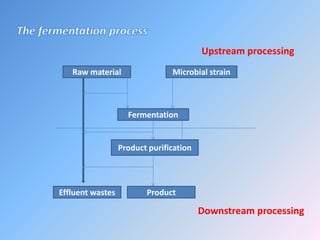
Raw material Microbial strain
Fermentation
Product purification
ProductEffluent wastes
Upstream processing
Downstream processing
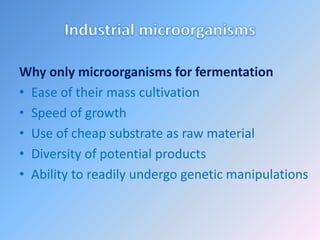
Why only microorganisms for fermentation
• Ease of their mass cultivation
• Speed of growth
• Use of cheap substrate as raw material
• Diversity of potential products
• Ability to readily undergo genetic manipulations
 Traditional fermentations used mixed
cultures
 Wild organisms present in the raw
materials
 e.g some food and alcoholic
fermentations
 Pure cultures in fermentations (just 120
years)
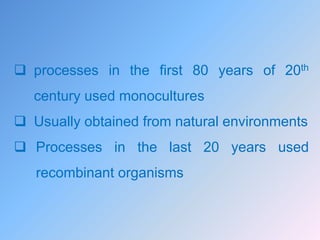
 processes in the first 80 years of 20th
century used monocultures
 Usually obtained from natural environments
 Processes in the last 20 years used
recombinant organisms
Examples of industrial products
and their producers
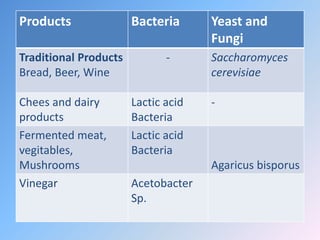
Products Bacteria Yeast and
Fungi
Traditional Products
Bread, Beer, Wine
- Saccharomyces
cerevisiae
Chees and dairy
products
Lactic acid
Bacteria
-
Fermented meat,
vegitables,
Mushrooms
Lactic acid
Bacteria
Agaricus bisporus
Vinegar Acetobacter
Sp.
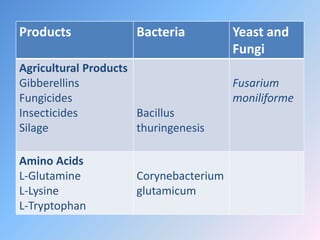
Products Bacteria Yeast and
Fungi
Agricultural Products
Gibberellins
Fungicides
Insecticides
Silage
Bacillus
thuringenesis
Fusarium
moniliforme
Amino Acids
L-Glutamine
L-Lysine
L-Tryptophan
Corynebacterium
glutamicum
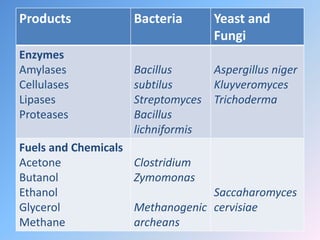
Products Bacteria Yeast and
Fungi
Enzymes
Amylases
Cellulases
Lipases
Proteases
Bacillus
subtilus
Streptomyces
Bacillus
lichniformis
Aspergillus niger
Kluyveromyces
Trichoderma
Fuels and Chemicals
Acetone
Butanol
Ethanol
Glycerol
Methane
Clostridium
Zymomonas
Methanogenic
archeans
Saccaharomyces
cervisiae
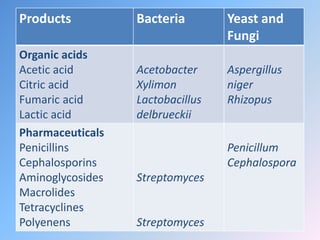
Products Bacteria Yeast and
Fungi
Organic acids
Acetic acid
Citric acid
Fumaric acid
Lactic acid
Acetobacter
Xylimon
Lactobacillus
delbrueckii
Aspergillus
niger
Rhizopus
Pharmaceuticals
Penicillins
Cephalosporins
Aminoglycosides
Macrolides
Tetracyclines
Polyenens
Streptomyces
Streptomyces
Penicillum
Cephalospora
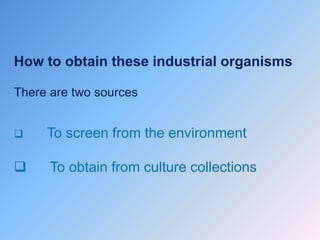
How to obtain these industrial organisms
There are two sources
 To screen from the environment
 To obtain from culture collections
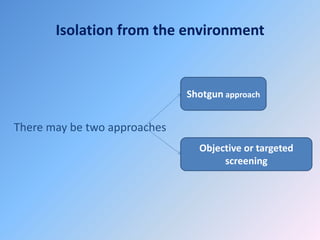
Isolation from the environment
There may be two approaches
Shotgun approach
Objective or targeted
screening
Isolation from environment
In shotgun approach random sampling is done
 Biofilms or microbial communities from
 Animal or plant material
 Sewage, water streams
For targeted screening
 Sampling from more specific sites e.g.
 Isolation of the organism for degradation or
detoxification
Further steps
 Selection of appropriate media
 Enrichment methods
 Selection of the strains
 Purification of the strains
 Screening for specific activity
 Screening is good to get one organism
but not for a consortia
Culture collections
 Good source of industrial organisms
 About 500 culture collection world wide
 Provide organisms by special agreements
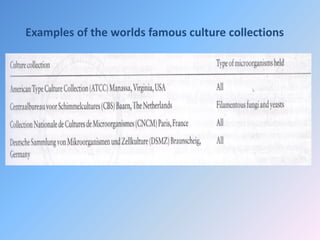
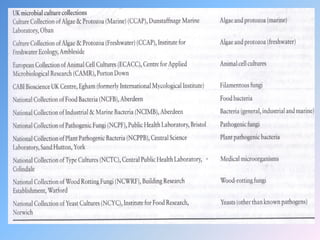
 UKNCC (made up of several collection, housed in
separate institutions)
 ATCC (centralized collection, holds all types of
organisms)
Prime functions of a culture collection
 To maintain the existing collection
 To collect new useful strains
 To provide authentic industrial culture
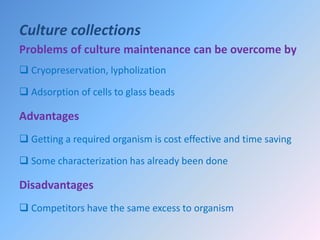
Culture collections
Problems of culture maintenance can be overcome by
 Cryopreservation, lypholization
 Adsorption of cells to glass beads
Advantages
 Getting a required organism is cost effective and time saving
 Some characterization has already been done
Disadvantages
 Competitors have the same excess to organism
Examples of the worlds famous culture collections
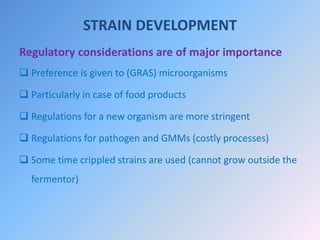
STRAIN DEVELOPMENT
Regulatory considerations are of major importance
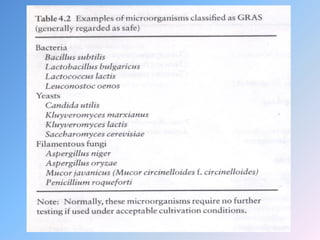
 Preference is given to (GRAS) microorganisms
 Particularly in case of food products
 Regulations for a new organism are more stringent
 Regulations for pathogen and GMMs (costly processes)
 Some time crippled strains are used (cannot grow outside the
fermentor)
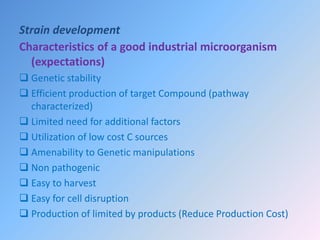
Strain development
Characteristics of a good industrial microorganism
(expectations)
 Genetic stability
 Efficient production of target Compound (pathway
characterized)
 Limited need for additional factors
 Utilization of low cost C sources
 Amenability to Genetic manipulations
 Non pathogenic
 Easy to harvest
 Easy for cell disruption
 Production of limited by products (Reduce Production Cost)
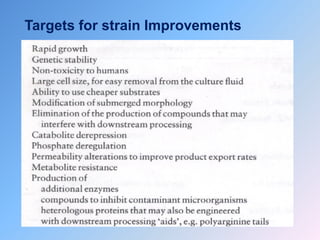
Targets for strain Improvements
Strain development
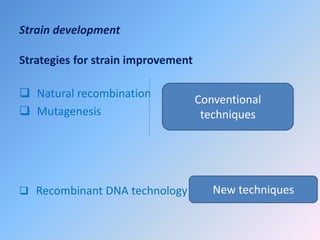
Strategies for strain improvement
 Natural recombination
 Mutagenesis
 Recombinant DNA technology
Conventional
techniques
New techniques
Strain development
Natural recombination
Bacterial DNA consists of
1- a single chromosome
2- plasmids (autonomous, carries few hundred additional
genes, as many as 1000 copies)
Exchange of genetic material by three means
Conjugation
Cell to cell contact
Filamentous protein structure (sex pilus)
Strain development
Transduction
• Bacteriophages act as a vector
• Bacteriophages can also acquire transposones and
can transfer to the new hosts
Transformation
• Uptake of naked piece of DNA from the surrounding
• The cells should be competent
In eukaryotes
• Recombination occurs by sexual reproduction
• Parasexuality in fungi (heterokarion)
Mutagenesis
Physical change to the DNA of a cell e.g.
• Deletions
• Insertions
• Duplications
• Inversions
• Organisms are subjected to repeated
mutagenesis and screening
• Mutation can arise naturally or
• may be induced
Strain development
Mutagens (there are two types)
Physical mutagens
• UV radiations
• Gamma radiations
• X-rays etc
Chemical mutagens
• Ethane Methane Sulphonates (EMS)
• Nitrosomethyl Guanidine (NTG)
• Nitrous acid, acridine, SDS etc
Strain development
• Mutagenesis have limited application
• It’s a random method not specific
Site directed mutagenesis
May be more useful
But ……….
More knowledge about the gene e.g. its exact
location, size, product etc should be known
Selection of Mutants
There are basically two methods of mutants
selection
 Random Screening
 Selective isolation of mutants
Strain development
Genetic engineering (recombinant DNA technology)
• New industrial products e.g.
• Insulin
• Interferons
• Monoclonal antibodies (by fusion of cells)
• Enzymes
• Advantages (better expression systems)
• Strategies ………………………………………

Industrial Microorganism (Lecture 3)

  • 1.
  • 2.
    Raw material Microbialstrain Fermentation Product purification ProductEffluent wastes Upstream processing Downstream processing
  • 3.
    Why only microorganismsfor fermentation • Ease of their mass cultivation • Speed of growth • Use of cheap substrate as raw material • Diversity of potential products • Ability to readily undergo genetic manipulations
  • 4.
     Traditional fermentationsused mixed cultures  Wild organisms present in the raw materials  e.g some food and alcoholic fermentations  Pure cultures in fermentations (just 120 years)
  • 5.
     processes inthe first 80 years of 20th century used monocultures  Usually obtained from natural environments  Processes in the last 20 years used recombinant organisms
  • 6.
    Examples of industrialproducts and their producers
  • 7.
    Products Bacteria Yeastand Fungi Traditional Products Bread, Beer, Wine - Saccharomyces cerevisiae Chees and dairy products Lactic acid Bacteria - Fermented meat, vegitables, Mushrooms Lactic acid Bacteria Agaricus bisporus Vinegar Acetobacter Sp.
  • 8.
    Products Bacteria Yeastand Fungi Agricultural Products Gibberellins Fungicides Insecticides Silage Bacillus thuringenesis Fusarium moniliforme Amino Acids L-Glutamine L-Lysine L-Tryptophan Corynebacterium glutamicum
  • 9.
    Products Bacteria Yeastand Fungi Enzymes Amylases Cellulases Lipases Proteases Bacillus subtilus Streptomyces Bacillus lichniformis Aspergillus niger Kluyveromyces Trichoderma Fuels and Chemicals Acetone Butanol Ethanol Glycerol Methane Clostridium Zymomonas Methanogenic archeans Saccaharomyces cervisiae
  • 10.
    Products Bacteria Yeastand Fungi Organic acids Acetic acid Citric acid Fumaric acid Lactic acid Acetobacter Xylimon Lactobacillus delbrueckii Aspergillus niger Rhizopus Pharmaceuticals Penicillins Cephalosporins Aminoglycosides Macrolides Tetracyclines Polyenens Streptomyces Streptomyces Penicillum Cephalospora
  • 11.
    How to obtainthese industrial organisms There are two sources  To screen from the environment  To obtain from culture collections
  • 12.
    Isolation from theenvironment There may be two approaches Shotgun approach Objective or targeted screening
  • 13.
    Isolation from environment Inshotgun approach random sampling is done  Biofilms or microbial communities from  Animal or plant material  Sewage, water streams For targeted screening  Sampling from more specific sites e.g.  Isolation of the organism for degradation or detoxification
  • 14.
    Further steps  Selectionof appropriate media  Enrichment methods  Selection of the strains  Purification of the strains  Screening for specific activity  Screening is good to get one organism but not for a consortia
  • 15.
    Culture collections  Goodsource of industrial organisms  About 500 culture collection world wide  Provide organisms by special agreements  UKNCC (made up of several collection, housed in separate institutions)  ATCC (centralized collection, holds all types of organisms)
  • 16.
    Prime functions ofa culture collection  To maintain the existing collection  To collect new useful strains  To provide authentic industrial culture
  • 17.
    Culture collections Problems ofculture maintenance can be overcome by  Cryopreservation, lypholization  Adsorption of cells to glass beads Advantages  Getting a required organism is cost effective and time saving  Some characterization has already been done Disadvantages  Competitors have the same excess to organism
  • 18.
    Examples of theworlds famous culture collections
  • 20.
    STRAIN DEVELOPMENT Regulatory considerationsare of major importance  Preference is given to (GRAS) microorganisms  Particularly in case of food products  Regulations for a new organism are more stringent  Regulations for pathogen and GMMs (costly processes)  Some time crippled strains are used (cannot grow outside the fermentor)
  • 22.
    Strain development Characteristics ofa good industrial microorganism (expectations)  Genetic stability  Efficient production of target Compound (pathway characterized)  Limited need for additional factors  Utilization of low cost C sources  Amenability to Genetic manipulations  Non pathogenic  Easy to harvest  Easy for cell disruption  Production of limited by products (Reduce Production Cost)
  • 23.
    Targets for strainImprovements
  • 24.
    Strain development Strategies forstrain improvement  Natural recombination  Mutagenesis  Recombinant DNA technology Conventional techniques New techniques
  • 25.
    Strain development Natural recombination BacterialDNA consists of 1- a single chromosome 2- plasmids (autonomous, carries few hundred additional genes, as many as 1000 copies) Exchange of genetic material by three means Conjugation Cell to cell contact Filamentous protein structure (sex pilus)
  • 26.
    Strain development Transduction • Bacteriophagesact as a vector • Bacteriophages can also acquire transposones and can transfer to the new hosts Transformation • Uptake of naked piece of DNA from the surrounding • The cells should be competent In eukaryotes • Recombination occurs by sexual reproduction • Parasexuality in fungi (heterokarion)
  • 27.
    Mutagenesis Physical change tothe DNA of a cell e.g. • Deletions • Insertions • Duplications • Inversions • Organisms are subjected to repeated mutagenesis and screening • Mutation can arise naturally or • may be induced
  • 28.
    Strain development Mutagens (thereare two types) Physical mutagens • UV radiations • Gamma radiations • X-rays etc Chemical mutagens • Ethane Methane Sulphonates (EMS) • Nitrosomethyl Guanidine (NTG) • Nitrous acid, acridine, SDS etc
  • 29.
    Strain development • Mutagenesishave limited application • It’s a random method not specific Site directed mutagenesis May be more useful But ………. More knowledge about the gene e.g. its exact location, size, product etc should be known
  • 30.
    Selection of Mutants Thereare basically two methods of mutants selection  Random Screening  Selective isolation of mutants
  • 31.
    Strain development Genetic engineering(recombinant DNA technology) • New industrial products e.g. • Insulin • Interferons • Monoclonal antibodies (by fusion of cells) • Enzymes • Advantages (better expression systems) • Strategies ………………………………………