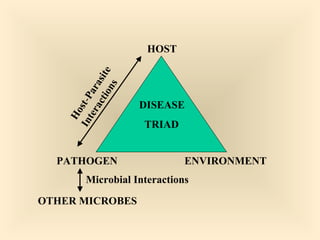
PATHOGEN ENVIRONMENT
HOST
DISEASE
TRIAD
Host-Parasite
Interactions
OTHER MICROBES
Microbial Interactions
MICROBIAL FLORA OF THE
NORMAL HUMAN BODY (a.k.a.,
normal flora)
NORMALLY STERILE SITES IN THE
HUMAN BODY
Colonization of one of these sites generally involves a defect
or breach in the natural defenses that creates a portal of entry
♦Brain; Central nervous system
♦Blood; Tissues; Organ systems
♦Sinuses; Inner and Middle Ear
♦Lower Respiratory Tract: Larynx; Trachea;
Bronchioles (bronchi); Lungs; Alveoli
♦Kidneys; Ureters; Urinary Bladder; Posterior Urethra
♦Uterus; Endometrium (Inner mucous membrane of
uterus ); Fallopian Tubes; Cervix and Endocervix
ACQUIRING INFECTIOUS AGENTS
PORTAL OF ENTRY/EXIT
INGESTION
INHALATION
DIRECT PENETRATION
Trauma or Surgical Procedure
Needlestick
Arthropod Bite
Sexual Transmission
Transplacental
COLONIZATION: the successful occupation of a new
habitat by a species not normally found in this niche
Adherence (attachment)
INVASION
MULTIPLICATION
TRANSMISSION OF DISEASE
ENTRANCE, COLONIZATION, PENETRATION:
VECTOR
CARRIER
NOSOCOMIAL INFECTIONS
NOSOCOMIAL INFECTIONS in
ACUTE CARE INSTITUTIONS
Infection
Site
Percentage of All
Nosocomial
Infections
Most Common Agents
Urinary
Tract
40%
Escherichia coli, Enterococcus,
Proteus, Klebsiella,
Pseudomonas aeruginosa
Surgical
Wound
20% Staphylococcus aureus,
Staphylococcus epidermidis, E. coli
Pulmonary 10% Klebsiella, Pseudomonas,
E. coli, S. aureus
Primary
Bacteremia
5% - 10% S. aureus, S. epidermidis,
Gram-negative rods
Others 20% - 25% S. aureus, E. coli
EPIDEMIOLOGY
EPIDEMIC
ENDEMIC
PANDEMIC
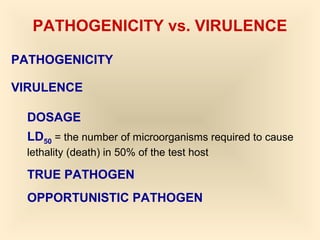
PATHOGENICITY vs. VIRULENCE
PATHOGENICITY
VIRULENCE
DOSAGE
LD50 = the number of microorganisms required to cause
lethality (death) in 50% of the test host
TRUE PATHOGEN
OPPORTUNISTIC PATHOGEN
INFECTION vs. DISEASE
INFECTION: the colonization and/or invasion and
multiplication of pathogenic microrganisms in the host
with or without the manifestation of disease
DISEASE: an abnormal condition of body function(s)
or structure that is considered to be harmful to the affected
individual (host); any deviation from or interruption of the
normal structure or function of any part, organ, or system
of the body
VIRULENCE FACTORS (cont.)
INVASIVE FACTORS (invasins): enable a pathogenic
microorganism to enter and spread throughout the tissues of
the host body; specific recognition of receptor sites on target
cells enhances pathogenic advantage
DEGRADATIVE ENZYMES: a class of protein capable of
catalytic reactions; bacterial and host enzymes both play roles
in the disease process
Host degrading enzymes by bacteria
Example of tissue degrading
enzymes
VIRULENCE FACTORS (cont.)
TOXIGENICITY: the ability of a microorganism to cause
disease as determined by the toxin it produces which partly
determines its virulence
1. ENDOTOXIN: a complex bacterial toxin that is
composed of protein, lipid, and polysaccharide (LPS)
which is released only upon lysis of the cell
2. EXOTOXINS: a potent toxic substance formed
and secreted by species of certain bacteria
BASIC EFFECTS of ENDOTOXIN
FEVER:
LEUKOPENIA/LEUKOCYTOSIS:
METABOLIC EFFECTS :
RELEASE OF LYMPHOCYTE FACTORS
CELLULAR DEATH:
SEPTIC SHOCK:
DISSEMINATED INTRAVASCULAR COAGULATION (DIC):
ORGAN NECROSIS:
• Table 21.6 shows tissue specificity in
infectious disease.
EXOTOXINS
TWO-COMPONENT (BIPARTITE) A-B TOXINS
with INTRACELLULAR TARGETS: conform to
general structural model; usually one component is a
binding domain (B subunit) associated with absorption to
target cell surface and transfer of active component across
cell membrane, the second component is an enzymatic or
active domain (A subunit) that enzymatically disrupts cell
function
BACTERIAL CYTOLYSINS (a.k.a. Cytotoxins)
with CELL MEMBRANE TARGETS: hemolysis, tissue
necrosis, may be lethal when administered intravenously
EXAMPLES of BIPARTITE A-B TOXINS
with
INTRACELLULAR TARGETS
♦ Diphtheria toxin - ADP-ribosylation inhibits cell protein synthesis by
catalyzing transfer of ADP- ribose from NAD (nicotinimamide adenine
nucleotide) to EF-2 (elongation factor- 2)
♦ Pseudomonas aeruginosa toxin - similar action as DT
♦ Cholera toxin - A-subunit catalyzes ADP-ribosylation of the B-subunit
of the stimulatory guanine nucleotide protein Gs; profound life-threatening
diarrhea with profuse outpouring of fluids and electrolytes
♦ Enterotoxigenic Escherichia coli (ETEC) heat-labile
enterotoxin - similar or identical to cholera toxin
♦ Tetanus neurotoxin - less well understood; binding domain binds to
neuroreceptor gangliosides, releases inhibitory impulses with trismus
♦ Botulinum neurotoxin - among most potent of all biological toxins;
binding domain binds to neuroreceptor gangliosides, inhibits release of
acetylcholine at myoneural junction resulting in fatal paralysis
Exotoxins mechanisms
Cholera toxin mechanism
G protein receptor
Botulinum toxin mechanism
Tetanus toxin mechanism
Diphtheria toxin mechanism
• Endotoxins are generally less toxic than
exotoxins (Table 21.5).
ENDOTOXINS
1.IInntteeggrraall ppaarrtt ooff cceellll wwaallll
2.Endotoxin is LLPPSS;
lipid A is toxic
3.Heat stable
4.Antigenic; questionable
immunogenicity
5.Toxoids not be produced
6.Many effects on host
7.Produced oonnllyy bbyy ggrraamm--
nneeggaattiivvee organisms
EXOTOXINS
1.RReelleeaasseedd ffrroomm tthhee cceellll
before or after lysis
2.PPrrootteeiinn
3.Heat labile
4.Antigenic and iimmmmuunnooggeenniicc
5.TTooxxooiiddss can be produced
6.Specific in effect on host
7.Produced by gram-positive
& gram-negative organisms
MICROBIAL PATHOGENICITY (cont.)
RESISTANCE TO HOST DEFENSES
ENCAPSULATION and
ANTIGENIC MIMICRY, MASKING or SHIFT
CAPSULE, GLYCOCALYX or SLIME LAYER
Polysachharide capsules Streptococcus pneumoniae,
Neisseria meningitidis, Haemophilus influenzae, etc.
Polypeptide capsule of Bacillus anthracis
EVASION or INCAPACITATION of PHAGOCYTOSIS
and/or IMMUNE CLEARANCE
PHAGOCYTOSIS INHIBITORS: mechanisms enabling an
invading microorganism to resist being engulfed, ingested,
and or lysed by phagocytes/ phagolysosomes
RESISTANCE to HUMORAL FACTORS
RESISTANCE to CELLULAR FACTORS
MICROBIAL PATHOGENICITY (cont.)
DAMAGE TO HOST
DIRECT DAMAGE
(Tissue Damage from Disease Process):
Toxins
Enzymes
INDIRECT DAMAGE
(Tissue Reactions from Immunopathological Response):
Damage Resulting from Vigorous Host Immune Response
(a.k.a, immunopathogenesis; autoimmune
hypersensitivy)
Hypersensitivity Reactions (Types I - IV)
HOST RESISTANCE
The degree to which a host can limit the effects of an
infection, ranging from:
♦ TOLERANCE in which symptoms are suppressed or
unusually large doses of a drug, toxin, or protein are able to be
endured
♦ HYPERSENSITIVITY in which only a few cells
surrounding the infected cell(s) are affected or an increased
susceptibility to an antigen, such as an allergic reaction to a
previous exposure to an antigen, the extreme case being
anaphylactic shock
♦ IMMUNITY in which the microorganisms do not multiply
due to any one or a combination of host immune factors or the
biological condition by which a body is capable of resisting or
overcoming an infection or disease
Host pathogen interactions

Host pathogen interactions

  • 1.
  • 3.
    MICROBIAL FLORA OFTHE NORMAL HUMAN BODY (a.k.a., normal flora)
  • 4.
    NORMALLY STERILE SITESIN THE HUMAN BODY Colonization of one of these sites generally involves a defect or breach in the natural defenses that creates a portal of entry ♦Brain; Central nervous system ♦Blood; Tissues; Organ systems ♦Sinuses; Inner and Middle Ear ♦Lower Respiratory Tract: Larynx; Trachea; Bronchioles (bronchi); Lungs; Alveoli ♦Kidneys; Ureters; Urinary Bladder; Posterior Urethra ♦Uterus; Endometrium (Inner mucous membrane of uterus ); Fallopian Tubes; Cervix and Endocervix
  • 5.
    ACQUIRING INFECTIOUS AGENTS PORTALOF ENTRY/EXIT INGESTION INHALATION DIRECT PENETRATION Trauma or Surgical Procedure Needlestick Arthropod Bite Sexual Transmission Transplacental COLONIZATION: the successful occupation of a new habitat by a species not normally found in this niche Adherence (attachment) INVASION MULTIPLICATION
  • 7.
    TRANSMISSION OF DISEASE ENTRANCE,COLONIZATION, PENETRATION: VECTOR CARRIER NOSOCOMIAL INFECTIONS
  • 8.
    NOSOCOMIAL INFECTIONS in ACUTECARE INSTITUTIONS Infection Site Percentage of All Nosocomial Infections Most Common Agents Urinary Tract 40% Escherichia coli, Enterococcus, Proteus, Klebsiella, Pseudomonas aeruginosa Surgical Wound 20% Staphylococcus aureus, Staphylococcus epidermidis, E. coli Pulmonary 10% Klebsiella, Pseudomonas, E. coli, S. aureus Primary Bacteremia 5% - 10% S. aureus, S. epidermidis, Gram-negative rods Others 20% - 25% S. aureus, E. coli
  • 9.
  • 10.
    PATHOGENICITY vs. VIRULENCE PATHOGENICITY VIRULENCE DOSAGE LD50= the number of microorganisms required to cause lethality (death) in 50% of the test host TRUE PATHOGEN OPPORTUNISTIC PATHOGEN
  • 11.
    INFECTION vs. DISEASE INFECTION:the colonization and/or invasion and multiplication of pathogenic microrganisms in the host with or without the manifestation of disease DISEASE: an abnormal condition of body function(s) or structure that is considered to be harmful to the affected individual (host); any deviation from or interruption of the normal structure or function of any part, organ, or system of the body
  • 12.
    VIRULENCE FACTORS (cont.) INVASIVEFACTORS (invasins): enable a pathogenic microorganism to enter and spread throughout the tissues of the host body; specific recognition of receptor sites on target cells enhances pathogenic advantage DEGRADATIVE ENZYMES: a class of protein capable of catalytic reactions; bacterial and host enzymes both play roles in the disease process
  • 13.
  • 14.
    Example of tissuedegrading enzymes
  • 16.
    VIRULENCE FACTORS (cont.) TOXIGENICITY:the ability of a microorganism to cause disease as determined by the toxin it produces which partly determines its virulence 1. ENDOTOXIN: a complex bacterial toxin that is composed of protein, lipid, and polysaccharide (LPS) which is released only upon lysis of the cell 2. EXOTOXINS: a potent toxic substance formed and secreted by species of certain bacteria
  • 17.
    BASIC EFFECTS ofENDOTOXIN FEVER: LEUKOPENIA/LEUKOCYTOSIS: METABOLIC EFFECTS : RELEASE OF LYMPHOCYTE FACTORS CELLULAR DEATH: SEPTIC SHOCK: DISSEMINATED INTRAVASCULAR COAGULATION (DIC): ORGAN NECROSIS:
  • 20.
    • Table 21.6shows tissue specificity in infectious disease.
  • 21.
    EXOTOXINS TWO-COMPONENT (BIPARTITE) A-BTOXINS with INTRACELLULAR TARGETS: conform to general structural model; usually one component is a binding domain (B subunit) associated with absorption to target cell surface and transfer of active component across cell membrane, the second component is an enzymatic or active domain (A subunit) that enzymatically disrupts cell function BACTERIAL CYTOLYSINS (a.k.a. Cytotoxins) with CELL MEMBRANE TARGETS: hemolysis, tissue necrosis, may be lethal when administered intravenously
  • 22.
    EXAMPLES of BIPARTITEA-B TOXINS with INTRACELLULAR TARGETS ♦ Diphtheria toxin - ADP-ribosylation inhibits cell protein synthesis by catalyzing transfer of ADP- ribose from NAD (nicotinimamide adenine nucleotide) to EF-2 (elongation factor- 2) ♦ Pseudomonas aeruginosa toxin - similar action as DT ♦ Cholera toxin - A-subunit catalyzes ADP-ribosylation of the B-subunit of the stimulatory guanine nucleotide protein Gs; profound life-threatening diarrhea with profuse outpouring of fluids and electrolytes ♦ Enterotoxigenic Escherichia coli (ETEC) heat-labile enterotoxin - similar or identical to cholera toxin ♦ Tetanus neurotoxin - less well understood; binding domain binds to neuroreceptor gangliosides, releases inhibitory impulses with trismus ♦ Botulinum neurotoxin - among most potent of all biological toxins; binding domain binds to neuroreceptor gangliosides, inhibits release of acetylcholine at myoneural junction resulting in fatal paralysis
  • 23.
  • 25.
  • 26.
  • 27.
  • 28.
  • 29.
  • 30.
    • Endotoxins aregenerally less toxic than exotoxins (Table 21.5).
  • 31.
    ENDOTOXINS 1.IInntteeggrraall ppaarrtt ooffcceellll wwaallll 2.Endotoxin is LLPPSS; lipid A is toxic 3.Heat stable 4.Antigenic; questionable immunogenicity 5.Toxoids not be produced 6.Many effects on host 7.Produced oonnllyy bbyy ggrraamm-- nneeggaattiivvee organisms EXOTOXINS 1.RReelleeaasseedd ffrroomm tthhee cceellll before or after lysis 2.PPrrootteeiinn 3.Heat labile 4.Antigenic and iimmmmuunnooggeenniicc 5.TTooxxooiiddss can be produced 6.Specific in effect on host 7.Produced by gram-positive & gram-negative organisms
  • 32.
    MICROBIAL PATHOGENICITY (cont.) RESISTANCETO HOST DEFENSES ENCAPSULATION and ANTIGENIC MIMICRY, MASKING or SHIFT CAPSULE, GLYCOCALYX or SLIME LAYER Polysachharide capsules Streptococcus pneumoniae, Neisseria meningitidis, Haemophilus influenzae, etc. Polypeptide capsule of Bacillus anthracis EVASION or INCAPACITATION of PHAGOCYTOSIS and/or IMMUNE CLEARANCE PHAGOCYTOSIS INHIBITORS: mechanisms enabling an invading microorganism to resist being engulfed, ingested, and or lysed by phagocytes/ phagolysosomes RESISTANCE to HUMORAL FACTORS RESISTANCE to CELLULAR FACTORS
  • 33.
    MICROBIAL PATHOGENICITY (cont.) DAMAGETO HOST DIRECT DAMAGE (Tissue Damage from Disease Process): Toxins Enzymes INDIRECT DAMAGE (Tissue Reactions from Immunopathological Response): Damage Resulting from Vigorous Host Immune Response (a.k.a, immunopathogenesis; autoimmune hypersensitivy) Hypersensitivity Reactions (Types I - IV)
  • 34.
    HOST RESISTANCE The degreeto which a host can limit the effects of an infection, ranging from: ♦ TOLERANCE in which symptoms are suppressed or unusually large doses of a drug, toxin, or protein are able to be endured ♦ HYPERSENSITIVITY in which only a few cells surrounding the infected cell(s) are affected or an increased susceptibility to an antigen, such as an allergic reaction to a previous exposure to an antigen, the extreme case being anaphylactic shock ♦ IMMUNITY in which the microorganisms do not multiply due to any one or a combination of host immune factors or the biological condition by which a body is capable of resisting or overcoming an infection or disease