ِ‫سم‬ِ‫ب‬ِ‫ن‬ ٰ‫حم‬َّ‫الر‬ ِ‫ہللا‬‫ا‬‫يم‬ ِ‫ح‬َّ‫لر‬
1
Microbial Strain Selection
Techniques
2
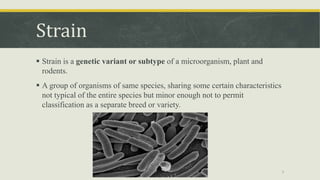
Strain
 Strain is a genetic variant or subtype of a microorganism, plant and
rodents.
 A group of organisms of same species, sharing some certain characteristics
not typical of the entire species but minor enough not to permit
classification as a separate breed or variety.
3
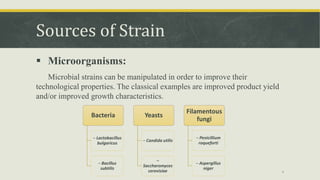
Sources of Strain
Bacteria
– Lactobacillus
bulgaricus
– Bacillus
subtilis
Yeasts
– Candida utilis
–
Saccharomyces
cerevisiae
Filamentous
fungi
– Penicillium
roqueforti
– Aspergillus
niger
 Microorganisms:
Microbial strains can be manipulated in order to improve their
technological properties. The classical examples are improved product yield
and/or improved growth characteristics.
4
Sources of Strain
 Plants:
Strain is designated group of off springs that are descendant from a modified plant produced
by conventional breeding by biotechnological means or result from genetic mutation.
 Rodents:
A mouse or rat strain is a group of animals that is genetically uniform.
Microbes are preferred to plants and animals because:
- They are generally cheaper to produce.
- Their enzyme contents are more predictable and controllable.
- Plant and animal tissues contain more potentially harmful materials than microbes, including
phenolic compounds (from plants). 5
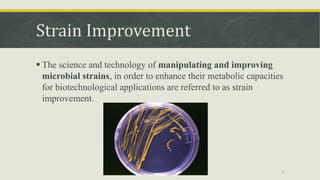
Strain Improvement
 The science and technology of manipulating and improving
microbial strains, in order to enhance their metabolic capacities
for biotechnological applications are referred to as strain
improvement.
6
Purpose of Strain Development
To relate individual cases to an outbreak of infectious
disease.
To establish an association between an outbreak of food
poisoning and a specific food vehicle.
To study variations in the pathogenicity, virulence and
antibiotic resistance of individual strains within a
species.
7
Purpose of Strain Development
To trace the source of contaminants within a manufacturing
process
To study the microbial ecology of complex communities,
such as biofilms
To characterize microorganisms with important industrial
applications
8
Targets of Strain Improvement
Rapid growth
Genetic stability
Non-toxicity to humans
Large cell size, for easy removal from the culture
fluids
Ability to use cheaper substrates
9
Targets of Strain Improvement
Increase productivity
To improve the use of carbon and nitrogen sources
Reduction of cultivation cost
Production of
- Additional enzymes
- Compounds to inhibit contaminant microorganisms
10
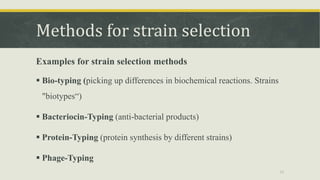
Methods for strain selection
Examples for strain selection methods
 Bio-typing (picking up differences in biochemical reactions. Strains
"biotypes“)
 Bacteriocin-Typing (anti-bacterial products)
 Protein-Typing (protein synthesis by different strains)
 Phage-Typing
11
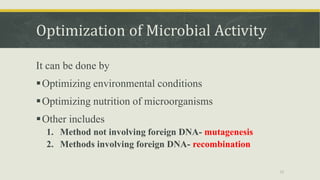
Optimization of Microbial Activity
It can be done by
Optimizing environmental conditions
Optimizing nutrition of microorganisms
Other includes
1. Method not involving foreign DNA- mutagenesis
2. Methods involving foreign DNA- recombination
12
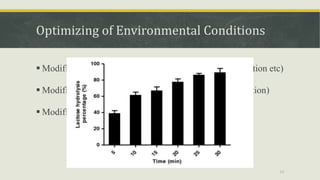
Optimizing of Environmental Conditions
 Modification of physical parameter (temperature, agitation etc)
 Modification of chemical parameter (pH,O2 concentration)
 Modification of biological parameter (enzymes )
13
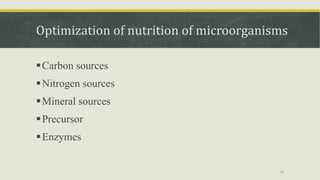
Optimization of nutrition of microorganisms
Carbon sources
Nitrogen sources
Mineral sources
Precursor
Enzymes
14
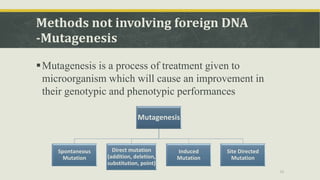
Methods not involving foreign DNA
-Mutagenesis
Mutagenesis is a process of treatment given to
microorganism which will cause an improvement in
their genotypic and phenotypic performances
Mutagenesis
Spontaneous
Mutation
Direct mutation
(addition, deletion,
substitution, point)
Induced
Mutation
Site Directed
Mutation
15
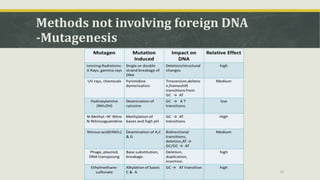
Methods not involving foreign DNA
-Mutagenesis
16
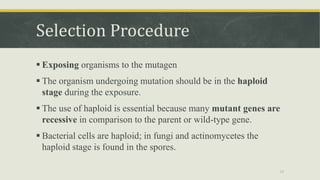
Selection Procedure
 Exposing organisms to the mutagen
 The organism undergoing mutation should be in the haploid
stage during the exposure.
 The use of haploid is essential because many mutant genes are
recessive in comparison to the parent or wild-type gene.
 Bacterial cells are haploid; in fungi and actinomycetes the
haploid stage is found in the spores.
17
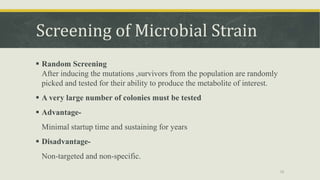
Screening of Microbial Strain
 Random Screening
After inducing the mutations ,survivors from the population are randomly
picked and tested for their ability to produce the metabolite of interest.
 A very large number of colonies must be tested
 Advantage-
Minimal startup time and sustaining for years
 Disadvantage-
Non-targeted and non-specific.
18
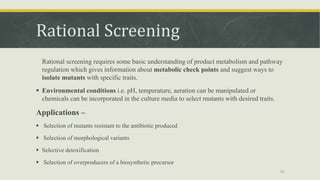
Rational Screening
Rational screening requires some basic understanding of product metabolism and pathway
regulation which gives information about metabolic check points and suggest ways to
isolate mutants with specific traits.
 Environmental conditions i.e. pH, temperature, aeration can be manipulated or
chemicals can be incorporated in the culture media to select mutants with desired traits.
Applications –
 Selection of mutants resistant to the antibiotic produced
 Selection of morphological variants
 Selective detoxification
 Selection of overproducers of a biosynthetic precursor
19
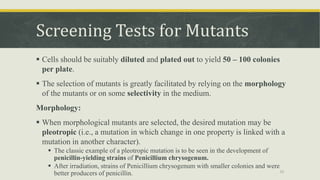
Screening Tests for Mutants
 Cells should be suitably diluted and plated out to yield 50 – 100 colonies
per plate.
 The selection of mutants is greatly facilitated by relying on the morphology
of the mutants or on some selectivity in the medium.
Morphology:
 When morphological mutants are selected, the desired mutation may be
pleotropic (i.e., a mutation in which change in one property is linked with a
mutation in another character).
 The classic example of a pleotropic mutation is to be seen in the development of
penicillin-yielding strains of Penicillium chrysogenum.
 After irradiation, strains of Penicillium chrysogenum with smaller colonies and were
better producers of penicillin. 20
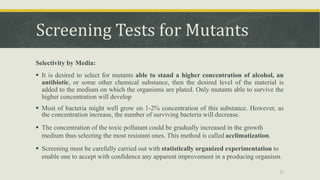
Screening Tests for Mutants
Selectivity by Media:
 It is desired to select for mutants able to stand a higher concentration of alcohol, an
antibiotic, or some other chemical substance, then the desired level of the material is
added to the medium on which the organisms are plated. Only mutants able to survive the
higher concentration will develop
 Most of bacteria might well grow on 1-2% concentration of this substance. However, as
the concentration increase, the number of surviving bacteria will decrease.
 The concentration of the toxic pollutant could be gradually increased in the growth
medium thus selecting the most resistant ones. This method is called acclimatization.
 Screening must be carefully carried out with statistically organized experimentation to
enable one to accept with confidence any apparent improvement in a producing organism.
21
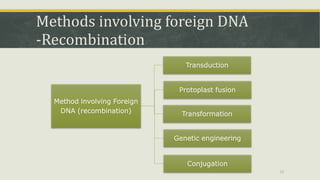
Methods involving foreign DNA
-Recombination
Method involving Foreign
DNA (recombination)
Transduction
Protoplast fusion
Transformation
Genetic engineering
Conjugation
22
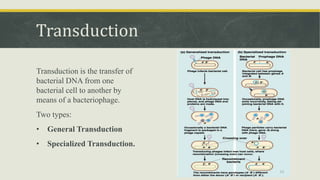
Transduction
Transduction is the transfer of
bacterial DNA from one
bacterial cell to another by
means of a bacteriophage.
Two types:
• General Transduction
• Specialized Transduction.
23
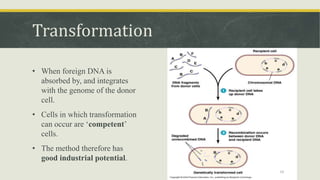
Transformation
• When foreign DNA is
absorbed by, and integrates
with the genome of the donor
cell.
• Cells in which transformation
can occur are ‘competent’
cells.
• The method therefore has
good industrial potential.
24
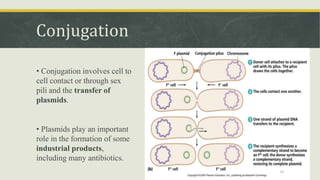
Conjugation
• Conjugation involves cell to
cell contact or through sex
pili and the transfer of
plasmids.
• Plasmids play an important
role in the formation of some
industrial products,
including many antibiotics.
25
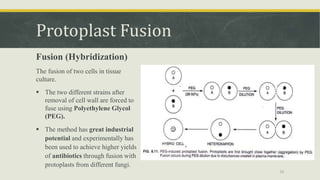
Protoplast Fusion
Fusion (Hybridization)
The fusion of two cells in tissue
culture.
 The two different strains after
removal of cell wall are forced to
fuse using Polyethylene Glycol
(PEG).
 The method has great industrial
potential and experimentally has
been used to achieve higher yields
of antibiotics through fusion with
protoplasts from different fungi.
26
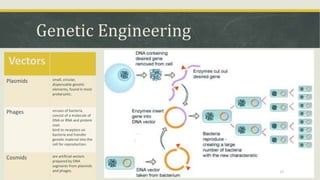
Genetic Engineering
27
Vectors
Plasmids small, circular,
dispensable genetic
elements, found in most
prokaryotic.
Phages viruses of bacteria,
consist of a molecule of
DNA or RNA and protein
coat.
bind to receptors on
bacteria and transfer
genetic material into the
cell for reproduction.
Cosmids are artificial vectors
prepared by DNA
segments from plasmids
and phages.
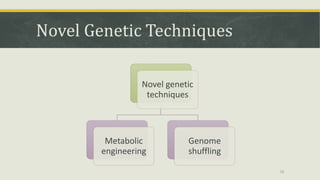
Novel Genetic Techniques
Novel genetic
techniques
Metabolic
engineering
Genome
shuffling
28
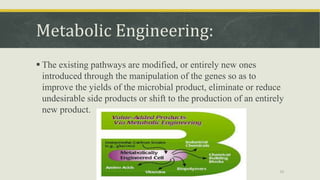
Metabolic Engineering:
 The existing pathways are modified, or entirely new ones
introduced through the manipulation of the genes so as to
improve the yields of the microbial product, eliminate or reduce
undesirable side products or shift to the production of an entirely
new product.
29
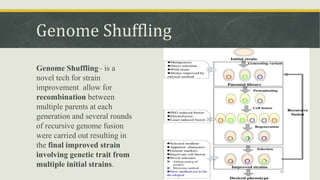
Genome Shuffling
Genome Shuffling– is a
novel tech for strain
improvement allow for
recombination between
multiple parents at each
generation and several rounds
of recursive genome fusion
were carried out resulting in
the final improved strain
involving genetic trait from
multiple initial strains.
30
Applications of Strain Selection
 Its basic purpose is to bridge basic knowledge and industrial
application.
 The tremendous increase in fermentation productivity and resulting decreases in
cultivation costs.
 Discovering new microbial compounds and improving the
synthesis of known ones. (amylase, protease)
 Recombinant DNA technology has also been applied in
medicine (insulin, HGH, hepatitis B vaccine), agriculture
(golden rice, insect resistant crops)
 Improve thermotolerance and ethanol tolerance in S.cerevisiae.31
32
Applications of Strain Selection
Genomic shuffling:
 The yeild of biochemically products such as ethanol and bioinsectisides is
successfully improved by genomic shuffling.
Metabolic engineering:
 It has been used to overproduce the amino acid isoluecine in Corynebacterium
glutamicum
 It has been also implied to introduce the gene for utilizing lactose into Corynebacterium
glutamicum thus making it possible for the organism to utilize whey which is plentiful
and cheap.
 The Strain of E.coli has been engineered for the production of lycopene amino acids
and alcohols through metabolic engineering methods.
 The improvement of Saccharomyces cerevisiae for the production of ethanol by
metabolic engineering method
33
Presented By:
Mujahid Iqbal
THANK YOU!
34

Microbial strain selection..

  • 1.
  • 2.
  • 3.
    Strain  Strain isa genetic variant or subtype of a microorganism, plant and rodents.  A group of organisms of same species, sharing some certain characteristics not typical of the entire species but minor enough not to permit classification as a separate breed or variety. 3
  • 4.
    Sources of Strain Bacteria –Lactobacillus bulgaricus – Bacillus subtilis Yeasts – Candida utilis – Saccharomyces cerevisiae Filamentous fungi – Penicillium roqueforti – Aspergillus niger  Microorganisms: Microbial strains can be manipulated in order to improve their technological properties. The classical examples are improved product yield and/or improved growth characteristics. 4
  • 5.
    Sources of Strain Plants: Strain is designated group of off springs that are descendant from a modified plant produced by conventional breeding by biotechnological means or result from genetic mutation.  Rodents: A mouse or rat strain is a group of animals that is genetically uniform. Microbes are preferred to plants and animals because: - They are generally cheaper to produce. - Their enzyme contents are more predictable and controllable. - Plant and animal tissues contain more potentially harmful materials than microbes, including phenolic compounds (from plants). 5
  • 6.
    Strain Improvement  Thescience and technology of manipulating and improving microbial strains, in order to enhance their metabolic capacities for biotechnological applications are referred to as strain improvement. 6
  • 7.
    Purpose of StrainDevelopment To relate individual cases to an outbreak of infectious disease. To establish an association between an outbreak of food poisoning and a specific food vehicle. To study variations in the pathogenicity, virulence and antibiotic resistance of individual strains within a species. 7
  • 8.
    Purpose of StrainDevelopment To trace the source of contaminants within a manufacturing process To study the microbial ecology of complex communities, such as biofilms To characterize microorganisms with important industrial applications 8
  • 9.
    Targets of StrainImprovement Rapid growth Genetic stability Non-toxicity to humans Large cell size, for easy removal from the culture fluids Ability to use cheaper substrates 9
  • 10.
    Targets of StrainImprovement Increase productivity To improve the use of carbon and nitrogen sources Reduction of cultivation cost Production of - Additional enzymes - Compounds to inhibit contaminant microorganisms 10
  • 11.
    Methods for strainselection Examples for strain selection methods  Bio-typing (picking up differences in biochemical reactions. Strains "biotypes“)  Bacteriocin-Typing (anti-bacterial products)  Protein-Typing (protein synthesis by different strains)  Phage-Typing 11
  • 12.
    Optimization of MicrobialActivity It can be done by Optimizing environmental conditions Optimizing nutrition of microorganisms Other includes 1. Method not involving foreign DNA- mutagenesis 2. Methods involving foreign DNA- recombination 12
  • 13.
    Optimizing of EnvironmentalConditions  Modification of physical parameter (temperature, agitation etc)  Modification of chemical parameter (pH,O2 concentration)  Modification of biological parameter (enzymes ) 13
  • 14.
    Optimization of nutritionof microorganisms Carbon sources Nitrogen sources Mineral sources Precursor Enzymes 14
  • 15.
    Methods not involvingforeign DNA -Mutagenesis Mutagenesis is a process of treatment given to microorganism which will cause an improvement in their genotypic and phenotypic performances Mutagenesis Spontaneous Mutation Direct mutation (addition, deletion, substitution, point) Induced Mutation Site Directed Mutation 15
  • 16.
    Methods not involvingforeign DNA -Mutagenesis 16
  • 17.
    Selection Procedure  Exposingorganisms to the mutagen  The organism undergoing mutation should be in the haploid stage during the exposure.  The use of haploid is essential because many mutant genes are recessive in comparison to the parent or wild-type gene.  Bacterial cells are haploid; in fungi and actinomycetes the haploid stage is found in the spores. 17
  • 18.
    Screening of MicrobialStrain  Random Screening After inducing the mutations ,survivors from the population are randomly picked and tested for their ability to produce the metabolite of interest.  A very large number of colonies must be tested  Advantage- Minimal startup time and sustaining for years  Disadvantage- Non-targeted and non-specific. 18
  • 19.
    Rational Screening Rational screeningrequires some basic understanding of product metabolism and pathway regulation which gives information about metabolic check points and suggest ways to isolate mutants with specific traits.  Environmental conditions i.e. pH, temperature, aeration can be manipulated or chemicals can be incorporated in the culture media to select mutants with desired traits. Applications –  Selection of mutants resistant to the antibiotic produced  Selection of morphological variants  Selective detoxification  Selection of overproducers of a biosynthetic precursor 19
  • 20.
    Screening Tests forMutants  Cells should be suitably diluted and plated out to yield 50 – 100 colonies per plate.  The selection of mutants is greatly facilitated by relying on the morphology of the mutants or on some selectivity in the medium. Morphology:  When morphological mutants are selected, the desired mutation may be pleotropic (i.e., a mutation in which change in one property is linked with a mutation in another character).  The classic example of a pleotropic mutation is to be seen in the development of penicillin-yielding strains of Penicillium chrysogenum.  After irradiation, strains of Penicillium chrysogenum with smaller colonies and were better producers of penicillin. 20
  • 21.
    Screening Tests forMutants Selectivity by Media:  It is desired to select for mutants able to stand a higher concentration of alcohol, an antibiotic, or some other chemical substance, then the desired level of the material is added to the medium on which the organisms are plated. Only mutants able to survive the higher concentration will develop  Most of bacteria might well grow on 1-2% concentration of this substance. However, as the concentration increase, the number of surviving bacteria will decrease.  The concentration of the toxic pollutant could be gradually increased in the growth medium thus selecting the most resistant ones. This method is called acclimatization.  Screening must be carefully carried out with statistically organized experimentation to enable one to accept with confidence any apparent improvement in a producing organism. 21
  • 22.
    Methods involving foreignDNA -Recombination Method involving Foreign DNA (recombination) Transduction Protoplast fusion Transformation Genetic engineering Conjugation 22
  • 23.
    Transduction Transduction is thetransfer of bacterial DNA from one bacterial cell to another by means of a bacteriophage. Two types: • General Transduction • Specialized Transduction. 23
  • 24.
    Transformation • When foreignDNA is absorbed by, and integrates with the genome of the donor cell. • Cells in which transformation can occur are ‘competent’ cells. • The method therefore has good industrial potential. 24
  • 25.
    Conjugation • Conjugation involvescell to cell contact or through sex pili and the transfer of plasmids. • Plasmids play an important role in the formation of some industrial products, including many antibiotics. 25
  • 26.
    Protoplast Fusion Fusion (Hybridization) Thefusion of two cells in tissue culture.  The two different strains after removal of cell wall are forced to fuse using Polyethylene Glycol (PEG).  The method has great industrial potential and experimentally has been used to achieve higher yields of antibiotics through fusion with protoplasts from different fungi. 26
  • 27.
    Genetic Engineering 27 Vectors Plasmids small,circular, dispensable genetic elements, found in most prokaryotic. Phages viruses of bacteria, consist of a molecule of DNA or RNA and protein coat. bind to receptors on bacteria and transfer genetic material into the cell for reproduction. Cosmids are artificial vectors prepared by DNA segments from plasmids and phages.
  • 28.
    Novel Genetic Techniques Novelgenetic techniques Metabolic engineering Genome shuffling 28
  • 29.
    Metabolic Engineering:  Theexisting pathways are modified, or entirely new ones introduced through the manipulation of the genes so as to improve the yields of the microbial product, eliminate or reduce undesirable side products or shift to the production of an entirely new product. 29
  • 30.
    Genome Shuffling Genome Shuffling–is a novel tech for strain improvement allow for recombination between multiple parents at each generation and several rounds of recursive genome fusion were carried out resulting in the final improved strain involving genetic trait from multiple initial strains. 30
  • 31.
    Applications of StrainSelection  Its basic purpose is to bridge basic knowledge and industrial application.  The tremendous increase in fermentation productivity and resulting decreases in cultivation costs.  Discovering new microbial compounds and improving the synthesis of known ones. (amylase, protease)  Recombinant DNA technology has also been applied in medicine (insulin, HGH, hepatitis B vaccine), agriculture (golden rice, insect resistant crops)  Improve thermotolerance and ethanol tolerance in S.cerevisiae.31
  • 32.
    32 Applications of StrainSelection Genomic shuffling:  The yeild of biochemically products such as ethanol and bioinsectisides is successfully improved by genomic shuffling. Metabolic engineering:  It has been used to overproduce the amino acid isoluecine in Corynebacterium glutamicum  It has been also implied to introduce the gene for utilizing lactose into Corynebacterium glutamicum thus making it possible for the organism to utilize whey which is plentiful and cheap.  The Strain of E.coli has been engineered for the production of lycopene amino acids and alcohols through metabolic engineering methods.  The improvement of Saccharomyces cerevisiae for the production of ethanol by metabolic engineering method
  • 33.
  • 34.