Dr. Imran Sajid
Experiment: Bioassay of Amoxycillin 3H2O,
to determine the potency of the product
Materials Required
• Media: Nutrient broth, Nutrient agar
• Reagents: 0.1N HCL, 0.07M Sodium Phosphate Buffer
(prepared by mixing sodium hydrogen phosphate and
potassium dihydrogen phosphate, pH 7.5), 18N Phosphoric
Acid, 10N KOH, Distilled water, Antibiotic standard (standard
Amoxycillin 3H2O), Antibiotcs sample (sample Amoxycillin
3H2O)
• Test organisms : Bacillus subtilis ATCC 6633
• Petri plates
• Glass test tubes
• Micropipettes
• Sterile cork borer
• Incubators etc
Lab Utilities/Supplies Required
Principle (Theoretical Background)
The activity of antibiotics may be demonstrated under suitable
conditions by their inhibitory effects on microbes. The
reduction or loss in antimicrobial activity will reveal changes
not demonstrable by chemical methods. Accordingly
microbiological assay remains generally the standard in such
cases.
There are two general methods used for antibiotics bioassays
1. Cylinder plate, cup plate or plate assays
2. Turbidimetric or tube assays
1. Cylinder plate or cup plate assay
This method depends on the diffusion of antibiotics from a
vertical cylinder or a well in the solidified agar in a Petri plate, to
an extent that the growth of the test organism is inhibited in a
circular area up till where the antibiotic solution has diffused as
a clear zone around the well. In plate assays the agar wells are
made and the dilutions of antibiotics are loaded into the wells.
Subsequently the plates are incubated under appropriate growth
conditions of the test organism. After incubation diameter of the
zone of inhibition is measured and is recorded.
2. Tube Assay (Turbidimetric method)
In this method the liquid medium is taken in the form of broth in
test tubes or in the well of a microtiter plate (usually 96 wells
plate). The test organism is inoculated to the medium broth
along with dilutions of the antibiotics, the tubes or microtiter
plate is incubated under appropriate growth conditions of the
test organism. After incubation the optical density of the
medium in tubes or microwell is measured at 580 or 600 nm
in a spectrophotometer. Alternatively the medium in test
tubes after incubation can also be compared to some visual
standards (such as McFarland standards etc) to determine the
turbidity. The tube assay or turbidimetric method depends on
the growth inhibition of the test organism in auniform
solution of antibiotics dissolved in the liquid medium, which is
suitable for the growth of the organism in the absence of
antibiotics dilution.
Procedure
Preparation of reagents
• Prepare 0.1N HCL
• Prepare sodium phosphate buffer by dissolving disodium
hydrogen phosphate and potassium dihydrogen phosphate in
DH2O and adjust the pH of the buffer at 7.4-7.6 with 18N
phosphoric acid and 10N KOH. Autoclave the buffer at 121°C,
15 PSI pressure for 15 min.
Preparation of inoculum: Prepare nutrient broth, dispense 5ml
broth in different tubes and autoclave the tubes. Inoculate the
tubes with recommended test organism (Bacillus subtilis ATCC
6633), and incubate the tubes at 37°C for 24 hours. Prepare the
assay medium (nutrient agar), autoclave and at pouring
temperature add the prepared inoculum to assay medium and
pour the medium in to the petriplates. After solidification make
four wells in each plate
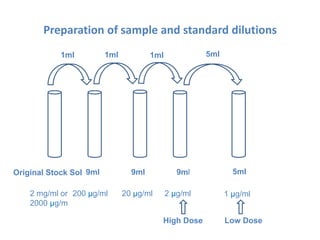
Preparation of sample and standard dilutions
• Prepare the stock solutions of the working standard of
Amoxicillin 3H2O by dissolving accurately weighed quantity
equivalent to 100 mg of amoxicillin in 10 ml of 0.1N HCL,
volume make up to 50ml with DH2O.
• Prepare the stock solution of sample Amoxicillin 3H2O in the
same way.
• Prepare the standard and sample dilutions up to the following
plating out level.
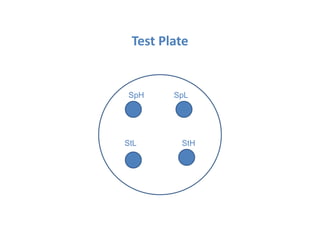
• SpH = 2µg/ml
• StH = 2µg/ml
• SpL = 1µg/ml
• StL = 1µg/ml
Preparation of sample and standard dilutions
Original Stock Sol 9ml 9ml 9ml 5ml
1ml 1ml 1ml 5ml
2 mg/ml or
2000 µg/m
200 µg/ml 20 µg/ml 2 µg/ml 1 µg/ml
High Dose Low Dose
Loading of samples on the test plates
• Load the sample and standard dilutions in the respective wells
with the help of a micropippette. Use 50µl volume in each
well
• Use 2µg/ml as high dose and 1µg/ml as low dose
• After loading keep the plates on bench top for about 2 hours
to allow the antibiotic solution to diffuse in to the surrounding
agar around the well
• Incubate the plates at 37C for 24-48 hours
• After incubation measure the zone of inhibition around each
well in mm. Record your observations and results in the form
of a table
Test Plate
SpH SpL
StL StH
Results Interpretation
Calculate the potency of the antibiotic by the following formula
𝑃𝑜𝑡𝑒𝑛𝑐𝑦 𝑜𝑓 𝑝𝑟𝑜𝑑𝑢𝑐𝑡 = 𝐴𝑛𝑡𝑖𝑙𝑜𝑔[
𝑆𝑝𝐻+𝑆𝑝𝐿 − 𝑆𝑡𝐻+𝑆𝑡𝐿
𝑆𝑝𝐻−𝑆𝑝𝐿 + 𝑆𝑡𝐻−𝑆𝑡𝐿
𝑋 𝐹] X 100
Where F= 0.301

Lab experiment antibiotics bioassay

  • 1.
  • 2.
    Experiment: Bioassay ofAmoxycillin 3H2O, to determine the potency of the product Materials Required • Media: Nutrient broth, Nutrient agar • Reagents: 0.1N HCL, 0.07M Sodium Phosphate Buffer (prepared by mixing sodium hydrogen phosphate and potassium dihydrogen phosphate, pH 7.5), 18N Phosphoric Acid, 10N KOH, Distilled water, Antibiotic standard (standard Amoxycillin 3H2O), Antibiotcs sample (sample Amoxycillin 3H2O) • Test organisms : Bacillus subtilis ATCC 6633
  • 3.
    • Petri plates •Glass test tubes • Micropipettes • Sterile cork borer • Incubators etc Lab Utilities/Supplies Required
  • 4.
    Principle (Theoretical Background) Theactivity of antibiotics may be demonstrated under suitable conditions by their inhibitory effects on microbes. The reduction or loss in antimicrobial activity will reveal changes not demonstrable by chemical methods. Accordingly microbiological assay remains generally the standard in such cases. There are two general methods used for antibiotics bioassays 1. Cylinder plate, cup plate or plate assays 2. Turbidimetric or tube assays
  • 5.
    1. Cylinder plateor cup plate assay This method depends on the diffusion of antibiotics from a vertical cylinder or a well in the solidified agar in a Petri plate, to an extent that the growth of the test organism is inhibited in a circular area up till where the antibiotic solution has diffused as a clear zone around the well. In plate assays the agar wells are made and the dilutions of antibiotics are loaded into the wells. Subsequently the plates are incubated under appropriate growth conditions of the test organism. After incubation diameter of the zone of inhibition is measured and is recorded.
  • 6.
    2. Tube Assay(Turbidimetric method) In this method the liquid medium is taken in the form of broth in test tubes or in the well of a microtiter plate (usually 96 wells plate). The test organism is inoculated to the medium broth along with dilutions of the antibiotics, the tubes or microtiter plate is incubated under appropriate growth conditions of the test organism. After incubation the optical density of the medium in tubes or microwell is measured at 580 or 600 nm in a spectrophotometer. Alternatively the medium in test tubes after incubation can also be compared to some visual standards (such as McFarland standards etc) to determine the turbidity. The tube assay or turbidimetric method depends on the growth inhibition of the test organism in auniform solution of antibiotics dissolved in the liquid medium, which is suitable for the growth of the organism in the absence of antibiotics dilution.
  • 7.
    Procedure Preparation of reagents •Prepare 0.1N HCL • Prepare sodium phosphate buffer by dissolving disodium hydrogen phosphate and potassium dihydrogen phosphate in DH2O and adjust the pH of the buffer at 7.4-7.6 with 18N phosphoric acid and 10N KOH. Autoclave the buffer at 121°C, 15 PSI pressure for 15 min. Preparation of inoculum: Prepare nutrient broth, dispense 5ml broth in different tubes and autoclave the tubes. Inoculate the tubes with recommended test organism (Bacillus subtilis ATCC 6633), and incubate the tubes at 37°C for 24 hours. Prepare the assay medium (nutrient agar), autoclave and at pouring temperature add the prepared inoculum to assay medium and pour the medium in to the petriplates. After solidification make four wells in each plate
  • 8.
    Preparation of sampleand standard dilutions • Prepare the stock solutions of the working standard of Amoxicillin 3H2O by dissolving accurately weighed quantity equivalent to 100 mg of amoxicillin in 10 ml of 0.1N HCL, volume make up to 50ml with DH2O. • Prepare the stock solution of sample Amoxicillin 3H2O in the same way. • Prepare the standard and sample dilutions up to the following plating out level. • SpH = 2µg/ml • StH = 2µg/ml • SpL = 1µg/ml • StL = 1µg/ml
  • 9.
    Preparation of sampleand standard dilutions Original Stock Sol 9ml 9ml 9ml 5ml 1ml 1ml 1ml 5ml 2 mg/ml or 2000 µg/m 200 µg/ml 20 µg/ml 2 µg/ml 1 µg/ml High Dose Low Dose
  • 10.
    Loading of sampleson the test plates • Load the sample and standard dilutions in the respective wells with the help of a micropippette. Use 50µl volume in each well • Use 2µg/ml as high dose and 1µg/ml as low dose • After loading keep the plates on bench top for about 2 hours to allow the antibiotic solution to diffuse in to the surrounding agar around the well • Incubate the plates at 37C for 24-48 hours • After incubation measure the zone of inhibition around each well in mm. Record your observations and results in the form of a table
  • 11.
  • 12.
    Results Interpretation Calculate thepotency of the antibiotic by the following formula 𝑃𝑜𝑡𝑒𝑛𝑐𝑦 𝑜𝑓 𝑝𝑟𝑜𝑑𝑢𝑐𝑡 = 𝐴𝑛𝑡𝑖𝑙𝑜𝑔[ 𝑆𝑝𝐻+𝑆𝑝𝐿 − 𝑆𝑡𝐻+𝑆𝑡𝐿 𝑆𝑝𝐻−𝑆𝑝𝐿 + 𝑆𝑡𝐻−𝑆𝑡𝐿 𝑋 𝐹] X 100 Where F= 0.301