INDUSTRIAL PRODUCTION OF
GLUTAMICACID
PRESENTED BY DR. SATHYA PRASAD CH.
INTRODUCTION
 Amino acids have always played an important role in biology of life,
in biochemistry and in (industrial) chemistry.
 Amino acids are the building blocks of proteins and they play an
essential role in the metabolism regulation of living organisms.
 Large scale chemical and microbial production processes have been
commercialised for a number of essential amino acids.
 Current interest in developing peptide-derived chemo- therapeutics
has heightened the importance of rare and non- proteinogenic pure
amino acids.
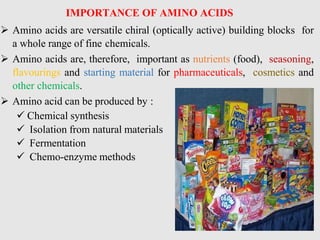
 Amino acids are versatile chiral (optically active) building blocks for
a whole range of fine chemicals.
 Amino acids are, therefore, important as nutrients (food), seasoning,
flavourings and starting material for pharmaceuticals, cosmetics and
other chemicals.
 Amino acid can be produced by :
 Chemical synthesis
 Isolation from natural materials
 Fermentation
 Chemo-enzyme methods
IMPORTANCE OF AMINO ACIDS
GLUTAMIC ACID
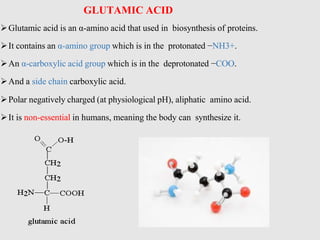
Glutamic acid is an α-amino acid that used in biosynthesis of proteins.
It contains an α-amino group which is in the protonated −NH3+.
An α-carboxylic acid group which is in the deprotonated −COO.
And a side chain carboxylic acid.
Polar negatively charged (at physiological pH), aliphatic amino acid.
It is non-essential in humans, meaning the body can synthesize it.
GLUTAMICACID
 Food Production:
 As flavor enhancer, to improve flavor.
 As nutritional supplement.
 Beverage
 As flavor enhancer: in soft drink and wine.
 Cosmetics
 As Hair restorer: in treatment of Hair Loss.
 As Wrinkle: in preventing aging.
 Agriculture/Animal Feed
 As nutritional supplement: in feed additive to enhance nutrition.
 Other Industries
 As intermediate: in manufacturing of various organic chemicals.
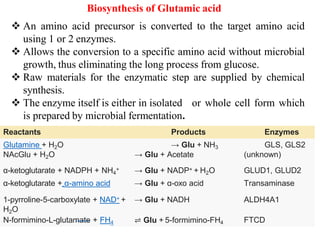
Biosynthesis of Glutamic acid
Reactants Products Enzymes
Glutamine + H2O → Glu + NH3 GLS, GLS2
NAcGlu + H2O → Glu + Acetate (unknown)
α-ketoglutarate + NADPH + NH4
+ → Glu + NADP+ + H2O GLUD1, GLUD2
α-ketoglutarate + α-amino acid → Glu + α-oxo acid Transaminase
1-pyrroline-5-carboxylate + NAD+ +
H2O
→ Glu + NADH ALDH4A1
N-formimino-L-glutamate + FH4 ⇌ Glu + 5-formimino-FH4 FTCD
 An amino acid precursor is converted to the target amino acid
using 1 or 2 enzymes.
 Allows the conversion to a specific amino acid without microbial
growth, thus eliminating the long process from glucose.
 Raw materials for the enzymatic step are supplied by chemical
synthesis.
 The enzyme itself is either in isolated or whole cell form which
is prepared by microbial fermentation.
Industrial Production and use of Microorganisms
 Industrial microbiology
 Microorganisms, typically grown on a large scale, to produce products or
carry out chemical transformations.
 The glutamic acid is produced through the fermentation process
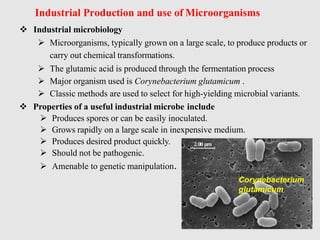
 Major organism used is Corynebacterium glutamicum .
 Classic methods are used to select for high-yielding microbial variants.
 Properties of a useful industrial microbe include
 Produces spores or can be easily inoculated.
 Grows rapidly on a large scale in inexpensive medium.
 Produces desired product quickly.
 Should not be pathogenic.
 Amenable to genetic manipulation.
Corynebacterium
glutamicum
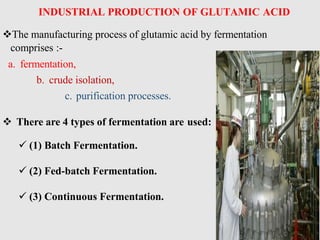
The manufacturing process of glutamic acid by fermentation
comprises :-
a. fermentation,
b. crude isolation,
c. purification processes.
 There are 4 types of fermentation are used:
 (1) Batch Fermentation.
 (2) Fed-batch Fermentation.
 (3) Continuous Fermentation.
INDUSTRIAL PRODUCTION OF GLUTAMIC ACID
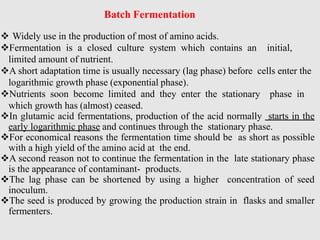
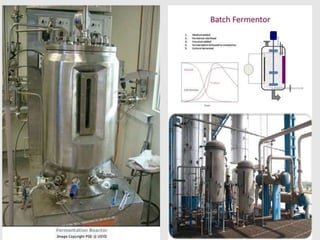
Batch Fermentation
 Widely use in the production of most of amino acids.
Fermentation is a closed culture system which contains an initial,
limited amount of nutrient.
A short adaptation time is usually necessary (lag phase) before cells enter the
logarithmic growth phase (exponential phase).
Nutrients soon become limited and they enter the stationary phase in
which growth has (almost) ceased.
In glutamic acid fermentations, production of the acid normally starts in the
early logarithmic phase and continues through the stationary phase.
For economical reasons the fermentation time should be as short as possible
with a high yield of the amino acid at the end.
A second reason not to continue the fermentation in the late stationary phase
is the appearance of contaminant- products.
The lag phase can be shortened by using a higher concentration of seed
inoculum.
The seed is produced by growing the production strain in flasks and smaller
fermenters.
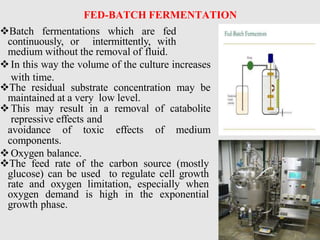
FED-BATCH FERMENTATION
Batch fermentations which are fed
continuously, or intermittently, with
medium without the removal of fluid.
In this way the volume of the culture increases
with time.
The residual substrate concentration may be
maintained at a very low level.
This may result in a removal of catabolite
repressive effects and
avoidance of toxic effects of medium
components.
Oxygen balance.
The feed rate of the carbon source (mostly
glucose) can be used to regulate cell growth
rate and oxygen limitation, especially when
oxygen demand is high in the exponential
growth phase.
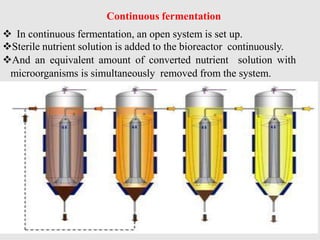
Continuous fermentation
 In continuous fermentation, an open system is set up.
Sterile nutrient solution is added to the bioreactor continuously.
And an equivalent amount of converted nutrient solution with
microorganisms is simultaneously removed from the system.
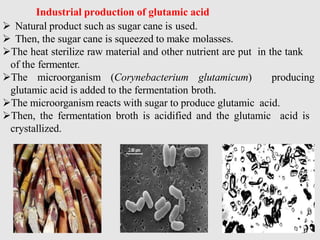
 Natural product such as sugar cane is used.
 Then, the sugar cane is squeezed to make molasses.
The heat sterilize raw material and other nutrient are put in the tank
of the fermenter.
The microorganism (Corynebacterium glutamicum) producing
glutamic acid is added to the fermentation broth.
The microorganism reacts with sugar to produce glutamic acid.
Then, the fermentation broth is acidified and the glutamic acid is
crystallized.
Industrial production of glutamic acid
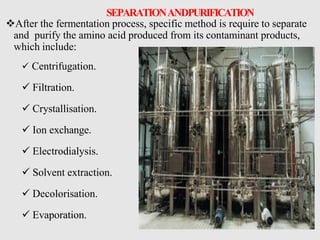
SEPARATIONANDPURIFICATION
After the fermentation process, specific method is require to separate
and purify the amino acid produced from its contaminant products,
which include:
 Centrifugation.
 Filtration.
 Crystallisation.
 Ion exchange.
 Electrodialysis.
 Solvent extraction.
 Decolorisation.
 Evaporation.
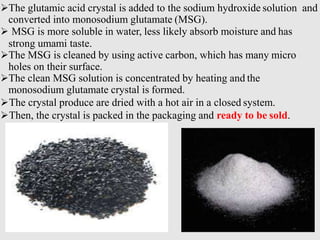
The glutamic acid crystal is added to the sodium hydroxide solution and
converted into monosodium glutamate (MSG).
 MSG is more soluble in water, less likely absorb moisture and has
strong umami taste.
The MSG is cleaned by using active carbon, which has many micro
holes on their surface.
The clean MSG solution is concentrated by heating and the
monosodium glutamate crystal is formed.
The crystal produce are dried with a hot air in a closed system.
Then, the crystal is packed in the packaging and ready to be sold.
Thank you

glutamic acid

  • 1.
  • 2.
    INTRODUCTION  Amino acidshave always played an important role in biology of life, in biochemistry and in (industrial) chemistry.  Amino acids are the building blocks of proteins and they play an essential role in the metabolism regulation of living organisms.  Large scale chemical and microbial production processes have been commercialised for a number of essential amino acids.  Current interest in developing peptide-derived chemo- therapeutics has heightened the importance of rare and non- proteinogenic pure amino acids.
  • 3.
     Amino acidsare versatile chiral (optically active) building blocks for a whole range of fine chemicals.  Amino acids are, therefore, important as nutrients (food), seasoning, flavourings and starting material for pharmaceuticals, cosmetics and other chemicals.  Amino acid can be produced by :  Chemical synthesis  Isolation from natural materials  Fermentation  Chemo-enzyme methods IMPORTANCE OF AMINO ACIDS
  • 4.
    GLUTAMIC ACID Glutamic acidis an α-amino acid that used in biosynthesis of proteins. It contains an α-amino group which is in the protonated −NH3+. An α-carboxylic acid group which is in the deprotonated −COO. And a side chain carboxylic acid. Polar negatively charged (at physiological pH), aliphatic amino acid. It is non-essential in humans, meaning the body can synthesize it.
  • 5.
    GLUTAMICACID  Food Production: As flavor enhancer, to improve flavor.  As nutritional supplement.  Beverage  As flavor enhancer: in soft drink and wine.  Cosmetics  As Hair restorer: in treatment of Hair Loss.  As Wrinkle: in preventing aging.  Agriculture/Animal Feed  As nutritional supplement: in feed additive to enhance nutrition.  Other Industries  As intermediate: in manufacturing of various organic chemicals.
  • 6.
    Biosynthesis of Glutamicacid Reactants Products Enzymes Glutamine + H2O → Glu + NH3 GLS, GLS2 NAcGlu + H2O → Glu + Acetate (unknown) α-ketoglutarate + NADPH + NH4 + → Glu + NADP+ + H2O GLUD1, GLUD2 α-ketoglutarate + α-amino acid → Glu + α-oxo acid Transaminase 1-pyrroline-5-carboxylate + NAD+ + H2O → Glu + NADH ALDH4A1 N-formimino-L-glutamate + FH4 ⇌ Glu + 5-formimino-FH4 FTCD  An amino acid precursor is converted to the target amino acid using 1 or 2 enzymes.  Allows the conversion to a specific amino acid without microbial growth, thus eliminating the long process from glucose.  Raw materials for the enzymatic step are supplied by chemical synthesis.  The enzyme itself is either in isolated or whole cell form which is prepared by microbial fermentation.
  • 7.
    Industrial Production anduse of Microorganisms  Industrial microbiology  Microorganisms, typically grown on a large scale, to produce products or carry out chemical transformations.  The glutamic acid is produced through the fermentation process  Major organism used is Corynebacterium glutamicum .  Classic methods are used to select for high-yielding microbial variants.  Properties of a useful industrial microbe include  Produces spores or can be easily inoculated.  Grows rapidly on a large scale in inexpensive medium.  Produces desired product quickly.  Should not be pathogenic.  Amenable to genetic manipulation. Corynebacterium glutamicum
  • 8.
    The manufacturing processof glutamic acid by fermentation comprises :- a. fermentation, b. crude isolation, c. purification processes.  There are 4 types of fermentation are used:  (1) Batch Fermentation.  (2) Fed-batch Fermentation.  (3) Continuous Fermentation. INDUSTRIAL PRODUCTION OF GLUTAMIC ACID
  • 9.
    Batch Fermentation  Widelyuse in the production of most of amino acids. Fermentation is a closed culture system which contains an initial, limited amount of nutrient. A short adaptation time is usually necessary (lag phase) before cells enter the logarithmic growth phase (exponential phase). Nutrients soon become limited and they enter the stationary phase in which growth has (almost) ceased. In glutamic acid fermentations, production of the acid normally starts in the early logarithmic phase and continues through the stationary phase. For economical reasons the fermentation time should be as short as possible with a high yield of the amino acid at the end. A second reason not to continue the fermentation in the late stationary phase is the appearance of contaminant- products. The lag phase can be shortened by using a higher concentration of seed inoculum. The seed is produced by growing the production strain in flasks and smaller fermenters.
  • 11.
    FED-BATCH FERMENTATION Batch fermentationswhich are fed continuously, or intermittently, with medium without the removal of fluid. In this way the volume of the culture increases with time. The residual substrate concentration may be maintained at a very low level. This may result in a removal of catabolite repressive effects and avoidance of toxic effects of medium components. Oxygen balance. The feed rate of the carbon source (mostly glucose) can be used to regulate cell growth rate and oxygen limitation, especially when oxygen demand is high in the exponential growth phase.
  • 12.
    Continuous fermentation  Incontinuous fermentation, an open system is set up. Sterile nutrient solution is added to the bioreactor continuously. And an equivalent amount of converted nutrient solution with microorganisms is simultaneously removed from the system.
  • 13.
     Natural productsuch as sugar cane is used.  Then, the sugar cane is squeezed to make molasses. The heat sterilize raw material and other nutrient are put in the tank of the fermenter. The microorganism (Corynebacterium glutamicum) producing glutamic acid is added to the fermentation broth. The microorganism reacts with sugar to produce glutamic acid. Then, the fermentation broth is acidified and the glutamic acid is crystallized. Industrial production of glutamic acid
  • 14.
    SEPARATIONANDPURIFICATION After the fermentationprocess, specific method is require to separate and purify the amino acid produced from its contaminant products, which include:  Centrifugation.  Filtration.  Crystallisation.  Ion exchange.  Electrodialysis.  Solvent extraction.  Decolorisation.  Evaporation.
  • 15.
    The glutamic acidcrystal is added to the sodium hydroxide solution and converted into monosodium glutamate (MSG).  MSG is more soluble in water, less likely absorb moisture and has strong umami taste. The MSG is cleaned by using active carbon, which has many micro holes on their surface. The clean MSG solution is concentrated by heating and the monosodium glutamate crystal is formed. The crystal produce are dried with a hot air in a closed system. Then, the crystal is packed in the packaging and ready to be sold.
  • 16.