Instrumentation & Process 
Control Fundamentals 
Designed by: 
Hossam A. Hassanein 
1
Goals 
 Basic understanding of process control 
 Important process control terminology 
 Major components of a process loop 
 Instrumentation P&ID symbols 
2
3 
Instrumentation 
Definition 
The use of 
measuring 
instruments to 
monitor and 
control a process 
variables 
Variables such as 
temperature, 
pressure, flow, 
level, speed 
Instrumentation
4 
Process Control 
Definition 
Engineering 
discipline that; 
deals with 
architecture and, 
algorithms for 
maintaining the 
output of a 
specific process 
with a desired 
range 
Output such as 
temperature, 
pressure, flow, 
level, speed 
Process 
Control
5 
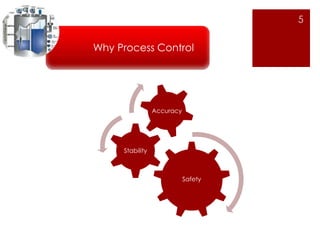
Why Process Control 
Safety 
Stability 
Accuracy
6 
Process Control Basics 
and 
Terminology
7 
Process Control Basics 
and 
Terminology 
Control Loop 
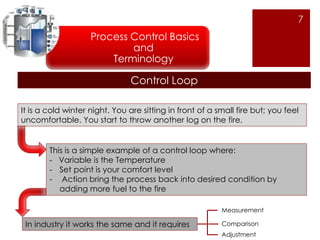
It is a cold winter night. You are sitting in front of a small fire but; you feel 
uncomfortable. You start to throw another log on the fire. 
This is a simple example of a control loop where: 
- Variable is the Temperature 
- Set point is your comfort level 
- Action bring the process back into desired condition by 
adding more fuel to the fire 
In industry it works the same and it requires 
Measurement 
Comparison 
Adjustment
8 
Process Control Basics 
and 
Terminology 
Simple Control Loop 
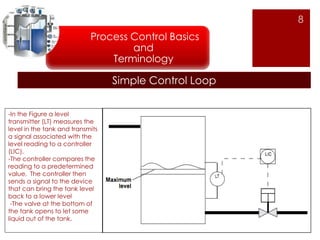
-In the Figure a level 
transmitter (LT) measures the 
level in the tank and transmits 
a signal associated with the 
level reading to a controller 
(LIC). 
-The controller compares the 
reading to a predetermined 
value, The controller then 
sends a signal to the device 
that can bring the tank level 
back to a lower level 
-The valve at the bottom of 
the tank opens to let some 
liquid out of the tank.
9 
Process Control Basics 
and 
Terminology 
Process Variables 
Is a condition of the process fluid that; can change the manufacturing 
process in some way. 
Process variables such as: 
 Pressure 
 Flow 
 Level 
 Temperature 
 Density 
 pH 
 Mass 
 Conductivity
10 
Process Control Basics 
and 
Terminology 
Controller 
Is a device that receives data from a measurement instrument, compares that 
data to a programmed set point, and, if necessary, signals a control element to 
take corrective action. 
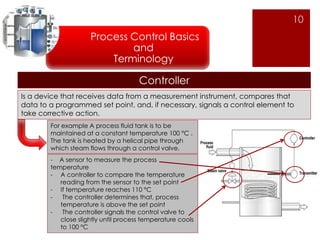
For example A process fluid tank is to be 
maintained at a constant temperature 100 °C . 
The tank is heated by a helical pipe through 
which steam flows through a control valve. 
- A sensor to measure the process 
temperature 
- A controller to compare the temperature 
reading from the sensor to the set point 
- If temperature reaches 110 °C 
- The controller determines that, process 
temperature is above the set point 
- The controller signals the control valve to 
close slightly until process temperature cools 
to 100 °C
11 
Process Control Basics 
and 
Terminology 
Set point 
Is the value for a process variable is desired to be maintained . 
Also known as Reference Variable.
12 
Process Control Basics 
and 
Terminology 
Measured Variables, Process Variables, and 
Manipulated Variables 
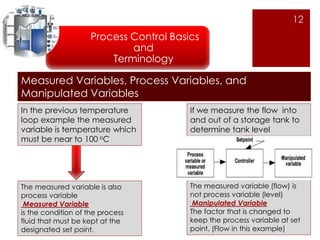
In the previous temperature 
loop example the measured 
variable is temperature which 
must be near to 100 oC 
If we measure the flow into 
and out of a storage tank to 
determine tank level 
The measured variable is also 
process variable 
Measured Variable 
is the condition of the process 
fluid that must be kept at the 
designated set point. 
The measured variable (flow) is 
not process variable (level) 
Manipulated Variable 
The factor that is changed to 
keep the process variable at set 
point. (Flow in this example)
13 
Process Control Basics 
and 
Terminology 
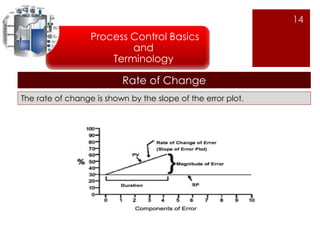
Error 
Is the difference between the measured variable and the set point and 
can be either positive or negative 
Magnitude 
Is the deviation between the values of the set point and the process 
variable 
Duration 
Duration refers to the length of time that an error condition has existed.
14 
Process Control Basics 
and 
Terminology 
Rate of Change 
The rate of change is shown by the slope of the error plot.
15 
Process Control Basics 
and 
Terminology 
Offset 
Is a sustained deviation of the process variable from the set point. 
Load Disturbance 
Is an undesired change in one of the factors that can affect the process 
variable.
16 
Process Control Basics 
and 
Terminology 
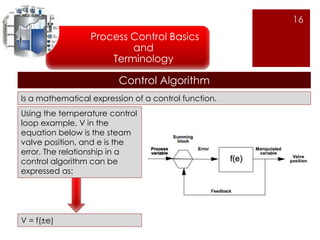
Control Algorithm 
Is a mathematical expression of a control function. 
Using the temperature control 
loop example, V in the 
equation below is the steam 
valve position, and e is the 
error. The relationship in a 
control algorithm can be 
expressed as: 
V = f(±e)
17 
Process Control Basics 
and 
Terminology 
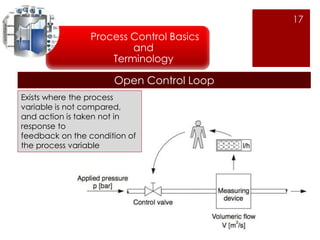
Open Control Loop 
Exists where the process 
variable is not compared, 
and action is taken not in 
response to 
feedback on the condition of 
the process variable
18 
Process Control Basics 
and 
Terminology 
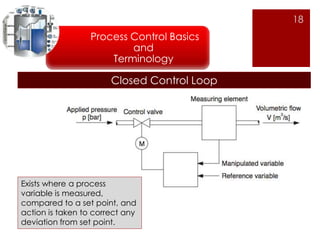
Closed Control Loop 
Exists where a process 
variable is measured, 
compared to a set point, and 
action is taken to correct any 
deviation from set point.
19 
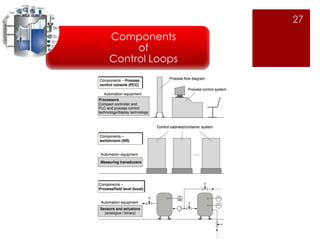
Components 
of 
Control Loops
20 
Components 
of 
Control Loops 
Primary Elements (Sensors) 
Devices that cause some change in their property with changes in 
process fluid conditions that can then be measured and, they are the 
first element in the control loop to measure the process variable 
Examples of primary elements include: 
-Pressure sensing diaphragms, strain gauges, capacitance cells 
-Resistance temperature detectors (RTDs) 
-Thermocouples 
-Orifice plates 
-Pitot tubes 
-Venturi tubes 
-Magnetic flow tubes 
-Coriolis flow tubes 
-Radar emitters and receivers 
-Ultrasonic emitters and receivers 
-Annular flow elements 
-Vortex shedder
21 
Components 
of 
Control Loops 
Transducers 
Device that translates a mechanical signal into an electrical signal. 
Converters 
Device that converts one type of signal into another type of signal. 
Transmitters 
device that converts a reading from a sensor or transducer into a 
standard signal and transmits that signal to a monitor or controller. 
Transmitter types include: 
-Pressure transmitters -Flow transmitters 
-Temperature transmitters -Level transmitters 
-Analytic (O2 [oxygen], CO [carbon monoxide], and pH) transmitters
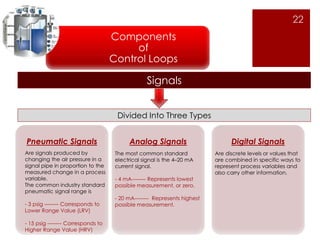
Pneumatic Signals Analog Signals Digital Signals 
22 
Components 
of 
Control Loops 
Signals 
Divided Into Three Types 
Are signals produced by 
changing the air pressure in a 
signal pipe in proportion to the 
measured change in a process 
variable. 
The common industry standard 
pneumatic signal range is 
- 3 psig -------- Corresponds to 
Lower Range Value (LRV) 
- 15 psig -------- Corresponds to 
Higher Range Value (HRV) 
The most common standard 
electrical signal is the 4–20 mA 
current signal. 
- 4 mA-------- Represents lowest 
possible measurement, or zero. 
- 20 mA-------- Represents highest 
possible measurement. 
Are discrete levels or values that 
are combined in specific ways to 
represent process variables and 
also carry other information,
23 
Components 
of 
Control Loops 
Indicators 
Is a human-readable device that displays information about the process 
like pressure gauge. 
Records 
Is a device that records the output of a measurement devices.
24 
Components 
of 
Control Loops 
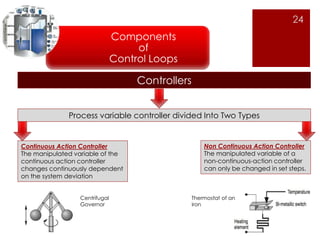
Controllers 
Process variable controller divided Into Two Types 
Continuous Action Controller 
The manipulated variable of the 
continuous action controller 
changes continuously dependent 
on the system deviation 
Centrifugal 
Governor 
Non Continuous Action Controller 
The manipulated variable of a 
non-continuous-action controller 
can only be changed in set steps. 
Thermostat of an 
iron
25 
Components 
of 
Control Loops 
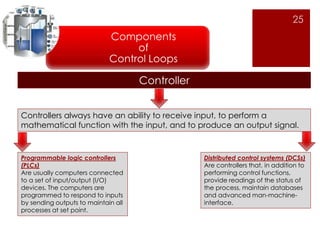
Controller 
Controllers always have an ability to receive input, to perform a 
mathematical function with the input, and to produce an output signal. 
Programmable logic controllers 
(PLCs) 
Are usually computers connected 
to a set of input/output (I/O) 
devices. The computers are 
programmed to respond to inputs 
by sending outputs to maintain all 
processes at set point. 
Distributed control systems (DCSs) 
Are controllers that, in addition to 
performing control functions, 
provide readings of the status of 
the process, maintain databases 
and advanced man-machine-interface.
26 
Components 
of 
Control Loops 
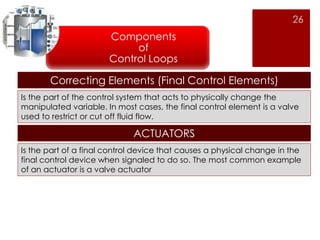
Correcting Elements (Final Control Elements) 
Is the part of the control system that acts to physically change the 
manipulated variable. In most cases, the final control element is a valve 
used to restrict or cut off fluid flow. 
ACTUATORS 
Is the part of a final control device that causes a physical change in the 
final control device when signaled to do so. The most common example 
of an actuator is a valve actuator
27 
Components 
of 
Control Loops
28 
Instrumentation, Systems, 
and Automation 
(ISA) Symbols
29 
Instrumentation, Systems, 
and Automation 
(ISA) Symbols 
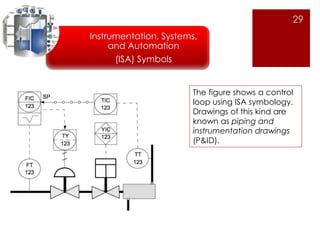
The figure shows a control 
loop using ISA symbology. 
Drawings of this kind are 
known as piping and 
instrumentation drawings 
(P&ID).
30 
Instrumentation, Systems, 
and Automation 
(ISA) Symbols 
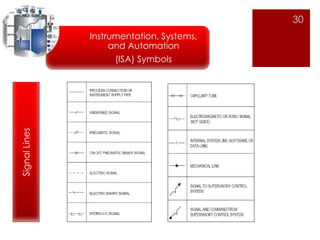
Signal Lines
31 
Instrumentation, Systems, 
and Automation 
(ISA) Symbols 
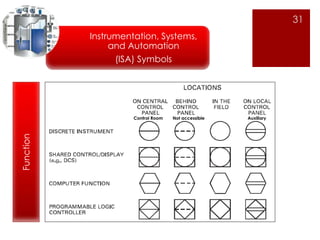
Control Room Not accessible Auxiliary 
Function
32 
Instrumentation, Systems, 
and Automation 
(ISA) Symbols 
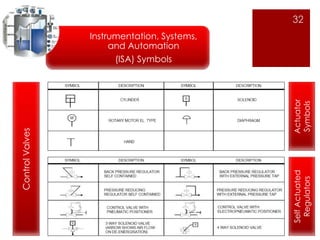
Control Valves 
Actuator 
Symbols 
Self Actuated 
Regulators
33 
Instrumentation, Systems, 
and Automation 
(ISA) Symbols 
Control Valves 
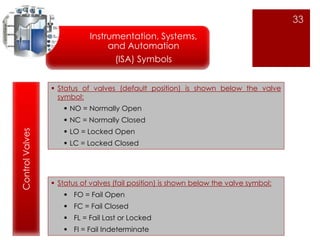
 Status of valves (default position) is shown below the valve 
symbol: 
 NO = Normally Open 
 NC = Normally Closed 
 LO = Locked Open 
 LC = Locked Closed 
 Status of valves (fail position) is shown below the valve symbol: 
 FO = Fail Open 
 FC = Fail Closed 
 FL = Fail Last or Locked 
 FI = Fail Indeterminate
34 
Instrumentation, Systems, 
and Automation 
(ISA) Symbols 
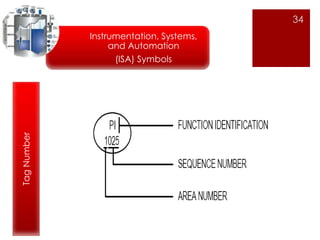
Tag Number
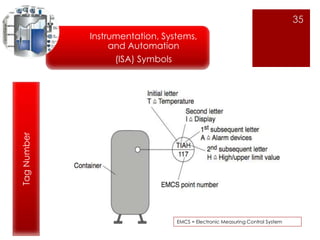
35 
Instrumentation, Systems, 
and Automation 
(ISA) Symbols 
Tag Number 
EMCS = Electronic Measuring Control System
36 
Instrumentation & Process 
Control Fundamentals 
Summary
37 
Instrumentation & Process 
Control Fundamentals 
Summary 
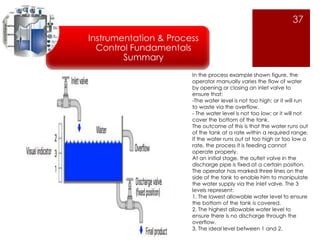
In the process example shown figure, the 
operator manually varies the flow of water 
by opening or closing an inlet valve to 
ensure that: 
-The water level is not too high; or it will run 
to waste via the overflow. 
- The water level is not too low; or it will not 
cover the bottom of the tank. 
The outcome of this is that the water runs out 
of the tank at a rate within a required range. 
If the water runs out at too high or too low a 
rate, the process it is feeding cannot 
operate properly. 
At an initial stage, the outlet valve in the 
discharge pipe is fixed at a certain position. 
The operator has marked three lines on the 
side of the tank to enable him to manipulate 
the water supply via the inlet valve. The 3 
levels represent: 
1. The lowest allowable water level to ensure 
the bottom of the tank is covered. 
2. The highest allowable water level to 
ensure there is no discharge through the 
overflow. 
3. The ideal level between 1 and 2.
38 
Instrumentation & Process 
Control Fundamentals 
Summary 
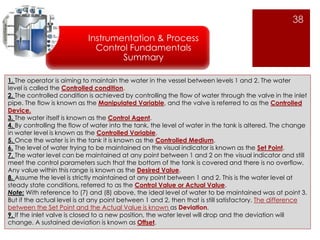
1. The operator is aiming to maintain the water in the vessel between levels 1 and 2. The water 
level is called the Controlled condition. 
2. The controlled condition is achieved by controlling the flow of water through the valve in the inlet 
pipe. The flow is known as the Manipulated Variable, and the valve is referred to as the Controlled 
Device. 
3. The water itself is known as the Control Agent. 
4. By controlling the flow of water into the tank, the level of water in the tank is altered. The change 
in water level is known as the Controlled Variable. 
5. Once the water is in the tank it is known as the Controlled Medium. 
6. The level of water trying to be maintained on the visual indicator is known as the Set Point. 
7. The water level can be maintained at any point between 1 and 2 on the visual indicator and still 
meet the control parameters such that the bottom of the tank is covered and there is no overflow. 
Any value within this range is known as the Desired Value. 
8. Assume the level is strictly maintained at any point between 1 and 2. This is the water level at 
steady state conditions, referred to as the Control Value or Actual Value. 
Note: With reference to (7) and (8) above, the ideal level of water to be maintained was at point 3. 
But if the actual level is at any point between 1 and 2, then that is still satisfactory. The difference 
between the Set Point and the Actual Value is known as Deviation. 
9. If the inlet valve is closed to a new position, the water level will drop and the deviation will 
change. A sustained deviation is known as Offset.
39 
Instrumentation & Process 
Control Fundamentals 
The End of The Session 
QUESTIONS??

Inst. & process control gtp

  • 1.
    Instrumentation & Process Control Fundamentals Designed by: Hossam A. Hassanein 1
  • 2.
    Goals  Basicunderstanding of process control  Important process control terminology  Major components of a process loop  Instrumentation P&ID symbols 2
  • 3.
    3 Instrumentation Definition The use of measuring instruments to monitor and control a process variables Variables such as temperature, pressure, flow, level, speed Instrumentation
  • 4.
    4 Process Control Definition Engineering discipline that; deals with architecture and, algorithms for maintaining the output of a specific process with a desired range Output such as temperature, pressure, flow, level, speed Process Control
  • 5.
    5 Why ProcessControl Safety Stability Accuracy
  • 6.
    6 Process ControlBasics and Terminology
  • 7.
    7 Process ControlBasics and Terminology Control Loop It is a cold winter night. You are sitting in front of a small fire but; you feel uncomfortable. You start to throw another log on the fire. This is a simple example of a control loop where: - Variable is the Temperature - Set point is your comfort level - Action bring the process back into desired condition by adding more fuel to the fire In industry it works the same and it requires Measurement Comparison Adjustment
  • 8.
    8 Process ControlBasics and Terminology Simple Control Loop -In the Figure a level transmitter (LT) measures the level in the tank and transmits a signal associated with the level reading to a controller (LIC). -The controller compares the reading to a predetermined value, The controller then sends a signal to the device that can bring the tank level back to a lower level -The valve at the bottom of the tank opens to let some liquid out of the tank.
  • 9.
    9 Process ControlBasics and Terminology Process Variables Is a condition of the process fluid that; can change the manufacturing process in some way. Process variables such as:  Pressure  Flow  Level  Temperature  Density  pH  Mass  Conductivity
  • 10.
    10 Process ControlBasics and Terminology Controller Is a device that receives data from a measurement instrument, compares that data to a programmed set point, and, if necessary, signals a control element to take corrective action. For example A process fluid tank is to be maintained at a constant temperature 100 °C . The tank is heated by a helical pipe through which steam flows through a control valve. - A sensor to measure the process temperature - A controller to compare the temperature reading from the sensor to the set point - If temperature reaches 110 °C - The controller determines that, process temperature is above the set point - The controller signals the control valve to close slightly until process temperature cools to 100 °C
  • 11.
    11 Process ControlBasics and Terminology Set point Is the value for a process variable is desired to be maintained . Also known as Reference Variable.
  • 12.
    12 Process ControlBasics and Terminology Measured Variables, Process Variables, and Manipulated Variables In the previous temperature loop example the measured variable is temperature which must be near to 100 oC If we measure the flow into and out of a storage tank to determine tank level The measured variable is also process variable Measured Variable is the condition of the process fluid that must be kept at the designated set point. The measured variable (flow) is not process variable (level) Manipulated Variable The factor that is changed to keep the process variable at set point. (Flow in this example)
  • 13.
    13 Process ControlBasics and Terminology Error Is the difference between the measured variable and the set point and can be either positive or negative Magnitude Is the deviation between the values of the set point and the process variable Duration Duration refers to the length of time that an error condition has existed.
  • 14.
    14 Process ControlBasics and Terminology Rate of Change The rate of change is shown by the slope of the error plot.
  • 15.
    15 Process ControlBasics and Terminology Offset Is a sustained deviation of the process variable from the set point. Load Disturbance Is an undesired change in one of the factors that can affect the process variable.
  • 16.
    16 Process ControlBasics and Terminology Control Algorithm Is a mathematical expression of a control function. Using the temperature control loop example, V in the equation below is the steam valve position, and e is the error. The relationship in a control algorithm can be expressed as: V = f(±e)
  • 17.
    17 Process ControlBasics and Terminology Open Control Loop Exists where the process variable is not compared, and action is taken not in response to feedback on the condition of the process variable
  • 18.
    18 Process ControlBasics and Terminology Closed Control Loop Exists where a process variable is measured, compared to a set point, and action is taken to correct any deviation from set point.
  • 19.
    19 Components of Control Loops
  • 20.
    20 Components of Control Loops Primary Elements (Sensors) Devices that cause some change in their property with changes in process fluid conditions that can then be measured and, they are the first element in the control loop to measure the process variable Examples of primary elements include: -Pressure sensing diaphragms, strain gauges, capacitance cells -Resistance temperature detectors (RTDs) -Thermocouples -Orifice plates -Pitot tubes -Venturi tubes -Magnetic flow tubes -Coriolis flow tubes -Radar emitters and receivers -Ultrasonic emitters and receivers -Annular flow elements -Vortex shedder
  • 21.
    21 Components of Control Loops Transducers Device that translates a mechanical signal into an electrical signal. Converters Device that converts one type of signal into another type of signal. Transmitters device that converts a reading from a sensor or transducer into a standard signal and transmits that signal to a monitor or controller. Transmitter types include: -Pressure transmitters -Flow transmitters -Temperature transmitters -Level transmitters -Analytic (O2 [oxygen], CO [carbon monoxide], and pH) transmitters
  • 22.
    Pneumatic Signals AnalogSignals Digital Signals 22 Components of Control Loops Signals Divided Into Three Types Are signals produced by changing the air pressure in a signal pipe in proportion to the measured change in a process variable. The common industry standard pneumatic signal range is - 3 psig -------- Corresponds to Lower Range Value (LRV) - 15 psig -------- Corresponds to Higher Range Value (HRV) The most common standard electrical signal is the 4–20 mA current signal. - 4 mA-------- Represents lowest possible measurement, or zero. - 20 mA-------- Represents highest possible measurement. Are discrete levels or values that are combined in specific ways to represent process variables and also carry other information,
  • 23.
    23 Components of Control Loops Indicators Is a human-readable device that displays information about the process like pressure gauge. Records Is a device that records the output of a measurement devices.
  • 24.
    24 Components of Control Loops Controllers Process variable controller divided Into Two Types Continuous Action Controller The manipulated variable of the continuous action controller changes continuously dependent on the system deviation Centrifugal Governor Non Continuous Action Controller The manipulated variable of a non-continuous-action controller can only be changed in set steps. Thermostat of an iron
  • 25.
    25 Components of Control Loops Controller Controllers always have an ability to receive input, to perform a mathematical function with the input, and to produce an output signal. Programmable logic controllers (PLCs) Are usually computers connected to a set of input/output (I/O) devices. The computers are programmed to respond to inputs by sending outputs to maintain all processes at set point. Distributed control systems (DCSs) Are controllers that, in addition to performing control functions, provide readings of the status of the process, maintain databases and advanced man-machine-interface.
  • 26.
    26 Components of Control Loops Correcting Elements (Final Control Elements) Is the part of the control system that acts to physically change the manipulated variable. In most cases, the final control element is a valve used to restrict or cut off fluid flow. ACTUATORS Is the part of a final control device that causes a physical change in the final control device when signaled to do so. The most common example of an actuator is a valve actuator
  • 27.
    27 Components of Control Loops
  • 28.
    28 Instrumentation, Systems, and Automation (ISA) Symbols
  • 29.
    29 Instrumentation, Systems, and Automation (ISA) Symbols The figure shows a control loop using ISA symbology. Drawings of this kind are known as piping and instrumentation drawings (P&ID).
  • 30.
    30 Instrumentation, Systems, and Automation (ISA) Symbols Signal Lines
  • 31.
    31 Instrumentation, Systems, and Automation (ISA) Symbols Control Room Not accessible Auxiliary Function
  • 32.
    32 Instrumentation, Systems, and Automation (ISA) Symbols Control Valves Actuator Symbols Self Actuated Regulators
  • 33.
    33 Instrumentation, Systems, and Automation (ISA) Symbols Control Valves  Status of valves (default position) is shown below the valve symbol:  NO = Normally Open  NC = Normally Closed  LO = Locked Open  LC = Locked Closed  Status of valves (fail position) is shown below the valve symbol:  FO = Fail Open  FC = Fail Closed  FL = Fail Last or Locked  FI = Fail Indeterminate
  • 34.
    34 Instrumentation, Systems, and Automation (ISA) Symbols Tag Number
  • 35.
    35 Instrumentation, Systems, and Automation (ISA) Symbols Tag Number EMCS = Electronic Measuring Control System
  • 36.
    36 Instrumentation &Process Control Fundamentals Summary
  • 37.
    37 Instrumentation &Process Control Fundamentals Summary In the process example shown figure, the operator manually varies the flow of water by opening or closing an inlet valve to ensure that: -The water level is not too high; or it will run to waste via the overflow. - The water level is not too low; or it will not cover the bottom of the tank. The outcome of this is that the water runs out of the tank at a rate within a required range. If the water runs out at too high or too low a rate, the process it is feeding cannot operate properly. At an initial stage, the outlet valve in the discharge pipe is fixed at a certain position. The operator has marked three lines on the side of the tank to enable him to manipulate the water supply via the inlet valve. The 3 levels represent: 1. The lowest allowable water level to ensure the bottom of the tank is covered. 2. The highest allowable water level to ensure there is no discharge through the overflow. 3. The ideal level between 1 and 2.
  • 38.
    38 Instrumentation &Process Control Fundamentals Summary 1. The operator is aiming to maintain the water in the vessel between levels 1 and 2. The water level is called the Controlled condition. 2. The controlled condition is achieved by controlling the flow of water through the valve in the inlet pipe. The flow is known as the Manipulated Variable, and the valve is referred to as the Controlled Device. 3. The water itself is known as the Control Agent. 4. By controlling the flow of water into the tank, the level of water in the tank is altered. The change in water level is known as the Controlled Variable. 5. Once the water is in the tank it is known as the Controlled Medium. 6. The level of water trying to be maintained on the visual indicator is known as the Set Point. 7. The water level can be maintained at any point between 1 and 2 on the visual indicator and still meet the control parameters such that the bottom of the tank is covered and there is no overflow. Any value within this range is known as the Desired Value. 8. Assume the level is strictly maintained at any point between 1 and 2. This is the water level at steady state conditions, referred to as the Control Value or Actual Value. Note: With reference to (7) and (8) above, the ideal level of water to be maintained was at point 3. But if the actual level is at any point between 1 and 2, then that is still satisfactory. The difference between the Set Point and the Actual Value is known as Deviation. 9. If the inlet valve is closed to a new position, the water level will drop and the deviation will change. A sustained deviation is known as Offset.
  • 39.
    39 Instrumentation &Process Control Fundamentals The End of The Session QUESTIONS??

Editor's Notes

  • #6 Safety - The plant or process must be safe to operate. The more complex or dangerous the plant or process, the greater is the need for process controls and safeguard protocol. Stability - The plant or processes should work steadily, predictably and repeatable, without fluctuations or unplanned shutdowns. Accuracy - This is a primary requirement in factories and buildings to prevent spoilage, increase quality and production rates, and maintain comfort. These are the fundamentals of economic efficiency.
  • #7 Safety - The plant or process must be safe to operate. The more complex or dangerous the plant or process, the greater is the need for process controls and safeguard protocol. Stability - The plant or processes should work steadily, predictably and repeatable, without fluctuations or unplanned shutdowns. Accuracy - This is a primary requirement in factories and buildings to prevent spoilage, increase quality and production rates, and maintain comfort. These are the fundamentals of economic efficiency.
  • #8 Safety - The plant or process must be safe to operate. The more complex or dangerous the plant or process, the greater is the need for process controls and safeguard protocol. Stability - The plant or processes should work steadily, predictably and repeatable, without fluctuations or unplanned shutdowns. Accuracy - This is a primary requirement in factories and buildings to prevent spoilage, increase quality and production rates, and maintain comfort. These are the fundamentals of economic efficiency.