FIRE AND ELECTRICAL HAZARDS
PRESENTED BY
RESHMA FATHIMA.K
FIRST YEAR M.PHARM
DEPARTMENT OF PHARMACEUTICS
CONTENTS
 INTRODUCTION
 FIRE AND EXPLOSION HAZARDS
 CONTROL OF FIRE AND EXPLOSION
 INDUSTRIAL PLANT
 FIRE EXTINGUISHERS
 ELECTRICAL HAZARDS
 HOW SHOCK OCCUR
 TYPES OF ELECTRICAL HAZARDS
 PREVENTION OF ELECTRICAL HAZARDS
INTRODUCTION
Hazard is a term associated with a substance that is
likelihood to cause an injury in a given environment
or situation.
Industrial hazard may be defined as any condition
produced by industries that may cause injury or
death to personnel or loss of product or property
safety in simple terms means freedom from the
occurrence of risk or injury or loss.
Industrial safety or employee safety
It refers to the protection of workers from the
danger of industrial accidents.
Safety hazards
Toxic and corrosive chemicals,fire,explosions and
personnel falling into accidents are the major
health and safety hazards encountered in the
operations of chemical and pharmaceutical related
industries.
Accident prevention needs systemic and technical
study of every aspect of the plant design and
operation. Todays industry employs user friendly
machinery, which can withstand human error and
equipment failure.
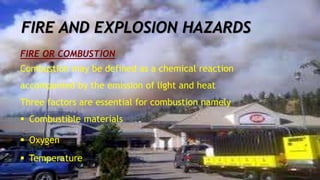
FIRE OR COMBUSTION
Combustion may be defined as a chemical reaction
accompanied by the emission of light and heat
Three factors are essential for combustion namely
 Combustible materials
 Oxygen
 Temperature
FIRE AND EXPLOSION HAZARDS
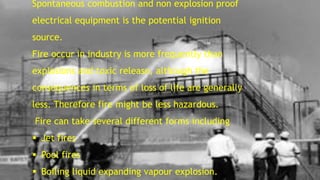
Spontaneous combustion and non explosion proof
electrical equipment is the potential ignition
source.
Fire occur in industry is more frequently than
explosions and toxic release, although the
consequences in terms of loss of life are generally
less. Therefore fire might be less hazardous.
Fire can take several different forms including
 Jet fires
 Pool fires
 Boiling liquid expanding vapour explosion.
CONTROL OF FIRE AND
EXPLOSION
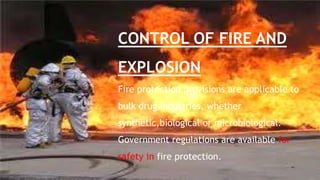
Fire protection provisions are applicable to
bulk drug industries, whether
synthetic,biological or microbiological.
Government regulations are available for
safety in fire protection.
 Careful plant layout and judicious choice of constructional
materials can reduce fire and explosion hazards.
 Hazards operations should be isolated by conducting them in
separate buildings.
• Fire resistance brick walls or reinforced concrete walls can
limit the effect of an explosion.
 The roof is designed to left easily under an explosive force
 Possible sources of fire are reduced by eliminating ignition
sources.
 Installation of fire alarms temperature alarms fire fighting
equipment and sprinkler system must be specified in design
INDUSTRIAL PLANT
 Location
 Arrangement of buildings
 Fire mains, hydrants and hoses
 Fire alarm equipment
BUILDINGS
 Type of construction
 Exits
 Lighting
 Color in industry
 Ventilation
 Sanitation
 Automatic sprinkler system
 First aid
 Fire extinguisher
 Equipment
 Avoiding of general machinery
 Flammable liquids
Fires are divided into three categories
Class A fires – originated from ordinary combustible
materials
Class B fires-originated from oils , greases,
flammable liquids etc.
Class C fires – originated from electrical equipments
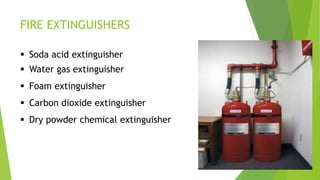
FIRE EXTINGUISHERS
 Soda acid extinguisher
 Water gas extinguisher
 Foam extinguisher
 Carbon dioxide extinguisher
 Dry powder chemical extinguisher
ELECTRICAL HAZARDS
Electrical hazards are 1 of the 4 main hazards in construction
causing serious injury or death. Approximately 350
electrically related fatalities occur each year. That’s 350
deaths that could be prevented
Many people working with electricity do not understand how
it works. Operating an electrical switch is like turning on a
water faucet. Behind the faucet (or)switch there is a source
of water (or electricity), a way to transport it, and pressure
to make it flow. The faucet’s water source is a reservoir or
pumping station.
 A pump provides enough pressure for the water to
travel through the pipes. The switch’s electrical
source is a power generating station. A generator
provides the pressure for the electrical current to
travel through electrical conductors, or wires.
 Three factors determine the resistance of a
substance to the flow of electricity:
 What is made of
 Its temperature , its size
HOW SHOCKS OCCUR
 Electricity travels in closed circuits, normally
through a conductor. Shock results when the body
becomes part of the electrical circuit; current
enters the body at one point and leaves at
another. Typically, shock occurs when a person
contacts:
 Both wires of an energized circuit
 One wire of an energized circuit and the ground
 A metallic part in contact with an energized wire while the
person is also in contact with the ground.
The most frequent causes of electrical injury/death are:
 Contact with power lines
 Lack of ground-fault protection
 Path to ground missing or discontinuous
 Equipment not used in manner prescribed
 Improper use of extension and flexible cords
TYPES OF ELECTRICAL
HAZARDS
SHORT CIRCUIT
SERIES CIRCUIT
PARALLEL CIRCUIT
SHORT CIRCUIT
A short circuit is a low resistance path usually made
unintentionally that bypasses the part of a circuit.
This can happen when two base coils in a circuit
touch each other.
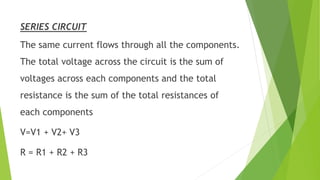
SERIES CIRCUIT
The same current flows through all the components.
The total voltage across the circuit is the sum of
voltages across each components and the total
resistance is the sum of the total resistances of
each components
V=V1 + V2+ V3
R = R1 + R2 + R3
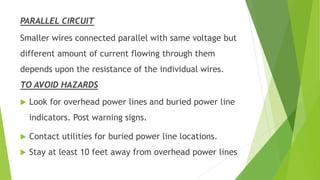
PARALLEL CIRCUIT
Smaller wires connected parallel with same voltage but
different amount of current flowing through them
depends upon the resistance of the individual wires.
TO AVOID HAZARDS
 Look for overhead power lines and buried power line
indicators. Post warning signs.
 Contact utilities for buried power line locations.
 Stay at least 10 feet away from overhead power lines
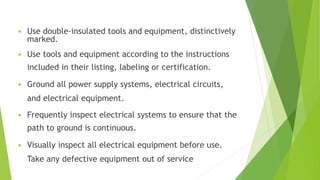
 Use double-insulated tools and equipment, distinctively
marked.
 Use tools and equipment according to the instructions
included in their listing, labeling or certification.
 Ground all power supply systems, electrical circuits,
and electrical equipment.
 Frequently inspect electrical systems to ensure that the
path to ground is continuous.
 Visually inspect all electrical equipment before use.
Take any defective equipment out of service
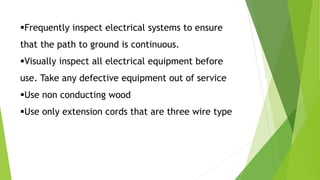
Frequently inspect electrical systems to ensure
that the path to ground is continuous.
Visually inspect all electrical equipment before
use. Take any defective equipment out of service
Use non conducting wood
Use only extension cords that are three wire type
Fire and electrical hazards

Fire and electrical hazards

  • 1.
    FIRE AND ELECTRICALHAZARDS PRESENTED BY RESHMA FATHIMA.K FIRST YEAR M.PHARM DEPARTMENT OF PHARMACEUTICS
  • 2.
    CONTENTS  INTRODUCTION  FIREAND EXPLOSION HAZARDS  CONTROL OF FIRE AND EXPLOSION  INDUSTRIAL PLANT  FIRE EXTINGUISHERS  ELECTRICAL HAZARDS  HOW SHOCK OCCUR  TYPES OF ELECTRICAL HAZARDS  PREVENTION OF ELECTRICAL HAZARDS
  • 3.
    INTRODUCTION Hazard is aterm associated with a substance that is likelihood to cause an injury in a given environment or situation. Industrial hazard may be defined as any condition produced by industries that may cause injury or death to personnel or loss of product or property safety in simple terms means freedom from the occurrence of risk or injury or loss.
  • 4.
    Industrial safety oremployee safety It refers to the protection of workers from the danger of industrial accidents. Safety hazards Toxic and corrosive chemicals,fire,explosions and personnel falling into accidents are the major health and safety hazards encountered in the operations of chemical and pharmaceutical related industries.
  • 5.
    Accident prevention needssystemic and technical study of every aspect of the plant design and operation. Todays industry employs user friendly machinery, which can withstand human error and equipment failure.
  • 6.
    FIRE OR COMBUSTION Combustionmay be defined as a chemical reaction accompanied by the emission of light and heat Three factors are essential for combustion namely  Combustible materials  Oxygen  Temperature FIRE AND EXPLOSION HAZARDS
  • 7.
    Spontaneous combustion andnon explosion proof electrical equipment is the potential ignition source. Fire occur in industry is more frequently than explosions and toxic release, although the consequences in terms of loss of life are generally less. Therefore fire might be less hazardous. Fire can take several different forms including  Jet fires  Pool fires  Boiling liquid expanding vapour explosion.
  • 8.
    CONTROL OF FIREAND EXPLOSION Fire protection provisions are applicable to bulk drug industries, whether synthetic,biological or microbiological. Government regulations are available for safety in fire protection.
  • 9.
     Careful plantlayout and judicious choice of constructional materials can reduce fire and explosion hazards.  Hazards operations should be isolated by conducting them in separate buildings. • Fire resistance brick walls or reinforced concrete walls can limit the effect of an explosion.  The roof is designed to left easily under an explosive force  Possible sources of fire are reduced by eliminating ignition sources.  Installation of fire alarms temperature alarms fire fighting equipment and sprinkler system must be specified in design
  • 10.
    INDUSTRIAL PLANT  Location Arrangement of buildings  Fire mains, hydrants and hoses  Fire alarm equipment BUILDINGS  Type of construction  Exits  Lighting  Color in industry
  • 11.
     Ventilation  Sanitation Automatic sprinkler system  First aid  Fire extinguisher  Equipment  Avoiding of general machinery  Flammable liquids
  • 12.
    Fires are dividedinto three categories Class A fires – originated from ordinary combustible materials Class B fires-originated from oils , greases, flammable liquids etc. Class C fires – originated from electrical equipments
  • 13.
    FIRE EXTINGUISHERS  Sodaacid extinguisher  Water gas extinguisher  Foam extinguisher  Carbon dioxide extinguisher  Dry powder chemical extinguisher
  • 14.
    ELECTRICAL HAZARDS Electrical hazardsare 1 of the 4 main hazards in construction causing serious injury or death. Approximately 350 electrically related fatalities occur each year. That’s 350 deaths that could be prevented Many people working with electricity do not understand how it works. Operating an electrical switch is like turning on a water faucet. Behind the faucet (or)switch there is a source of water (or electricity), a way to transport it, and pressure to make it flow. The faucet’s water source is a reservoir or pumping station.
  • 15.
     A pumpprovides enough pressure for the water to travel through the pipes. The switch’s electrical source is a power generating station. A generator provides the pressure for the electrical current to travel through electrical conductors, or wires.  Three factors determine the resistance of a substance to the flow of electricity:  What is made of  Its temperature , its size
  • 16.
    HOW SHOCKS OCCUR Electricity travels in closed circuits, normally through a conductor. Shock results when the body becomes part of the electrical circuit; current enters the body at one point and leaves at another. Typically, shock occurs when a person contacts:  Both wires of an energized circuit  One wire of an energized circuit and the ground
  • 17.
     A metallicpart in contact with an energized wire while the person is also in contact with the ground. The most frequent causes of electrical injury/death are:  Contact with power lines  Lack of ground-fault protection  Path to ground missing or discontinuous  Equipment not used in manner prescribed  Improper use of extension and flexible cords
  • 18.
    TYPES OF ELECTRICAL HAZARDS SHORTCIRCUIT SERIES CIRCUIT PARALLEL CIRCUIT SHORT CIRCUIT A short circuit is a low resistance path usually made unintentionally that bypasses the part of a circuit. This can happen when two base coils in a circuit touch each other.
  • 19.
    SERIES CIRCUIT The samecurrent flows through all the components. The total voltage across the circuit is the sum of voltages across each components and the total resistance is the sum of the total resistances of each components V=V1 + V2+ V3 R = R1 + R2 + R3
  • 20.
    PARALLEL CIRCUIT Smaller wiresconnected parallel with same voltage but different amount of current flowing through them depends upon the resistance of the individual wires. TO AVOID HAZARDS  Look for overhead power lines and buried power line indicators. Post warning signs.  Contact utilities for buried power line locations.  Stay at least 10 feet away from overhead power lines
  • 21.
     Use double-insulatedtools and equipment, distinctively marked.  Use tools and equipment according to the instructions included in their listing, labeling or certification.  Ground all power supply systems, electrical circuits, and electrical equipment.  Frequently inspect electrical systems to ensure that the path to ground is continuous.  Visually inspect all electrical equipment before use. Take any defective equipment out of service
  • 22.
    Frequently inspect electricalsystems to ensure that the path to ground is continuous. Visually inspect all electrical equipment before use. Take any defective equipment out of service Use non conducting wood Use only extension cords that are three wire type