1
 INTRODUCTION
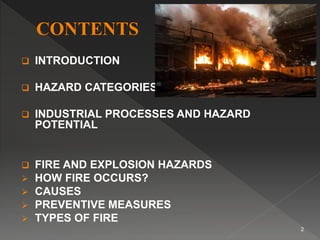
 HAZARD CATEGORIES
 INDUSTRIAL PROCESSES AND HAZARD
POTENTIAL
 FIRE AND EXPLOSION HAZARDS
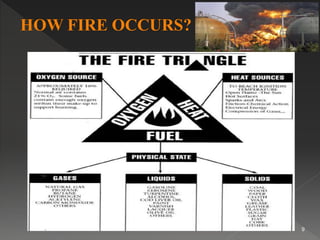
 HOW FIRE OCCURS?
 CAUSES
 PREVENTIVE MEASURES
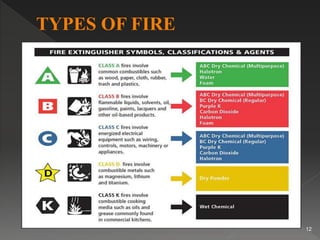
 TYPES OF FIRE
2
 MECHANICAL HAZARDS
 CAUSES
 PREVENTIVE MEASURES
 ELECTRICAL HAZARDS
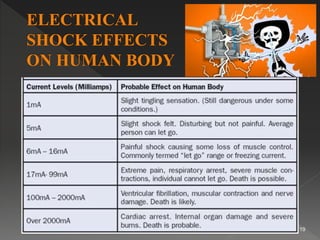
 ELECTRICAL SHOCK EFFECTS ON HUMAN BODY
 CAUSES
 PREVENTIVE MEASURES
 THERMAL HAZARDS
 CAUSES
 PREVENTIVE MEASURES
 PROCESS HAZARDS
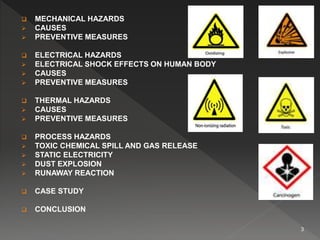
 TOXIC CHEMICAL SPILL AND GAS RELEASE
 STATIC ELECTRICITY
 DUST EXPLOSION
 RUNAWAY REACTION
 CASE STUDY
 CONCLUSION
3
 HAZARD
 it is a situation that posses a level of threat to life,
health, property or environment. It is a term
associated with a substance that is likelihood to cause
an injury in a given situation.
 INDUSTRIAL HAZARD
 It may be defined as any condition produced by
industries that may cause injury or death to personnel
or loss of product or property.
 Industrial hazards are threats to people and life-
support systems that arise from the mass production
of goods and services.
 Toxic and corrosive chemicals, fire, explosions and
personnel falling into accidents are the major health
and safety hazards encountered in the operations of
chemical and pharmaceutical related industries.
4
 Industrial processes are procedures involving
chemical, physical, electrical or mechanical
steps to aid in the manufacturing of an item or
items, usually carried out on a very large scale.
 The pharmaceutical manufacturing process is
typically made up of a combination of specific
unit processes chosen according to the
physical and chemical characteristics of the
active pharmaceutical ingredient.
 Potential means having or showing the capacity
to develop into something in the future.
5
 Fire and explosion Hazards
 Electrical Hazards
 Mechanical Hazards
 Thermal Hazards
 Process Hazards
 Dust Hazards
 Physical Hazards (noise, vibration, heat, cold,
pressure, radiation, fibres.)
 Chemical Hazards (flammable/explosive materials,
toxics, sensitising agents)
 Biological Hazards (dust, pathogens)
 Psychological Hazards (work place practices &
systems, payment systems)
6
 FIRE
• Fire is a process involving rapid oxidation at elevated
temperatures accompanied by the evolution of heated gaseous
products of combustion, and the emission of visible and invisible
radiation.
• In other words we can explain as : Fire is a very rapid chemical
reaction between oxygen and a combustible material, which
results in the release of heat, light, flames, and smoke.
 EXPLOSION
• An explosion is defined as a very rapid release of high-pressure
gas into the environment. The energy from this very rapid release
of the high-pressure gas is dissipated in the form of a shock
wave.
• Explosions can be classified as physical, a balloon bursting, as
physical and/or chemical, a boiler explosion, or a chemical
reaction of a gas/particle mixture.
7
8
https://www.hindustantimes.com/india-
news/chemical-factory-near-mumbai-
catches-fire-explosions-fan-blaze/story-
43G83VZhi1b73lI23uUwoO.html
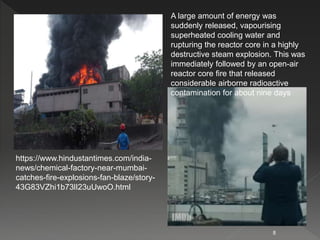
A large amount of energy was
suddenly released, vapourising
superheated cooling water and
rupturing the reactor core in a highly
destructive steam explosion. This was
immediately followed by an open-air
reactor core fire that released
considerable airborne radioactive
contamination for about nine days
9
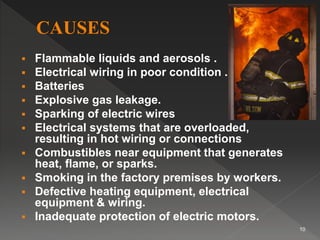
 Flammable liquids and aerosols .
 Electrical wiring in poor condition .
 Batteries
 Explosive gas leakage.
 Sparking of electric wires
 Electrical systems that are overloaded,
resulting in hot wiring or connections
 Combustibles near equipment that generates
heat, flame, or sparks.
 Smoking in the factory premises by workers.
 Defective heating equipment, electrical
equipment & wiring.
 Inadequate protection of electric motors.
10
 Not exceeding the maximum occupancy within any part of the building.
 Maintaining proper fire exits and proper exit signage (e.g., exit signs
pointing to them that can function in a power failure).
 Prohibiting flammable materials in certain areas of the facility.
 Each and every section of the industry should have fire extinguisher .
 Make sure that all employees are familiar with fire extinguisher.
 Well planned design and layout
 Proper ventilated systems
 Proper training of personnel
 Proper maintenance of surroundings
 Prohibition of smoking in manufacturing areas.
 Automatic sprinklers
 Don’t wear nylon cloths at work place
 Equipment should design to meet the specifications & code of
recognized authorities, such as ISA, API &ASME
 The design & construction of pressure vessels & storage tanks should
follow API & ASME codes.
 use of fire extinguishers, alarms ,sensors, detectors , fire fighting
equipment, Sprinkler systems
11
12
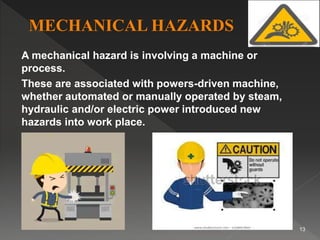
A mechanical hazard is involving a machine or
process.
These are associated with powers-driven machine,
whether automated or manually operated by steam,
hydraulic and/or electric power introduced new
hazards into work place.
13
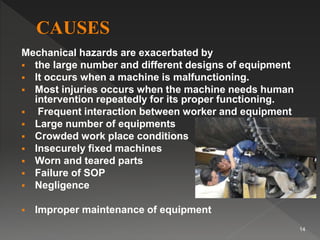
Mechanical hazards are exacerbated by
 the large number and different designs of equipment
 It occurs when a machine is malfunctioning.
 Most injuries occurs when the machine needs human
intervention repeatedly for its proper functioning.
 Frequent interaction between worker and equipment
 Large number of equipments
 Crowded work place conditions
 Insecurely fixed machines
 Worn and teared parts
 Failure of SOP
 Negligence
 Improper maintenance of equipment
14
Mechanical hazards can be reduced by the application of appropriate
safeguards, But the Safeguards must meet these minimum
requirements:
 PREVENT CONTACT: The safeguard must prevent hands, arms, or
any part of a worker's body from making contact with dangerous
moving parts.
 SECURE: Workers should not be able to easily remove with the
safeguard. Guards and safety devices should be made of durable
material that will withstand the conditions of normal use.
 PROTECT FROM FALLING OBJECTS: The safeguard should
ensure that no objects can fall into moving parts. A small tool
which is dropped into a cycling machine could easily become a
projectile that could strike and injure someone.
 CREATE NO NEW HAZARDS: The edges of guards, for instance,
should be rolled or rounded in such a way that they eliminate
sharp edges to prevent unwanted injuries.
 CREATE NO INTERFERENCE: Proper safeguarding can actually
enhance efficiency, since workers will not be afraid of injuries
then.
15
 ALLOW SAFE LUBRICATION: If possible, one should be able to
lubricate the machine without removing the safeguards.
Locating oil reservoirs outside of the guard, with a line leading
to the lubrication point, will reduce the need for the operator or
maintenance worker to enter the hazardous area.
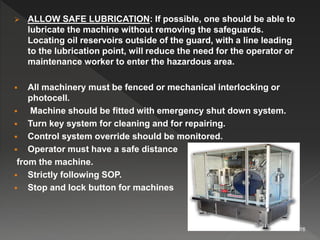
 All machinery must be fenced or mechanical interlocking or
photocell.
 Machine should be fitted with emergency shut down system.
 Turn key system for cleaning and for repairing.
 Control system override should be monitored.
 Operator must have a safe distance
from the machine.
 Strictly following SOP.
 Stop and lock button for machines
16
 Lock Out, Tag Out - LOTO
 It is a safety procedure used in industry and research settings to ensure
that dangerous machines are properly shut off and not able to be started
up again prior to the completion of maintenance or repair work.
 It requires that hazardous energy sources be "isolated and rendered
inoperative" before work is started on the equipment in question.
 The isolated power sources are then locked and a tag is placed on the
lock identifying the worker who placed it. The worker then holds the key
for the lock, ensuring that only he or she can remove the lock and start
the machine.
 This prevents accidental startup of a machine while it is in a hazardous
state or while a worker is in direct contact with it.
 GROUP LOCKOUT
 When two or more people are working on the same or different parts of a
larger overall system, there must be multiple holes to lock the device. To
expand the number of available holes, the lockout device is secured with
a folding scissors clamp that has many pairs of padlock holes capable of
keeping it closed. Each worker applies their own padlock to the clamp.
The locked-out machinery cannot be activated until all workers have
removed their padlocks from the clamp.
17
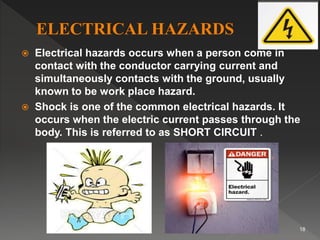
 Electrical hazards occurs when a person come in
contact with the conductor carrying current and
simultaneously contacts with the ground, usually
known to be work place hazard.
 Shock is one of the common electrical hazards. It
occurs when the electric current passes through the
body. This is referred to as SHORT CIRCUIT .
18
19
 The improper use of machinery or apparatus
 The improper use of electrical outlets
 The improper use of electrical equipment, such
as cables and power cords.
 The improper maintenance of apparatus,
outlets, and electrical equipment .
 An overloaded circuit .
 The improper joints of two wires.
 Contact with power lines.
 Path to ground missing or discontinuous.
 wiring faults and improperly wired equipments.
 Sparking at loose connection
20
 Design a safer system
 Implement a safe electrical work program
 Observe work practice
 Use protective equipment
 Use warning labels (Indication of danger sign at every
high voltage terminal)
 Recheck the equipment everyday
 Overhead electrical wire should have extra care
 Proper training to workers
 High voltage equipments should be properly enclosed.
 Insulation, guarding , grounding, electrical protective
devices.
 Worker should avoid working with the equipment in
wet clothes and shoes.
 Water supply should be far away from electrical
circuits.
21
 All workplace has an electrical safety policy created
by authority.
The following items should be included in the electrical
safety policy:
 Power equipment should be plugged into wall
receptacles with power switches in the off position
 Electrical equipment should be unplugged by
grasping the plug and pulling.
 Never pull or jerk the cord to unplug the equipment.
Frayed, cracked or exposed wiring on equipment
cords must be corrected.
 Also check for defective cord clamps at locations
where the power cord enters the equipment or the
attachment plug.
 Temporary or permanent storage of materials must not
be allowed within 3 feet of an electrical equipment.
 Any electrical equipment causing shocks or which has
high leakage potential must be tagged with a
DANGER—DO NOT USE label or equivalent.
22
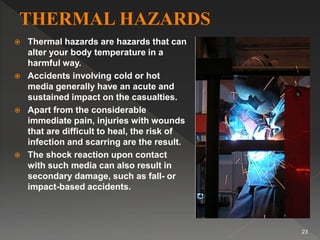
 Thermal hazards are hazards that can
alter your body temperature in a
harmful way.
 Accidents involving cold or hot
media generally have an acute and
sustained impact on the casualties.
 Apart from the considerable
immediate pain, injuries with wounds
that are difficult to heal, the risk of
infection and scarring are the result.
 The shock reaction upon contact
with such media can also result in
secondary damage, such as fall- or
impact-based accidents.
23
FOR EXAMPLE: THE STERILIZATION ROOM POSES A THERMAL
HAZARD
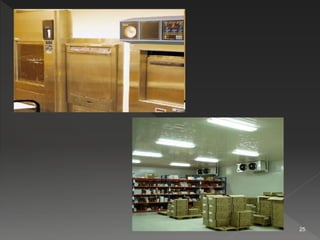
 The hazard here is that temperatures rise during sterilization;
the room gets hot. Staying in this room for extended periods
of time could lead to hyperthermia which is an elevated body
temperature.
 The sterilization room is located on the same hallway as some
of the storage areas for the labs.
 Some supplies and materials for the labs have to be stored at
very low temperatures such as -20 degrees and -80 degrees
Celsius. These freezers represent a thermal hazard as well.
 Thermal does refer to heat, but in this case it refers to your
body heat. Anything that could cause harmful alterations in
your body heat is considered a thermal hazard.
 So exposure to the extremely cold temperatures in the
freezers may cause a drastic decrease in body heat resulting
in hypothermia (notice the difference between 'hyperthermia'
(too hot) and 'hypothermia' (too cold).
24
25
The majority of incidents are caused by
either
 equipment failure (e.g. loss of cooling or
agitation)
 human error (e.g.mischarging and over
heating)
 these incidents can occur either under
standard processing conditions or by
deviation from the standard conditions.
26
 Schedule maintenance and repair jobs in hot areas
for cooler months.
 Schedule hot jobs for the cooler parts of the day.
 Acclimatize workers by exposing them for
progressively longer periods to hot work
environments.
 Avoid non-breathable synthetic clothing.
 Monitor all workers, especially those at increased
risk of heat stress.
 Provide heat stress training that covers: worker
risk, prevention, symptoms, the importance of
monitoring oneself and coworkers for symptoms,
treatment, and personal protective equipment.
27
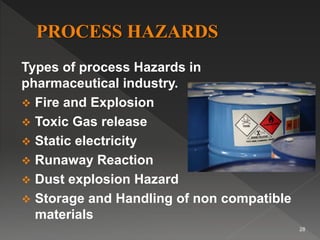
Types of process Hazards in
pharmaceutical industry.
 Fire and Explosion
 Toxic Gas release
 Static electricity
 Runaway Reaction
 Dust explosion Hazard
 Storage and Handling of non compatible
materials
28
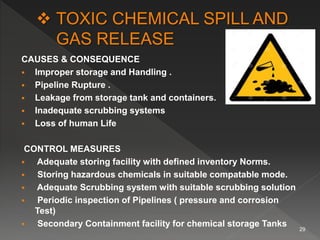
CAUSES & CONSEQUENCE
 Improper storage and Handling .
 Pipeline Rupture .
 Leakage from storage tank and containers.
 Inadequate scrubbing systems
 Loss of human Life
CONTROL MEASURES
 Adequate storing facility with defined inventory Norms.
 Storing hazardous chemicals in suitable compatable mode.
 Adequate Scrubbing system with suitable scrubbing solution
 Periodic inspection of Pipelines ( pressure and corrosion
Test)
 Secondary Containment facility for chemical storage Tanks
29
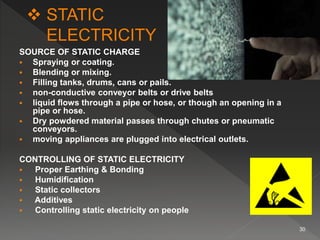
SOURCE OF STATIC CHARGE
 Spraying or coating.
 Blending or mixing.
 Filling tanks, drums, cans or pails.
 non-conductive conveyor belts or drive belts
 liquid flows through a pipe or hose, or though an opening in a
pipe or hose.
 Dry powdered material passes through chutes or pneumatic
conveyors.
 moving appliances are plugged into electrical outlets.
CONTROLLING OF STATIC ELECTRICITY
 Proper Earthing & Bonding
 Humidification
 Static collectors
 Additives
 Controlling static electricity on people
30
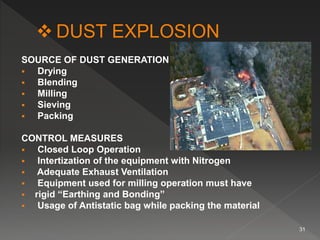
SOURCE OF DUST GENERATION
 Drying
 Blending
 Milling
 Sieving
 Packing
CONTROL MEASURES
 Closed Loop Operation
 Intertization of the equipment with Nitrogen
 Adequate Exhaust Ventilation
 Equipment used for milling operation must have
 rigid “Earthing and Bonding”
 Usage of Antistatic bag while packing the material
31
CAUSES
 improper addition of the Raw material
 Failure of cooling systems
 Vigorous Agitation
 Contamination
CONTROL MEASURES
 Control addition of raw materials by procedural
control
 Adopting Best Engineering practices
 Keep ready for Suitable inhibitor
 Complete process safety study should be done
before starting commercial process.
32
 SITUATION: AG Machining supplies complex assemblies to
companies in the aerospace, medical device, pharmaceutical,
technology, and industrial controls industries. Their precision
machining, sub-assembly fabrication, powder coating, and
production engineering operations have a high potential to
introduce safety hazards.
 CHALLENGE: AG Machining is a family-owned company where
management wears several hats. They had created a safety
program in-house, however they were concerned that they were
not implementing adequate precautions to protect employees and
satisfy OSHA and EPA requirements.
 SOLUTION: In 2005, AG Machining hired Hellman & Associates
(H&A) to perform a Compliance Action Assessment and signed
up for the AssuredCompliance™ program. To begin with, H&A
wrote/revised the health and safety manuals to apply to site- and
job-specific hazards as well as regulatory requirements. H&A then
developed training materials and implemented a compliance
calendar to keep all training and tasks current. In response to a
specific OSHA inspection, H&A implemented a safety program for
press brakes that complied with OSHA’s directive. H&A also
developed a lockout-tagout program and specific procedures for
more than 80 equipment types.
33
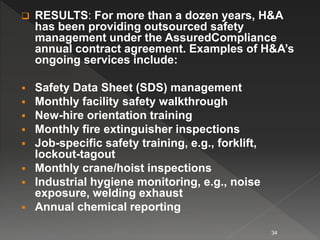
 RESULTS: For more than a dozen years, H&A
has been providing outsourced safety
management under the AssuredCompliance
annual contract agreement. Examples of H&A’s
ongoing services include:
 Safety Data Sheet (SDS) management
 Monthly facility safety walkthrough
 New-hire orientation training
 Monthly fire extinguisher inspections
 Job-specific safety training, e.g., forklift,
lockout-tagout
 Monthly crane/hoist inspections
 Industrial hygiene monitoring, e.g., noise
exposure, welding exhaust
 Annual chemical reporting
34
• Knowing and understanding the risk of
hazardous facility and hazard release are the
most important segments of an optimal
pharmaceutical safety management.
• An effective hazard and risk assessment
allows developing an incident action plan
and implement strategies and tactics.
• The bulk of societal costs, however, are
actually being borne by the workers
themselves. There is an urgent need of
rethinking the production process by taking
into account the health impact on workers
from the very beginning.
35
 O. G. bhusnure1*, R.B. dongare1, S.B. gholve1, P.S. giram2,
chemical hazards and safety management in pharmaceutical
industry, journal of pharmacy research 12(03) · april 2018
 Princy agarwal*, Anju goyal, Rajat vaishnav, chemical hazards in
pharmaceutical industry: an overview, asian journal of
pharmaceutical and clinical research
 Shabaninejad h, Madani h, Amineh za, Doostzadeh e. a framework
for evaluation of pharmaceutical industry development in
developing countries: evidence from iran. asian j pharm clin res
2016;9:50-4.
 Gupta ak, Nair ss. chemical (industrial) disaster management,
trainer’s module. new delhi: national institute of disaster
management (ministry of home affairs); 2012.
 Occupational safety and health administration (wosh specialist
training supplemental module). washington, dc (us): united states
department of labor.
 Dikshith ts. hazardous chemicals: safety management and global
regulations. boca raton, florida (us): crc press (taylor and francis
group); c2013.
 https://www.youtube.com/watch?v=m-c97PPA0Zo
 https://www.ehscompliance.com/
36
THANK YOU
37

FIRE AND EXPLOSION (Industrial Hazards).pptx

  • 1.
  • 2.
     INTRODUCTION  HAZARDCATEGORIES  INDUSTRIAL PROCESSES AND HAZARD POTENTIAL  FIRE AND EXPLOSION HAZARDS  HOW FIRE OCCURS?  CAUSES  PREVENTIVE MEASURES  TYPES OF FIRE 2
  • 3.
     MECHANICAL HAZARDS CAUSES  PREVENTIVE MEASURES  ELECTRICAL HAZARDS  ELECTRICAL SHOCK EFFECTS ON HUMAN BODY  CAUSES  PREVENTIVE MEASURES  THERMAL HAZARDS  CAUSES  PREVENTIVE MEASURES  PROCESS HAZARDS  TOXIC CHEMICAL SPILL AND GAS RELEASE  STATIC ELECTRICITY  DUST EXPLOSION  RUNAWAY REACTION  CASE STUDY  CONCLUSION 3
  • 4.
     HAZARD  itis a situation that posses a level of threat to life, health, property or environment. It is a term associated with a substance that is likelihood to cause an injury in a given situation.  INDUSTRIAL HAZARD  It may be defined as any condition produced by industries that may cause injury or death to personnel or loss of product or property.  Industrial hazards are threats to people and life- support systems that arise from the mass production of goods and services.  Toxic and corrosive chemicals, fire, explosions and personnel falling into accidents are the major health and safety hazards encountered in the operations of chemical and pharmaceutical related industries. 4
  • 5.
     Industrial processesare procedures involving chemical, physical, electrical or mechanical steps to aid in the manufacturing of an item or items, usually carried out on a very large scale.  The pharmaceutical manufacturing process is typically made up of a combination of specific unit processes chosen according to the physical and chemical characteristics of the active pharmaceutical ingredient.  Potential means having or showing the capacity to develop into something in the future. 5
  • 6.
     Fire andexplosion Hazards  Electrical Hazards  Mechanical Hazards  Thermal Hazards  Process Hazards  Dust Hazards  Physical Hazards (noise, vibration, heat, cold, pressure, radiation, fibres.)  Chemical Hazards (flammable/explosive materials, toxics, sensitising agents)  Biological Hazards (dust, pathogens)  Psychological Hazards (work place practices & systems, payment systems) 6
  • 7.
     FIRE • Fireis a process involving rapid oxidation at elevated temperatures accompanied by the evolution of heated gaseous products of combustion, and the emission of visible and invisible radiation. • In other words we can explain as : Fire is a very rapid chemical reaction between oxygen and a combustible material, which results in the release of heat, light, flames, and smoke.  EXPLOSION • An explosion is defined as a very rapid release of high-pressure gas into the environment. The energy from this very rapid release of the high-pressure gas is dissipated in the form of a shock wave. • Explosions can be classified as physical, a balloon bursting, as physical and/or chemical, a boiler explosion, or a chemical reaction of a gas/particle mixture. 7
  • 8.
    8 https://www.hindustantimes.com/india- news/chemical-factory-near-mumbai- catches-fire-explosions-fan-blaze/story- 43G83VZhi1b73lI23uUwoO.html A large amountof energy was suddenly released, vapourising superheated cooling water and rupturing the reactor core in a highly destructive steam explosion. This was immediately followed by an open-air reactor core fire that released considerable airborne radioactive contamination for about nine days
  • 9.
  • 10.
     Flammable liquidsand aerosols .  Electrical wiring in poor condition .  Batteries  Explosive gas leakage.  Sparking of electric wires  Electrical systems that are overloaded, resulting in hot wiring or connections  Combustibles near equipment that generates heat, flame, or sparks.  Smoking in the factory premises by workers.  Defective heating equipment, electrical equipment & wiring.  Inadequate protection of electric motors. 10
  • 11.
     Not exceedingthe maximum occupancy within any part of the building.  Maintaining proper fire exits and proper exit signage (e.g., exit signs pointing to them that can function in a power failure).  Prohibiting flammable materials in certain areas of the facility.  Each and every section of the industry should have fire extinguisher .  Make sure that all employees are familiar with fire extinguisher.  Well planned design and layout  Proper ventilated systems  Proper training of personnel  Proper maintenance of surroundings  Prohibition of smoking in manufacturing areas.  Automatic sprinklers  Don’t wear nylon cloths at work place  Equipment should design to meet the specifications & code of recognized authorities, such as ISA, API &ASME  The design & construction of pressure vessels & storage tanks should follow API & ASME codes.  use of fire extinguishers, alarms ,sensors, detectors , fire fighting equipment, Sprinkler systems 11
  • 12.
  • 13.
    A mechanical hazardis involving a machine or process. These are associated with powers-driven machine, whether automated or manually operated by steam, hydraulic and/or electric power introduced new hazards into work place. 13
  • 14.
    Mechanical hazards areexacerbated by  the large number and different designs of equipment  It occurs when a machine is malfunctioning.  Most injuries occurs when the machine needs human intervention repeatedly for its proper functioning.  Frequent interaction between worker and equipment  Large number of equipments  Crowded work place conditions  Insecurely fixed machines  Worn and teared parts  Failure of SOP  Negligence  Improper maintenance of equipment 14
  • 15.
    Mechanical hazards canbe reduced by the application of appropriate safeguards, But the Safeguards must meet these minimum requirements:  PREVENT CONTACT: The safeguard must prevent hands, arms, or any part of a worker's body from making contact with dangerous moving parts.  SECURE: Workers should not be able to easily remove with the safeguard. Guards and safety devices should be made of durable material that will withstand the conditions of normal use.  PROTECT FROM FALLING OBJECTS: The safeguard should ensure that no objects can fall into moving parts. A small tool which is dropped into a cycling machine could easily become a projectile that could strike and injure someone.  CREATE NO NEW HAZARDS: The edges of guards, for instance, should be rolled or rounded in such a way that they eliminate sharp edges to prevent unwanted injuries.  CREATE NO INTERFERENCE: Proper safeguarding can actually enhance efficiency, since workers will not be afraid of injuries then. 15
  • 16.
     ALLOW SAFELUBRICATION: If possible, one should be able to lubricate the machine without removing the safeguards. Locating oil reservoirs outside of the guard, with a line leading to the lubrication point, will reduce the need for the operator or maintenance worker to enter the hazardous area.  All machinery must be fenced or mechanical interlocking or photocell.  Machine should be fitted with emergency shut down system.  Turn key system for cleaning and for repairing.  Control system override should be monitored.  Operator must have a safe distance from the machine.  Strictly following SOP.  Stop and lock button for machines 16
  • 17.
     Lock Out,Tag Out - LOTO  It is a safety procedure used in industry and research settings to ensure that dangerous machines are properly shut off and not able to be started up again prior to the completion of maintenance or repair work.  It requires that hazardous energy sources be "isolated and rendered inoperative" before work is started on the equipment in question.  The isolated power sources are then locked and a tag is placed on the lock identifying the worker who placed it. The worker then holds the key for the lock, ensuring that only he or she can remove the lock and start the machine.  This prevents accidental startup of a machine while it is in a hazardous state or while a worker is in direct contact with it.  GROUP LOCKOUT  When two or more people are working on the same or different parts of a larger overall system, there must be multiple holes to lock the device. To expand the number of available holes, the lockout device is secured with a folding scissors clamp that has many pairs of padlock holes capable of keeping it closed. Each worker applies their own padlock to the clamp. The locked-out machinery cannot be activated until all workers have removed their padlocks from the clamp. 17
  • 18.
     Electrical hazardsoccurs when a person come in contact with the conductor carrying current and simultaneously contacts with the ground, usually known to be work place hazard.  Shock is one of the common electrical hazards. It occurs when the electric current passes through the body. This is referred to as SHORT CIRCUIT . 18
  • 19.
  • 20.
     The improperuse of machinery or apparatus  The improper use of electrical outlets  The improper use of electrical equipment, such as cables and power cords.  The improper maintenance of apparatus, outlets, and electrical equipment .  An overloaded circuit .  The improper joints of two wires.  Contact with power lines.  Path to ground missing or discontinuous.  wiring faults and improperly wired equipments.  Sparking at loose connection 20
  • 21.
     Design asafer system  Implement a safe electrical work program  Observe work practice  Use protective equipment  Use warning labels (Indication of danger sign at every high voltage terminal)  Recheck the equipment everyday  Overhead electrical wire should have extra care  Proper training to workers  High voltage equipments should be properly enclosed.  Insulation, guarding , grounding, electrical protective devices.  Worker should avoid working with the equipment in wet clothes and shoes.  Water supply should be far away from electrical circuits. 21
  • 22.
     All workplacehas an electrical safety policy created by authority. The following items should be included in the electrical safety policy:  Power equipment should be plugged into wall receptacles with power switches in the off position  Electrical equipment should be unplugged by grasping the plug and pulling.  Never pull or jerk the cord to unplug the equipment. Frayed, cracked or exposed wiring on equipment cords must be corrected.  Also check for defective cord clamps at locations where the power cord enters the equipment or the attachment plug.  Temporary or permanent storage of materials must not be allowed within 3 feet of an electrical equipment.  Any electrical equipment causing shocks or which has high leakage potential must be tagged with a DANGER—DO NOT USE label or equivalent. 22
  • 23.
     Thermal hazardsare hazards that can alter your body temperature in a harmful way.  Accidents involving cold or hot media generally have an acute and sustained impact on the casualties.  Apart from the considerable immediate pain, injuries with wounds that are difficult to heal, the risk of infection and scarring are the result.  The shock reaction upon contact with such media can also result in secondary damage, such as fall- or impact-based accidents. 23
  • 24.
    FOR EXAMPLE: THESTERILIZATION ROOM POSES A THERMAL HAZARD  The hazard here is that temperatures rise during sterilization; the room gets hot. Staying in this room for extended periods of time could lead to hyperthermia which is an elevated body temperature.  The sterilization room is located on the same hallway as some of the storage areas for the labs.  Some supplies and materials for the labs have to be stored at very low temperatures such as -20 degrees and -80 degrees Celsius. These freezers represent a thermal hazard as well.  Thermal does refer to heat, but in this case it refers to your body heat. Anything that could cause harmful alterations in your body heat is considered a thermal hazard.  So exposure to the extremely cold temperatures in the freezers may cause a drastic decrease in body heat resulting in hypothermia (notice the difference between 'hyperthermia' (too hot) and 'hypothermia' (too cold). 24
  • 25.
  • 26.
    The majority ofincidents are caused by either  equipment failure (e.g. loss of cooling or agitation)  human error (e.g.mischarging and over heating)  these incidents can occur either under standard processing conditions or by deviation from the standard conditions. 26
  • 27.
     Schedule maintenanceand repair jobs in hot areas for cooler months.  Schedule hot jobs for the cooler parts of the day.  Acclimatize workers by exposing them for progressively longer periods to hot work environments.  Avoid non-breathable synthetic clothing.  Monitor all workers, especially those at increased risk of heat stress.  Provide heat stress training that covers: worker risk, prevention, symptoms, the importance of monitoring oneself and coworkers for symptoms, treatment, and personal protective equipment. 27
  • 28.
    Types of processHazards in pharmaceutical industry.  Fire and Explosion  Toxic Gas release  Static electricity  Runaway Reaction  Dust explosion Hazard  Storage and Handling of non compatible materials 28
  • 29.
    CAUSES & CONSEQUENCE Improper storage and Handling .  Pipeline Rupture .  Leakage from storage tank and containers.  Inadequate scrubbing systems  Loss of human Life CONTROL MEASURES  Adequate storing facility with defined inventory Norms.  Storing hazardous chemicals in suitable compatable mode.  Adequate Scrubbing system with suitable scrubbing solution  Periodic inspection of Pipelines ( pressure and corrosion Test)  Secondary Containment facility for chemical storage Tanks 29
  • 30.
    SOURCE OF STATICCHARGE  Spraying or coating.  Blending or mixing.  Filling tanks, drums, cans or pails.  non-conductive conveyor belts or drive belts  liquid flows through a pipe or hose, or though an opening in a pipe or hose.  Dry powdered material passes through chutes or pneumatic conveyors.  moving appliances are plugged into electrical outlets. CONTROLLING OF STATIC ELECTRICITY  Proper Earthing & Bonding  Humidification  Static collectors  Additives  Controlling static electricity on people 30
  • 31.
    SOURCE OF DUSTGENERATION  Drying  Blending  Milling  Sieving  Packing CONTROL MEASURES  Closed Loop Operation  Intertization of the equipment with Nitrogen  Adequate Exhaust Ventilation  Equipment used for milling operation must have  rigid “Earthing and Bonding”  Usage of Antistatic bag while packing the material 31
  • 32.
    CAUSES  improper additionof the Raw material  Failure of cooling systems  Vigorous Agitation  Contamination CONTROL MEASURES  Control addition of raw materials by procedural control  Adopting Best Engineering practices  Keep ready for Suitable inhibitor  Complete process safety study should be done before starting commercial process. 32
  • 33.
     SITUATION: AGMachining supplies complex assemblies to companies in the aerospace, medical device, pharmaceutical, technology, and industrial controls industries. Their precision machining, sub-assembly fabrication, powder coating, and production engineering operations have a high potential to introduce safety hazards.  CHALLENGE: AG Machining is a family-owned company where management wears several hats. They had created a safety program in-house, however they were concerned that they were not implementing adequate precautions to protect employees and satisfy OSHA and EPA requirements.  SOLUTION: In 2005, AG Machining hired Hellman & Associates (H&A) to perform a Compliance Action Assessment and signed up for the AssuredCompliance™ program. To begin with, H&A wrote/revised the health and safety manuals to apply to site- and job-specific hazards as well as regulatory requirements. H&A then developed training materials and implemented a compliance calendar to keep all training and tasks current. In response to a specific OSHA inspection, H&A implemented a safety program for press brakes that complied with OSHA’s directive. H&A also developed a lockout-tagout program and specific procedures for more than 80 equipment types. 33
  • 34.
     RESULTS: Formore than a dozen years, H&A has been providing outsourced safety management under the AssuredCompliance annual contract agreement. Examples of H&A’s ongoing services include:  Safety Data Sheet (SDS) management  Monthly facility safety walkthrough  New-hire orientation training  Monthly fire extinguisher inspections  Job-specific safety training, e.g., forklift, lockout-tagout  Monthly crane/hoist inspections  Industrial hygiene monitoring, e.g., noise exposure, welding exhaust  Annual chemical reporting 34
  • 35.
    • Knowing andunderstanding the risk of hazardous facility and hazard release are the most important segments of an optimal pharmaceutical safety management. • An effective hazard and risk assessment allows developing an incident action plan and implement strategies and tactics. • The bulk of societal costs, however, are actually being borne by the workers themselves. There is an urgent need of rethinking the production process by taking into account the health impact on workers from the very beginning. 35
  • 36.
     O. G.bhusnure1*, R.B. dongare1, S.B. gholve1, P.S. giram2, chemical hazards and safety management in pharmaceutical industry, journal of pharmacy research 12(03) · april 2018  Princy agarwal*, Anju goyal, Rajat vaishnav, chemical hazards in pharmaceutical industry: an overview, asian journal of pharmaceutical and clinical research  Shabaninejad h, Madani h, Amineh za, Doostzadeh e. a framework for evaluation of pharmaceutical industry development in developing countries: evidence from iran. asian j pharm clin res 2016;9:50-4.  Gupta ak, Nair ss. chemical (industrial) disaster management, trainer’s module. new delhi: national institute of disaster management (ministry of home affairs); 2012.  Occupational safety and health administration (wosh specialist training supplemental module). washington, dc (us): united states department of labor.  Dikshith ts. hazardous chemicals: safety management and global regulations. boca raton, florida (us): crc press (taylor and francis group); c2013.  https://www.youtube.com/watch?v=m-c97PPA0Zo  https://www.ehscompliance.com/ 36
  • 37.

Editor's Notes

  • #32 A dust explosion is the rapid combustion of fine particles suspended in the air within an enclosed location. Dust explosions can occur where any dispersed powdered combustible material is present in high-enough concentrations in the atmosphere or other oxidizing gaseous medium, such as pure oxygen.
  • #33 Runaway Reactions. A thermally unstable reaction system which exhibits an uncontrolled accelerating rate of reaction leading to rapid increases in temperature and pressure.