www.CareerSafeOnline.com
Electrical Safety
www.CareerSafeOnline.com
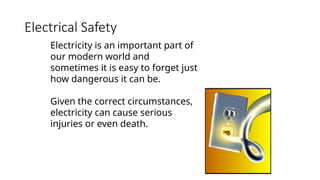
Electricity is an important part of
our modern world and
sometimes it is easy to forget just
how dangerous it can be.
Given the correct circumstances,
electricity can cause serious
injuries or even death.
Electrical Safety
www.CareerSafeOnline.com
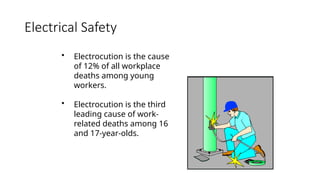
• Electrocution is the cause
of 12% of all workplace
deaths among young
workers.
• Electrocution is the third
leading cause of work-
related deaths among 16
and 17-year-olds.
Electrical Safety
www.CareerSafeOnline.com
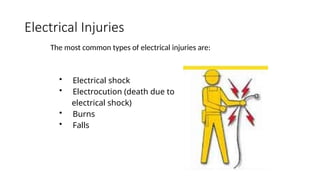
The most common types of electrical injuries are:
• Electrical shock
• Electrocution (death due to
electrical shock)
• Burns
• Falls
Electrical Injuries
www.CareerSafeOnline.com
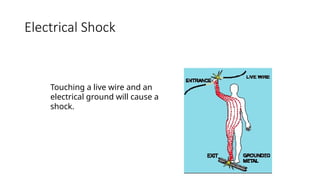
Touching a live wire and an
electrical ground will cause a
shock.
Electrical Shock
www.CareerSafeOnline.com
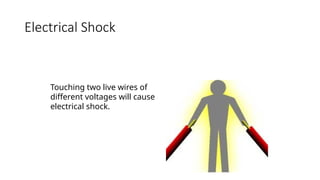
Touching two live wires of
different voltages will cause
electrical shock.
Electrical Shock
www.CareerSafeOnline.com
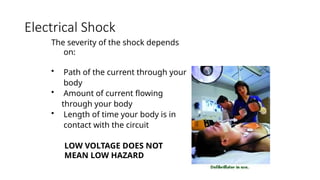
The severity of the shock depends
on:
• Path of the current through your
body
• Amount of current flowing
through your body
• Length of time your body is in
contact with the circuit
Electrical Shock
LOW VOLTAGE DOES NOT
MEAN LOW HAZARD
www.CareerSafeOnline.com
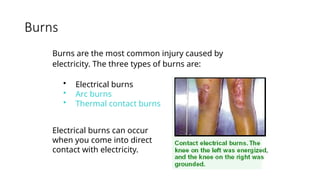
Burns are the most common injury caused by
electricity. The three types of burns are:
Burns
• Electrical burns
• Arc burns
• Thermal contact burns
Electrical burns can occur
when you come into direct
contact with electricity.
www.CareerSafeOnline.com
An arc occurs when there is a
gap between conductors and
current travels through the air.
Burns
•Electrical burns
•Arc burns
•Thermal contact burns
www.CareerSafeOnline.com
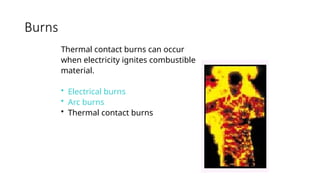
Thermal contact burns can occur
when electricity ignites combustible
material.
• Electrical burns
• Arc burns
• Thermal contact burns
Burns
www.CareerSafeOnline.com
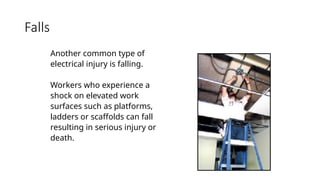
Another common type of
electrical injury is falling.
Workers who experience a
shock on elevated work
surfaces such as platforms,
ladders or scaffolds can fall
resulting in serious injury or
death.
Falls
www.CareerSafeOnline.com
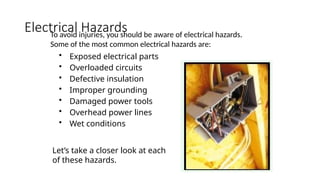
To avoid injuries, you should be aware of electrical hazards.
Some of the most common electrical hazards are:
• Exposed electrical parts
• Overloaded circuits
• Defective insulation
• Improper grounding
• Damaged power tools
• Overhead power lines
• Wet conditions
Electrical Hazards
Let’s take a closer look at each
of these hazards.
www.CareerSafeOnline.com
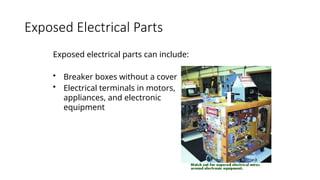
Exposed electrical parts can include:
• Breaker boxes without a cover
• Electrical terminals in motors,
appliances, and electronic
equipment
Exposed Electrical Parts
www.CareerSafeOnline.com
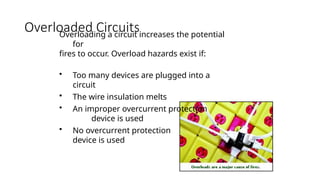
Overloading a circuit increases the potential
for
fires to occur. Overload hazards exist if:
• Too many devices are plugged into a
circuit
• The wire insulation melts
• An improper overcurrent protection
device is used
• No overcurrent protection
device is used
Overloaded Circuits
www.CareerSafeOnline.com
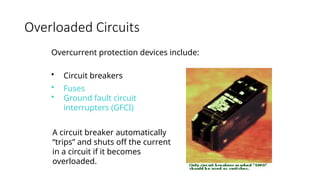
Overcurrent protection devices include:
• Circuit breakers
Overloaded Circuits
• Fuses
• Ground fault circuit
interrupters (GFCI)
A circuit breaker automatically
“trips” and shuts off the current
in a circuit if it becomes
overloaded.
www.CareerSafeOnline.com
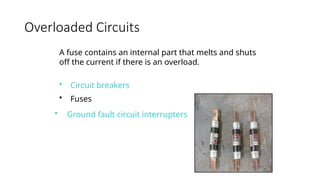
A fuse contains an internal part that melts and shuts
off the current if there is an overload.
• Circuit breakers
• Fuses
Overloaded Circuits
• Ground fault circuit interrupters
www.CareerSafeOnline.com
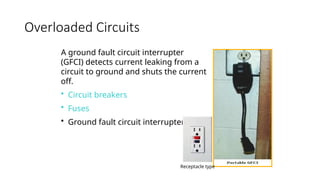
A ground fault circuit interrupter
(GFCI) detects current leaking from a
circuit to ground and shuts the current
off.
• Circuit breakers
• Fuses
• Ground fault circuit interrupters
Overloaded Circuits
Receptacle type
www.CareerSafeOnline.com
Defective Insulation
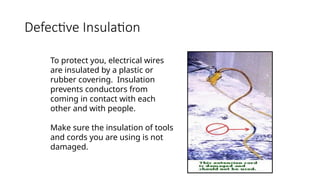
To protect you, electrical wires
are insulated by a plastic or
rubber covering. Insulation
prevents conductors from
coming in contact with each
other and with people.
Make sure the insulation of tools
and cords you are using is not
damaged.
www.CareerSafeOnline.com
Grounding
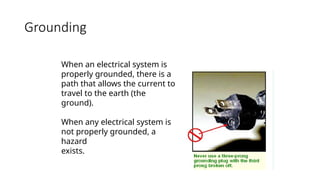
When an electrical system is
properly grounded, there is a
path that allows the current to
travel to the earth (the
ground).
When any electrical system is
not properly grounded, a
hazard
exists.
www.CareerSafeOnline.com
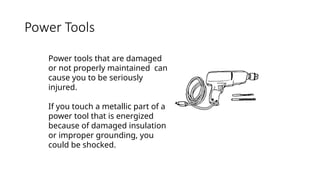
Power tools that are damaged
or not properly maintained can
cause you to be seriously
injured.
If you touch a metallic part of a
power tool that is energized
because of damaged insulation
or improper grounding, you
could be shocked.
Power Tools
www.CareerSafeOnline.com
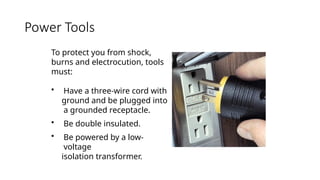
Power Tools
To protect you from shock,
burns and electrocution, tools
must:
• Have a three-wire cord with
ground and be plugged into
a grounded receptacle.
• Be double insulated.
• Be powered by a low-
voltage
isolation transformer.
www.CareerSafeOnline.com
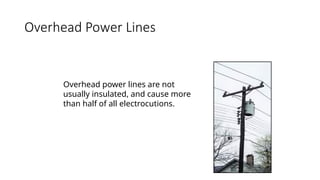
Overhead Power Lines
Overhead power lines are not
usually insulated, and cause more
than half of all electrocutions.
www.CareerSafeOnline.com
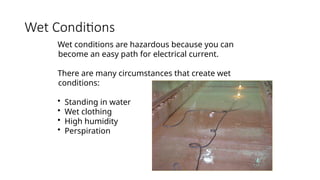
Wet Conditions
Wet conditions are hazardous because you can
become an easy path for electrical current.
There are many circumstances that create wet
conditions:
• Standing in water
• Wet clothing
• High humidity
• Perspiration
www.CareerSafeOnline.com
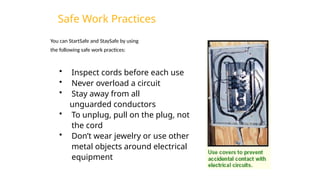
Safe Work Practices
• Inspect cords before each use
• Never overload a circuit
• Stay away from all
unguarded conductors
• To unplug, pull on the plug, not
the cord
• Don’t wear jewelry or use other
metal objects around electrical
equipment
You can StartSafe and StaySafe by using
the following safe work practices:
www.CareerSafeOnline.com
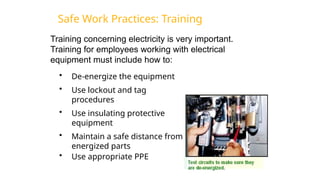
Training concerning electricity is very important.
Training for employees working with electrical
equipment must include how to:
• De-energize the equipment
• Use lockout and tag
procedures
• Use insulating protective
equipment
• Maintain a safe distance from
energized parts
• Use appropriate PPE
Safe Work Practices: Training
www.CareerSafeOnline.com
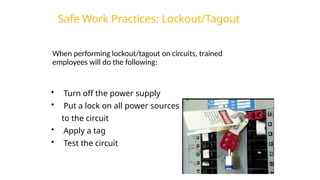
Safe Work Practices: Lockout/Tagout
• Turn off the power supply
• Put a lock on all power sources
to the circuit
• Apply a tag
• Test the circuit
When performing lockout/tagout on circuits, trained
employees will do the following:
www.CareerSafeOnline.com
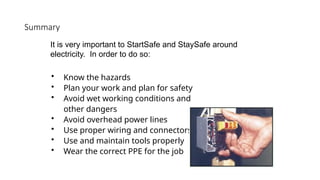
Summary
It is very important to StartSafe and StaySafe around
electricity. In order to do so:
• Know the hazards
• Plan your work and plan for safety
• Avoid wet working conditions and
other dangers
• Avoid overhead power lines
• Use proper wiring and connectors
• Use and maintain tools properly
• Wear the correct PPE for the job
28
Electrical Safety
Electrical Definitions
• Volts – standard unit of measure of electricity.
• Voltage – force of electrical current measured in
volts.
• Amps – standard unit of measure for the strength
of electrical current.
• Amperage – the strength of electrical current to
make a piece of equipment work.
29
Electrical Safety
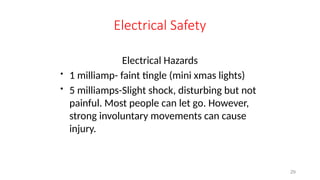
Electrical Hazards
• 1 milliamp- faint tingle (mini xmas lights)
• 5 milliamps-Slight shock, disturbing but not
painful. Most people can let go. However,
strong involuntary movements can cause
injury.
30
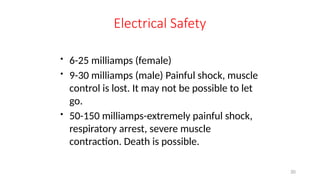
• 6-25 milliamps (female)
• 9-30 milliamps (male) Painful shock, muscle
control is lost. It may not be possible to let
go.
• 50-150 milliamps-extremely painful shock,
respiratory arrest, severe muscle
contraction. Death is possible.
Electrical Safety
31
Electrical Safety
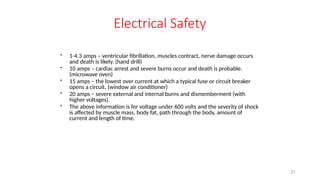
• 1-4.3 amps – ventricular fibrillation, muscles contract, nerve damage occurs
and death is likely. (hand drill)
• 10 amps – cardiac arrest and severe burns occur and death is probable.
(microwave oven)
• 15 amps – the lowest over current at which a typical fuse or circuit breaker
opens a circuit. (window air conditioner)
• 20 amps – severe external and internal burns and dismemberment (with
higher voltages).
• The above information is for voltage under 600 volts and the severity of shock
is affected by muscle mass, body fat, path through the body, amount of
current and length of time.
32
Electrical Safety
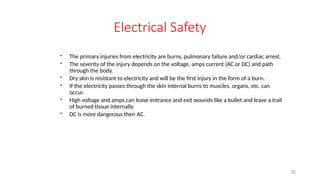
• The primary injuries from electricity are burns, pulmonary failure and/or cardiac arrest.
• The severity of the injury depends on the voltage, amps current (AC or DC) and path
through the body.
• Dry skin is resistant to electricity and will be the first injury in the form of a burn.
• If the electricity passes through the skin internal burns to muscles, organs, etc. can
occur.
• High voltage and amps can leave entrance and exit wounds like a bullet and leave a trail
of burned tissue internally.
• DC is more dangerous then AC.
33
Electrical Safety
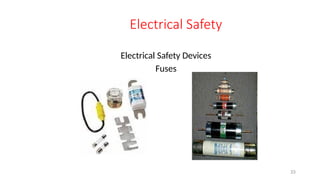
Electrical Safety Devices
Fuses
34
Electrical Safety
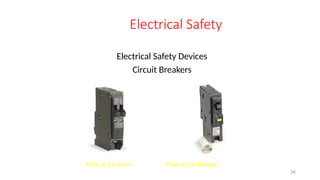
Electrical Safety Devices
Circuit Breakers
Trips at 15 amps Trips at 5 milliamps
35
Electrical Safety
• Fuses and circuit breakers are not designed to
protect you from electrical shock or electrocution.
• Fuses and circuit breakers are designed to protect
equipment and wiring from catching fire.
• The only circuit breaker designed to protect people
is the GFCI breaker, receptacle or extension cord.
• Electricity is always looking for ground.
• OSHA estimates that they issue approximately
20,000 citations per year for improper grounding
per NEC, NFPA and OSHA standards.
36
Electrical Safety
Electricity Do’s
Do:
• Turn off and secure electrical circuits before
working on item.
• Remove jewelry.
• Wear appropriate PPE.
• Do not work in wet areas.
• Use GFCI extension cords if working outside or
damp areas.
37
Electrical Safety
• Use insulated hand tools.
• If you are not sure of what your doing, call
an electrician.
• Open circuit breaker boxes and fuse panels
properly.
• Low voltage does not mean low hazard.
38
Electrical Safety
Electricity Don’ts
DON’T:
• Overload circuits.
• Cut the ground prong from a three prong
plug.
• Use damaged extension cords.
• Use damaged power tools.
39
Electrical Safety
• Work around water or on a wet surface.
• Run extension cords through walls, under
carpet or across aisles.
• Repair extension or power cords.
• Modify electrical equipment.
• Bypass or modify fuses, breakers, etc.
• Use extension cords in place of permanent
wiring.
40
Electrical Safety
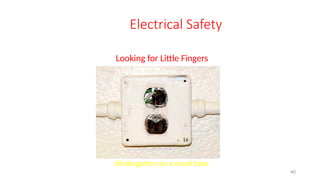
Looking for Little Fingers
kindergarten on a naval base
41
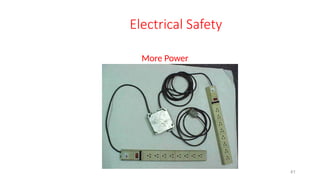
Electrical Safety
More Power
42
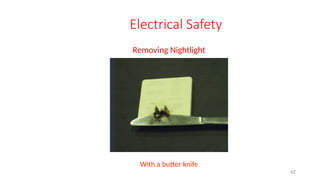
Electrical Safety
Removing Nightlight
With a butter knife
43
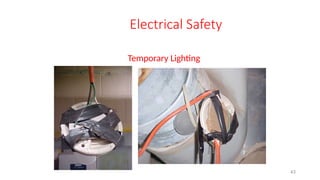
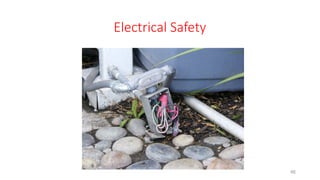
Electrical Safety
Temporary Lighting
44
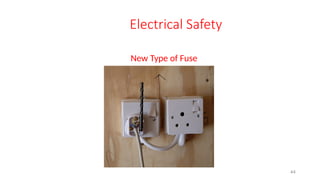
Electrical Safety
New Type of Fuse
45
Electrical Safety
Jewelry Box?
46
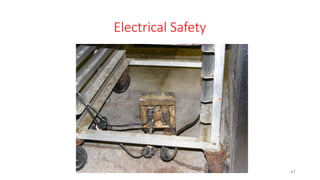
Electrical Safety
47
Electrical Safety
48
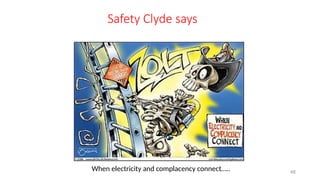
Safety Clyde says
When electricity and complacency connect…..
49
Other Disaster Examples
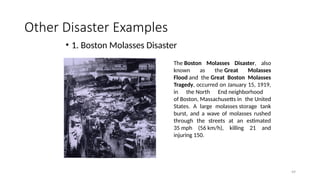
• 1. Boston Molasses Disaster
The Boston Molasses Disaster, also
known as the Great Molasses
Flood and the Great Boston Molasses
Tragedy, occurred on January 15, 1919,
in the North End neighborhood
of Boston, Massachusetts in the United
States. A large molasses storage tank
burst, and a wave of molasses rushed
through the streets at an estimated
35 mph (56 km/h), killing 21 and
injuring 150.
50
2. Space Shuttle Challenger
• http://www.youtube.com/watch?v=COZ-GKfwQX8
KEY DATES
1974 - Morton-Thiokol awarded contract to build solid
rocket boosters.
1976 - NASA accepts Morton-Thiokol's booster design.
1977 - Morton-Thiokol discovers joint rotation
problem. November 1981 - O-ring erosion
discovered after second shuttle flight.
January 24, 1985 - shuttle flight that exhibited the
worst O-ring blow-by.
July 1985 - Thiokol orders new steel billets for new
field joint design.
August 19, 1985 - NASA LevelI management briefed on
booster problem.
January 27, 1986 - night teleconference to discuss
effects of cold temperature on booster
performance.
January 28, 1986 - Challenger explodes 72 seconds
after liftoff.