Indus Valley Civilization
Presented by,
Surabhi mol B K
ZM17EDSS12
Social Science
Indus Valley
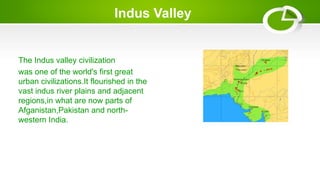
The Indus valley civilization
was one of the world's first great
urban civilizations.It flourished in the
vast indus river plains and adjacent
regions,in what are now parts of
Afganistan,Pakistan and north-
western India.
Begining
Around five thousand years ago,an important civilization developed on the
indus river floodplain named the Indus Valley Civilization(IVC)which was a
bronze age civilization(3300-1300 BCE;mature period 2600-1900 BCE).
Evolution of the Indus Valley Civilization
• 6500-5000 BC :Early food producing era.
• 5000-2600 BC :Regionalization era.
(3300-2600 BC : Early Harappan).
• 2600-1900 BC :Integration era.(mature Harappan).
• 1900-1300 BC: Localization era.(Late Harappan)
• 1300-300 BC: Post Indus tradition.
Discovery and Excavation
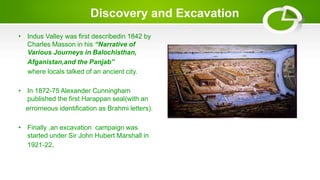
• Indus Valley was first describedin 1842 by
Charles Masson in his “Narrative of
Various Journeys in Balochisthan,
Afganistan,and the Panjab”
where locals talked of an ancient city.
• In 1872-75 Alexander Cunningham
published the first Harappan seal(with an
errorneous identification as Brahmi letters).
• Finally ,an excavation campaign was
started under Sir John Hubert Marshall in
1921-22.
Geography of Indus Valley
• The geography of the Indus Valley put the civilization that arose there in a highly similar
situation to those in Egypt and Peru, with rich agricultural lands being surrounded by
highlands,desert,and ocean.
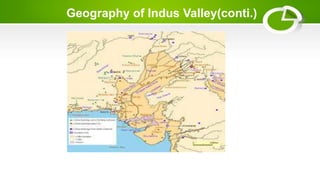
• The civilization extended east into the Ghaggr-Hakra Rivervalley and the upper reaches
Ganges-Yamuna Doab;it extended west to the Makran coast of Balochistan.
• The Indus Valley Civilization encompassed most of Pakistan,extending from Balochistan to
Sindh,and extending into modern day indian states of Gujarat,Rajasthan,Haryana,and
Panjab,with an upward reach to Rupar on the upper Sutlej.
• Recently Indus sites have been discovered in Pakistans northwestern Frontier province as
well.Other IVC colonies can be found in Afganisthan while smaller isolated colonies can be
found as far away as Turkmenistan and Gujarat.
Geography of Indus Valley(conti.)
Cities
Mohenja-daro
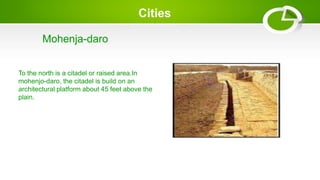
To the north is a citadel or raised area.In
mohenjo-daro, the citadel is build on an
architectural platform about 45 feet above the
plain.
Cities
Harappa
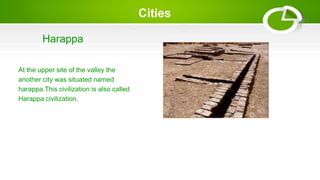
At the upper site of the valley the
another city was situated named
harappa.This civilization is also called
Harappa civilization.
Culture of Indus Valley Civilization
Religion
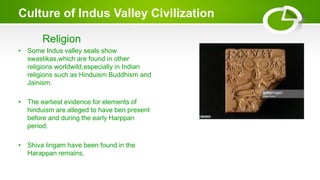
• Some Indus valley seals show
swastikas,which are found in other
religions worldwild,especially in Indian
religions such as Hinduism Buddhism and
Jainism.
• The earliest evidence for elements of
hinduism are alleged to have ben present
before and during the early Harppan
period.
• Shiva lingam have been found in the
Harappan remains.
Culture of Indus Valley Civilization(conti.)
Writing system
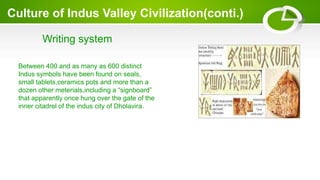
Between 400 and as many as 600 distinct
Indus symbols have been found on seals,
small tablets,ceramics pots and more than a
dozen other meterials,including a “signboard”
that apparently once hung over the gate of the
inner citadrel of the indus city of Dholavira.
Culture of Indus Valley Civilization(conti.)
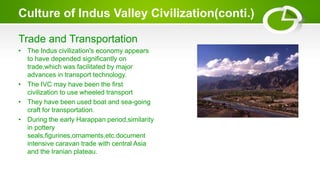
Trade and Transportation
• The Indus civilization's economy appears
to have depended significantly on
trade,which was facilitated by major
advances in transport technology.
• The IVC may have been the first
civilization to use wheeled transport
• They have been used boat and sea-going
craft for transportation.
• During the early Harappan period,similarity
in pottery
seals,figurines,ornaments,etc.document
intensive caravan trade with central Asia
and the Iranian plateau.
Culture of Indus Valley Civilization(conti.)
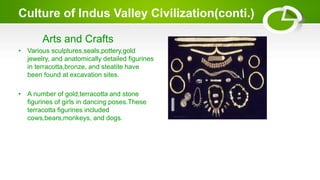
Arts and Crafts
• Various sculptures,seals,pottery,gold
jewelry, and anatomically detailed figurines
in terracotta,bronze, and steatite have
been found at excavation sites.
• A number of gold,terracotta and stone
figurines of girls in dancing poses.These
terracotta figurines included
cows,bears,monkeys, and dogs.
Culture of Indus Valley Civilization(conti.)
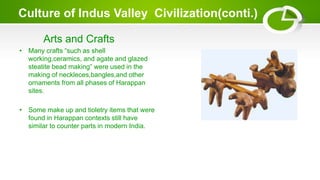
Arts and Crafts
• Many crafts “such as shell
working,ceramics, and agate and glazed
steatite bead making” were used in the
making of neckleces,bangles,and other
ornaments from all phases of Harappan
sites.
• Some make up and tioletry items that were
found in Harappan contexts still have
similar to counter parts in modern India.
Culture of Indus Valley Civilization(conti.)
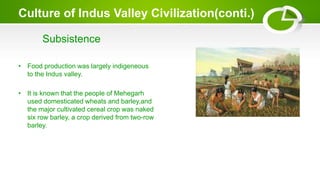
Subsistence
• Food production was largely indigeneous
to the Indus valley.
• It is known that the people of Mehegarh
used domesticated wheats and barley,and
the major cultivated cereal crop was naked
six row barley, a crop derived from two-row
barley.
References
• htpp://www.harappa.com/har/har0.html
• htpp://www.harappa.com/har/indus-saraswathi-
geography.html
• htpp://en.wikipedia.org/wiki/Indus_Valley_Civilization
• htpp://www.geocities.com/look4harappan/colapse.htm
Indus Valley Civilization

Indus Valley Civilization

  • 1.
    Indus Valley Civilization Presentedby, Surabhi mol B K ZM17EDSS12 Social Science
  • 3.
    Indus Valley The Indusvalley civilization was one of the world's first great urban civilizations.It flourished in the vast indus river plains and adjacent regions,in what are now parts of Afganistan,Pakistan and north- western India.
  • 4.
    Begining Around five thousandyears ago,an important civilization developed on the indus river floodplain named the Indus Valley Civilization(IVC)which was a bronze age civilization(3300-1300 BCE;mature period 2600-1900 BCE).
  • 5.
    Evolution of theIndus Valley Civilization • 6500-5000 BC :Early food producing era. • 5000-2600 BC :Regionalization era. (3300-2600 BC : Early Harappan). • 2600-1900 BC :Integration era.(mature Harappan). • 1900-1300 BC: Localization era.(Late Harappan) • 1300-300 BC: Post Indus tradition.
  • 6.
    Discovery and Excavation •Indus Valley was first describedin 1842 by Charles Masson in his “Narrative of Various Journeys in Balochisthan, Afganistan,and the Panjab” where locals talked of an ancient city. • In 1872-75 Alexander Cunningham published the first Harappan seal(with an errorneous identification as Brahmi letters). • Finally ,an excavation campaign was started under Sir John Hubert Marshall in 1921-22.
  • 7.
    Geography of IndusValley • The geography of the Indus Valley put the civilization that arose there in a highly similar situation to those in Egypt and Peru, with rich agricultural lands being surrounded by highlands,desert,and ocean. • The civilization extended east into the Ghaggr-Hakra Rivervalley and the upper reaches Ganges-Yamuna Doab;it extended west to the Makran coast of Balochistan. • The Indus Valley Civilization encompassed most of Pakistan,extending from Balochistan to Sindh,and extending into modern day indian states of Gujarat,Rajasthan,Haryana,and Panjab,with an upward reach to Rupar on the upper Sutlej. • Recently Indus sites have been discovered in Pakistans northwestern Frontier province as well.Other IVC colonies can be found in Afganisthan while smaller isolated colonies can be found as far away as Turkmenistan and Gujarat.
  • 8.
    Geography of IndusValley(conti.)
  • 9.
    Cities Mohenja-daro To the northis a citadel or raised area.In mohenjo-daro, the citadel is build on an architectural platform about 45 feet above the plain.
  • 10.
    Cities Harappa At the uppersite of the valley the another city was situated named harappa.This civilization is also called Harappa civilization.
  • 11.
    Culture of IndusValley Civilization Religion • Some Indus valley seals show swastikas,which are found in other religions worldwild,especially in Indian religions such as Hinduism Buddhism and Jainism. • The earliest evidence for elements of hinduism are alleged to have ben present before and during the early Harppan period. • Shiva lingam have been found in the Harappan remains.
  • 12.
    Culture of IndusValley Civilization(conti.) Writing system Between 400 and as many as 600 distinct Indus symbols have been found on seals, small tablets,ceramics pots and more than a dozen other meterials,including a “signboard” that apparently once hung over the gate of the inner citadrel of the indus city of Dholavira.
  • 13.
    Culture of IndusValley Civilization(conti.) Trade and Transportation • The Indus civilization's economy appears to have depended significantly on trade,which was facilitated by major advances in transport technology. • The IVC may have been the first civilization to use wheeled transport • They have been used boat and sea-going craft for transportation. • During the early Harappan period,similarity in pottery seals,figurines,ornaments,etc.document intensive caravan trade with central Asia and the Iranian plateau.
  • 14.
    Culture of IndusValley Civilization(conti.) Arts and Crafts • Various sculptures,seals,pottery,gold jewelry, and anatomically detailed figurines in terracotta,bronze, and steatite have been found at excavation sites. • A number of gold,terracotta and stone figurines of girls in dancing poses.These terracotta figurines included cows,bears,monkeys, and dogs.
  • 15.
    Culture of IndusValley Civilization(conti.) Arts and Crafts • Many crafts “such as shell working,ceramics, and agate and glazed steatite bead making” were used in the making of neckleces,bangles,and other ornaments from all phases of Harappan sites. • Some make up and tioletry items that were found in Harappan contexts still have similar to counter parts in modern India.
  • 16.
    Culture of IndusValley Civilization(conti.) Subsistence • Food production was largely indigeneous to the Indus valley. • It is known that the people of Mehegarh used domesticated wheats and barley,and the major cultivated cereal crop was naked six row barley, a crop derived from two-row barley.
  • 17.
    References • htpp://www.harappa.com/har/har0.html • htpp://www.harappa.com/har/indus-saraswathi- geography.html •htpp://en.wikipedia.org/wiki/Indus_Valley_Civilization • htpp://www.geocities.com/look4harappan/colapse.htm