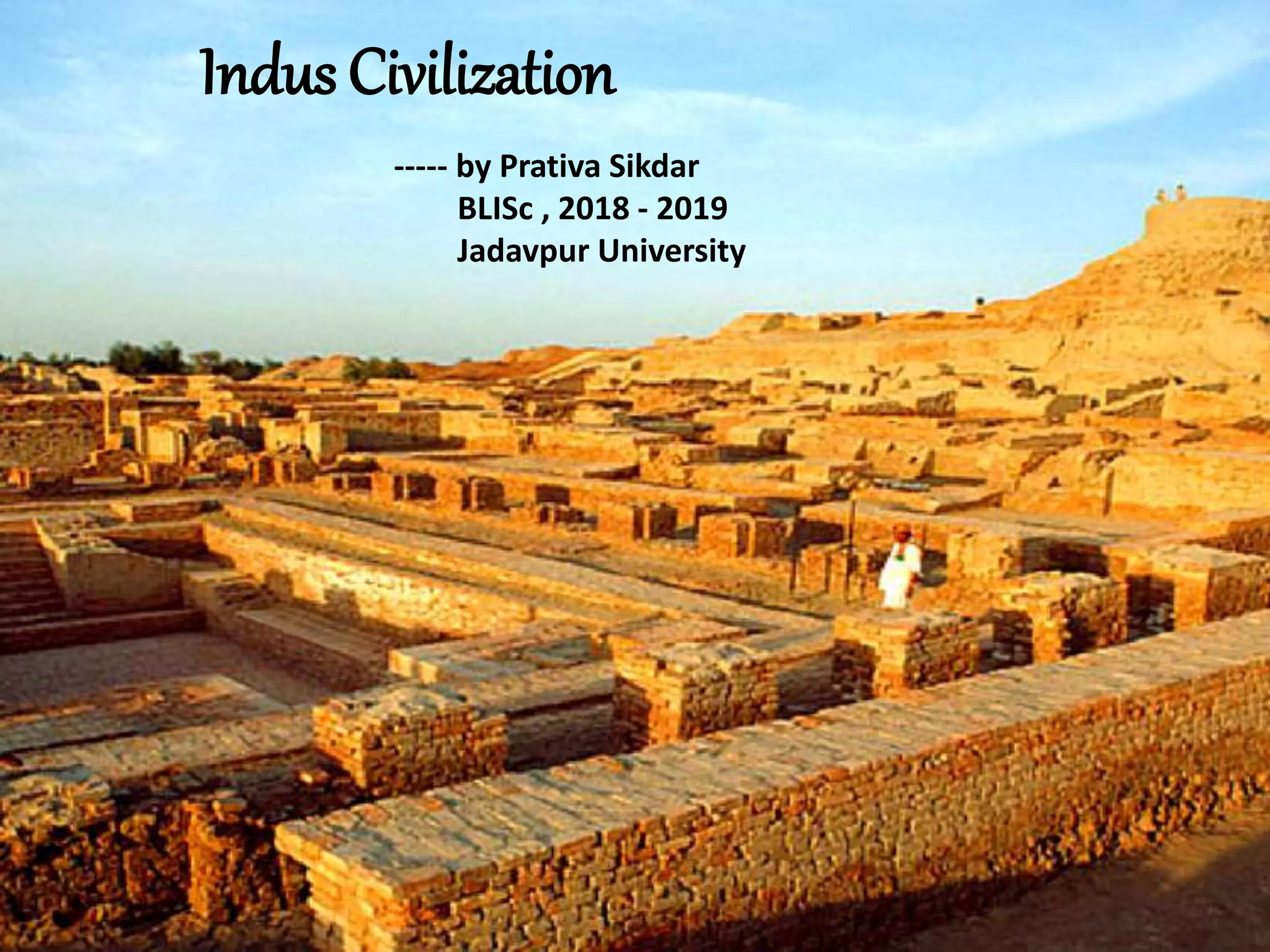
Indus Civilization
----- by Prativa Sikdar
BLISc , 2018 - 2019
Jadavpur University
Introduction
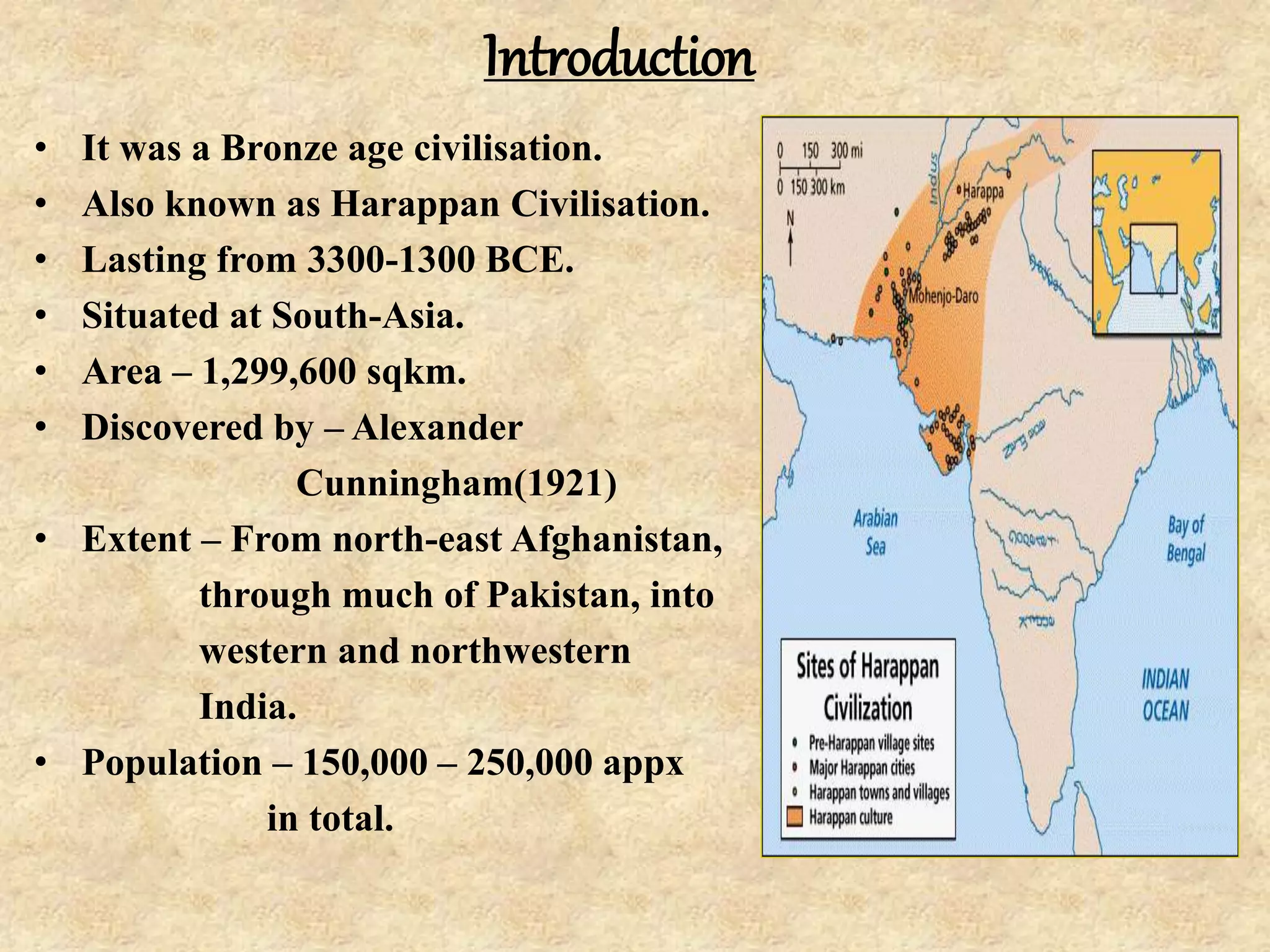
• It was a Bronze age civilisation.
• Also known as Harappan Civilisation.
• Lasting from 3300-1300 BCE.
• Situated at South-Asia.
• Area – 1,299,600 sqkm.
• Discovered by – Alexander
Cunningham(1921)
• Extent – From north-east Afghanistan,
through much of Pakistan, into
western and northwestern
India.
• Population – 150,000 – 250,000 appx
in total.
Most Important Cities
City Year Situated at Excavators Features
Harappa 1921 Punjab
(Pakistan)
Dayaram Sahni Stone dancing Nataraja
excavated
Mohenjodaro 1922 Punjab
(Pakistan)
R.D. Bannerjee Great bath, assembly hall
Chanhudaro 1925 Sindh Mackay Only site without Citadel
Lothal 1954 Gujarat S.R. Rao Dockyard city,
Evidence of rice
Kalibangan 1961 Rajasthan B.B. Lal Ploughed field, camel bones,
two types of burials
Dholavira 1967 Kutch J.P. Joshi Harappan inscription found
Surkotada 1972 Gujrat J.P. Joshi Horse, oval grave& pit burial
found
Banwali 1973 Haryana R.S. Bisht Barley found
Dholavira Lothal
Mohenjodaro
Harappa
Architecture
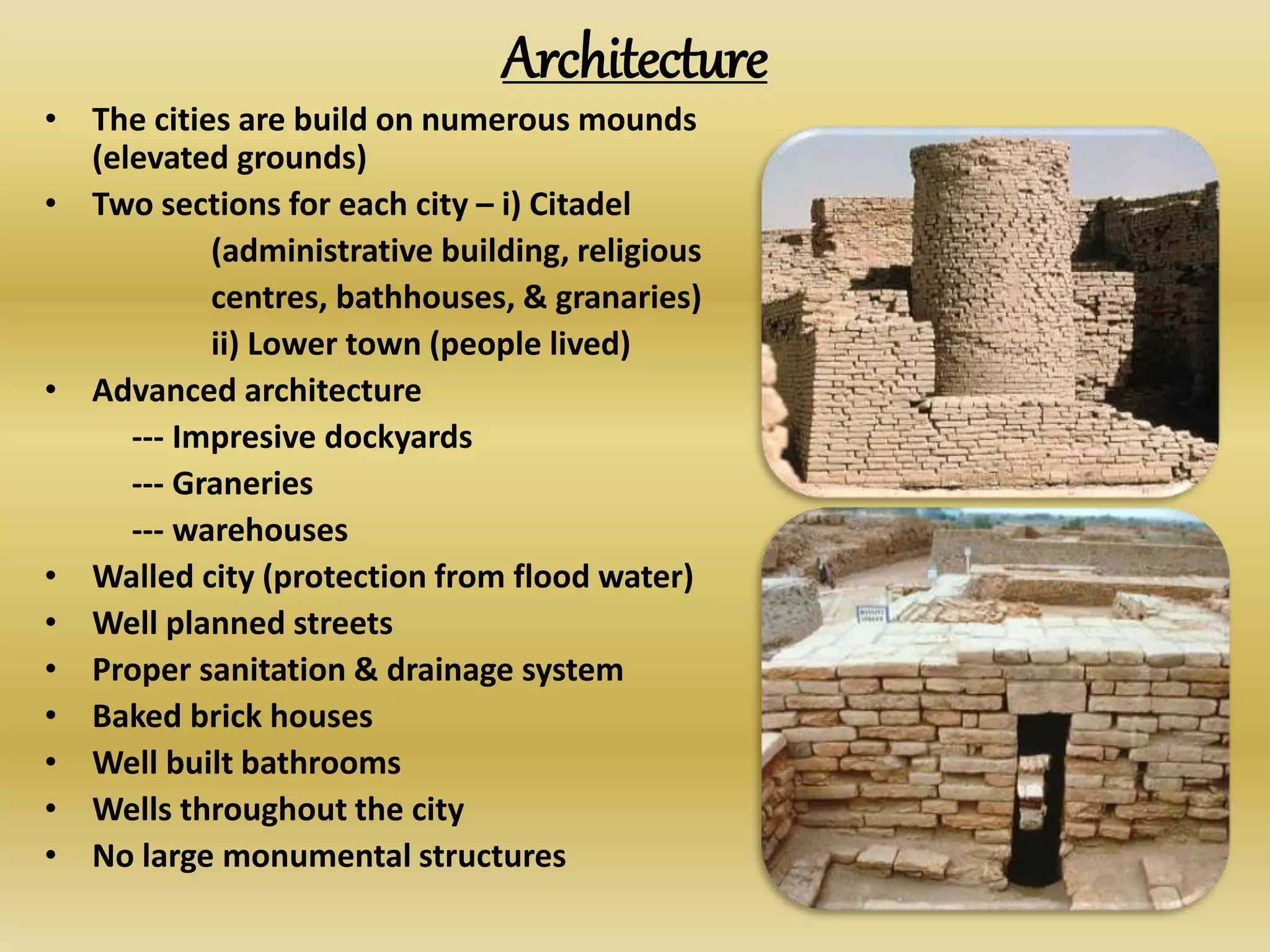
• The cities are build on numerous mounds
(elevated grounds)
• Two sections for each city – i) Citadel
(administrative building, religious
centres, bathhouses, & granaries)
ii) Lower town (people lived)
• Advanced architecture
--- Impresive dockyards
--- Graneries
--- warehouses
• Walled city (protection from flood water)
• Well planned streets
• Proper sanitation & drainage system
• Baked brick houses
• Well built bathrooms
• Wells throughout the city
• No large monumental structures
Society & Politics
• Primarily urban.
• There are no king.
• Governed by Priest King.
• Everyone has equal rights in
society.
• Some merchants but mostly
farmers.
• There are so many craft
specialist, like potters, metal
workers, seal makers etc.
ECONOMY
• Based on agriculture & trade.
• Standards of weights &measures
was established
• Industry= textiles.
• Cotton used for textiles.
• Jewels made from gold, silver
&copper.
• Most city dwellers were traders
or artisans.
AGRICULTURE
• Harappans were
agricultural people.
• The people harvested
different kinds of crops
like Wheat, Barley,
Peas, Sesame, Melons,
Dates, Cotton.
• Each city has
“Granaries” or food
storage areas.
Trade
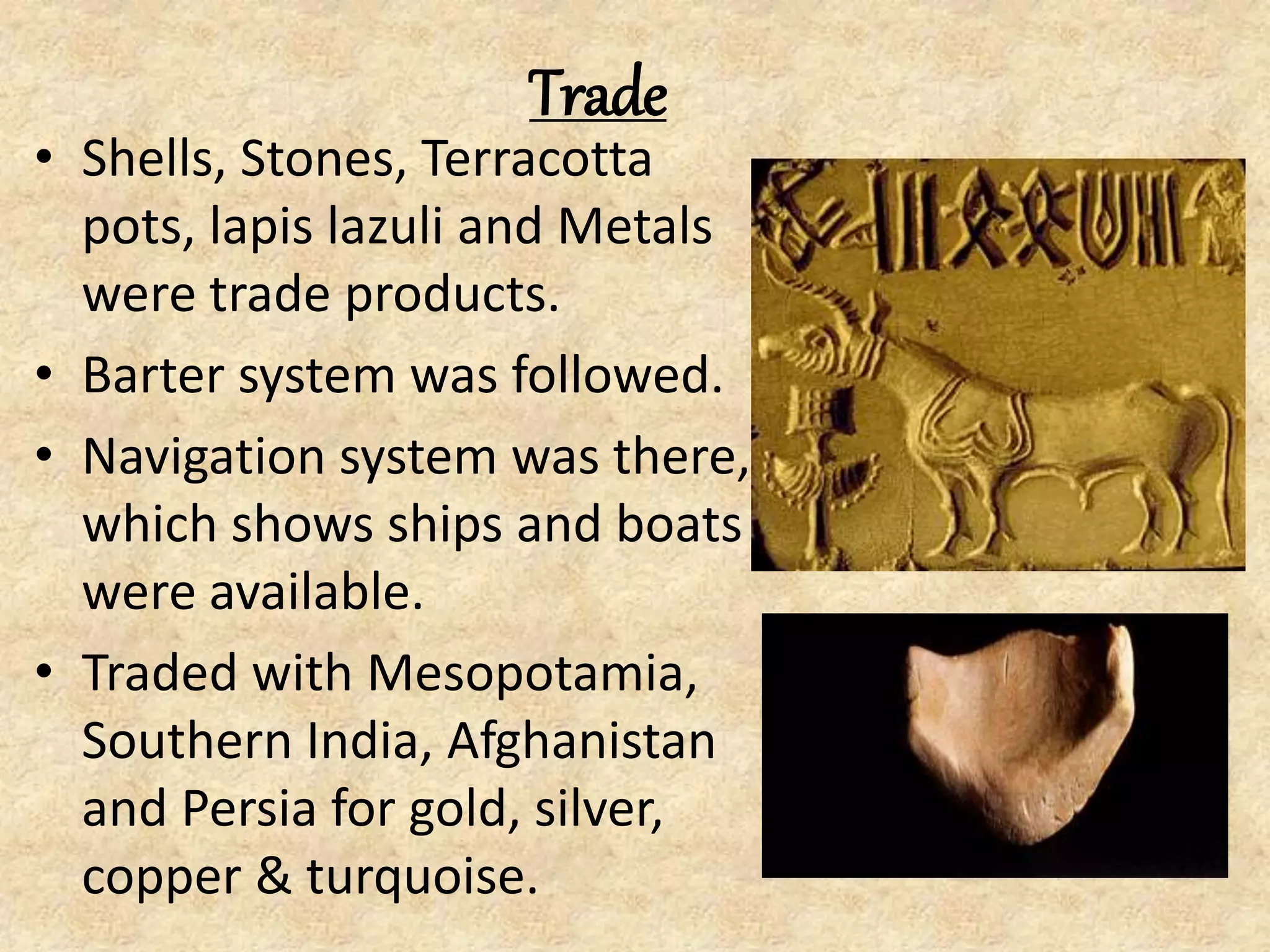
• Shells, Stones, Terracotta
pots, lapis lazuli and Metals
were trade products.
• Barter system was followed.
• Navigation system was there,
which shows ships and boats
were available.
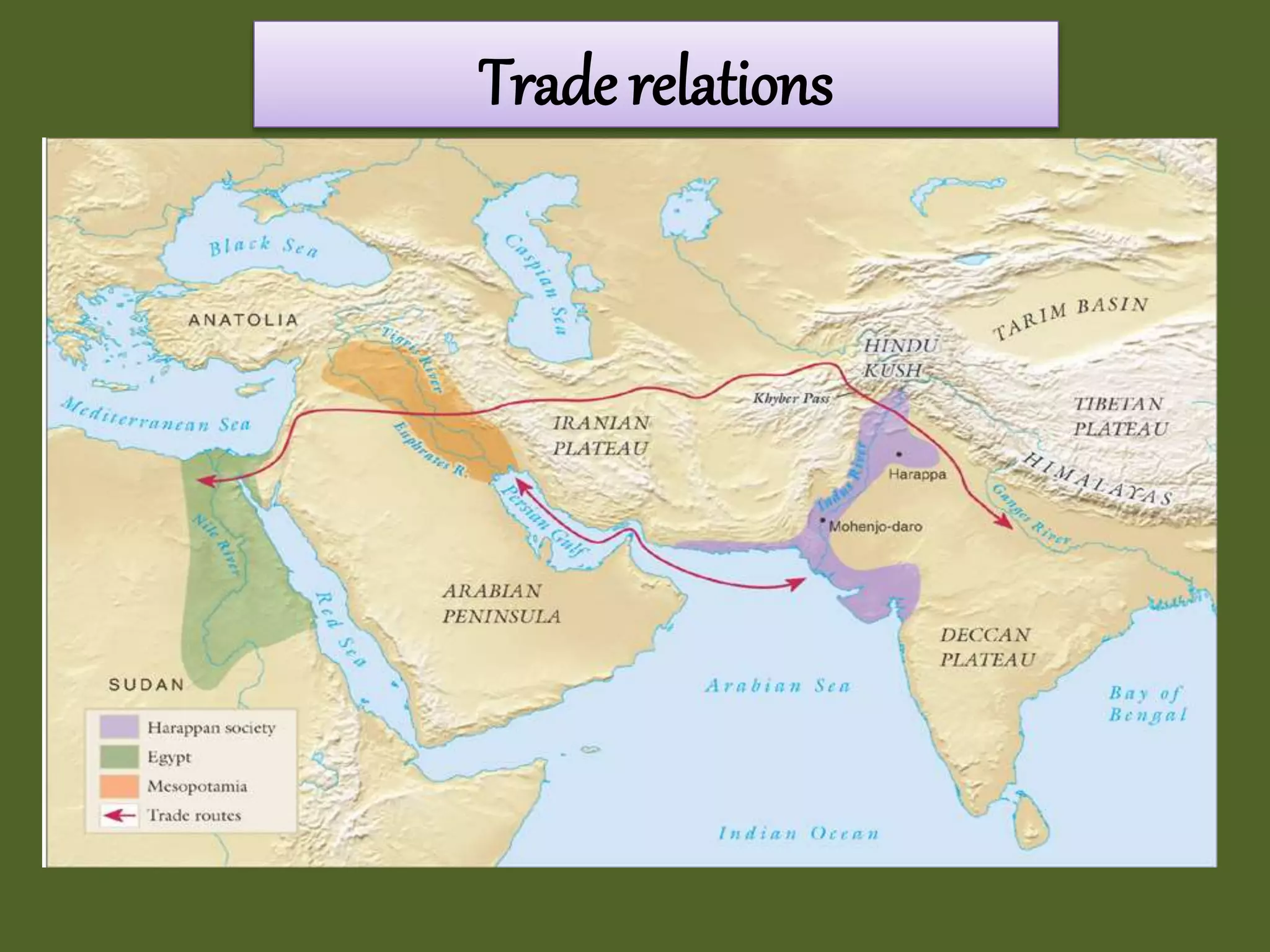
• Traded with Mesopotamia,
Southern India, Afghanistan
and Persia for gold, silver,
copper & turquoise.
Trade relations
LANGUAGE & Culture
• Language
– Had writing system of
300 symbols, but
scientists cannot
decipher it
• Culture
– Harappan cities
appear uniform in
culture, no great
social divisions
– Animals importance
to the culture; toys
suggest prosperity
Art & crafts
•Dancing girl
•Pottery
•Terracotta cart
•Jewellery
Religion
• Normally termed as
animism. i.e., worship of
trees, animals.
• Terracotta figure of
Mother Goddess found.
• Chief male deity,
Pashupati, the lord of
beasts & animals.
• Use amulets to prevent
ghosts & evil forces.
End of the Civilization
• Repeated floods caused the
course of the Indus River to
shift away .
• The Ghaggar-Hakra river
shifted & forced the people
to move.
• Shift in major trade routes.
• Deforestation & soil
erosion.
• Migration/ Invasion of
Aryans.
Latest discovery & technique
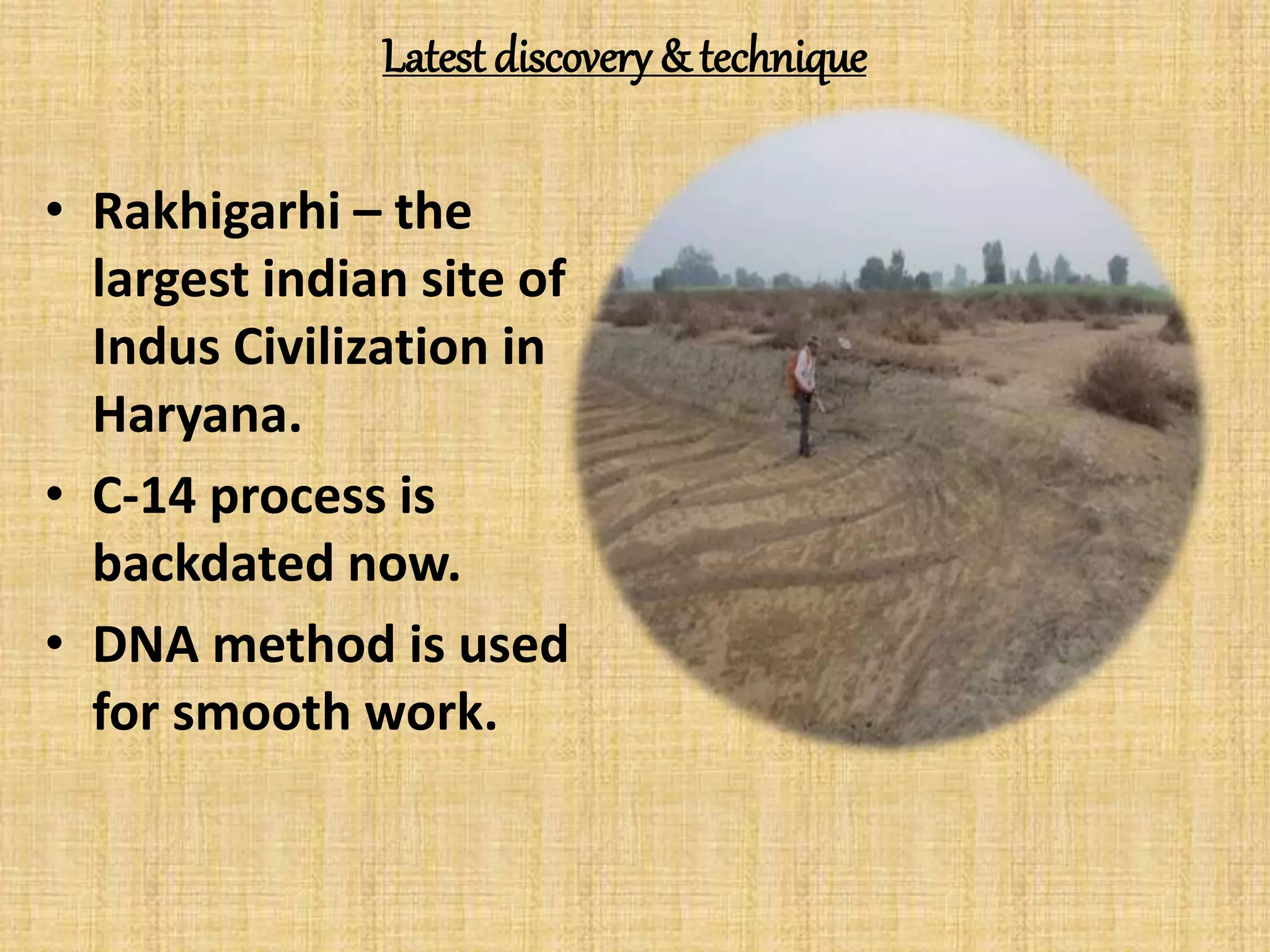
• Rakhigarhi – the
largest indian site of
Indus Civilization in
Haryana.
• C-14 process is
backdated now.
• DNA method is used
for smooth work.
Conclusion
• Highly planned urban city.
• Standardized economy.
• Talented artwork, which are inspiration
for today’s world.
• The Indus Valley script has never been
translated.
• So we know very little about the people.
Indus civilization ppt

Indus civilization ppt

  • 1.
    Indus Civilization ----- byPrativa Sikdar BLISc , 2018 - 2019 Jadavpur University
  • 2.
    Introduction • It wasa Bronze age civilisation. • Also known as Harappan Civilisation. • Lasting from 3300-1300 BCE. • Situated at South-Asia. • Area – 1,299,600 sqkm. • Discovered by – Alexander Cunningham(1921) • Extent – From north-east Afghanistan, through much of Pakistan, into western and northwestern India. • Population – 150,000 – 250,000 appx in total.
  • 3.
    Most Important Cities CityYear Situated at Excavators Features Harappa 1921 Punjab (Pakistan) Dayaram Sahni Stone dancing Nataraja excavated Mohenjodaro 1922 Punjab (Pakistan) R.D. Bannerjee Great bath, assembly hall Chanhudaro 1925 Sindh Mackay Only site without Citadel Lothal 1954 Gujarat S.R. Rao Dockyard city, Evidence of rice Kalibangan 1961 Rajasthan B.B. Lal Ploughed field, camel bones, two types of burials Dholavira 1967 Kutch J.P. Joshi Harappan inscription found Surkotada 1972 Gujrat J.P. Joshi Horse, oval grave& pit burial found Banwali 1973 Haryana R.S. Bisht Barley found
  • 4.
  • 5.
    Architecture • The citiesare build on numerous mounds (elevated grounds) • Two sections for each city – i) Citadel (administrative building, religious centres, bathhouses, & granaries) ii) Lower town (people lived) • Advanced architecture --- Impresive dockyards --- Graneries --- warehouses • Walled city (protection from flood water) • Well planned streets • Proper sanitation & drainage system • Baked brick houses • Well built bathrooms • Wells throughout the city • No large monumental structures
  • 6.
    Society & Politics •Primarily urban. • There are no king. • Governed by Priest King. • Everyone has equal rights in society. • Some merchants but mostly farmers. • There are so many craft specialist, like potters, metal workers, seal makers etc.
  • 7.
    ECONOMY • Based onagriculture & trade. • Standards of weights &measures was established • Industry= textiles. • Cotton used for textiles. • Jewels made from gold, silver &copper. • Most city dwellers were traders or artisans.
  • 8.
    AGRICULTURE • Harappans were agriculturalpeople. • The people harvested different kinds of crops like Wheat, Barley, Peas, Sesame, Melons, Dates, Cotton. • Each city has “Granaries” or food storage areas.
  • 9.
    Trade • Shells, Stones,Terracotta pots, lapis lazuli and Metals were trade products. • Barter system was followed. • Navigation system was there, which shows ships and boats were available. • Traded with Mesopotamia, Southern India, Afghanistan and Persia for gold, silver, copper & turquoise.
  • 10.
  • 11.
    LANGUAGE & Culture •Language – Had writing system of 300 symbols, but scientists cannot decipher it • Culture – Harappan cities appear uniform in culture, no great social divisions – Animals importance to the culture; toys suggest prosperity
  • 12.
    Art & crafts •Dancinggirl •Pottery •Terracotta cart •Jewellery
  • 13.
    Religion • Normally termedas animism. i.e., worship of trees, animals. • Terracotta figure of Mother Goddess found. • Chief male deity, Pashupati, the lord of beasts & animals. • Use amulets to prevent ghosts & evil forces.
  • 14.
    End of theCivilization • Repeated floods caused the course of the Indus River to shift away . • The Ghaggar-Hakra river shifted & forced the people to move. • Shift in major trade routes. • Deforestation & soil erosion. • Migration/ Invasion of Aryans.
  • 15.
    Latest discovery &technique • Rakhigarhi – the largest indian site of Indus Civilization in Haryana. • C-14 process is backdated now. • DNA method is used for smooth work.
  • 16.
    Conclusion • Highly plannedurban city. • Standardized economy. • Talented artwork, which are inspiration for today’s world. • The Indus Valley script has never been translated. • So we know very little about the people.