Indus River Civilizations A Peaceable Kingdom?
Introduction to the Region Indus River is located in today’s Pakistan River rises in snow-capped Himalayas Descends through Kashmir  Flows through Pakistani plains Spring runoff Floods the plains Leave silt, a soil soft enough to turn without aid of plows
Neolithic Along the Indus Mehrgarh Villages formed around 6000 BC Primary domesticates Western Asiatic wheat Animals native to the area Zebu cattle (humped back) Goats Water buffalo Trade routes in evidence even then Linked Mesopotamia with Indus region Became main routes with Harappan civilizations
Early Villages: 3200-2600 BC Small villages with a few acres of land Society: egalitarian Enjoyed fertile, well-watered soils Lacked metal ores Trade soon developed Baluchi Highlands: metals, semiprecious stones, timber Symbiosis developed between Baluchistan and lowlanders (trade and also transhumance) May have led to development of complex societies along Indus
Harappan Civilization (2700-1700 BC) Trade with Sumeria may have contributed to Harappan growth Sumeria expanded trade with Meluhha, probably in the Indus region Through Dilmun, on island of Bahrain at the Persian Gulf Items obtained from Meluhha: ivory, wool, cloth, leather, oils, cedar, and cereals Others claim that Harappan civilization developed independently
Harappan Civilization: Cities There were five cities, best know of which were Harappa: namesake of the civilization Mohenjo-Daro Cities were known for their  Planned neighborhoods with grid pattern Sophisticated drainage system (most had indoor bathrooms with sewage system) Communal granaries Bathhouses Citadels or great structures (palaces, temples, granaries) built on hills (Left) Population: 35,000 or more each
Harappan Civilization: Surrounding Regions Hundreds of farming communities for each city Comprising territory of 300,000 miles square (775,000 km square) Other cities beyond region Lothai: similar urban planning Shortugai: a mining settlement (source of lapis lazuli) 621 mi east of Indus
Harappan Civilization: Public Urban Design Primary source: Jane McIntosh  A Peaceful Realm Uniform design for Harappa, Mohenjo-Daro, and Kalibangan Dominated by a  citadel raised on a mud brick platform in western edge of city Surrounded by large granaries, bathhouses, and other public buildings Encompassed by a monumental wall Residential areas spread out on eastern side
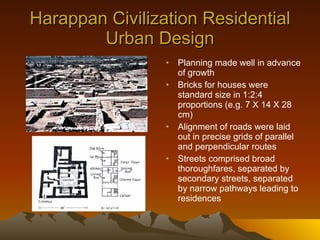
Harappan Civilization Residential Urban Design Planning made well in advance of growth Bricks for houses were standard size in 1:2:4 proportions (e.g. 7 X 14 X 28 cm) Alignment of roads were laid out in precise grids of parallel and perpendicular routes Streets comprised broad thoroughfares, separated by secondary streets, separated by narrow pathways leading to residences
Harappan Civilization: Economy A standard of weights and measures was established. Sections of cities were blocked off for craft specialists Potters  --Flint workers Metal workers  --Brick makers Shell workers  --Ivory carvers Textile workers –Shell workers Precious stone workers Wood workers  --Seal makers Other workshops, such as bakeries and bead manufacturers
Harappan Civilization: Trade Imported exotic raw materials Gold  --Lead Lapis lazuli  --Turquoise Alabaster  --Amethyst Agate  --Carnelian Chalcedony Exported finely finished goods Harappan seals found in Sumeria Bahrain was the transshipping point
Harappan Civilization: Political and Social Organization Political organization was tight and centralized Dwellings varied considerably From mansion with several rooms and courtyards To single-room apartments Despite stratification,  Names of rulers are unknown No lavish displays of wealth No evidence of bombastic rulers boasting of their deeds on monument walls
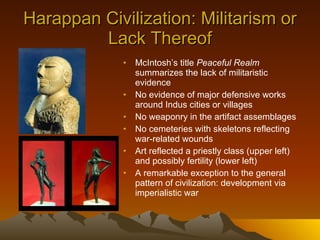
Harappan Civilization: Militarism or Lack Thereof McIntosh’s title  Peaceful Realm  summarizes the lack of militaristic evidence No evidence of major defensive works around Indus cities or villages No weaponry in the artifact assemblages No cemeteries with skeletons reflecting war-related wounds Art reflected a priestly class (upper left) and possibly fertility (lower left) A remarkable exception to the general pattern of civilization: development via imperialistic war
Harappan Civilization: Writing Writing is yet to be deciphered, so we know less than we otherwise might 400 different pictographic symbols have been identified Scholars agree they might be a mixture of sounds and concepts But differ on what the common language was, or if there were more than one Other depictions suggest forerunners to Hinduism Seals depict three headed figure in yogic position Surrounded by tigers, water buffalo, elephants, and other indigenous fauna This figure may be Shiva, Lord of Beasts Other seals depict cattle, symbol of Shiva
Causes of Decline Possibly a major river, the Ghaggar-Hakra River, shifted, forcing the population to move elsewhere Other Probable Factors Shift in major trade routes Deforestation and soil erosion Flooding of the Indus River
Post-Harappan South Asia (1700-180 BC) Population moved to the Ganges Rice replaced wheat and barley Iron technology emerged 16 kingdoms later developed along the Ganges Classic period of South Asia began Brahmin religion Buddhism also developed and spread Invasion of outside powers Darius of Persia incorporated Indus region to the Persian empire in 516 BC Alexander the Great came along two centuries later, failed to conquer all of India Mauryan Empire developed from vacuum and dominated India from ca 300 BC to 185 BC; sway extended from Nepal to Daccan region
Conclusion Similarities with Other Civilizations: High-yield subsistence base, supported by irrigation Centralized authority with stratification Presence of writing Differences from Other Civilizations: No evidence of extreme stratification No evidence of warfare Highly planned urban society Standardized economy

Indus River Civilizations

  • 1.
    Indus River CivilizationsA Peaceable Kingdom?
  • 2.
    Introduction to theRegion Indus River is located in today’s Pakistan River rises in snow-capped Himalayas Descends through Kashmir Flows through Pakistani plains Spring runoff Floods the plains Leave silt, a soil soft enough to turn without aid of plows
  • 3.
    Neolithic Along theIndus Mehrgarh Villages formed around 6000 BC Primary domesticates Western Asiatic wheat Animals native to the area Zebu cattle (humped back) Goats Water buffalo Trade routes in evidence even then Linked Mesopotamia with Indus region Became main routes with Harappan civilizations
  • 4.
    Early Villages: 3200-2600BC Small villages with a few acres of land Society: egalitarian Enjoyed fertile, well-watered soils Lacked metal ores Trade soon developed Baluchi Highlands: metals, semiprecious stones, timber Symbiosis developed between Baluchistan and lowlanders (trade and also transhumance) May have led to development of complex societies along Indus
  • 5.
    Harappan Civilization (2700-1700BC) Trade with Sumeria may have contributed to Harappan growth Sumeria expanded trade with Meluhha, probably in the Indus region Through Dilmun, on island of Bahrain at the Persian Gulf Items obtained from Meluhha: ivory, wool, cloth, leather, oils, cedar, and cereals Others claim that Harappan civilization developed independently
  • 6.
    Harappan Civilization: CitiesThere were five cities, best know of which were Harappa: namesake of the civilization Mohenjo-Daro Cities were known for their Planned neighborhoods with grid pattern Sophisticated drainage system (most had indoor bathrooms with sewage system) Communal granaries Bathhouses Citadels or great structures (palaces, temples, granaries) built on hills (Left) Population: 35,000 or more each
  • 7.
    Harappan Civilization: SurroundingRegions Hundreds of farming communities for each city Comprising territory of 300,000 miles square (775,000 km square) Other cities beyond region Lothai: similar urban planning Shortugai: a mining settlement (source of lapis lazuli) 621 mi east of Indus
  • 8.
    Harappan Civilization: PublicUrban Design Primary source: Jane McIntosh A Peaceful Realm Uniform design for Harappa, Mohenjo-Daro, and Kalibangan Dominated by a citadel raised on a mud brick platform in western edge of city Surrounded by large granaries, bathhouses, and other public buildings Encompassed by a monumental wall Residential areas spread out on eastern side
  • 9.
    Harappan Civilization ResidentialUrban Design Planning made well in advance of growth Bricks for houses were standard size in 1:2:4 proportions (e.g. 7 X 14 X 28 cm) Alignment of roads were laid out in precise grids of parallel and perpendicular routes Streets comprised broad thoroughfares, separated by secondary streets, separated by narrow pathways leading to residences
  • 10.
    Harappan Civilization: EconomyA standard of weights and measures was established. Sections of cities were blocked off for craft specialists Potters --Flint workers Metal workers --Brick makers Shell workers --Ivory carvers Textile workers –Shell workers Precious stone workers Wood workers --Seal makers Other workshops, such as bakeries and bead manufacturers
  • 11.
    Harappan Civilization: TradeImported exotic raw materials Gold --Lead Lapis lazuli --Turquoise Alabaster --Amethyst Agate --Carnelian Chalcedony Exported finely finished goods Harappan seals found in Sumeria Bahrain was the transshipping point
  • 12.
    Harappan Civilization: Politicaland Social Organization Political organization was tight and centralized Dwellings varied considerably From mansion with several rooms and courtyards To single-room apartments Despite stratification, Names of rulers are unknown No lavish displays of wealth No evidence of bombastic rulers boasting of their deeds on monument walls
  • 13.
    Harappan Civilization: Militarismor Lack Thereof McIntosh’s title Peaceful Realm summarizes the lack of militaristic evidence No evidence of major defensive works around Indus cities or villages No weaponry in the artifact assemblages No cemeteries with skeletons reflecting war-related wounds Art reflected a priestly class (upper left) and possibly fertility (lower left) A remarkable exception to the general pattern of civilization: development via imperialistic war
  • 14.
    Harappan Civilization: WritingWriting is yet to be deciphered, so we know less than we otherwise might 400 different pictographic symbols have been identified Scholars agree they might be a mixture of sounds and concepts But differ on what the common language was, or if there were more than one Other depictions suggest forerunners to Hinduism Seals depict three headed figure in yogic position Surrounded by tigers, water buffalo, elephants, and other indigenous fauna This figure may be Shiva, Lord of Beasts Other seals depict cattle, symbol of Shiva
  • 15.
    Causes of DeclinePossibly a major river, the Ghaggar-Hakra River, shifted, forcing the population to move elsewhere Other Probable Factors Shift in major trade routes Deforestation and soil erosion Flooding of the Indus River
  • 16.
    Post-Harappan South Asia(1700-180 BC) Population moved to the Ganges Rice replaced wheat and barley Iron technology emerged 16 kingdoms later developed along the Ganges Classic period of South Asia began Brahmin religion Buddhism also developed and spread Invasion of outside powers Darius of Persia incorporated Indus region to the Persian empire in 516 BC Alexander the Great came along two centuries later, failed to conquer all of India Mauryan Empire developed from vacuum and dominated India from ca 300 BC to 185 BC; sway extended from Nepal to Daccan region
  • 17.
    Conclusion Similarities withOther Civilizations: High-yield subsistence base, supported by irrigation Centralized authority with stratification Presence of writing Differences from Other Civilizations: No evidence of extreme stratification No evidence of warfare Highly planned urban society Standardized economy