Success begins with bismillah
Metabolism of cholesterol
and steroids
Group members
• Hafiza minahil 0112
• Wajeeha baryar 0089
• Samiullah 0110
• Ummehani 0124
• Saman shehzadi 0126
• Zakia akram 0115
What are Steroids ?
• Lipophilic, low molecular weight, derived from
cholesterol
• contains four rings of carbon atoms
• Acts as hormones in body estradiol,
testosterone, progesterone
• includes drugs such as prednisone, cortisone,
dexamethasone.
• Classes of steroids
1. Glucocorticoids
2. Mineralocorticoids
3. Sex hormones
Functions of steroids
• Stress response
• Immune response
• Regulation of inflammation
• Carbohydrate metabolism
• Protein catabolism
• Blood electrolyte level maintenance
Regulation
Done by Coactivators and Corepessors
Diseases caused by fluctuations in steroid
hormone levels
• Osteoporosis
• Adrenal cortex suppression
• Growth retardation
• Hypertension
• Development of secondary sex characteristics
in male and female
• Cushing's syndrome
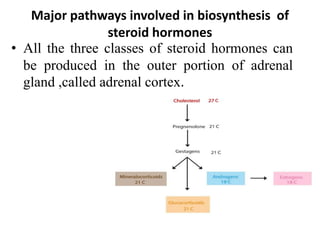
Major pathways involved in biosynthesis of
steroid hormones
• All the three classes of steroid hormones can
be produced in the outer portion of adrenal
gland ,called adrenal cortex.
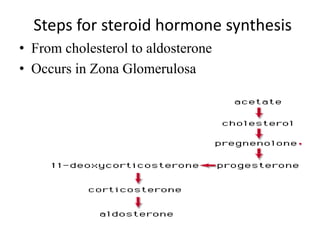
Steps for steroid hormone synthesis
• From cholesterol to aldosterone
• Occurs in Zona Glomerulosa
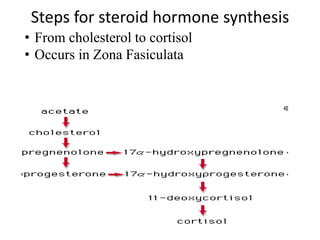
Steps for steroid hormone synthesis
• From cholesterol to cortisol
• Occurs in Zona Fasiculata
Steps for steroid hormone synthesis
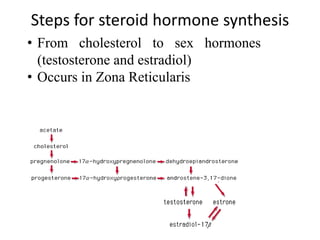
• From cholesterol to sex hormones
(testosterone and estradiol)
• Occurs in Zona Reticularis
What is cholesterol ?
• Cholesterol is a waxy fat (lipid) carried through blood
by lipoproteins
• the most decorated small molecule in biology
• First isolated from gall stones in 1784
• two main types of cholesterol are
i. Good cholesterol (HDLs)
ii. Bad cholesterol (LDLs)
• Also known as sterol because it is made of alcohol
and steroid
• amphipathic molecule ,contains both hydrophobic
and hydrophilic part
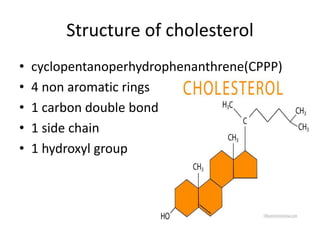
Structure of cholesterol
• cyclopentanoperhydrophenanthrene(CPPP)
• 4 non aromatic rings
• 1 carbon double bond
• 1 side chain
• 1 hydroxyl group
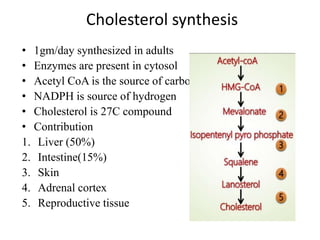
Cholesterol synthesis
• 1gm/day synthesized in adults
• Enzymes are present in cytosol
• Acetyl CoA is the source of carbon
• NADPH is source of hydrogen
• Cholesterol is 27C compound
• Contribution
1. Liver (50%)
2. Intestine(15%)
3. Skin
4. Adrenal cortex
5. Reproductive tissue
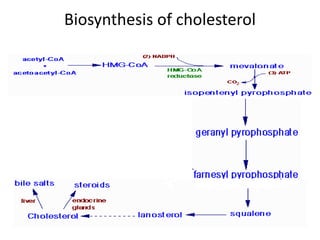
Biosynthesis of cholesterol
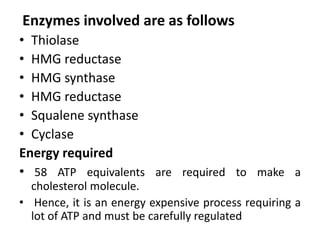
Enzymes involved are as follows
• Thiolase
• HMG reductase
• HMG synthase
• HMG reductase
• Squalene synthase
• Cyclase
Energy required
• 58 ATP equivalents are required to make a
cholesterol molecule.
• Hence, it is an energy expensive process requiring a
lot of ATP and must be carefully regulated
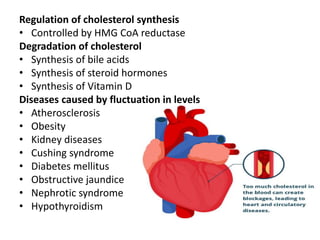
Regulation of cholesterol synthesis
• Controlled by HMG CoA reductase
Degradation of cholesterol
• Synthesis of bile acids
• Synthesis of steroid hormones
• Synthesis of Vitamin D
Diseases caused by fluctuation in levels
• Atherosclerosis
• Obesity
• Kidney diseases
• Cushing syndrome
• Diabetes mellitus
• Obstructive jaundice
• Nephrotic syndrome
• Hypothyroidism
References
• https://en.wikibooks.org/wiki/Structural_Bioc
hemistry/Lipids/Cholesterol
• https://www.slideshare.net/ashokktt/metabol
ism-of-cholesterol
• https://www.gfmer.ch/Books/Reproductive_h
ealth/Steroid_hormone_metabolism.html
• https://www.youtube.com/watch?v=37EZp-
LD2kU
• https://www.youtube.com/watch?v=SWOwdP
NzMrQ

Steroids and Cholesterol

  • 1.
  • 2.
  • 3.
    Group members • Hafizaminahil 0112 • Wajeeha baryar 0089 • Samiullah 0110 • Ummehani 0124 • Saman shehzadi 0126 • Zakia akram 0115
  • 4.
    What are Steroids? • Lipophilic, low molecular weight, derived from cholesterol • contains four rings of carbon atoms • Acts as hormones in body estradiol, testosterone, progesterone • includes drugs such as prednisone, cortisone, dexamethasone. • Classes of steroids 1. Glucocorticoids 2. Mineralocorticoids 3. Sex hormones
  • 5.
    Functions of steroids •Stress response • Immune response • Regulation of inflammation • Carbohydrate metabolism • Protein catabolism • Blood electrolyte level maintenance Regulation Done by Coactivators and Corepessors
  • 6.
    Diseases caused byfluctuations in steroid hormone levels • Osteoporosis • Adrenal cortex suppression • Growth retardation • Hypertension • Development of secondary sex characteristics in male and female • Cushing's syndrome
  • 7.
    Major pathways involvedin biosynthesis of steroid hormones • All the three classes of steroid hormones can be produced in the outer portion of adrenal gland ,called adrenal cortex.
  • 8.
    Steps for steroidhormone synthesis • From cholesterol to aldosterone • Occurs in Zona Glomerulosa
  • 9.
    Steps for steroidhormone synthesis • From cholesterol to cortisol • Occurs in Zona Fasiculata
  • 10.
    Steps for steroidhormone synthesis • From cholesterol to sex hormones (testosterone and estradiol) • Occurs in Zona Reticularis
  • 11.
    What is cholesterol? • Cholesterol is a waxy fat (lipid) carried through blood by lipoproteins • the most decorated small molecule in biology • First isolated from gall stones in 1784 • two main types of cholesterol are i. Good cholesterol (HDLs) ii. Bad cholesterol (LDLs) • Also known as sterol because it is made of alcohol and steroid • amphipathic molecule ,contains both hydrophobic and hydrophilic part
  • 12.
    Structure of cholesterol •cyclopentanoperhydrophenanthrene(CPPP) • 4 non aromatic rings • 1 carbon double bond • 1 side chain • 1 hydroxyl group
  • 13.
    Cholesterol synthesis • 1gm/daysynthesized in adults • Enzymes are present in cytosol • Acetyl CoA is the source of carbon • NADPH is source of hydrogen • Cholesterol is 27C compound • Contribution 1. Liver (50%) 2. Intestine(15%) 3. Skin 4. Adrenal cortex 5. Reproductive tissue
  • 14.
  • 15.
    Enzymes involved areas follows • Thiolase • HMG reductase • HMG synthase • HMG reductase • Squalene synthase • Cyclase Energy required • 58 ATP equivalents are required to make a cholesterol molecule. • Hence, it is an energy expensive process requiring a lot of ATP and must be carefully regulated
  • 16.
    Regulation of cholesterolsynthesis • Controlled by HMG CoA reductase Degradation of cholesterol • Synthesis of bile acids • Synthesis of steroid hormones • Synthesis of Vitamin D Diseases caused by fluctuation in levels • Atherosclerosis • Obesity • Kidney diseases • Cushing syndrome • Diabetes mellitus • Obstructive jaundice • Nephrotic syndrome • Hypothyroidism
  • 18.
    References • https://en.wikibooks.org/wiki/Structural_Bioc hemistry/Lipids/Cholesterol • https://www.slideshare.net/ashokktt/metabol ism-of-cholesterol •https://www.gfmer.ch/Books/Reproductive_h ealth/Steroid_hormone_metabolism.html • https://www.youtube.com/watch?v=37EZp- LD2kU • https://www.youtube.com/watch?v=SWOwdP NzMrQ