Pak Studies
Alishba Ishaq
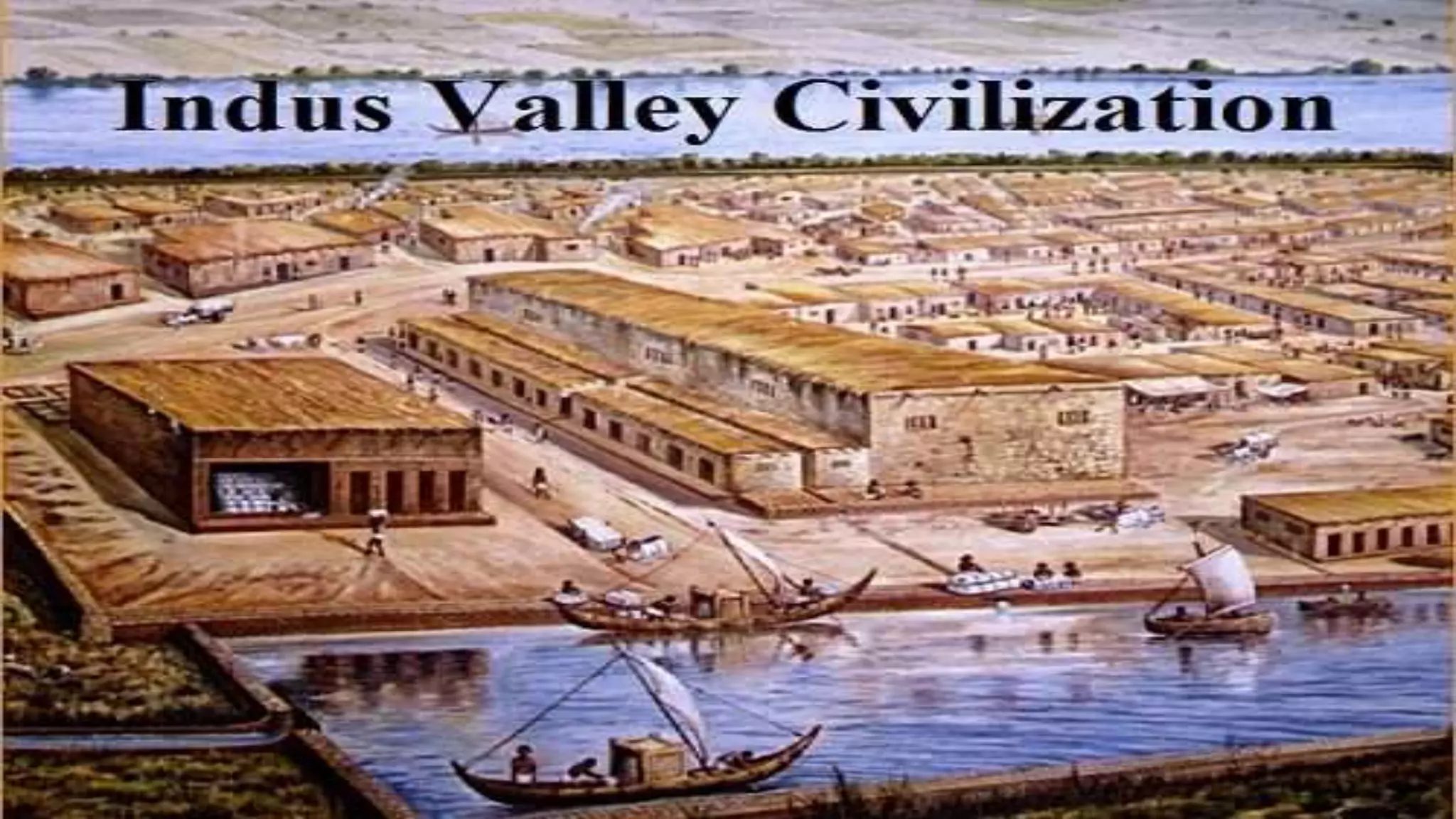
Indus Valley Civilization
Ma'am Dhanak Fatima
WHAT IS CIVILISATION?
• The stage of human social
development and organisation which
is considered most advanced.
• Or simply, the society, culture and
lifestyle of people in a particular area.
Ancient Civilizations
• All major ancient civilizations were established along the
banks of major river.
• The abundance of agriculture due to fertile land helped
the Civilization to thrive.
• There is no credible evidence to establish anyone
Civilization as the earliest/first Civilization to have been
established.
• Indus Valley Civilization was an ancient civilization
that thrived along the course of Indus river in North-
Western part of Indian subcontinent.
• It was also the period of the Bronze Age.
• It is also referred to as Harappan Civilization owing to
the fact that this civilization was first discovered in 1921
at the modern site of Harappa situated in the Punjab
province Punjab of current day Pakistan.
Geographical History Of Indus Civilization
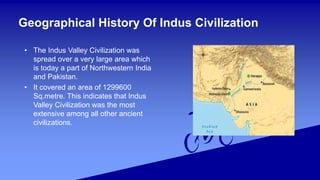
• The Indus Valley Civilization was
spread over a very large area which
is today a part of Northwestern India
and Pakistan.
• It covered an area of 1299600
Sq.metre. This indicates that Indus
Valley Civilization was the most
extensive among all other ancient
civilizations.
Important Cities and sites
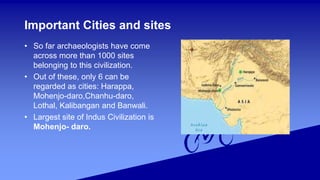
• So far archaeologists have come
across more than 1000 sites
belonging to this civilization.
• Out of these, only 6 can be
regarded as cities: Harappa,
Mohenjo-daro,Chanhu-daro,
Lothal, Kalibangan and Banwali.
• Largest site of Indus Civilization is
Mohenjo- daro.
Major Sites of Indus Valley Civilization
• Harappa (after which the civilization was named) was the
largest city and is thought to have been the capital.
• Mohenjodaro was the second largest city and was most
likely the capital of one Harappa’s provinces. Each city is
estimated to have housed up to 80,000 people, quite
large for that time period. They also had a precise
measuring system as well as a written language.
Important Features of Indus Valley Civilization
Indus Valley civilization Town Planning
• Town planning was the hallmark of
Harappan culture.
• Harappan towns and cities were built
as per grid pattern wherein roads and
by lanes bisected each other at right
angles.
• Drainage system in Indus Civilization
towns was very impressive.
• Large places for communal bath were
found as a part of the towns.
Architecture
The architecture of the Harappan civilization was unique for its day.
The cities were designed in an extremely uniform and organized
manner on a grand scale. It appears that the engineers planned
the city before they built it, resulting in much more organization
than is typically seen in ancient cities. Their structures were also
uniform; they used bricks of the same material and shape for all of
their structures. It wasn’t just one city that was built the same way;
the two major cities (i.e. Harappa and Mohenjodaro) both had
bricks the same size. This consistent engineering is very
impressive.
Agriculture
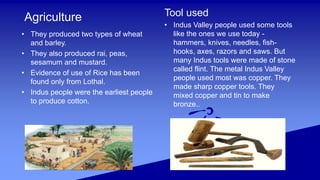
• They produced two types of wheat
and barley.
• They also produced rai, peas,
sesamum and mustard.
• Evidence of use of Rice has been
found only from Lothal.
• Indus people were the earliest people
to produce cotton.
Tool used
• Indus Valley people used some tools
like the ones we use today -
hammers, knives, needles, fish-
hooks, axes, razors and saws. But
many Indus tools were made of stone
called flint. The metal Indus Valley
people used most was copper. They
made sharp copper tools. They
mixed copper and tin to make
bronze..
Making Pots
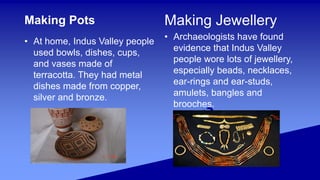
• At home, Indus Valley people
used bowls, dishes, cups,
and vases made of
terracotta. They had metal
dishes made from copper,
silver and bronze.
Making Jewellery
• Archaeologists have found
evidence that Indus Valley
people wore lots of jewellery,
especially beads, necklaces,
ear-rings and ear-studs,
amulets, bangles and
brooches.
What does Indus Valley writing tell us?
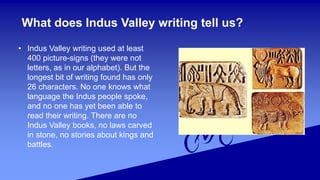
• Indus Valley writing used at least
400 picture-signs (they were not
letters, as in our alphabet). But the
longest bit of writing found has only
26 characters. No one knows what
language the Indus people spoke,
and no one has yet been able to
read their writing. There are no
Indus Valley books, no laws carved
in stone, no stories about kings and
battles.
Clothes
Pictures on seals and other artefact
show us how some Indus people
dressed. It was hot all year round, so
people did not need thick clothes to
keep warm. Many workmen probably
just wore a loincloth, which looked a bit
like baggy shorts. Rich men wore
tunics. Women wore dresses that
probably covered much of the body
though some might have been topless.
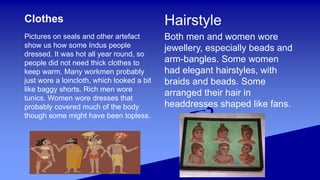
Hairstyle
Both men and women wore
jewellery, especially beads and
arm-bangles. Some women
had elegant hairstyles, with
braids and beads. Some
arranged their hair in
headdresses shaped like fans.
Decline of the civilization
Three most prevalent theories for the decline of the
civilization are:
1) Invasion by conquerors like the Aryans.
2) Ecological disturbances like low rainfall, floods,
change in the course of the river.
3) Natural Disaster like earthquakes.

Indus Valley Civilization

  • 2.
    Pak Studies Alishba Ishaq IndusValley Civilization Ma'am Dhanak Fatima
  • 3.
    WHAT IS CIVILISATION? •The stage of human social development and organisation which is considered most advanced. • Or simply, the society, culture and lifestyle of people in a particular area.
  • 4.
    Ancient Civilizations • Allmajor ancient civilizations were established along the banks of major river. • The abundance of agriculture due to fertile land helped the Civilization to thrive. • There is no credible evidence to establish anyone Civilization as the earliest/first Civilization to have been established.
  • 5.
    • Indus ValleyCivilization was an ancient civilization that thrived along the course of Indus river in North- Western part of Indian subcontinent. • It was also the period of the Bronze Age. • It is also referred to as Harappan Civilization owing to the fact that this civilization was first discovered in 1921 at the modern site of Harappa situated in the Punjab province Punjab of current day Pakistan.
  • 6.
    Geographical History OfIndus Civilization • The Indus Valley Civilization was spread over a very large area which is today a part of Northwestern India and Pakistan. • It covered an area of 1299600 Sq.metre. This indicates that Indus Valley Civilization was the most extensive among all other ancient civilizations.
  • 7.
    Important Cities andsites • So far archaeologists have come across more than 1000 sites belonging to this civilization. • Out of these, only 6 can be regarded as cities: Harappa, Mohenjo-daro,Chanhu-daro, Lothal, Kalibangan and Banwali. • Largest site of Indus Civilization is Mohenjo- daro.
  • 8.
    Major Sites ofIndus Valley Civilization • Harappa (after which the civilization was named) was the largest city and is thought to have been the capital. • Mohenjodaro was the second largest city and was most likely the capital of one Harappa’s provinces. Each city is estimated to have housed up to 80,000 people, quite large for that time period. They also had a precise measuring system as well as a written language.
  • 9.
    Important Features ofIndus Valley Civilization Indus Valley civilization Town Planning • Town planning was the hallmark of Harappan culture. • Harappan towns and cities were built as per grid pattern wherein roads and by lanes bisected each other at right angles. • Drainage system in Indus Civilization towns was very impressive. • Large places for communal bath were found as a part of the towns.
  • 10.
    Architecture The architecture ofthe Harappan civilization was unique for its day. The cities were designed in an extremely uniform and organized manner on a grand scale. It appears that the engineers planned the city before they built it, resulting in much more organization than is typically seen in ancient cities. Their structures were also uniform; they used bricks of the same material and shape for all of their structures. It wasn’t just one city that was built the same way; the two major cities (i.e. Harappa and Mohenjodaro) both had bricks the same size. This consistent engineering is very impressive.
  • 11.
    Agriculture • They producedtwo types of wheat and barley. • They also produced rai, peas, sesamum and mustard. • Evidence of use of Rice has been found only from Lothal. • Indus people were the earliest people to produce cotton. Tool used • Indus Valley people used some tools like the ones we use today - hammers, knives, needles, fish- hooks, axes, razors and saws. But many Indus tools were made of stone called flint. The metal Indus Valley people used most was copper. They made sharp copper tools. They mixed copper and tin to make bronze..
  • 12.
    Making Pots • Athome, Indus Valley people used bowls, dishes, cups, and vases made of terracotta. They had metal dishes made from copper, silver and bronze. Making Jewellery • Archaeologists have found evidence that Indus Valley people wore lots of jewellery, especially beads, necklaces, ear-rings and ear-studs, amulets, bangles and brooches.
  • 13.
    What does IndusValley writing tell us? • Indus Valley writing used at least 400 picture-signs (they were not letters, as in our alphabet). But the longest bit of writing found has only 26 characters. No one knows what language the Indus people spoke, and no one has yet been able to read their writing. There are no Indus Valley books, no laws carved in stone, no stories about kings and battles.
  • 14.
    Clothes Pictures on sealsand other artefact show us how some Indus people dressed. It was hot all year round, so people did not need thick clothes to keep warm. Many workmen probably just wore a loincloth, which looked a bit like baggy shorts. Rich men wore tunics. Women wore dresses that probably covered much of the body though some might have been topless. Hairstyle Both men and women wore jewellery, especially beads and arm-bangles. Some women had elegant hairstyles, with braids and beads. Some arranged their hair in headdresses shaped like fans.
  • 15.
    Decline of thecivilization Three most prevalent theories for the decline of the civilization are: 1) Invasion by conquerors like the Aryans. 2) Ecological disturbances like low rainfall, floods, change in the course of the river. 3) Natural Disaster like earthquakes.