Research Methodology 
Chapter 1 
Nagendra Amatya 
Associate Professor 
Science and Humanities Department 
Central Campus Pulchowk 
nbamatya@ioe.edu.np
Introduction 
• Conceptualization of Research 
• Nature of research types of research 
• Qualities of research 
• Place of theory in research 
• Relationship of theory and facts 
• Research process
Introduction 
YOUR RESEARCH 
Research can be one of the most interesting features of any 
degree course as it offers you a measure of control and autonomy 
over what you learn. It gives you an opportunity to confirm, clarify, 
pursue – or even discover – new aspects of a subject or topic you 
are interested in. 
RESEARCH IS… 
…….. a process of enquiry and investigation; it is systematic, 
methodical and ethical; research can help solve practical problems 
and increase knowledge.
Introduction cont.. 
THE PURPOSE OF RESEARCH IS TO… 
 Review or synthesize existing knowledge 
 Investigate existing situations or problems 
 Provide solutions to problems 
 Explore and analyse more general issues 
 Construct or create new procedures or systems 
 Explain new phenomenon 
 Generate new knowledge 
 …or a combination of any of the above! 
(Collis & Hussey, 2003)
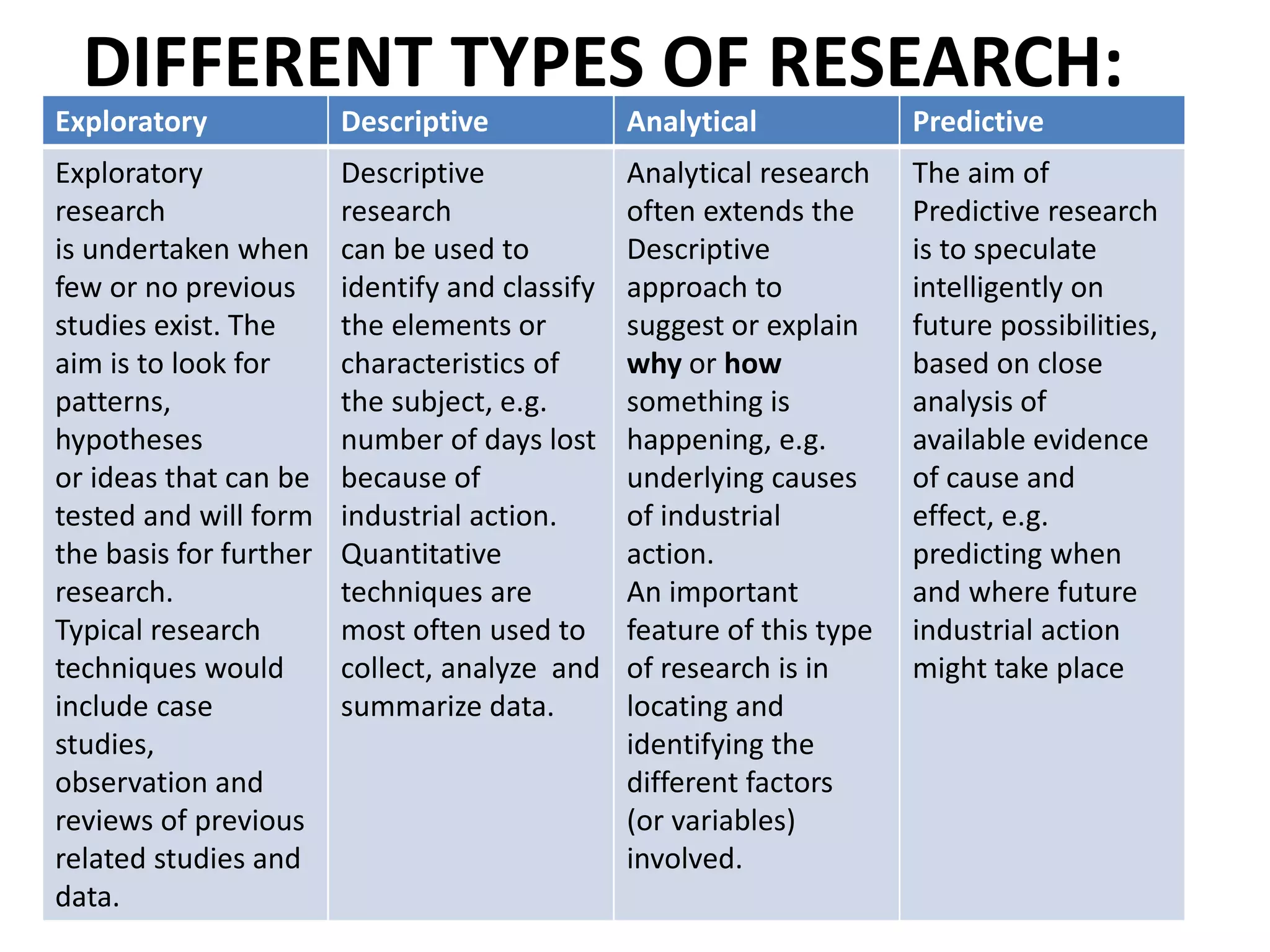
DIFFERENT TYPES OF RESEARCH: 
Exploratory Descriptive Analytical Predictive 
Exploratory 
Descriptive 
Analytical research 
research 
research 
often extends the 
is undertaken when 
can be used to 
Descriptive 
few or no previous 
identify and classify 
approach to 
studies exist. The 
the elements or 
suggest or explain 
aim is to look for 
characteristics of 
why or how 
patterns, 
the subject, e.g. 
something is 
hypotheses 
number of days lost 
happening, e.g. 
or ideas that can be 
because of 
underlying causes 
tested and will form 
industrial action. 
of industrial 
the basis for further 
Quantitative 
action. 
research. 
techniques are 
An important 
Typical research 
most often used to 
feature of this type 
techniques would 
collect, analyze and 
of research is in 
include case 
summarize data. 
locating and 
studies, 
identifying the 
observation and 
different factors 
reviews of previous 
(or variables) 
related studies and 
involved. 
data. 
The aim of 
Predictive research 
is to speculate 
intelligently on 
future possibilities, 
based on close 
analysis of 
available evidence 
of cause and 
effect, e.g. 
predicting when 
and where future 
industrial action 
might take place
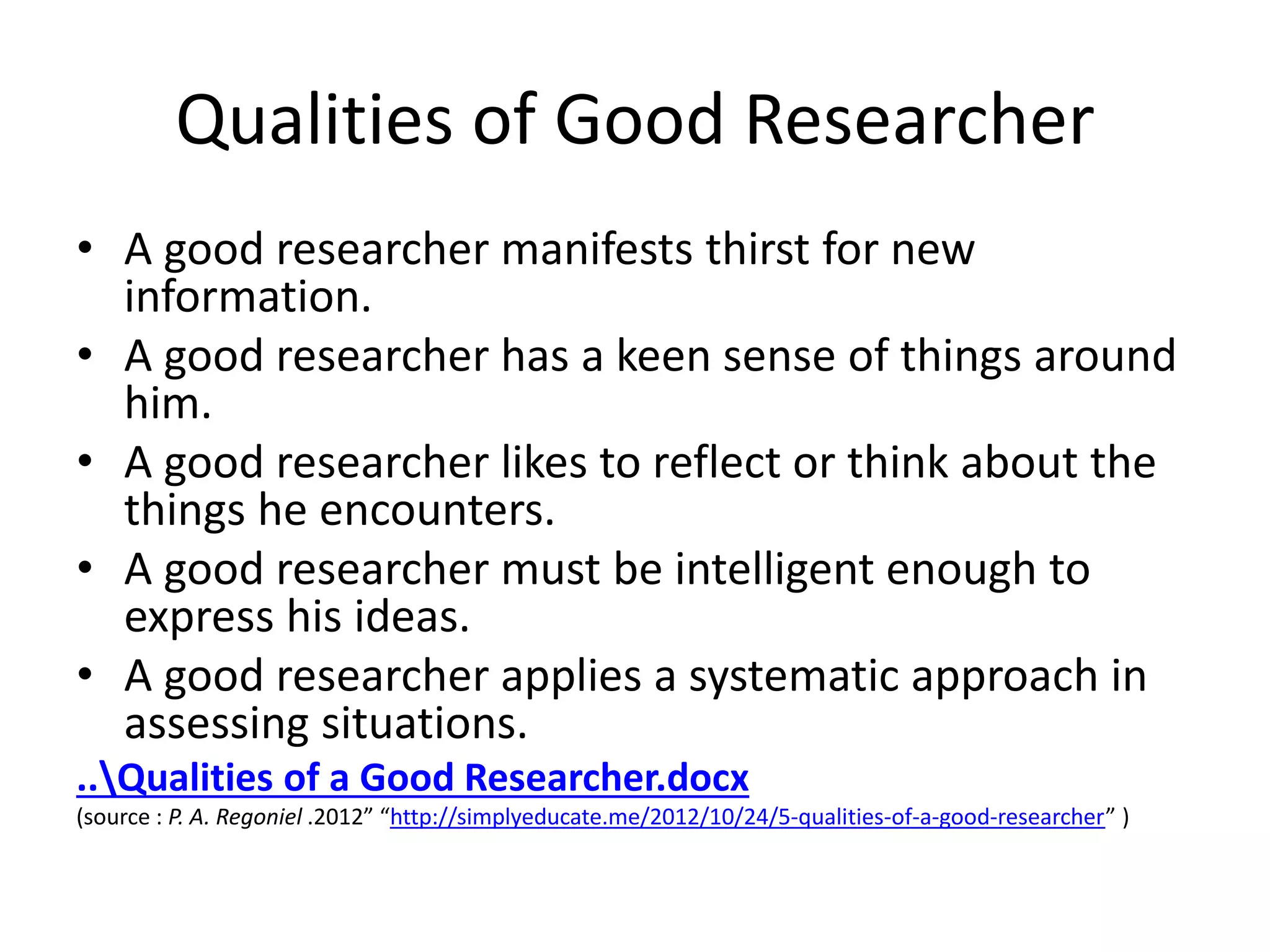
Qualities of Good Researcher 
• A good researcher manifests thirst for new 
information. 
• A good researcher has a keen sense of things around 
him. 
• A good researcher likes to reflect or think about the 
things he encounters. 
• A good researcher must be intelligent enough to 
express his ideas. 
• A good researcher applies a systematic approach in 
assessing situations. 
..Qualities of a Good Researcher.docx 
(source : P. A. Regoniel .2012” “http://simplyeducate.me/2012/10/24/5-qualities-of-a-good-researcher” )
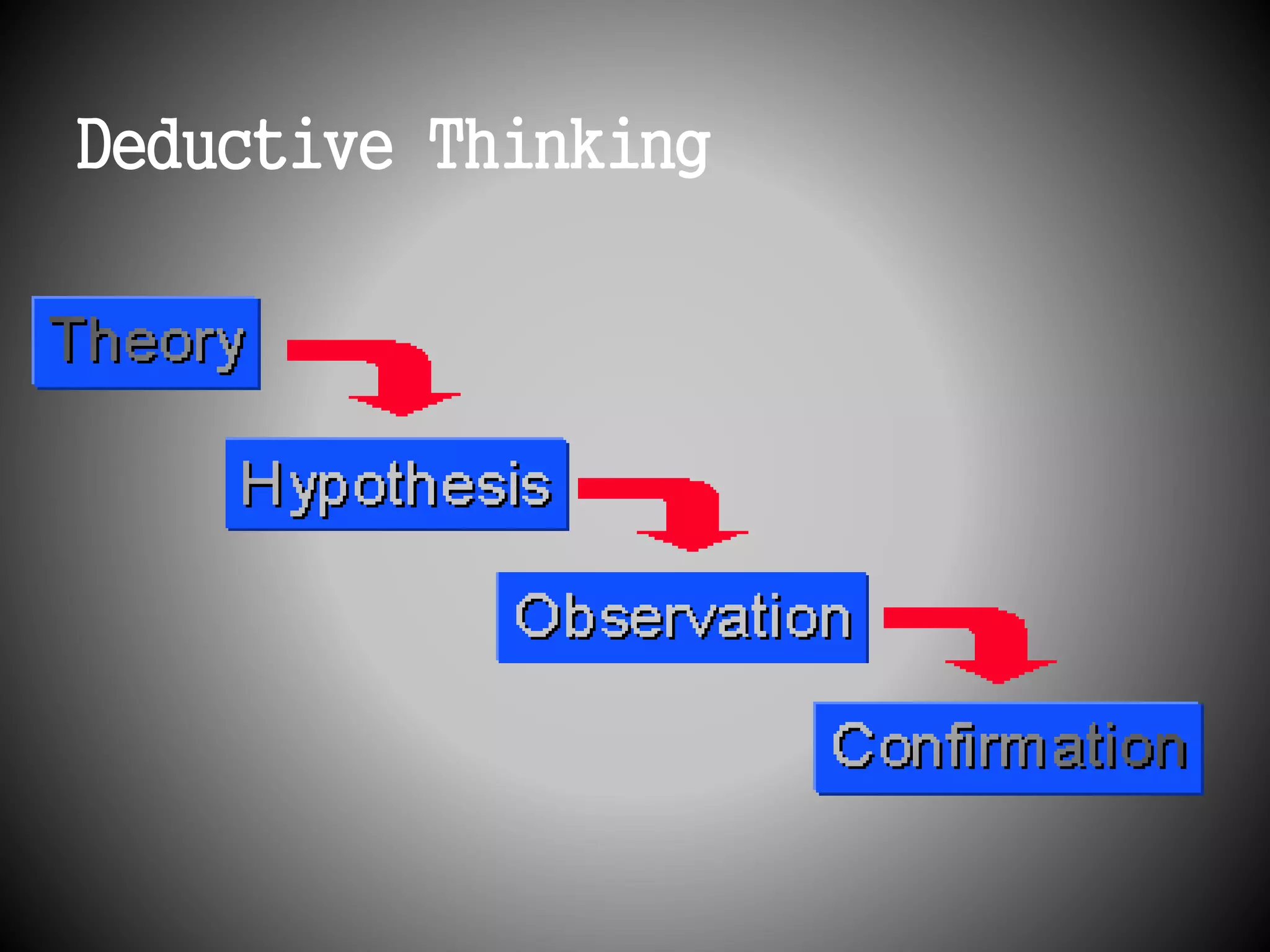
Deductive Thinking
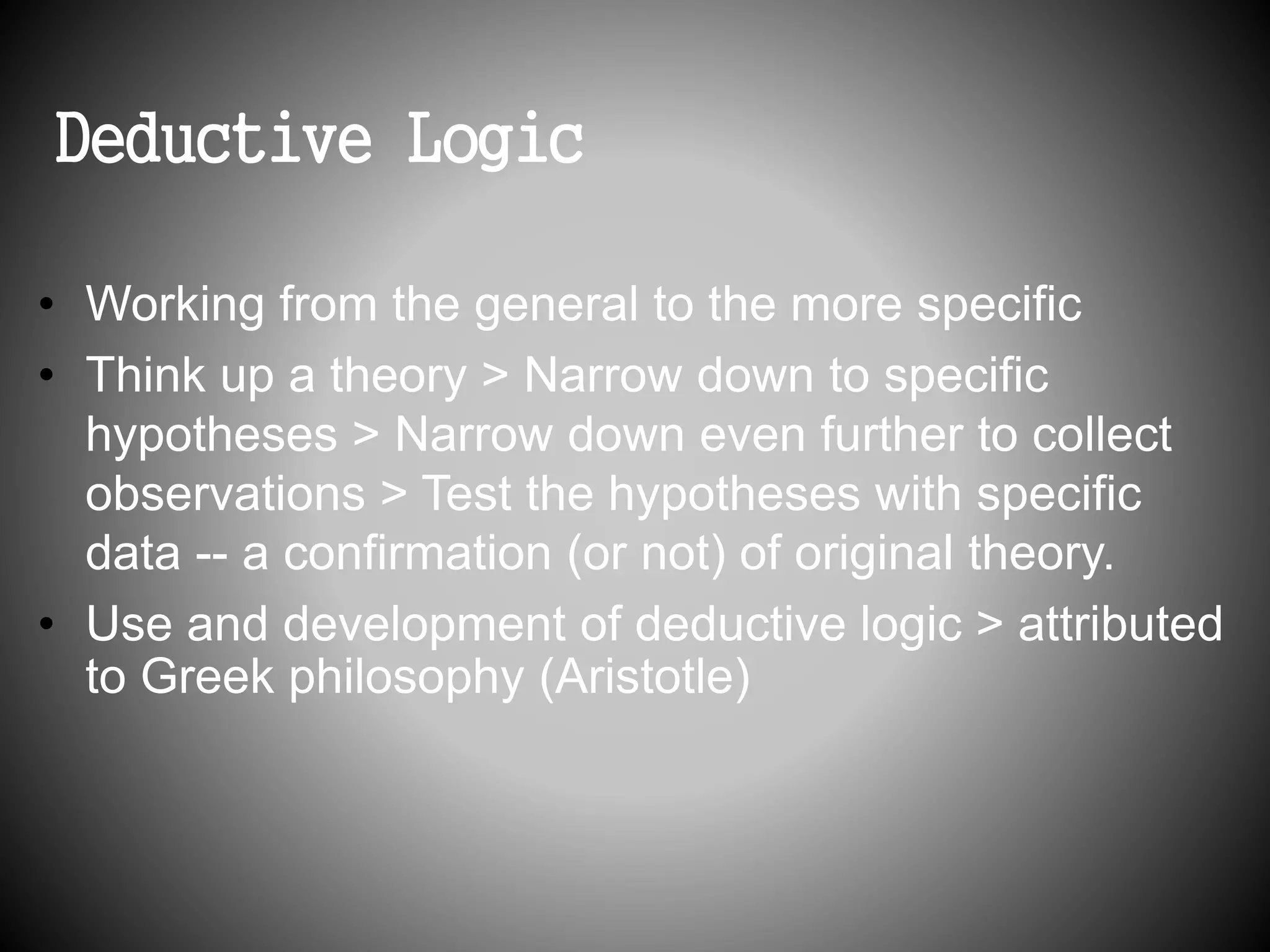
Deductive Logic 
• Working from the general to the more specific 
• Think up a theory > Narrow down to specific 
hypotheses > Narrow down even further to collect 
observations > Test the hypotheses with specific 
data -- a confirmation (or not) of original theory. 
• Use and development of deductive logic > attributed 
to Greek philosophy (Aristotle)
Deduction 
The Deductive approach begins explicitly with a 
theory (which could provide a possible answer or 
explanation for a particular problem) used to 
postulate tentative hypothesis or set of hypotheses, 
then proceeds to use observations to rigorously test 
the hypotheses.
The Deductive argument moves from premises, at 
least one of which is a general or universal 
statement, to a conclusion that is a singular 
statement. 
• Deductive propositions form a hierarchy from 
theoretical to observational; from abstract to 
concrete. 
• The Deductivist accepts that observation is 
guided and presupposed by the theory.
Deduction -Falsification 
•Attempts are made to refute the hypotheses 
through rigorous criticism and testing. If the data 
derived by testing the hypothesis is not consistent 
with the predicted conclusions, the theory must be 
false. 
•Surviving theories are corroborated, but are never 
proved true despite withstanding testing and 
observation. 
•A current theory is superior to its predecessors 
only because it has withstood tests which falsified 
its predecessor.
Inductive Thinking
Inductive Approach 
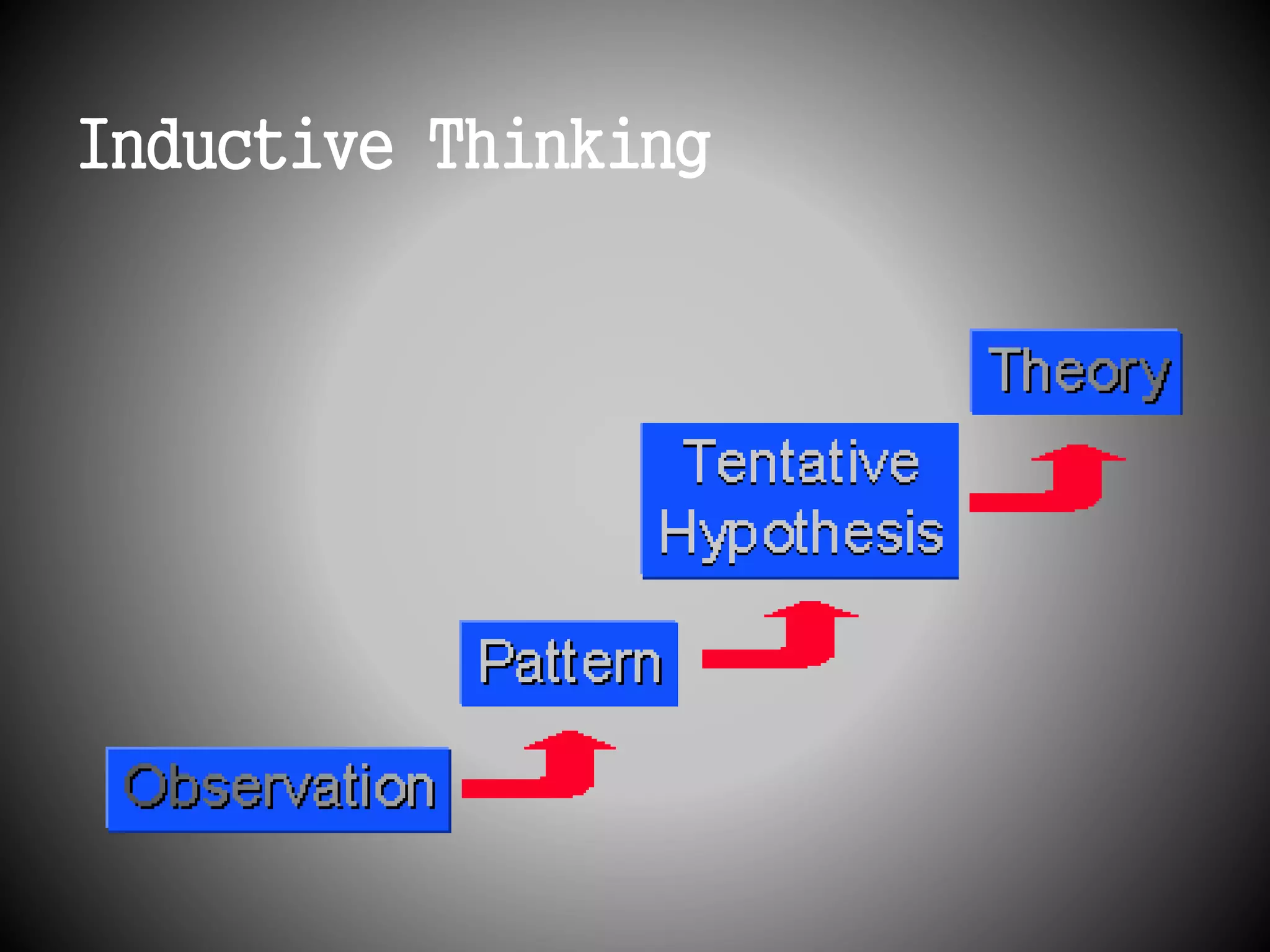
• Working from the specific to the general 
(theories) 
• Specific observations >> patterns and 
regularities >> tentative hypotheses >> tests 
(further observations) >> extended to general 
conclusions or theories 
• Perfect induction >> Baconian induction 
• Imperfect Inductions >> limited observations 
and generalization >> certainty of the 
generalization and concept of probability >> 
continuous reassessment.
Induction 
The Inductive approach to enquiry builds 
generalizations out of observations of specific 
events. It starts with singular or particular 
statements and ends up with general or universal 
propositions. 
It presupposes that explanations about the 
workings of the world should be based on facts 
gained from pure, dispassionate and neutral 
observation, rather than on preconceived notions; 
that nature will reveal itself to a passively 
receptive mind.
Induction (Continued) 
•The Inductive strategy assumes that all science 
starts with observations which provide a secure 
basis from which knowledge can be derived and 
claims that reality impinges directly on the 
senses. 
•The conclusion of an inductive argument makes 
claims that exceed what is contained in the 
premises and so promises to extend knowledge by 
going beyond actual experience. 
•The more observations that demonstrate, say, a 
relationship between phenomena, the higher the 
probability that the general statement is true.
Mix of Inductive and Deductive 
Logic 
• Natural sciences > usually deductive and also 
objective (greater store of theories?) > 
Mathematics is almost totally deductive 
• Social sciences > inductive and also normative 
in many instances. 
• These days: Research methods use both types of 
logics in their procedure and methodologies 
• Methods specific to nature of discipline, 
problem and objectives of research.
Combined approach 
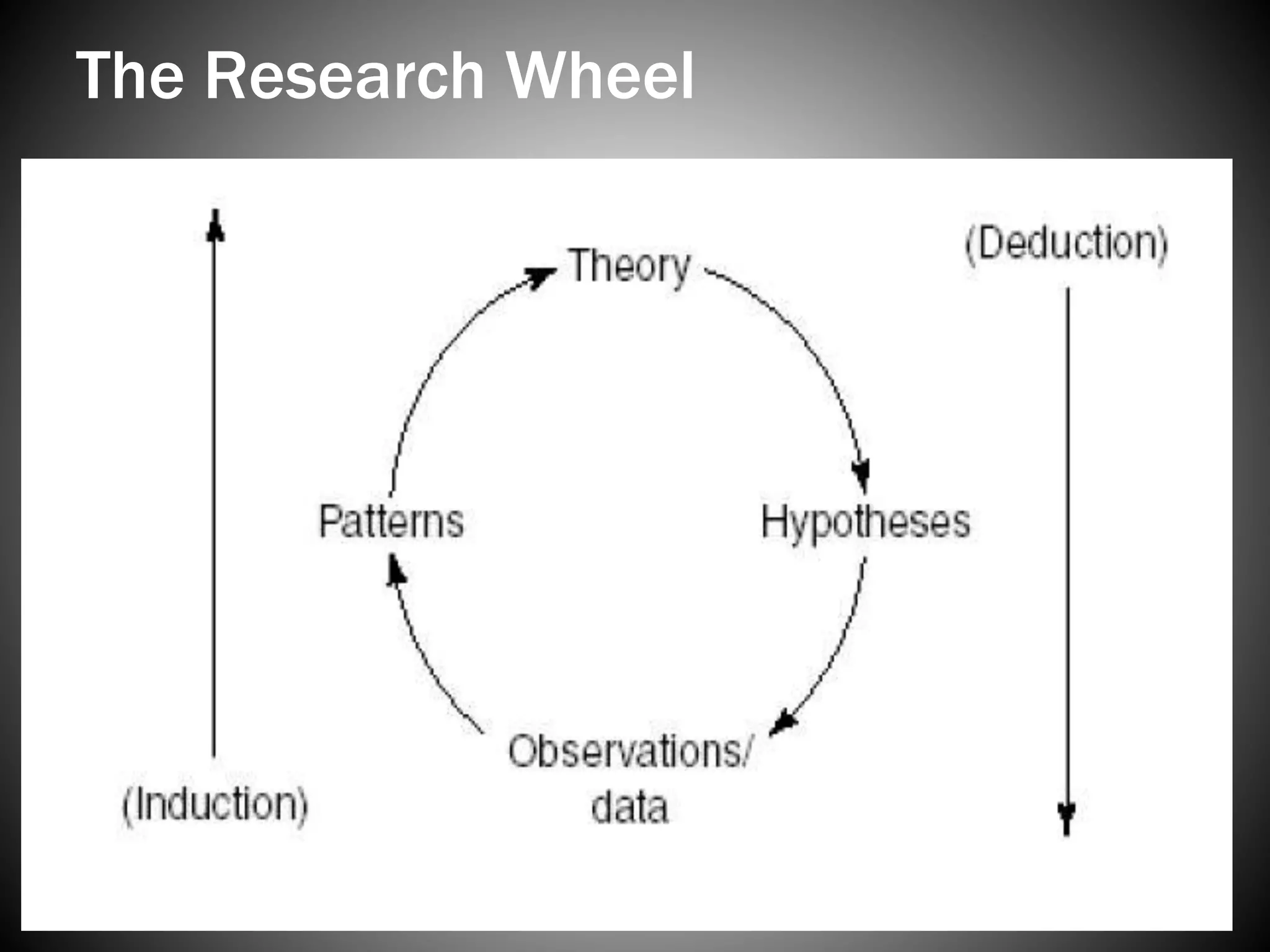
A scheme has been proposed by Wallace 
(1971) that combines Inductive and 
Deductive strategies to capitalize on 
their strengths and minimize their 
weaknesses creating a cyclic process that 
allows for movement between theorizing 
and doing empirical research while using 
both Inductive and Deductive methods of 
reasoning.
The Research Wheel
Retroduction 
Retroductive research logic involves the 
building of hypothetical models as a way of 
uncovering the real structures and mechanisms 
which are assumed to produce empirical 
phenomena. The model, if it were to exist and 
act in the postulated way, would account for 
the phenomena in question. In constructing 
these models of mechanisms that have usually 
never been observed, ideas may be borrowed from 
known structures and mechanisms in other 
fields.
A phenomena or range of phenomena is 
identified, explanations based on the 
postulated existence of a generative mechanism 
is constructed and empirically tested, and this 
mechanism then becomes the phenomenon to be 
explained and the cycle repeats. 
Astronomical examples: 
heliocentric model/Geocentric model, 
earth’s tilt and rotation and changing length of days 
motion/s of earth, moon and sun and eclipses
Retroduction has 'hypothesis formulation' as 
the first stage of an enquiry. Here, a 
hypothesis must eliminate puzzlement as a 
necessary first step. 
The hypothesis must be tested using both 
Deduction and Induction; in the second stage of 
an enquiry, consequences are deducted from the 
hypothesis and, in the third stage, these 
consequences are tested by means of Induction.
Retroduction differs from Induction which infers 
from one set of facts, another set of facts, 
whereas Retroduction infers from facts of one 
kind, to facts of another.
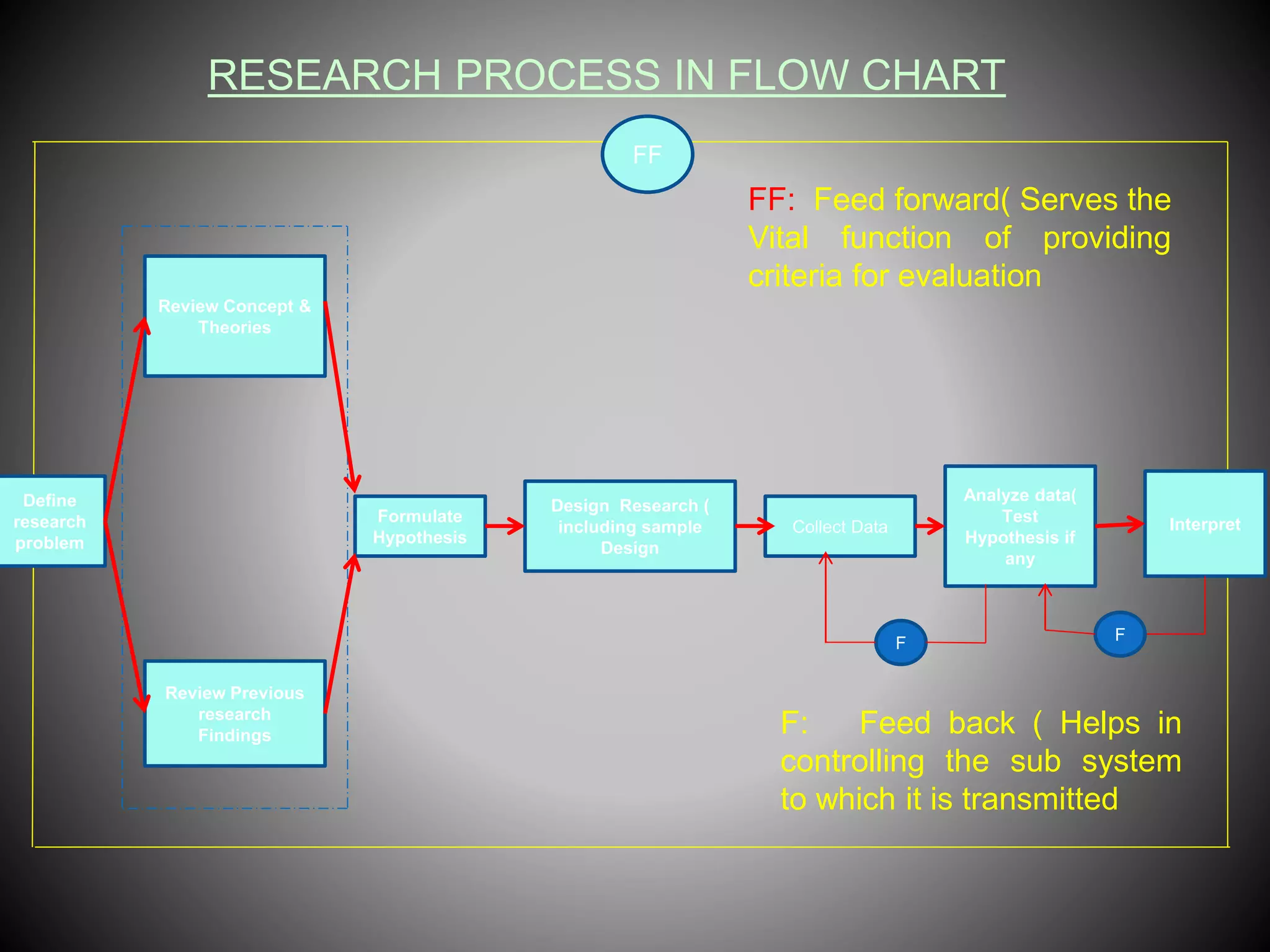
RESEARCH PROCESS IN FLOW CHART 
FF 
Define 
research 
problem 
Review Concept & 
Theories 
Review Previous 
research 
Findings 
Formulate 
Hypothesis 
Design Research ( 
including sample 
Design 
FF: Feed forward( Serves the 
Vital function of providing 
criteria for evaluation 
Collect Data 
Analyze data( 
Test 
Hypothesis if 
any 
Interpret 
F 
F 
F: Feed back ( Helps in 
controlling the sub system 
to which it is transmitted

Research methodology Chapter 1

  • 1.
    Research Methodology Chapter1 Nagendra Amatya Associate Professor Science and Humanities Department Central Campus Pulchowk nbamatya@ioe.edu.np
  • 2.
    Introduction • Conceptualizationof Research • Nature of research types of research • Qualities of research • Place of theory in research • Relationship of theory and facts • Research process
  • 3.
    Introduction YOUR RESEARCH Research can be one of the most interesting features of any degree course as it offers you a measure of control and autonomy over what you learn. It gives you an opportunity to confirm, clarify, pursue – or even discover – new aspects of a subject or topic you are interested in. RESEARCH IS… …….. a process of enquiry and investigation; it is systematic, methodical and ethical; research can help solve practical problems and increase knowledge.
  • 4.
    Introduction cont.. THEPURPOSE OF RESEARCH IS TO…  Review or synthesize existing knowledge  Investigate existing situations or problems  Provide solutions to problems  Explore and analyse more general issues  Construct or create new procedures or systems  Explain new phenomenon  Generate new knowledge  …or a combination of any of the above! (Collis & Hussey, 2003)
  • 5.
    DIFFERENT TYPES OFRESEARCH: Exploratory Descriptive Analytical Predictive Exploratory Descriptive Analytical research research research often extends the is undertaken when can be used to Descriptive few or no previous identify and classify approach to studies exist. The the elements or suggest or explain aim is to look for characteristics of why or how patterns, the subject, e.g. something is hypotheses number of days lost happening, e.g. or ideas that can be because of underlying causes tested and will form industrial action. of industrial the basis for further Quantitative action. research. techniques are An important Typical research most often used to feature of this type techniques would collect, analyze and of research is in include case summarize data. locating and studies, identifying the observation and different factors reviews of previous (or variables) related studies and involved. data. The aim of Predictive research is to speculate intelligently on future possibilities, based on close analysis of available evidence of cause and effect, e.g. predicting when and where future industrial action might take place
  • 6.
    Qualities of GoodResearcher • A good researcher manifests thirst for new information. • A good researcher has a keen sense of things around him. • A good researcher likes to reflect or think about the things he encounters. • A good researcher must be intelligent enough to express his ideas. • A good researcher applies a systematic approach in assessing situations. ..Qualities of a Good Researcher.docx (source : P. A. Regoniel .2012” “http://simplyeducate.me/2012/10/24/5-qualities-of-a-good-researcher” )
  • 7.
  • 8.
    Deductive Logic •Working from the general to the more specific • Think up a theory > Narrow down to specific hypotheses > Narrow down even further to collect observations > Test the hypotheses with specific data -- a confirmation (or not) of original theory. • Use and development of deductive logic > attributed to Greek philosophy (Aristotle)
  • 9.
    Deduction The Deductiveapproach begins explicitly with a theory (which could provide a possible answer or explanation for a particular problem) used to postulate tentative hypothesis or set of hypotheses, then proceeds to use observations to rigorously test the hypotheses.
  • 10.
    The Deductive argumentmoves from premises, at least one of which is a general or universal statement, to a conclusion that is a singular statement. • Deductive propositions form a hierarchy from theoretical to observational; from abstract to concrete. • The Deductivist accepts that observation is guided and presupposed by the theory.
  • 11.
    Deduction -Falsification •Attemptsare made to refute the hypotheses through rigorous criticism and testing. If the data derived by testing the hypothesis is not consistent with the predicted conclusions, the theory must be false. •Surviving theories are corroborated, but are never proved true despite withstanding testing and observation. •A current theory is superior to its predecessors only because it has withstood tests which falsified its predecessor.
  • 12.
  • 13.
    Inductive Approach •Working from the specific to the general (theories) • Specific observations >> patterns and regularities >> tentative hypotheses >> tests (further observations) >> extended to general conclusions or theories • Perfect induction >> Baconian induction • Imperfect Inductions >> limited observations and generalization >> certainty of the generalization and concept of probability >> continuous reassessment.
  • 14.
    Induction The Inductiveapproach to enquiry builds generalizations out of observations of specific events. It starts with singular or particular statements and ends up with general or universal propositions. It presupposes that explanations about the workings of the world should be based on facts gained from pure, dispassionate and neutral observation, rather than on preconceived notions; that nature will reveal itself to a passively receptive mind.
  • 15.
    Induction (Continued) •TheInductive strategy assumes that all science starts with observations which provide a secure basis from which knowledge can be derived and claims that reality impinges directly on the senses. •The conclusion of an inductive argument makes claims that exceed what is contained in the premises and so promises to extend knowledge by going beyond actual experience. •The more observations that demonstrate, say, a relationship between phenomena, the higher the probability that the general statement is true.
  • 16.
    Mix of Inductiveand Deductive Logic • Natural sciences > usually deductive and also objective (greater store of theories?) > Mathematics is almost totally deductive • Social sciences > inductive and also normative in many instances. • These days: Research methods use both types of logics in their procedure and methodologies • Methods specific to nature of discipline, problem and objectives of research.
  • 17.
    Combined approach Ascheme has been proposed by Wallace (1971) that combines Inductive and Deductive strategies to capitalize on their strengths and minimize their weaknesses creating a cyclic process that allows for movement between theorizing and doing empirical research while using both Inductive and Deductive methods of reasoning.
  • 18.
  • 19.
    Retroduction Retroductive researchlogic involves the building of hypothetical models as a way of uncovering the real structures and mechanisms which are assumed to produce empirical phenomena. The model, if it were to exist and act in the postulated way, would account for the phenomena in question. In constructing these models of mechanisms that have usually never been observed, ideas may be borrowed from known structures and mechanisms in other fields.
  • 20.
    A phenomena orrange of phenomena is identified, explanations based on the postulated existence of a generative mechanism is constructed and empirically tested, and this mechanism then becomes the phenomenon to be explained and the cycle repeats. Astronomical examples: heliocentric model/Geocentric model, earth’s tilt and rotation and changing length of days motion/s of earth, moon and sun and eclipses
  • 21.
    Retroduction has 'hypothesisformulation' as the first stage of an enquiry. Here, a hypothesis must eliminate puzzlement as a necessary first step. The hypothesis must be tested using both Deduction and Induction; in the second stage of an enquiry, consequences are deducted from the hypothesis and, in the third stage, these consequences are tested by means of Induction.
  • 22.
    Retroduction differs fromInduction which infers from one set of facts, another set of facts, whereas Retroduction infers from facts of one kind, to facts of another.
  • 24.
    RESEARCH PROCESS INFLOW CHART FF Define research problem Review Concept & Theories Review Previous research Findings Formulate Hypothesis Design Research ( including sample Design FF: Feed forward( Serves the Vital function of providing criteria for evaluation Collect Data Analyze data( Test Hypothesis if any Interpret F F F: Feed back ( Helps in controlling the sub system to which it is transmitted