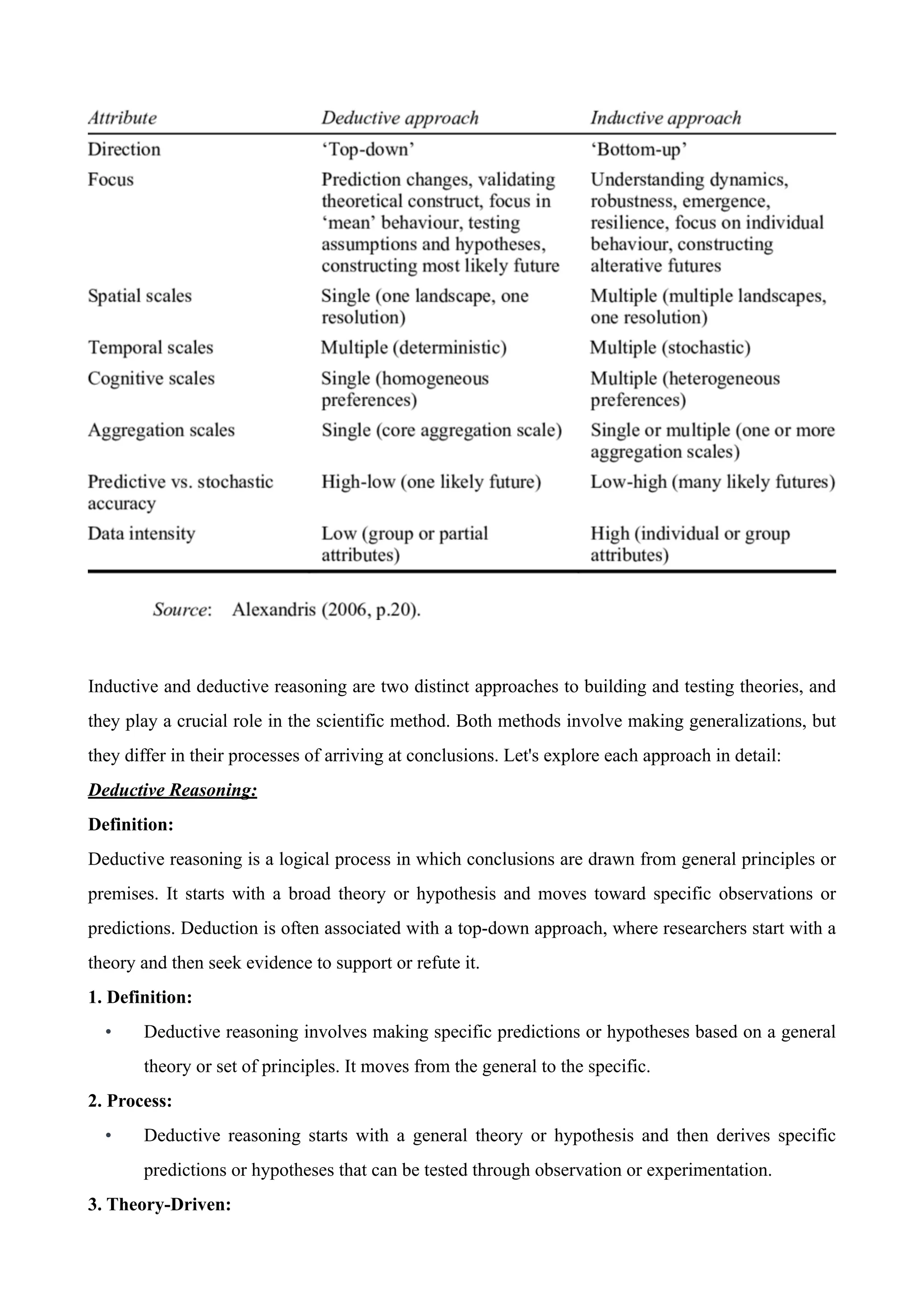
Inductive and deductive reasoning are two distinct approaches to building and testing theories, and
they play a crucial role in the scientific method. Both methods involve making generalizations, but
they differ in their processes of arriving at conclusions. Let's explore each approach in detail:
Deductive Reasoning:
Definition:
Deductive reasoning is a logical process in which conclusions are drawn from general principles or
premises. It starts with a broad theory or hypothesis and moves toward specific observations or
predictions. Deduction is often associated with a top-down approach, where researchers start with a
theory and then seek evidence to support or refute it.
1. Definition:
• Deductive reasoning involves making specific predictions or hypotheses based on a general
theory or set of principles. It moves from the general to the specific.
2. Process:
• Deductive reasoning starts with a general theory or hypothesis and then derives specific
predictions or hypotheses that can be tested through observation or experimentation.
3. Theory-Driven:
• The process begins with a well-established theory or hypothesis. Specific predictions are
then made based on this theory, and these predictions guide empirical testing.
4. Top-Down Approach:
• Deductive reasoning is often described as a top-down approach, as it starts with overarching
principles and deduces specific expectations or predictions.
5. Hypothesis Testing:
• Deductive theory development involves formulating specific hypotheses that can be tested
through empirical research. These hypotheses are derived from the general principles of the
theory.
6. Example:
• General theory: "All men are mortal."
• Deductive conclusion: "Socrates is a man, therefore, Socrates is mortal."
7. Strengths:
• Deductive reasoning provides a systematic and structured approach to theory development.
It allows for the generation of specific hypotheses that can be rigorously tested, leading to
more conclusive results.
8. Limitations:
• Deductive reasoning relies heavily on the accuracy of the initial theory or hypothesis. If the
underlying theory is flawed, the specific predictions derived from it may also be inaccurate.
Additionally, deductive reasoning may not be suitable for exploring entirely new or
uncharted areas.
In summary, inductive reasoning involves moving from specific observations to general principles,
while deductive reasoning involves moving from general principles to specific predictions or
hypotheses. Both approaches play essential roles in the scientific method, contributing to the
development and testing of theories. The choice between inductive and deductive reasoning often
depends on the nature of the research question and the available evidence.
Key Features:
• Top-Down Approach: Deductive reasoning begins with a general theory or hypothesis and
moves towards specific observations or predictions.
• Logical Certainty: If the premises are true and the logic is valid, the conclusion is
considered certain or logically necessary.
• Testable Predictions: Deductive reasoning often leads to testable predictions that can be
empirically tested through observation or experimentation.
• Common in Formal Logic: Deductive reasoning is commonly used in formal logic and
mathematical proofs.
Example:
• Theory/Hypothesis: All humans are mortal.
• Premise: Socrates is a human.
• Conclusion: Therefore, Socrates is mortal.
Inductive Reasoning:
Definition:
Inductive reasoning is a logical process in which specific observations or patterns are used to form a
general theory or hypothesis. It involves moving from specific instances to broader generalizations.
Induction is associated with a bottom-up approach, where observations lead to the formulation of
theories.
1. Definition:
• Inductive reasoning involves making generalizations based on specific observations. It
moves from specific instances to broader, more generalized conclusions.
2. Process:
• In inductive reasoning, researchers start with specific observations or data and then identify
patterns, trends, or regularities. From these patterns, they derive general principles, theories,
or hypotheses.
3. Observation-Driven:
• The process begins with collecting and analyzing specific data or observations. Patterns and
regularities are identified through a careful examination of these specific instances.
4. Bottom-Up Approach:
• Inductive reasoning is often described as a bottom-up approach, as it builds from specific
examples to form general theories or principles.
5. Theory Development:
• Inductive theory development is characterized by the emergence of theories from the ground
up, with generalizations derived from observed patterns. Theories generated through
inductive reasoning are considered more open-ended and exploratory.
6. Example:
• Specific observations: "Every observed crow is black."
• Inductive conclusion: "All crows are black."
7. Strengths:
• Inductive reasoning is valuable for generating new ideas, theories, or hypotheses. It is
particularly useful when researchers are exploring a new or poorly understood phenomenon.
8. Limitations:
• Inductive reasoning may lead to conclusions that are not universally true, as it relies on
specific observations. Additionally, it does not provide absolute certainty, as new
observations could challenge the generalizations made.
Key Features:
• Bottom-Up Approach: Inductive reasoning starts with specific observations or data and
leads to the development of general theories or conclusions.
• Probabilistic Conclusions: Conclusions drawn through inductive reasoning are considered
probabilistic rather than certain. They are based on the observed patterns, but there is always
a level of uncertainty.
• Theory Building: Inductive reasoning is particularly useful for generating new theories,
identifying patterns, and making generalizations based on observed phenomena.
• Common in Scientific Inquiry: Scientific inquiry often involves inductive reasoning,
especially in the early stages of exploration.
Example:
• Observation: Every observed crow is black.
• Conclusion: Therefore, all crows are black.
Comparing Deductive and Inductive Reasoning:
• Nature of Process:
• Deductive: Starts with a general theory or hypothesis and derives specific
predictions or observations.
• Inductive: Starts with specific observations and derives general theories or
conclusions.
• Certainty:
• Deductive: If the premises are true and the logic is valid, the conclusion is certain.
• Inductive: Conclusions are probabilistic and subject to revision based on new
observations.
• Application:
• Deductive: Commonly used in formal logic, mathematics, and hypothesis testing.
• Inductive: Often used in scientific inquiry, theory building, and pattern recognition.
• Examples:
• Deductive: All men are mortal. Socrates is a man. Therefore, Socrates is mortal.
• Inductive: Every observed instance of a comet follows an elliptical orbit. Therefore,
all comets likely follow elliptical orbits.
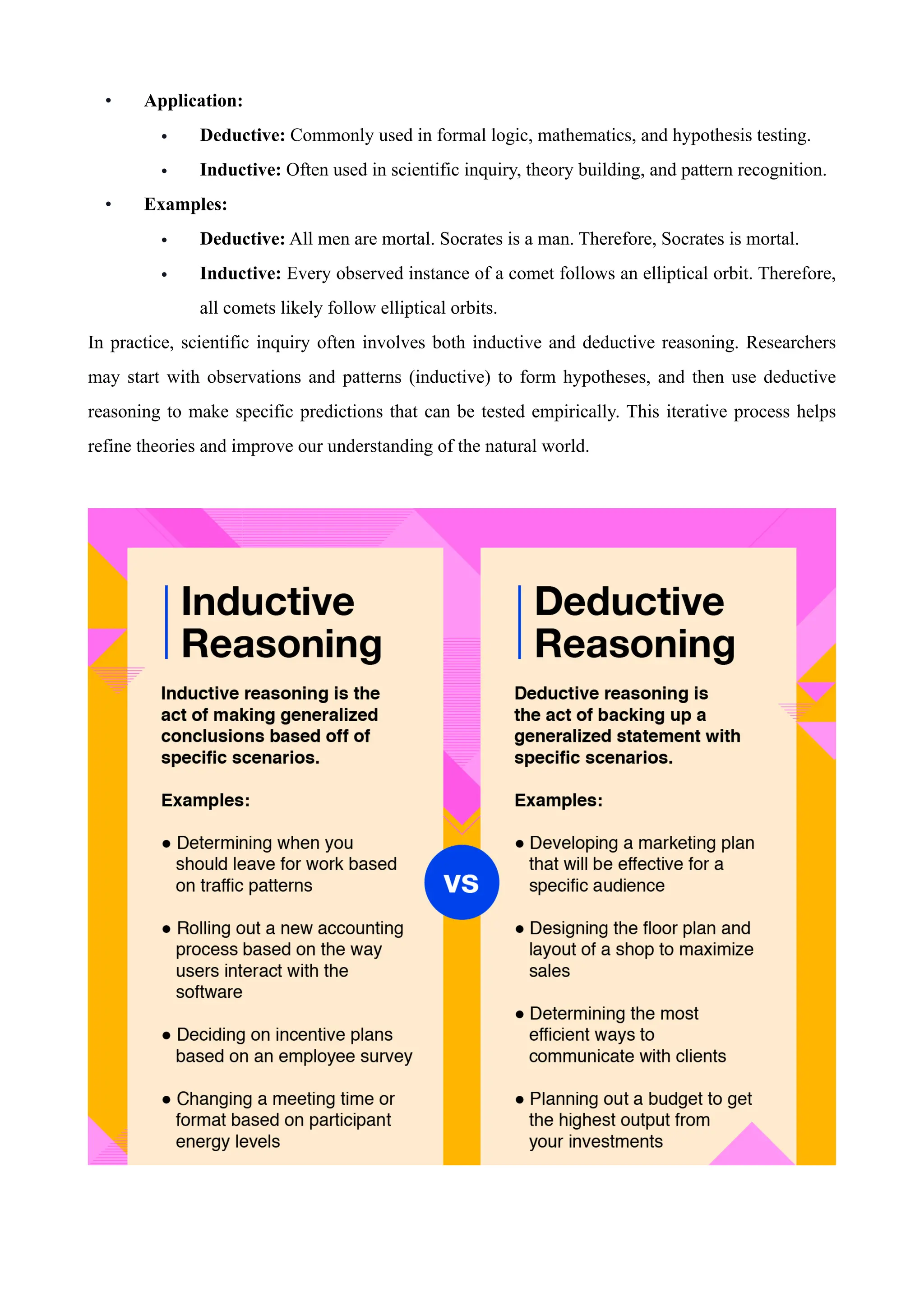
In practice, scientific inquiry often involves both inductive and deductive reasoning. Researchers
may start with observations and patterns (inductive) to form hypotheses, and then use deductive
reasoning to make specific predictions that can be tested empirically. This iterative process helps
refine theories and improve our understanding of the natural world.

Meaning & Difference: Deductive & Inductive Theory .pdf

  • 1.
    Inductive and deductivereasoning are two distinct approaches to building and testing theories, and they play a crucial role in the scientific method. Both methods involve making generalizations, but they differ in their processes of arriving at conclusions. Let's explore each approach in detail: Deductive Reasoning: Definition: Deductive reasoning is a logical process in which conclusions are drawn from general principles or premises. It starts with a broad theory or hypothesis and moves toward specific observations or predictions. Deduction is often associated with a top-down approach, where researchers start with a theory and then seek evidence to support or refute it. 1. Definition: • Deductive reasoning involves making specific predictions or hypotheses based on a general theory or set of principles. It moves from the general to the specific. 2. Process: • Deductive reasoning starts with a general theory or hypothesis and then derives specific predictions or hypotheses that can be tested through observation or experimentation. 3. Theory-Driven:
  • 2.
    • The processbegins with a well-established theory or hypothesis. Specific predictions are then made based on this theory, and these predictions guide empirical testing. 4. Top-Down Approach: • Deductive reasoning is often described as a top-down approach, as it starts with overarching principles and deduces specific expectations or predictions. 5. Hypothesis Testing: • Deductive theory development involves formulating specific hypotheses that can be tested through empirical research. These hypotheses are derived from the general principles of the theory. 6. Example: • General theory: "All men are mortal." • Deductive conclusion: "Socrates is a man, therefore, Socrates is mortal." 7. Strengths: • Deductive reasoning provides a systematic and structured approach to theory development. It allows for the generation of specific hypotheses that can be rigorously tested, leading to more conclusive results. 8. Limitations: • Deductive reasoning relies heavily on the accuracy of the initial theory or hypothesis. If the underlying theory is flawed, the specific predictions derived from it may also be inaccurate. Additionally, deductive reasoning may not be suitable for exploring entirely new or uncharted areas. In summary, inductive reasoning involves moving from specific observations to general principles, while deductive reasoning involves moving from general principles to specific predictions or hypotheses. Both approaches play essential roles in the scientific method, contributing to the development and testing of theories. The choice between inductive and deductive reasoning often depends on the nature of the research question and the available evidence. Key Features: • Top-Down Approach: Deductive reasoning begins with a general theory or hypothesis and moves towards specific observations or predictions. • Logical Certainty: If the premises are true and the logic is valid, the conclusion is considered certain or logically necessary.
  • 3.
    • Testable Predictions:Deductive reasoning often leads to testable predictions that can be empirically tested through observation or experimentation. • Common in Formal Logic: Deductive reasoning is commonly used in formal logic and mathematical proofs. Example: • Theory/Hypothesis: All humans are mortal. • Premise: Socrates is a human. • Conclusion: Therefore, Socrates is mortal. Inductive Reasoning: Definition: Inductive reasoning is a logical process in which specific observations or patterns are used to form a general theory or hypothesis. It involves moving from specific instances to broader generalizations. Induction is associated with a bottom-up approach, where observations lead to the formulation of theories. 1. Definition: • Inductive reasoning involves making generalizations based on specific observations. It moves from specific instances to broader, more generalized conclusions. 2. Process: • In inductive reasoning, researchers start with specific observations or data and then identify patterns, trends, or regularities. From these patterns, they derive general principles, theories, or hypotheses. 3. Observation-Driven: • The process begins with collecting and analyzing specific data or observations. Patterns and regularities are identified through a careful examination of these specific instances. 4. Bottom-Up Approach: • Inductive reasoning is often described as a bottom-up approach, as it builds from specific examples to form general theories or principles. 5. Theory Development: • Inductive theory development is characterized by the emergence of theories from the ground up, with generalizations derived from observed patterns. Theories generated through inductive reasoning are considered more open-ended and exploratory. 6. Example:
  • 4.
    • Specific observations:"Every observed crow is black." • Inductive conclusion: "All crows are black." 7. Strengths: • Inductive reasoning is valuable for generating new ideas, theories, or hypotheses. It is particularly useful when researchers are exploring a new or poorly understood phenomenon. 8. Limitations: • Inductive reasoning may lead to conclusions that are not universally true, as it relies on specific observations. Additionally, it does not provide absolute certainty, as new observations could challenge the generalizations made. Key Features: • Bottom-Up Approach: Inductive reasoning starts with specific observations or data and leads to the development of general theories or conclusions. • Probabilistic Conclusions: Conclusions drawn through inductive reasoning are considered probabilistic rather than certain. They are based on the observed patterns, but there is always a level of uncertainty. • Theory Building: Inductive reasoning is particularly useful for generating new theories, identifying patterns, and making generalizations based on observed phenomena. • Common in Scientific Inquiry: Scientific inquiry often involves inductive reasoning, especially in the early stages of exploration. Example: • Observation: Every observed crow is black. • Conclusion: Therefore, all crows are black. Comparing Deductive and Inductive Reasoning: • Nature of Process: • Deductive: Starts with a general theory or hypothesis and derives specific predictions or observations. • Inductive: Starts with specific observations and derives general theories or conclusions. • Certainty: • Deductive: If the premises are true and the logic is valid, the conclusion is certain. • Inductive: Conclusions are probabilistic and subject to revision based on new observations.
  • 5.
    • Application: • Deductive:Commonly used in formal logic, mathematics, and hypothesis testing. • Inductive: Often used in scientific inquiry, theory building, and pattern recognition. • Examples: • Deductive: All men are mortal. Socrates is a man. Therefore, Socrates is mortal. • Inductive: Every observed instance of a comet follows an elliptical orbit. Therefore, all comets likely follow elliptical orbits. In practice, scientific inquiry often involves both inductive and deductive reasoning. Researchers may start with observations and patterns (inductive) to form hypotheses, and then use deductive reasoning to make specific predictions that can be tested empirically. This iterative process helps refine theories and improve our understanding of the natural world.