SLIDESMANIA.COM
ENGLISH FOR
ACADEMIC AND
PROFESSIONAL
PURPOSES
SLIDESMANIA.COM
INDUCTIVE
REASONING
SLIDESMANIA.COM
Inductive reasoning
 is a method of logical thinking in which
you use observations combined with
experiential information you already
know to be true to reach a conclusion.
When you are able to look at a specific
set of data and form general
conclusions based on existing
knowledge from past experiences, you
are using inductive reasoning.
SLIDESMANIA.COM
For example, if you review the
population information of a city for
the past 15 years, you may observe
that the population has increased
at a consistent rate. If you want to
predict what the population will be
in five years, you can use the
evidence or information you have to
make an estimate.
SLIDESMANIA.COM
Inductive vs. Deductive reasoning
 Where inductive thinking uses
experience and proven observations to
create guess of the outcome, deductive
reasoning uses theories and beliefs to
rationalize and prove a specific
conclusion. The goal of inductive
reasoning is to predict a likely outcome,
while the goal of deductive reasoning
to prove a fact.
SLIDESMANIA.COM
Inductive reasoning process:
Observation
Theory
Induction
SLIDESMANIA.COM
Inductive reasoning process:
1. I get tired if I don’t drink
coffee.
2. Coffee is addictive.
3. I am addicted to coffee.
SLIDESMANIA.COM
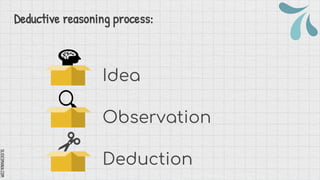
Deductive reasoning process:
Idea
Observation
Deduction
SLIDESMANIA.COM
Deductive reasoning process:
1. Human beings need breath
to live.
2. You are a human.
3. You must need breath to
live.
SLIDESMANIA.COM
Types of Inductive Reasoning
1. Inductive Generalization
 Inductive generalization asserts that
what obtains in known instances can
be generalized to all. A situation is
presented, you look at evidence from
past similar situations and draw a
conclusion based on the information
available.
SLIDESMANIA.COM
Types of Inductive Reasoning
 For example, for the past three
years, the company has beat its
revenue goal in Q3. Based on this
information, the company will
likely beat its revenue goal in Q3
this year.
SLIDESMANIA.COM
Types of Inductive Reasoning
2. Statistical Induction
 This type of inductive
reasoning utilizes
statistical data to draw
conclusions.
SLIDESMANIA.COM
Types of Inductive Reasoning
 For example, 90 percent of the
sales team met their quota last
month. Pat is on the sales team.
Pat likely met his sales quota
last month. In this case, you are
using statistical evidence to
inform your conclusion.
SLIDESMANIA.COM
Types of Inductive Reasoning
3. Induction by Confirmation
 Induction by confirmation allows you
to reach a possible conclusion, but
you must include specific
assumptions must be included for
the outcome to be accepted. This
type of inductive reasoning is used
often by police officers and
detectives.
SLIDESMANIA.COM
Types of Inductive Reasoning
 Renee broke into a building.
Anybody who breaks into a building
will have opportunity, motive and
means. Renee was in the area and
had lock picks in his bag. Renee
likely broke into the building. In this
situation, you develop a theory and
to prove it true must have specific
evidence.
SLIDESMANIA.COM
Thank you!
Do you have any question?

INDUCTIVE-REASONING.pptx