Philosophy of
Mathematics
By: Rey John B. Rebucas
3D3
What is Philosophy of
Mathematics?
 The philosophy of mathematics is the
branch of philosophy that studies
the philosophical assumptions, foundations,
and implications of mathematics
(Hilbert,1996).
 Studies the nature of mathematical truth,
mathematical proof, mathematical evidence,
mathematical practice, and mathematical
explanation (Russell, 1997).
Ontology for
Mathematics: “Being”
Ontology studies the nature of the
objects of mathematics.
It is the claim that mathematical
objects exist independently of their
linguistic expression.
“What we are talking about.”
 What is a number?
 What is a point? line?
 What is a set?
Epistemology for
Mathematics: “Knowing”
Epistemology studies the acquisition
of knowledge of the truth of a
mathematical statement.
“whether what we are saying is true.”
 Does knowledge come from experience
and evidence?
 Does knowledge come from argument and
proof?
 Is knowledge relative or absolute?
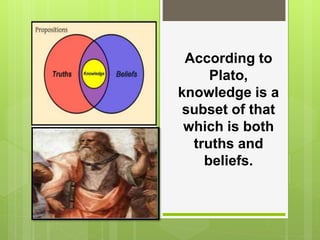
According to
Plato,
knowledge is a
subset of that
which is both
truths and
beliefs.
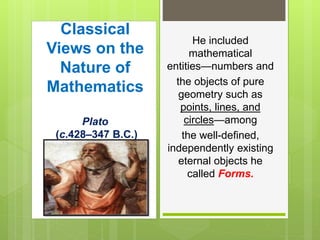
Classical
Views on the
Nature of
Mathematics
Plato
(c.428–347 B.C.)
He included
mathematical
entities—numbers and
the objects of pure
geometry such as
points, lines, and
circles—among
the well-defined,
independently existing
eternal objects he
called Forms.
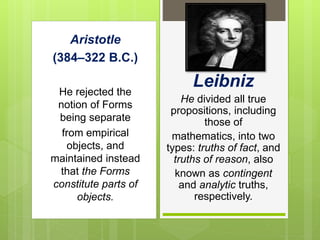
Aristotle
(384–322 B.C.)
He rejected the
notion of Forms
being separate
from empirical
objects, and
maintained instead
that the Forms
constitute parts of
objects.
Leibniz
He divided all true
propositions, including
those of
mathematics, into two
types: truths of fact, and
truths of reason, also
known as contingent
and analytic truths,
respectively.
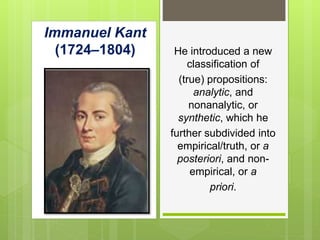
Immanuel Kant
(1724–1804) He introduced a new
classification of
(true) propositions:
analytic, and
nonanalytic, or
synthetic, which he
further subdivided into
empirical/truth, or a
posteriori, and non-
empirical, or a
priori.
PURE
MATHEMATICS
is the analysis of
the structure of
pure space and
time, free from
empirical
material.
APPLIED
MATHEMATICS
is the analysis of
the structure of
space and time,
augmented by
empirical
material..
Four Schools of
Mathematical Philosophy
In the first decades of the twentieth
century, three non-platonistic accounts
of mathematics were developed:
1.logicism,
2. formalism,
3. intuitionism, and
4. predicativism
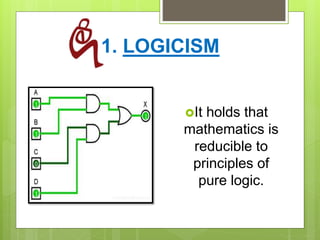
1. LOGICISM
It holds that
mathematics is
reducible to
principles of
pure logic.
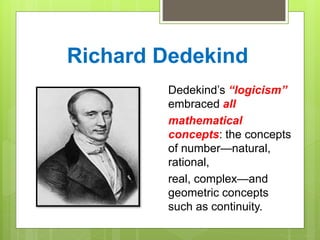
Richard Dedekind
Dedekind’s “logicism”
embraced all
mathematical
concepts: the concepts
of number—natural,
rational,
real, complex—and
geometric concepts
such as continuity.
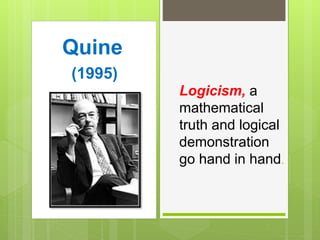
Logicism, a
mathematical
truth and logical
demonstration
go hand in hand.
Quine
(1995)
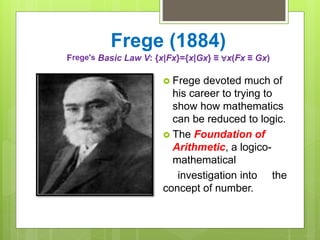
Frege (1884)
Frege's Basic Law V: {x|Fx}={x|Gx} ≡ ∀x(Fx ≡ Gx)
 Frege devoted much of
his career to trying to
show how mathematics
can be reduced to logic.
 The Foundation of
Arithmetic, a logico-
mathematical
investigation into the
concept of number.
2. FORMALISM
 is the view that
much or all of
mathematics is
devoid of content
and a purely formal
study of strings of
mathematical
language/
medium of formal
symbols.
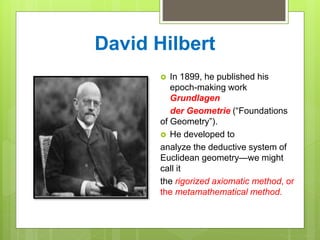
David Hilbert
 In 1899, he published his
epoch-making work
Grundlagen
der Geometrie (“Foundations
of Geometry”).
 He developed to
analyze the deductive system of
Euclidean geometry—we might
call it
the rigorized axiomatic method, or
the metamathematical method.
On the formalist view, a minimal
requirement of formal systems of higher
mathematics is that they are at least
consistent.
 Hilbert aims the
provision of a new
foundation for
mathematics by
representing its
essential form
within the realm of
concrete symbols.
For example:
2 + 2 = 4
would count as a real
proposition, while there
exists an odd perfect
number would count as
an ideal one/real or
concrete.
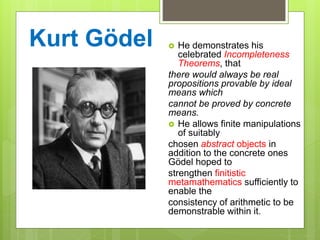
Kurt Gödel  He demonstrates his
celebrated Incompleteness
Theorems, that
there would always be real
propositions provable by ideal
means which
cannot be proved by concrete
means.
 He allows finite manipulations
of suitably
chosen abstract objects in
addition to the concrete ones
Gödel hoped to
strengthen finitistic
metamathematics sufficiently to
enable the
consistency of arithmetic to be
demonstrable within it.
3. INTUITIONISM
 It holds that
mathematics is
concerned with
mental constructions
and defends a
revision of classical
mathematics and
logic.
Intuitionism rejects non-constructive
existence proofs as ‘theological’ and
‘metaphysical’. φ ∨ ¬φ
According to intuitionism, mathematics
is essentially an activity of construction.
The natural numbers are mental
constructions, the real numbers are
mental constructions, proofs and
theorems are mental constructions,
mathematical meaning is a mental
construction.
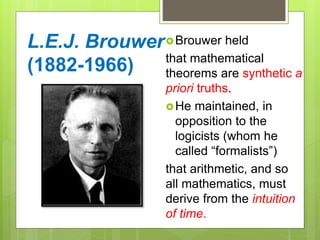
L.E.J. Brouwer
(1882-1966)
Brouwer held
that mathematical
theorems are synthetic a
priori truths.
He maintained, in
opposition to the
logicists (whom he
called “formalists”)
that arithmetic, and so
all mathematics, must
derive from the intuition
of time.
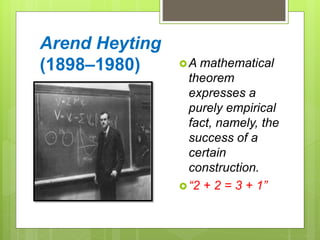
Arend Heyting
(1898–1980) A mathematical
theorem
expresses a
purely empirical
fact, namely, the
success of a
certain
construction.
“2 + 2 = 3 + 1”
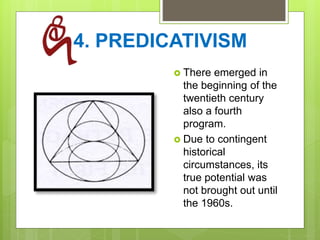
4. PREDICATIVISM
 There emerged in
the beginning of the
twentieth century
also a fourth
program.
 Due to contingent
historical
circumstances, its
true potential was
not brought out until
the 1960s.
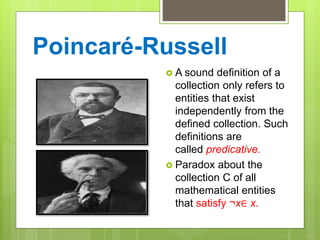
Poincaré-Russell
 A sound definition of a
collection only refers to
entities that exist
independently from the
defined collection. Such
definitions are
called predicative.
 Paradox about the
collection C of all
mathematical entities
that satisfy ¬x∈ x.
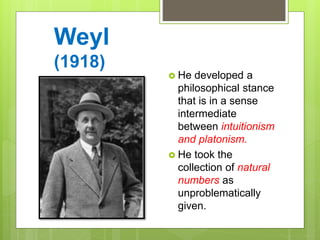
Weyl
(1918)
 He developed a
philosophical stance
that is in a sense
intermediate
between intuitionism
and platonism.
 He took the
collection of natural
numbers as
unproblematically
given.
New Views
In Recent Decades
Structuralis
m
which holds that
mathematics is
the study of
abstract
structures.
 Non-
eliminative version of
structuralism holds
that there exist such
things as abstract
structures.
 An eliminative
version tries to make do
with concrete objects
variously structured.
Nominalism
denies that there are any abstract
mathematical objects and tries to
reconstruct classical mathematics
accordingly.
Fictionalism
is based on the idea that, although
most mathematical theorems are
literally false, there is a non-literal (or
fictional) sense in which assertions of
them nevertheless count as correct.
Mathematical
Naturalism
 urges that mathematics be taken
as a sui generis discipline in good
scientific standing.
Rey John
B.
Rebucas
BEED
Gen. Ed.
3D3

Philosophy of Mathematics

  • 1.
  • 2.
    What is Philosophyof Mathematics?  The philosophy of mathematics is the branch of philosophy that studies the philosophical assumptions, foundations, and implications of mathematics (Hilbert,1996).  Studies the nature of mathematical truth, mathematical proof, mathematical evidence, mathematical practice, and mathematical explanation (Russell, 1997).
  • 3.
    Ontology for Mathematics: “Being” Ontologystudies the nature of the objects of mathematics. It is the claim that mathematical objects exist independently of their linguistic expression. “What we are talking about.”  What is a number?  What is a point? line?  What is a set?
  • 4.
    Epistemology for Mathematics: “Knowing” Epistemologystudies the acquisition of knowledge of the truth of a mathematical statement. “whether what we are saying is true.”  Does knowledge come from experience and evidence?  Does knowledge come from argument and proof?  Is knowledge relative or absolute?
  • 5.
    According to Plato, knowledge isa subset of that which is both truths and beliefs.
  • 6.
    Classical Views on the Natureof Mathematics Plato (c.428–347 B.C.) He included mathematical entities—numbers and the objects of pure geometry such as points, lines, and circles—among the well-defined, independently existing eternal objects he called Forms.
  • 7.
    Aristotle (384–322 B.C.) He rejectedthe notion of Forms being separate from empirical objects, and maintained instead that the Forms constitute parts of objects. Leibniz He divided all true propositions, including those of mathematics, into two types: truths of fact, and truths of reason, also known as contingent and analytic truths, respectively.
  • 8.
    Immanuel Kant (1724–1804) Heintroduced a new classification of (true) propositions: analytic, and nonanalytic, or synthetic, which he further subdivided into empirical/truth, or a posteriori, and non- empirical, or a priori.
  • 9.
    PURE MATHEMATICS is the analysisof the structure of pure space and time, free from empirical material. APPLIED MATHEMATICS is the analysis of the structure of space and time, augmented by empirical material..
  • 10.
    Four Schools of MathematicalPhilosophy In the first decades of the twentieth century, three non-platonistic accounts of mathematics were developed: 1.logicism, 2. formalism, 3. intuitionism, and 4. predicativism
  • 11.
    1. LOGICISM It holdsthat mathematics is reducible to principles of pure logic.
  • 12.
    Richard Dedekind Dedekind’s “logicism” embracedall mathematical concepts: the concepts of number—natural, rational, real, complex—and geometric concepts such as continuity.
  • 13.
    Logicism, a mathematical truth andlogical demonstration go hand in hand. Quine (1995)
  • 14.
    Frege (1884) Frege's BasicLaw V: {x|Fx}={x|Gx} ≡ ∀x(Fx ≡ Gx)  Frege devoted much of his career to trying to show how mathematics can be reduced to logic.  The Foundation of Arithmetic, a logico- mathematical investigation into the concept of number.
  • 15.
    2. FORMALISM  isthe view that much or all of mathematics is devoid of content and a purely formal study of strings of mathematical language/ medium of formal symbols.
  • 16.
    David Hilbert  In1899, he published his epoch-making work Grundlagen der Geometrie (“Foundations of Geometry”).  He developed to analyze the deductive system of Euclidean geometry—we might call it the rigorized axiomatic method, or the metamathematical method.
  • 17.
    On the formalistview, a minimal requirement of formal systems of higher mathematics is that they are at least consistent.  Hilbert aims the provision of a new foundation for mathematics by representing its essential form within the realm of concrete symbols. For example: 2 + 2 = 4 would count as a real proposition, while there exists an odd perfect number would count as an ideal one/real or concrete.
  • 18.
    Kurt Gödel He demonstrates his celebrated Incompleteness Theorems, that there would always be real propositions provable by ideal means which cannot be proved by concrete means.  He allows finite manipulations of suitably chosen abstract objects in addition to the concrete ones Gödel hoped to strengthen finitistic metamathematics sufficiently to enable the consistency of arithmetic to be demonstrable within it.
  • 19.
    3. INTUITIONISM  Itholds that mathematics is concerned with mental constructions and defends a revision of classical mathematics and logic.
  • 20.
    Intuitionism rejects non-constructive existenceproofs as ‘theological’ and ‘metaphysical’. φ ∨ ¬φ According to intuitionism, mathematics is essentially an activity of construction. The natural numbers are mental constructions, the real numbers are mental constructions, proofs and theorems are mental constructions, mathematical meaning is a mental construction.
  • 21.
    L.E.J. Brouwer (1882-1966) Brouwer held thatmathematical theorems are synthetic a priori truths. He maintained, in opposition to the logicists (whom he called “formalists”) that arithmetic, and so all mathematics, must derive from the intuition of time.
  • 22.
    Arend Heyting (1898–1980) Amathematical theorem expresses a purely empirical fact, namely, the success of a certain construction. “2 + 2 = 3 + 1”
  • 23.
    4. PREDICATIVISM  Thereemerged in the beginning of the twentieth century also a fourth program.  Due to contingent historical circumstances, its true potential was not brought out until the 1960s.
  • 24.
    Poincaré-Russell  A sounddefinition of a collection only refers to entities that exist independently from the defined collection. Such definitions are called predicative.  Paradox about the collection C of all mathematical entities that satisfy ¬x∈ x.
  • 25.
    Weyl (1918)  He developeda philosophical stance that is in a sense intermediate between intuitionism and platonism.  He took the collection of natural numbers as unproblematically given.
  • 26.
  • 27.
    Structuralis m which holds that mathematicsis the study of abstract structures.  Non- eliminative version of structuralism holds that there exist such things as abstract structures.  An eliminative version tries to make do with concrete objects variously structured.
  • 28.
    Nominalism denies that thereare any abstract mathematical objects and tries to reconstruct classical mathematics accordingly.
  • 29.
    Fictionalism is based onthe idea that, although most mathematical theorems are literally false, there is a non-literal (or fictional) sense in which assertions of them nevertheless count as correct.
  • 30.
    Mathematical Naturalism  urges thatmathematics be taken as a sui generis discipline in good scientific standing.
  • 31.