SINYAT   PRESENTS


OPTICAL ILLUSION
Sure, we have five main senses – sight, hearing, taste, touch and smell – but about
75 per cent of the information humans receive about our environment comes from
our sight, making it the most ‘important’ of the five senses. The vision depends,
obviously, on the EYES to see (with optic receptors called rods and cones) and on
the BRAIN to make sense of what we see. The optic nerve at the back of the eye
connects to the central nervous system in the brain. The brain receives electrical
impulses (stimuli) from our eyes which are interpreted as SIGHT, but the brain
adds two extra ingredients to the received image: memory and interpretation (in
short, perception). Sometimes the brain is deceived by information received from
the eyes. Visual illusions are caused when differences occur between our
perceptions or expectations and the image seen by the eye. Actually, there are
particular illusions which deceive the human visual system into perceiving
something that is not present, or incorrectly perceiving what is present.
Types Of Optical Illusions

There are in all 3 types of optical illusions,namely:-

1} Literal Illusion

2} Physiological Illusion

3} Cognitive Illusion
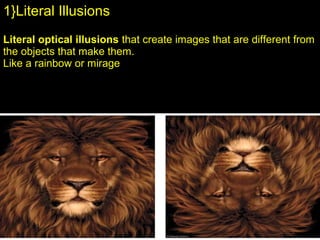
1}Literal Illusions
Literal optical illusions that create images that are different from
the objects that make them.
Like a rainbow or mirage
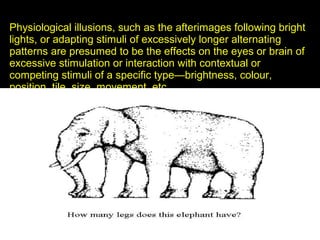
Physiological illusions, such as the afterimages following bright
lights, or adapting stimuli of excessively longer alternating
patterns are presumed to be the effects on the eyes or brain of
excessive stimulation or interaction with contextual or
competing stimuli of a specific type—brightness, colour,
position, tile, size, movement, etc.
“cognitive illusions”

The human eye has a blind spot where the optic disk is
located. We aren’t normally aware of this blind spot, but
with one eye closed, any object passing through this
small area will disappear momentarily. Our visual field
appears seamless because of an optical illusion: Our
mind conspires to fill in the blank area with the colours
of what surrounds it. We have other blind spots
too“cognitive illusions” – that our minds and our culture
work to obscure.
Photograph illusion
Photograph of eiffel tower or a ladies face

    Shadow illusions
3D Street art a form of illusion
.


Still image! Keeps rotating till you look at
it directly.
Waving hearts
Rotating flowers
Waving coffee beans
Snake like image due to the colour combination
For any advertising campaign to stand out from the
crowd, a little bit of creativity is needed. Every
company aims for an advert that will arose people’s
curiosity, one that will get consumer to look at it a
second or even third time. There are many techniques
used and the most wondrous of them is the optical
illusion which, if done right, will stick long in the
memories of consumers,
Let s have some fun and try a few
optical illusion

    Rabbit or a duck ?
Very old and classical one. Those orange circles
          are the same size by the way.
Count the Black Dots
Stare at the black dot
ILLUSION

ILLUSION

  • 1.
    SINYAT PRESENTS OPTICAL ILLUSION
  • 2.
    Sure, we havefive main senses – sight, hearing, taste, touch and smell – but about 75 per cent of the information humans receive about our environment comes from our sight, making it the most ‘important’ of the five senses. The vision depends, obviously, on the EYES to see (with optic receptors called rods and cones) and on the BRAIN to make sense of what we see. The optic nerve at the back of the eye connects to the central nervous system in the brain. The brain receives electrical impulses (stimuli) from our eyes which are interpreted as SIGHT, but the brain adds two extra ingredients to the received image: memory and interpretation (in short, perception). Sometimes the brain is deceived by information received from the eyes. Visual illusions are caused when differences occur between our perceptions or expectations and the image seen by the eye. Actually, there are particular illusions which deceive the human visual system into perceiving something that is not present, or incorrectly perceiving what is present.
  • 3.
    Types Of OpticalIllusions There are in all 3 types of optical illusions,namely:- 1} Literal Illusion 2} Physiological Illusion 3} Cognitive Illusion
  • 4.
    1}Literal Illusions Literal opticalillusions that create images that are different from the objects that make them. Like a rainbow or mirage
  • 5.
    Physiological illusions, suchas the afterimages following bright lights, or adapting stimuli of excessively longer alternating patterns are presumed to be the effects on the eyes or brain of excessive stimulation or interaction with contextual or competing stimuli of a specific type—brightness, colour, position, tile, size, movement, etc.
  • 6.
    “cognitive illusions” The humaneye has a blind spot where the optic disk is located. We aren’t normally aware of this blind spot, but with one eye closed, any object passing through this small area will disappear momentarily. Our visual field appears seamless because of an optical illusion: Our mind conspires to fill in the blank area with the colours of what surrounds it. We have other blind spots too“cognitive illusions” – that our minds and our culture work to obscure.
  • 7.
  • 9.
    Photograph of eiffeltower or a ladies face
  • 10.
    Shadow illusions
  • 12.
    3D Street arta form of illusion
  • 19.
    . Still image! Keepsrotating till you look at it directly.
  • 20.
  • 21.
  • 22.
  • 23.
    Snake like imagedue to the colour combination
  • 25.
    For any advertisingcampaign to stand out from the crowd, a little bit of creativity is needed. Every company aims for an advert that will arose people’s curiosity, one that will get consumer to look at it a second or even third time. There are many techniques used and the most wondrous of them is the optical illusion which, if done right, will stick long in the memories of consumers,
  • 31.
    Let s havesome fun and try a few optical illusion
  • 33.
    Rabbit or a duck ?
  • 34.
    Very old andclassical one. Those orange circles are the same size by the way.
  • 36.
  • 37.
    Stare at theblack dot