Raghu Engineering College (Autonomous)
Accredited by NBA & NAAC with ‘A Grade, Permanently Affiliated JNTU Kakinada
Dakamarri (v), Bheemunipatnam Mandal, Visakhapatnam, Andhra Pradesh
531162
RAGHU ENGINERING COLLEGE BATCH 8 EM-1 1
Case Study
On
MATLAB STEP-UP TRANSFORMER SIMULATION
Submitted as a part of Second Year First Semester curriculum of
BACHELOR OF TECHNOLOGY
IN
ELECTRICAL AND ELECTRONICS ENGINEERING
By
Mr.P.ESWAR 18981A0237
Mr.K.MOHAN 18981A0238
MS. K.SUPRIYA18981A0239
Mr.M.NITISH KUMAR18981A0240
Mr. P.SANJAYKUMAR18981A0241
Under the Supervision of
Mr.Kranthi Kumar.S
M.Tech LMISTE
Associate Professor
Department of Electrical & Electronics Engineering
RAGHU ENGINERING COLLEGE BATCH 8 EM-1 2
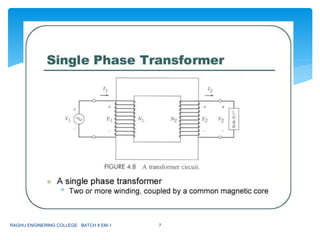
An A.C. device used to change high voltage low
current A.C. into low voltage high current A.C. and
vice-versa without changing the frequency
In brief,
1. Transfers electric power from one circuit to another
2. It does so without a change of frequency
3. It accomplishes this by electromagnetic induction
4. Where the two electric circuits are in mutual
inductive influence of each other.
Transformer
RAGHU ENGINERING COLLEGE BATCH 8 EM-1 3
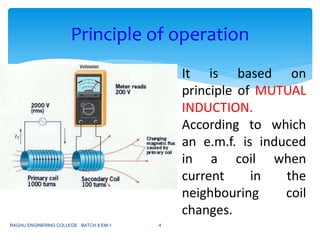
Principle of operation
It is based on
principle of MUTUAL
INDUCTION.
According to which
an e.m.f. is induced
in a coil when
current in the
neighbouring coil
changes.
RAGHU ENGINERING COLLEGE BATCH 8 EM-1 4
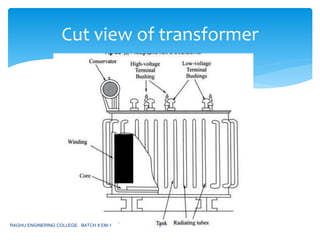
Cut view of transformer
RAGHU ENGINERING COLLEGE BATCH 8 EM-1 5
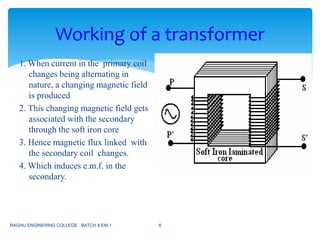
1. When current in the primary coil
changes being alternating in
nature, a changing magnetic field
is produced
2. This changing magnetic field gets
associated with the secondary
through the soft iron core
3. Hence magnetic flux linked with
the secondary coil changes.
4. Which induces e.m.f. in the
secondary.
Working of a transformer
RAGHU ENGINERING COLLEGE BATCH 8 EM-1 6
RAGHU ENGINERING COLLEGE BATCH 8 EM-1 7
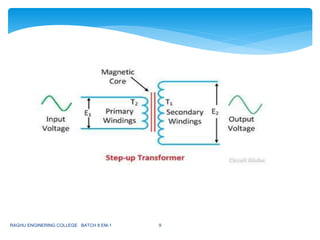
STEP UP TRANSFORMER
• In Step Up Transformer, there are more turns
on the secondary coil than the primary coil.
• The induced voltage across the secondary coil
is greater than the applied voltage across the
primary coil.
• The voltage has been “stepped-up”.
RAGHU ENGINERING COLLEGE BATCH 8 EM-1 8
RAGHU ENGINERING COLLEGE BATCH 8 EM-1 9
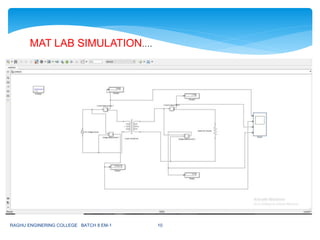
MAT LAB SIMULATION….
RAGHU ENGINERING COLLEGE BATCH 8 EM-1 10
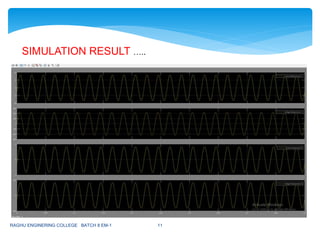
SIMULATION RESULT …..
RAGHU ENGINERING COLLEGE BATCH 8 EM-1 11
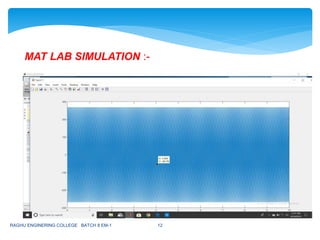
MAT LAB SIMULATION :-
RAGHU ENGINERING COLLEGE BATCH 8 EM-1 12
TECHINICAL SPECIFICATIONS ……
 Frequency: 50
 Input Voltage: 220 V / 415 V
 Phase In: SINGLE PHASE
 Phase Out: 1 Ph
Rating: 5kva – Onwards
 Voltage In: 220 V / 415v
RAGHU ENGINERING COLLEGE BATCH 8 EM-1 13
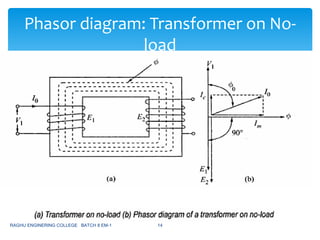
Phasor diagram: Transformer on No-
load
RAGHU ENGINERING COLLEGE BATCH 8 EM-1 14
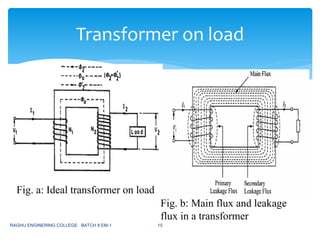
Transformer on load
Fig. a: Ideal transformer on load
Fig. b: Main flux and leakage
flux in a transformer
RAGHU ENGINERING COLLEGE BATCH 8 EM-1 15
 Starting the electrical motor,
 In the microwave oven,
 X-rays machines,
 In transmission lines
 Transformers with several secondar’s are used in
televisions and radio receivers
APPLICATIONS OF STEP UP
TRANSFORMER :-
RAGHU ENGINERING COLLEGE BATCH 8 EM-1 16
RAGHU ENGINERING COLLEGE BATCH 8 EM-1 17
Conclusion :-
 The output voltage of the transformer across the secondary coil
depends upon the ratio(Ns/Np)with respect to the input voltage.
 There is a loss of power between input and output coil of a
transformer.
RAGHU ENGINERING COLLEGE BATCH 8 EM-1 18
•[1] Ilie F., Bulucea C.A., Popescu M.C.,
Simulations of Oil-filled Transformer Loss-
of-Life Models, Proceedings of the 11th
International Conference on Mathematical
Methods and Computational Techniques in
Electrical Engineering,
•Electrical Machines notes
Reference
RAGHU ENGINERING COLLEGE BATCH 8 EM-1 19

ELECTRICAL MACHINES 1

  • 1.
    Raghu Engineering College(Autonomous) Accredited by NBA & NAAC with ‘A Grade, Permanently Affiliated JNTU Kakinada Dakamarri (v), Bheemunipatnam Mandal, Visakhapatnam, Andhra Pradesh 531162 RAGHU ENGINERING COLLEGE BATCH 8 EM-1 1
  • 2.
    Case Study On MATLAB STEP-UPTRANSFORMER SIMULATION Submitted as a part of Second Year First Semester curriculum of BACHELOR OF TECHNOLOGY IN ELECTRICAL AND ELECTRONICS ENGINEERING By Mr.P.ESWAR 18981A0237 Mr.K.MOHAN 18981A0238 MS. K.SUPRIYA18981A0239 Mr.M.NITISH KUMAR18981A0240 Mr. P.SANJAYKUMAR18981A0241 Under the Supervision of Mr.Kranthi Kumar.S M.Tech LMISTE Associate Professor Department of Electrical & Electronics Engineering RAGHU ENGINERING COLLEGE BATCH 8 EM-1 2
  • 3.
    An A.C. deviceused to change high voltage low current A.C. into low voltage high current A.C. and vice-versa without changing the frequency In brief, 1. Transfers electric power from one circuit to another 2. It does so without a change of frequency 3. It accomplishes this by electromagnetic induction 4. Where the two electric circuits are in mutual inductive influence of each other. Transformer RAGHU ENGINERING COLLEGE BATCH 8 EM-1 3
  • 4.
    Principle of operation Itis based on principle of MUTUAL INDUCTION. According to which an e.m.f. is induced in a coil when current in the neighbouring coil changes. RAGHU ENGINERING COLLEGE BATCH 8 EM-1 4
  • 5.
    Cut view oftransformer RAGHU ENGINERING COLLEGE BATCH 8 EM-1 5
  • 6.
    1. When currentin the primary coil changes being alternating in nature, a changing magnetic field is produced 2. This changing magnetic field gets associated with the secondary through the soft iron core 3. Hence magnetic flux linked with the secondary coil changes. 4. Which induces e.m.f. in the secondary. Working of a transformer RAGHU ENGINERING COLLEGE BATCH 8 EM-1 6
  • 7.
  • 8.
    STEP UP TRANSFORMER •In Step Up Transformer, there are more turns on the secondary coil than the primary coil. • The induced voltage across the secondary coil is greater than the applied voltage across the primary coil. • The voltage has been “stepped-up”. RAGHU ENGINERING COLLEGE BATCH 8 EM-1 8
  • 9.
  • 10.
    MAT LAB SIMULATION…. RAGHUENGINERING COLLEGE BATCH 8 EM-1 10
  • 11.
    SIMULATION RESULT ….. RAGHUENGINERING COLLEGE BATCH 8 EM-1 11
  • 12.
    MAT LAB SIMULATION:- RAGHU ENGINERING COLLEGE BATCH 8 EM-1 12
  • 13.
    TECHINICAL SPECIFICATIONS …… Frequency: 50  Input Voltage: 220 V / 415 V  Phase In: SINGLE PHASE  Phase Out: 1 Ph Rating: 5kva – Onwards  Voltage In: 220 V / 415v RAGHU ENGINERING COLLEGE BATCH 8 EM-1 13
  • 14.
    Phasor diagram: Transformeron No- load RAGHU ENGINERING COLLEGE BATCH 8 EM-1 14
  • 15.
    Transformer on load Fig.a: Ideal transformer on load Fig. b: Main flux and leakage flux in a transformer RAGHU ENGINERING COLLEGE BATCH 8 EM-1 15
  • 16.
     Starting theelectrical motor,  In the microwave oven,  X-rays machines,  In transmission lines  Transformers with several secondar’s are used in televisions and radio receivers APPLICATIONS OF STEP UP TRANSFORMER :- RAGHU ENGINERING COLLEGE BATCH 8 EM-1 16
  • 17.
    RAGHU ENGINERING COLLEGEBATCH 8 EM-1 17 Conclusion :-  The output voltage of the transformer across the secondary coil depends upon the ratio(Ns/Np)with respect to the input voltage.  There is a loss of power between input and output coil of a transformer.
  • 18.
    RAGHU ENGINERING COLLEGEBATCH 8 EM-1 18 •[1] Ilie F., Bulucea C.A., Popescu M.C., Simulations of Oil-filled Transformer Loss- of-Life Models, Proceedings of the 11th International Conference on Mathematical Methods and Computational Techniques in Electrical Engineering, •Electrical Machines notes Reference
  • 19.
    RAGHU ENGINERING COLLEGEBATCH 8 EM-1 19