Jenn Barrett
Mikaela Fero
Jay Purewal
Omar Qureshi
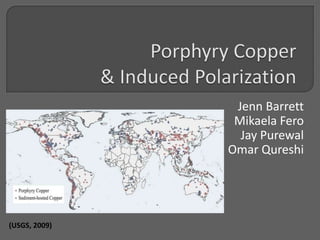
(USGS, 2009)
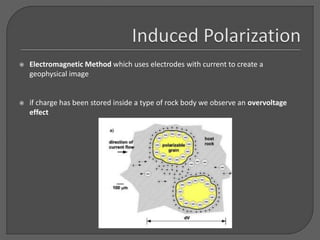
 Electromagnetic Method which uses electrodes with current to create a
geophysical image
 if charge has been stored inside a type of rock body we observe an overvoltage
effect
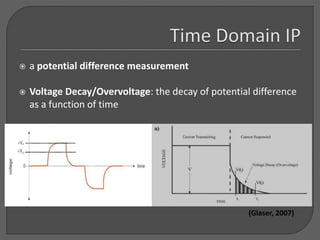
 a potential difference measurement
 Voltage Decay/Overvoltage: the decay of potential difference
as a function of time
(Glaser, 2007)
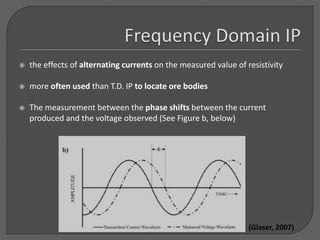
 the effects of alternating currents on the measured value of resistivity
 more often used than T.D. IP to locate ore bodies
 The measurement between the phase shifts between the current
produced and the voltage observed (See Figure b, below)
(Glaser, 2007)
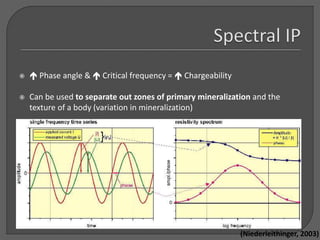
  Phase angle &  Critical frequency =  Chargeability
 Can be used to separate out zones of primary mineralization and the
texture of a body (variation in mineralization)
(Niederleithinger, 2003)
 Dipole-Dipole arrangement
(Morrison, 2012)
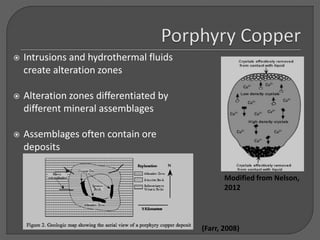
 Intrusions and hydrothermal fluids
create alteration zones
 Alteration zones differentiated by
different mineral assemblages
 Assemblages often contain ore
deposits
(Farr, 2008)
Modified from Nelson,
2012
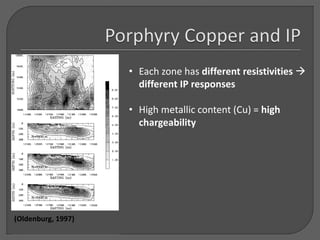
• Each zone has different resistivities 
different IP responses
• High metallic content (Cu) = high
chargeability
(Oldenburg, 1997)
 Use of spectral IP & Dipole-Dipole
 Low FE = core of deposit (Potassic)
• Highly resistive core (potassic)= high apparent
resistivity
• High apparent resistivity = low Fe [(p0-p1)/p1]
 High MF = high M = pyrite halo
 Economic ore likely occurs between
Potassic and Phyllic zone (potassic core
has little sulfides, phyllic zone has high
sulfide due to pyritization)
 200 million tons of 0.45% Cu
(Berger, 2008)
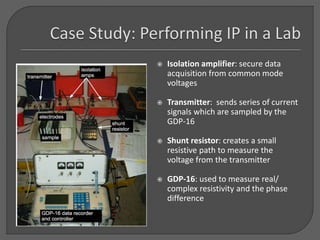
 Isolation amplifier: secure data
acquisition from common mode
voltages
 Transmitter: sends series of current
signals which are sampled by the
GDP-16
 Shunt resistor: creates a small
resistive path to measure the
voltage from the transmitter
 GDP-16: used to measure real/
complex resistivity and the phase
difference
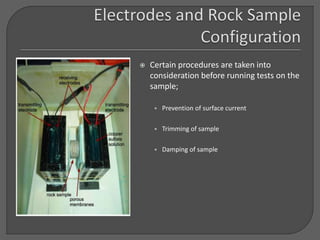
 Certain procedures are taken into
consideration before running tests on the
sample;
• Prevention of surface current
• Trimming of sample
• Damping of sample
 Finds disseminated ores that have weak magnetic and gravity
responses
 Good preliminary survey
 Provides supplemental information to build model
Berger, B.R., Ayuso, R.A., Wynn, J.C., Seal, R.R., 2008, Preliminary model of porphyry copper deposits, U.S. Geological Survey Open-File Report, v. 1321, p.55
Farr, M.R., 2008, Exploring for Copper Deposits, University of Kansas <http://www.beloit.edu/sepm/Rocks_and_minerals/exploring_for_copper.html> accessed on
November 8, 2013
Fink, James B., 1990, Induced Polarization: Applications and Case Histories, Society of Exploration Geophysicists, Tulsa, Okla.
Fu, Lei, 2011, Induced Polarization Effect in Time Domain: Theory, Modeling and Applications, The University of Utah
Holliday, J.R., Cooke, D.R., 2007, Advances in geological models and exploration methods for copper+gold porphyry deposits, Ore deposits and exploration technology:
proceedings of exploration, p. 791-809
Morrison and Gasparikova, 2012, DC Resistivity and IP field systems, data processing and interpretation, <http://appliedgeophysics.berkeley.edu/dc/EM46.pdf> accessed on
November 6, 2013
Nelson, S.A., 2012, EENS 2120 Petrology: Magmatic Differentiation <http://www.tulane.edu/~sanelson/eens212/magmadiff.htm> accessed on November 8, 2013
Niederleithinger, E., 2003, Spectral Induced Polarization – a tool for non-destructive testing of soils and building materials, Federal Institute for Materials Research, Berlin,
Germany, <http://www.ndt.net/article/ndtce03/papers/v060/v060.htm> accessed October 30, 2013
Oldenburg, D.W., Li, Y.L., Ellis, R.G., 1997, Inversion of geophysical data over a copper gold porphyry deposit: a case history for Mt Milligan, Geophysics, v. 62, n. 5, p. 1419-
1431
Pelton, William H. and Smith, Peter K., 1976, Mapping Porphyry Copper Deposits in the Philippines with IP, Geophysics, v. 41, no. 1 p. 106-122
Reynolds, John M., 2011, An Introduction to Applied and Environmental Geophysics, 2nd Edition, Chichester, Wiley, 712 p.
Sharma, Prem V., 1997, Environmental and Engineering Geophysics, Cambridge, Cambridge University Press, 500 p.
Toovey, L.M., 2011, Copper exploration techniques: induced polarization surveys, Copper investing news http://copperinvestingnews.com/6465-copper-exploration-
techniques-induced-polarization-surveys.html > accessed on October 31st, 2013
Toovey, L.M., 2011, Porphyry copper: the world’s most valuable deposits, Copper investing news http://copperinvestingnews.com/6465-copper-exploration-techniques-
induced-polarization-surveys.html > accessed on October 31st, 2013
Wightman, Jalinoos, and Sirles, Induced Polarization. EPA.
<http://epa.gov/esd/cmb/GeophysicsWebsite/pages/reference/methods/Surface_Geophysical_Methods/Electrical_Methods/Induced_Polarization.htm> Accessed
November 4, 2013.

Induced Polarization Presentation

  • 1.
    Jenn Barrett Mikaela Fero JayPurewal Omar Qureshi (USGS, 2009)
  • 2.
     Electromagnetic Methodwhich uses electrodes with current to create a geophysical image  if charge has been stored inside a type of rock body we observe an overvoltage effect
  • 3.
     a potentialdifference measurement  Voltage Decay/Overvoltage: the decay of potential difference as a function of time (Glaser, 2007)
  • 4.
     the effectsof alternating currents on the measured value of resistivity  more often used than T.D. IP to locate ore bodies  The measurement between the phase shifts between the current produced and the voltage observed (See Figure b, below) (Glaser, 2007)
  • 5.
      Phaseangle &  Critical frequency =  Chargeability  Can be used to separate out zones of primary mineralization and the texture of a body (variation in mineralization) (Niederleithinger, 2003)
  • 6.
  • 7.
     Intrusions andhydrothermal fluids create alteration zones  Alteration zones differentiated by different mineral assemblages  Assemblages often contain ore deposits (Farr, 2008) Modified from Nelson, 2012
  • 8.
    • Each zonehas different resistivities  different IP responses • High metallic content (Cu) = high chargeability (Oldenburg, 1997)
  • 9.
     Use ofspectral IP & Dipole-Dipole  Low FE = core of deposit (Potassic) • Highly resistive core (potassic)= high apparent resistivity • High apparent resistivity = low Fe [(p0-p1)/p1]  High MF = high M = pyrite halo  Economic ore likely occurs between Potassic and Phyllic zone (potassic core has little sulfides, phyllic zone has high sulfide due to pyritization)  200 million tons of 0.45% Cu (Berger, 2008)
  • 10.
     Isolation amplifier:secure data acquisition from common mode voltages  Transmitter: sends series of current signals which are sampled by the GDP-16  Shunt resistor: creates a small resistive path to measure the voltage from the transmitter  GDP-16: used to measure real/ complex resistivity and the phase difference
  • 11.
     Certain proceduresare taken into consideration before running tests on the sample; • Prevention of surface current • Trimming of sample • Damping of sample
  • 12.
     Finds disseminatedores that have weak magnetic and gravity responses  Good preliminary survey  Provides supplemental information to build model
  • 13.
    Berger, B.R., Ayuso,R.A., Wynn, J.C., Seal, R.R., 2008, Preliminary model of porphyry copper deposits, U.S. Geological Survey Open-File Report, v. 1321, p.55 Farr, M.R., 2008, Exploring for Copper Deposits, University of Kansas <http://www.beloit.edu/sepm/Rocks_and_minerals/exploring_for_copper.html> accessed on November 8, 2013 Fink, James B., 1990, Induced Polarization: Applications and Case Histories, Society of Exploration Geophysicists, Tulsa, Okla. Fu, Lei, 2011, Induced Polarization Effect in Time Domain: Theory, Modeling and Applications, The University of Utah Holliday, J.R., Cooke, D.R., 2007, Advances in geological models and exploration methods for copper+gold porphyry deposits, Ore deposits and exploration technology: proceedings of exploration, p. 791-809 Morrison and Gasparikova, 2012, DC Resistivity and IP field systems, data processing and interpretation, <http://appliedgeophysics.berkeley.edu/dc/EM46.pdf> accessed on November 6, 2013 Nelson, S.A., 2012, EENS 2120 Petrology: Magmatic Differentiation <http://www.tulane.edu/~sanelson/eens212/magmadiff.htm> accessed on November 8, 2013 Niederleithinger, E., 2003, Spectral Induced Polarization – a tool for non-destructive testing of soils and building materials, Federal Institute for Materials Research, Berlin, Germany, <http://www.ndt.net/article/ndtce03/papers/v060/v060.htm> accessed October 30, 2013 Oldenburg, D.W., Li, Y.L., Ellis, R.G., 1997, Inversion of geophysical data over a copper gold porphyry deposit: a case history for Mt Milligan, Geophysics, v. 62, n. 5, p. 1419- 1431 Pelton, William H. and Smith, Peter K., 1976, Mapping Porphyry Copper Deposits in the Philippines with IP, Geophysics, v. 41, no. 1 p. 106-122 Reynolds, John M., 2011, An Introduction to Applied and Environmental Geophysics, 2nd Edition, Chichester, Wiley, 712 p. Sharma, Prem V., 1997, Environmental and Engineering Geophysics, Cambridge, Cambridge University Press, 500 p. Toovey, L.M., 2011, Copper exploration techniques: induced polarization surveys, Copper investing news http://copperinvestingnews.com/6465-copper-exploration- techniques-induced-polarization-surveys.html > accessed on October 31st, 2013 Toovey, L.M., 2011, Porphyry copper: the world’s most valuable deposits, Copper investing news http://copperinvestingnews.com/6465-copper-exploration-techniques- induced-polarization-surveys.html > accessed on October 31st, 2013 Wightman, Jalinoos, and Sirles, Induced Polarization. EPA. <http://epa.gov/esd/cmb/GeophysicsWebsite/pages/reference/methods/Surface_Geophysical_Methods/Electrical_Methods/Induced_Polarization.htm> Accessed November 4, 2013.

Editor's Notes

  • #3 IP response is related to how well a unit is the subsurface can hold on to electrical charge The conductivity depends on the amount of ore present and the conduction of the ore Induced polarization is an electromagnetic method that uses electrodes with current to create a geophysical image. It is where a current is run through the ground by two electrodes and observed when the current is switched off. The voltage is then observed to have decayed, instead of instantaneously returning back to zero.
  • #4 Current is supplied to the ground, the moving charges induce a response from chargeable grains in the subsurface. When the current is supplied, a charge builds up outside of the metallic grains. Since charge is free to move in the metals present in the subsurface (because they are conductors), the electrons will move to the side of the mineral grain where the positive current is present. This creates a temporary charge separation where the mineral grain acts as a small capacitor, creating a potential difference within itself (within the grain). When the current is switched off from our current electrodes, the total observed voltage drops instantaneously by the amount of current being supplied by the current electrodes (V) so the remaining voltage is only that of the potential difference that was induced in the metallic grains by the original current. It takes a while for this potential difference to disperse, leaving us with Vi, the overvoltage which decays over time. The decrease in this overvoltage over time is what is measured  this is the IP response. Current is supplied (V) by current electrodes Charge builds up on metallic grains Current induces a potential difference in the metallic grains (Vi) – this is the overvoltage A voltage (VT) is observed at potential electrodes (where V + Vi=VT) Current is switched off  VT – V = Vi Vi decays at a rate depending on the conductivity of the grain and the amount of time the grain was subjected to the current Induced polarization (IP) is a potential difference measurement between the potential electrodes. When the current through the electrodes is switched off, the potential difference does not instantaneously drop to zero. The potential difference instead drops significantly at first, but then it slowly decays to zero after a short amount of time.
  • #5 Apparent resistivity is observed at 2 different frequencies  Frequency (f0) =  pa0  Frequency (f1) =  pa1 Pa0>pa1 Studying the effects of alternating currents on the measured value of resistivity is another method of IP, in the frequency domain (Figure b). This method is done by locating portions of the earth where resistivity decreases, as the frequency of applied current is being increased. This form of IP method is more often used to locate ore bodies. In a perfect earth we would expect to see the two curves matched up… instead we see a phase shift caused by a delay in time in when the supplied current is turned off/on and when that potential difference is measured
  • #6 Time and Frequency domain IP methods can locate ore bodies, but they cannot give us a good estimate of the amount of mineralization in the subsurface. To do this, we can use Spectral IP ρ0 = DC Resistivity ω = 2πf = angular frequency Μ = Vi/VT = Chargeability τ= time constant c = relaxation constant i= √-1 IP response is related to how well a unit is the subsurface can hold on to electrical charge The conductivity depends on the amount of ore present and the conduction of the ore  Phase angle &  Critical frequency =  Chargeability Can be used to separate out zones of primary mineralization and the texture of a body Spectral induced polarization (SIP) allows us to measure the variation in resistivity with different applied frequencies.  This method allows us to see several resistivity measurements at different frequencies. Spectral induced polarization aims to specifically distinguish material properties of the subsurface. Spectral induced polarization (SIP) allows us to measure the variation in resistivity with different applied frequencies.  This method allows us to see several resistivity measurements at different frequencies. Spectral induced polarization aims to specifically distinguish material properties of the subsurface.
  • #7 Dipole-Dipole is a commonly used set up for Induced polarization. It consists of two sets of electrodes, the current and potential electrodes. The pairs of current electrodes and pairs of potential electrodes are usually placed close to one another at equal distances. While the spacing between the pairs of each current and potential electrodes are spaced further apart at equal distances that are multiples of the spacing between the pairs of current electrodes and potential electrodes. A primary advantage of the dipole-dipole electrode array is the ease of deployment in the field due to shorter wire lengths. Why else would we use Dipole Dipole arrangement?
  • #8 How Porphyry deposits form: Large igneous intrusions develop at convergent boundaries Magma begins to cool within the earth (i.e. intrusions) Minerals begin to crystallize out of the magma, copper is not one of the first to crystallize since it is not able to fit into the crystal arrangement of the minerals present in the granite. Instead, it remains in solution this increases the concentration of Cu in the magma Granitic intrusion (minus the Cu) cools, and and Cu is left in fluid, it is the last to crystallize The remaining copper rich fluid is the last to crystallize and therefore it enters available fractures or fissures within the rock… or in the case of the Philippines a pre-existing fault line (the Philippine Fault which forms the Philippine Copper Belt) porphyry copper is in the vein network at top, intrusion is cooling - they are the last things to crystallize and take advantage of fractures - they dont fit into the other minerals’ crystal systems that form in the intrusive granite so they don't crystallize with the other minerals. Instead they enter the fluids in the veins alteration rim around the porphyry forms around the top and sides of the magma chamber explore where there is erosion so we can open-pit mine andesitic to rhyolitic volcanic types in subduction zones – since subduction related volcanism Porphyry is not a massive sulphide – it is spread out in a or vein network
  • #9 Since each zone has characteristic mineral assemblages, they will hold on to charges differently and for different amounts of time creating different IP responses
  • #10 Same case history dr. eaton used as an example for how topography can complicate IP responses… but we’re not concerned with that in this case Use of spectral IP & Dipole-Dipole Low FE = core of deposit (Potassic) Highly resistive core (potassic)= high apparent resistivity High apparent resistivity = low Fe [(p0-p1)/p1] High MF = pyrite halo Economic ore likely occurs between Potassic and Phyllic zone (potassic core has little sulfides, phyllic zone has high sulfide due to pyritization) 200 million tons of 0.45% Cu Tension fractures provide space for magma to move upwards Deposits exist north of the Philippine Fault (known as Philippine Copper Belt) (Step 5. in porphyry formationThe copper rich fluid is the last to crystallize and therefore it enters available fractures or fissures within the rock… or in the case of the Philippines a pre-existing fault line (the Philippine Fault which forms the Philippine Copper Belt)) Copper fills fractures and disseminations in surrounding rock Copper occasionally outcropped = targets are likely shallow (we like to look for shallow targets because 1. it makes for easy prospecting and tells us where to conduct geophysical surveys and 2. means we can likely easily open-pit mine (which is cheap)
  • #11 Isolation amplifier: The isolation amplifier eliminates common mode voltage. Common mode voltage creates a noisy signal and by using an isolation amplifier it eases data interpretation.   Transmitter: sends series of current signals in square wave which are essential in finding our complex resistivities and phase difference   Shunt resistor: The shunt resistor is used when dealing with large currents. The current passes through a small resistive path that is controlled which leads us to measuring our voltagecreates a small resistive path to measure the voltage from the transmitter   Electrodes/Sample: This is where the rock sample lies, between the two electrodes which pass the current through it, and measure it’s properties.