DIRECT-PROSPECTING TECHNOLOGY OF REMOTE
SENSING DATA FREQUENCY-RESONANCE PROCESSING:
PROSPECTS OF APPLICATION FOR THE NATURAL
HYDROGEN, HYDROCARBONS ORE MINERALS AND
WATERS SEARCHING
Mykola Yakymchuk1, Ignat Korchagin2
Arzu Javadova3
1Institute of Applied Problems of Ecology, Geophysics and Geochemistry, Kyiv,
Ukraine,
yakymchuk@gmail.com
2Institute of Geophysics of Ukraine National Academy of Science, Kyiv, Ukraine,
korchagin.i.n@gmail.com
³MicroPro GmBH, Microbiological Laboratory - Magdeburger Str. 26 b, 39245
Gommern, Germany, javadova@micropro.de
Possible projects of technology application for mineral exploration with foreign
partners:
•1. Reconnaissance survey of large blocks or the entire territory of a particular country in
order to identify local areas for detailed prospecting for: a) oil, gas, condensate; b) natural
hydrogen; c) ore minerals.
•2. Carrying out detailed exploration work within the most promising areas for hydrocarbons
and natural hydrogen in order to assess the feasibility of exploration wells drilling within
them and to select sites for their laying.
•3. A detailed survey of local areas (sites) of the drilled for oil and gas wells location in order
to identify missed oil and gas reservoirs and assess the prospects of hydrocarbon deposits
detecting in the cross-section below the bottom of the wells.
•4. A detailed survey of the sites of planned oil and gas wells location in order to additionally
assess the feasibility of their drilling.
•5. Examination of areas with sources of living and dead water location on the territory of the
country in order to study the medicinal properties of healing water and assess the feasibility of
its extraction.
•6. Detailed survey of local areas, promising for the searching of precious and non-ferrous
metals, as well as rare earth chemical elements.
If you want to find the secrets
of the universe, think in terms
of energy, frequency and
vibration. – Nikola Tesla
I can never forget the first sensations that I
experienced when it dawned on my mind that I
was watching something that might have
unpredictable consequences for humanity.
I felt myself present at the birth of a new
knowledge or at the discovery of a great truth
The standing electric waves, discovered by Nikola Tesla in 1899 in the deep
horizons of the Earth, are the basis of the developed direct-prospecting methods
Model of the standing electric waves formation in the deep horizons of the Earth
Model (fragment) of the Earth's crust: h1 – h3 - thickness of sedimentary rock strata;
1–3 - their dielectric constant; 1-3 - the boundaries of the layers; I – III - antinode of standing
waves
Using
THE FREQUENCY-RESONANCE PRINCIPLE
THE MOBILE GEOPHYSICAL TECHNOLOGIES:
Fluxmetres survey;
Method of vertical electric-resonance sounding (scanning);
Frequency-resonance method of remote sensing data of the Earth (satellite images
and photo images) processing and interpretation
are developed and improved and
NEW PARADIGM OF GEOPHYSICAL RESEARCH
is proposed
•Within the framework of a new, "substance" (“matter”) paradigm of geophysical
research, a "direct" search for a specific physical substance is carried out: gas, oil, gas
hydrates, water, ore minerals and rocks (gold, platinum, silver, zinc, uranium,
diamonds, kimberlites, etc.). The initial stage in the development of this paradigm can
be considered the first research and development on the "direct" methods for oil and
gas searching. At the same time, a well-known and widely used expression, the
anomaly of "deposit" type (DTA), was introduced into the geological and geophysical
terminology.
•DTA can also be viewed as a projection (approximate) of the contours of the desired
substance in a cross-section on the day surface.
•There are reasons to state that the effectiveness of geophysical methods, based on
the principles of the "matter" paradigm, is higher than traditional ones.
Hardware equipment of technology
Fig. 1. Measuring equipment: on the
long line generator (LLG) (aluminum box)
there are three modifications of the
fluxmeter
Fig. 2. A set of equipment for recording the strength of the
Earth electric field (fluxmeter in the right box) and changes in
the electric charge in the measurement zone depending on
meteorological conditions (fluxmeter in the left box).
Fig. 3. Plates (antennas)
placing on the cockpit to
record changes in the intensity
of the natural electric field.
Fig. 4. Sets of frequency
resonance sounding
equipment to a depth of
118 km (left) and 25 km
(right).
The shown hardware measuring systems have been tested during research at the Ukrainian
marine Antarctic Expedition of 2018
Base of magmatic and metamorphic rocks
1. Group of granites and rhyolites. 29 samples.
2. Group of granodiorites and dacites. 7 samples.
3. A group of syenites and trachytes. 18 samples.
4. A group of diorites and andesites. 14 samples.
5. Rocks of the lamprophyre group. 14 samples.
6. Group of gabbro and basalt. 32 samples.
7. The group of no-feldspathic no-feldspathoid ultramafic
rocks. 20 samples.
8. Group of feldspathoid syenites and phonolites. 23
samples.
9. Group of feldspathoid gabbroids and basaltoids. 6
samples.
10. A group of no-feldspathic ultramafic and mafic rocks. 10
samples.
11. A group of kimberlites and lamproites. 20 samples.
12. Non-silicate rocks. Group of carbonatites. 8 samples.
13. Metamorphic rocks of the granulite group. 10 samples.
14. Metamorphic rocks of the gneiss group. 26 samples.
15. Metamorphic rocks of the group of crystalline schists.
44 samples.
16. Metamorphic rocks of the group of microcrystalline
schists (phyllites). 11 samples.
17. Metamorphosed rocks of the slate group. 2 samples.
18. Iron ore. 5 samples
Base of sedimentary rocks.
1. Group of detrital rocks. Psefits. Monomineralic
conglomerates. 22 samples.
2. Group of detrital rocks. Psammites 18 samples.
3. Group of detrital rocks. Alevrits, argillites, clays. 6
samples.
4. Group of detrital and clay rocks. Clay rocks. Argillite
kaolinite. 6 samples.
5. Group of detrital rocks. Clay rocks. Kaolinite clays. 10
samples.
6. Sedimentary-volcanoclastic rocks. 9 samples.
7. Group of carbonate rocks. Limestone. 24 samples.
8. Group of carbonate rocks. Dolomites. 11 samples.
9. Group of carbonate rocks. Marls. 10 samples.
10. A group of siliceous rocks. 13 samples.
11. Salt. 3 samples.
12. Coal. 3 samples.
Photos of the listed sets of samples of sedimentary,
metamorphic and igneous rocks are taken from an
electronic document on the website
http://rockref.vsegei.ru/petro/.
“Electronic petrographic reference book-identifier of
magmatic, metamorphic and sedimentary rocks” for
operational use in the creation of Gosgeolkart1000 / 3 and
200/2 for the territory of the Russian Federation. St.
Petersburg, 2015. http://rockref.vsegei.ru/petro/
Collections of rocks
•Volcanoes filled with the following rock complexes:
•1) salt;
•2) sedimentary rocks of 1-6 groups;
•3) sedimentary rocks of the 7th group (limestones);
•4) sedimentary rocks of the 8th group (dolomites);
•5) sedimentary rocks of the 9th group (marls);
•6) sedimentary rocks of the 10th group (siliceous);
•7) igneous rocks of the 1st group (granites);
•8) igneous rocks of the 6th group (basalts);
•9) igneous rocks of the 7th group (ultramafic);
•10) igneous rocks of the 11th group (kimberlites).
•The roots of volcanoes are fixed at depths: 95-99 km; 195-217 km; 470 km; 723 km; 996 km.
Detection of combustible and ore minerals in volcanic complexes
•Minerals - volcanoes:
•Oil, condensate, gas: 1, 2, 3, 7, 9 (Only in volcanic structures of 5 types)
•Hydrogen: 8
•Amber: 2
•Gold: 7 (young volcanoes with roots at a depth of 470 km).
•Diamonds: 10
•Lonsdaleites: 9
Volcanic structures that are fixed during instrumental
measurements using the developed instrumentation systems
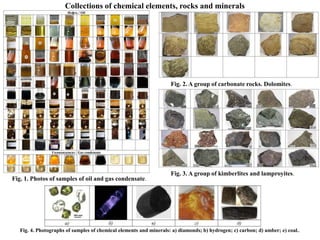
Fig. 1. Photos of samples of oil and gas condensate.
Fig. 2. A group of carbonate rocks. Dolomites.
Fig. 3. A group of kimberlites and lamproyites.
Fig. 4. Photographs of samples of chemical elements and minerals: a) diamonds; b) hydrogen; c) carbon; d) amber; e) coal..
Collections of chemical elements, rocks and minerals
A distinctive feature of mobile direct-prospecting methods
A fundamentally important feature of direct-prospecting frequency-
resonance methods is that, unlike classical geophysical methods, they
provide a real opportunity to fill the studied cross-section with the
appropriate complexes of sedimentary, metamorphic and igneous
rocks, as well as determine the intervals of the cross-section,
prospective for the detection of combustible and ore minerals,
immediately, in the process of carrying out measurements (recording
signals) with developed instrumentation devices (i.e., without
additional steps of modeling and geological interpretation of
geophysical measurements). In this presentation, as well as in other
published papers [1-12, in next slide], the measurement results are
presented and analyzed exclusively!
Publications
•1. Yakymchuk N.A., Korchagin I.N., Bakhmutov V.G., Solovjev V.D. Geophysical investigation in the Ukrainian marine Antarctic expedition of 2018: mobile measuring equipment,
innovative direct-prospecting methods, new results. Geoinformatika, 2019, no. 1, pp. 5-27 (in Russian).
•2. Yakymchuk N.A., Korchagin I.N. Integral estimation of the deep structure of some volcanoes and cymberlite pipes of the Earth. Geoinformatika, 2019, no. 1, pp. 28-38 (in Russian).
•3. Yakymchuk, N. A., Korchagin, I. N. Application of mobile frequency-resonance methods of satellite images and photo images processing for hydrogen accumulations searching.
Geoinformatika, 2019, no. 3, pp. 19-28 (in Russian).
•4. Yakymchuk, N. A., Korchagin, I. N. Studying the internal structure of volcanic complexes of different type by results of frequency-resonant processing of satellite and photo images.
Geoinformatika, 2019, no. 4, pp. 5-18 (in Russian).
•5. Yakymchuk, N. A., Korchagin, I. N. Technology of frequency-resonance processing of remote sensing data: results of practical approbation during mineral searching in various regions
of the globe. Part I. Geoinformatika, 2019, no. 3, pp. 29-51; Part II. Geoinformatika. 2019. no. 4, pp. 30-58; Part III. Geoinformatika. 2020. no. 1, pp. 19-41; Part IV. Geoinformatika.
2020. no. 3, pp. 29-62; Part V. Geoinformatika. 2021. no. 3-4, pp. 51-88 (in Russian).
•6. Yakymchuk, N. A., Korchagin, I. N. Approbation of direct-prospecting technology of frequency-resonance processing of satellite images and photo images at known hydrocarbon
deposits in different regions. Geoinformatika, 2020, no. 2, pp. 3-38 (in Russian).
•7. Yakymchuk, N. A., Korchagin, I. N. On the possibility of application the frequency-resonance technology of satellite images and photos images processing for studying objects of the
solar system and far space Geoinformatika, 2020, no. 2, pp. 98-108 (in Russian).
•8. Yakymchuk, N. A., Korchagin, I. N. Direct-prospecting technology of frequency-resonant processing of satellite images and photos images: results of use for determining areas of gas
and hydrogen migration to the surface and in the atmosphere. Geoinformatika, 2020, no. 3, pp. 3-28 (in Russian).
•9. Yakymchuk, N. A., Korchagin, I. N. New evidence in favor of the abiogenic genesis of hydrocarbons from the results of the testing of direct-prospecting methods in various regions of
the world. Reports of the National Academy of Sciences of Ukraine. 2020. № 9. P. 55-62. https://doi.org/10.15407/dopovidi2020.09.055 (in Ukrainian).
•10. Yakymchuk, N. A., Korchagin, I. N. Direct-prospecting technology of frequency-resonance processing of satellite images and photo images: potential opportunities and prospects of
application for natural hydrogen accumulations searching. Geoinformatika, 2020, no. 4, pp. 3-41 (in Russian).
•11. Yakymchuk, N. A., Korchagin, I. N. Depth structure features of large zones of hydrogen degassing in various regions of the earth by results of frequency-resonance processing of
satellite and photos images. Geoinformatika, 2021, no. 1-2, pp. 3-42 (in Russian).
•12. Yakymchuk, N. A., Korchagin, I. N. On the prospects of the technology of remote sensing data frequency-resonance processing using when conducting profiles geoelectric and
seismic studies. Geoinformatika. 2021. no. 3-4, pp. 18-50 (in Russian).
•13.N.A. Yakymchuk1, I.N. Korchagin2, A.Javadova3. Results of a survey by mobile direct-prospecting methods in the location of the active Dashly volcanic complex in the Caspian Sea,
“Azerbaijan Geologist” Scientific bulletin of the Azerbaijan society of Petroleum geologists; N26, 2021, ISSN 2410-4264, print in publishing “Mozaik Printing, Baku, Azerbaijan,
•13. Mykola Yakymchuk, Ignat Korchagin, Arzu Javadova Results of the application of direct-prospecting technology of satellite images and photo images by frequency-resonance
processing on the drilling sites of exploration wells in the Caspian Sea. Publisher: European Association of Geoscientists & Engineers Proceedings, Geoinformatics, May 2021, Volume
2021, p.1 – 6, DOI: https://doi.org/10.3997/2214-4609.20215521016
•14 Yakymchuk N.A., Korchagin I.N., Javadova A. Application of frequency-resonance methods of satellite images processing for hydrogen and living water accumulations searching
within local areas in Europe, World Multidisciplinary Earth Sciences Symposium – WMESS, Praqa, Chezh Republic, Informatics, Geoinformatics & Remote Sensing, 5-9 september 2021,
A proceedings journal (IOP Conference Series: Earth and Environmental Science) which is indexed in Web of Science, SCOPUS, etc. Page 10 https://iopscience.iop.org/issue/1755-
1315/906/1 IOP Conf. Series: Earth and 7th World Multidisciplinary Earth Sciences Symposium (WMESS 2021), Environmental Science 906 (2021) 011001; doi:10.1088/1755-
1315/906/1/011001
•15 Yakimchuk N.A.1, Korchagin I.N.2, Javadova A , Results of the application of direct-prospecting technology of satellite images and frequency-resonance processing on the exploration
blocks of Shakal and Halabja (Kurdistan). Multidisciplinary Earth Sciences Symposium – WMESS, Praqa, Chezh Republic, Informatics, Geoinformatics & Remote Sensing, 5-9
september 2021, A proceedings journal (IOP Conference Series: Earth and Environmental Science) which is indexed in Web of Science, SCOPUS, etc. Page 10
https://iopscience.iop.org/issue/1755-1315/906/1 IOP Conf. Series: Earth and 7th World Multidisciplinary Earth Sciences Symposium (WMESS 2021), Environmental Science 906 (2021)
011001; doi:10.1088/1755-1315/906/1/011001
•16 Yakymchuk N.A., Korchagin I.N., Javadova A. Peculiarities of the West Turkmenian offshore part of South Caspian by direct prospecting methods. Reports of European Academic
Research. February 2022. Publisher: “EASR”. SciPub.de. P. 56-68. https://ojs.scipub.de/index.php/REAR/issue/view/31/50
•17Yakymchuk N.A.1, Korchagin I.N.2, Javadova A.T 3 . Results of reconnaissance survey of the local area on the seismic profile TESZ-2021. 83rd EAGE Annual Conference &
Exhibition in Madrid, 5-9 June, 2022. Conference Proceedings, 83rd EAGE Annual Conference & Exhibition, Jun 2022, Volume 2022, p.1 - 5 DOI: https://doi.org/10.3997/2214-
4609.202210285
In many publications, including [1], it is noted that the efficiency of prospecting and exploration
wells drilling for oil and gas does not exceed 25–30%. It is also stated here that the main reasons for
this situation are “the dogma of the organic genesis of hydrocarbons and the orientation of deep
drilling towards positive structural traps of the sedimentary cover, the fund of which is currently
close to exhaustion” [1]. At the end of this article, the authors also draw “attention to the need for a
mass transition to “direct” prospecting, which is important in the conditions of low success in
hydrocarbon exploration” [1].
The authors of the monograph [2] in the introduction write (state) that in «the South Caspian Basin, the
largest Western multinational companies and their consortium for period from 1995 to 2008, having
drilled 28 exploratory wells with depths up to 7301 m on 21 highly promising structures, previously
surveyed by high-resolution 3D seismic, did not discover a single commercially viable field,
spending about $1 billion on their search» [2, p. 10].
Experimental investigation show, that additional surveys promptly carried out using direct-prospecting
methods at local drilling sites of prospecting and exploratory wells will contribute to an increase in the
drilling success rate (an increase in the number of wells with commercial hydrocarbon inflows).
Reference
1. Rachinsky M.Z., Karpov V.A. On the issue of increasing the efficiency of exploration work. // Geology and subsoil use. 2022. No. 1. P. 158-161 (in
Russian).
2. Rachinsky M.Z., Kerimov V.I. Geofluid dynamics of oil and gas potential of mobile belts. Scientific editor: M.V. Gorfunkel. John Wiley & Sons,
Inc., Hoboken, New Jersey, and Scrivener Publishing LLC, Salem, Massachusetts. 2015. 494 p. (in Russian).
About efficiency of prospecting wells drilling and transition to “direct” prospecting
Garadashlyk-1 Exploration well (dry) drilled on the west Turkmenia offshore part of South Caspian
Figure 1. A- Satellite image of the survey site in the area of the
drilled well. B-The position of the well is indicated by a marker
Figure 2. Position of local processing areas on the satellite image
of the territory
Blocks 11 and 12. Responses from the 10th group of
sedimentary (siliceous) rocks were recorded. The root
of the volcano of siliceous rocks was determined at a
depth of 723 km. The investigation within
exploration blocks 11 and 12 allows us to conclude
that the probability of receiving commercial HC
inflows is close to zero! Therefore, it is not advisable
to carry out further exploration work within these
blocks on Figure 1.
Reconnaissance research in oil and gas fields.
During processing the image of HC fields (Fig. 2),
signals were recorded at the frequencies of oil,
condensate, gas, amber, methane-oxidizing
bacteria, phosphorus (yellow), oil shale, gas
hydrates, anthracite, nitrogen, oxygen, carbon, ice.
Responses from hydrogen, living water, diamonds,
graphite, mercury, gold, and sodium chloride salt
were not received
Yakymchuk N.A., Korchagin I.N., Javadova A. Peculiarities of the West Turkmenian offshore part of South Caspian by direct prospecting
methods. Reports of European Academic Research. February 2022. Publisher: “EASR”. SciPub.de. P. 56-68.
https://ojs.scipub.de/index.php/REAR/issue/view/31/50
https://www.researchgate.net/publication/359438120_PECULIARITIES_OF_THE_WEST_TURKMENIAN_OFFSHORE_PART_OF_SOUTH_
CASPIAN_BY_DIRECT_PROSPECTING_METHODS#fullTextFileContent
Area with a gas field. When processing the image in Fig. 2 (rectangle 1) responses from the 1-6th and 10th (siliceous)
groups of sedimentary rocks were recorded. The root of the volcano of 1-6 groups of rocks was determined at a depth of
470 km.
Signals from oil (delayed), condensate (delayed), gas, methane-oxidizing bacteria (delayed), and phosphorus (yellow)
were recorded from the surface.
Fig. 1. Satellite image of the South Korea territory.
Fig. 2. Fragments of a satellite image of
South Korea territory, prepared for
frequency-resonance processing.
South Korea hydrogen project: stage 1
Results: Only two blocks are identified as the most promising for conducting
detailed prospecting for natural hydrogen - 3-4 and 3-9.
•Block 3-4. Signals of basalts. The root of basaltic volcano - at 470 km.
•Signals were recorded at the frequencies of hydrogen (of low intensity, from
19 s), red phosphorus, and hydrogen bacteria.
•The fact of hydrogen migration into the atmosphere was not confirmed by
instrumental measurements (90 s).
•Block 3-9. Signals from basalts were registered. The root of the basalt
volcano was identified at a depth of 99 km.
•Signals were recorded from the surface at the frequencies of hydrogen (of
low intensity, from 18 s), red phosphorus, and hydrogen bacteria.
•Instrumental measurements confirmed the fact of hydrogen migration into
the atmosphere (from 54 s).
Territory of South
Korea is divided
into 29 local
fragments (Fig. 2).
Frequency-
resonance
processing of each
image fragment
were performed to
detect basalt
volcanic complexes
with hydrogen
within it.
Studies of a similar nature can be carried out on the territory of South Korea in order to search for
various minerals: 1. Oil, condensate, gas; 2. Iron ore; 3. Zinc, lithium, copper, scandium, cobalt, etc.; 3.
Ores of non-ferrous metals; 4. Rare earth elements; 5. Water (drinking, mineral, healing); 6. And other
minerals/
Poland and Great Britain mineral projects
Fig. 1. Satellite image of Poland territory.
Fig. 2. Fragments of a satellite image of Great Britain
territory, prepared for frequency-resonance processing.
Territory of Poland and Great Britain is divided into 53 and
67 local fragments. Further, in the reconnaissance mode,
frequency-resonance processing of each fragment of the
image will be performed separately in order to detect
basalt volcanic complexes with hydrogen and living
(healing) water within it.
Studies of a similar nature can be carried out on the
territory of Poland and Great Britain in order to search
for various minerals
Extraction and use of hydrogen in Mali
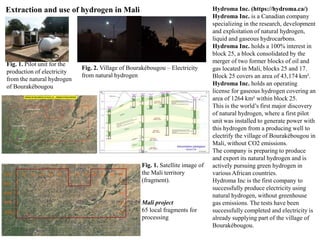
Fig. 1. Pilot unit for the
production of electricity
from the natural hydrogen
of Bourakébougou
Fig. 2. Village of Bourakébougou – Electricity
from natural hydrogen
Hydroma Inc. (https://hydroma.ca/)
Hydroma Inc. is a Canadian company
specializing in the research, development
and exploitation of natural hydrogen,
liquid and gaseous hydrocarbons.
Hydroma Inc. holds a 100% interest in
block 25, a block consolidated by the
merger of two former blocks of oil and
gas located in Mali, blocks 25 and 17.
Block 25 covers an area of 43,174 km².
Hydroma Inc. holds an operating
license for gaseous hydrogen covering an
area of 1264 km² within block 25.
This is the world’s first major discovery
of natural hydrogen, where a first pilot
unit was installed to generate power with
this hydrogen from a producing well to
electrify the village of Bourakébougou in
Mali, without CO2 emissions.
The company is preparing to produce
and export its natural hydrogen and is
actively pursuing green hydrogen in
various African countries.
Hydroma Inc is the first company to
successfully produce electricity using
natural hydrogen, without greenhouse
gas emissions. The tests have been
successfully completed and electricity is
already supplying part of the village of
Bourakébougou.
Fig. 1. Satellite image of
the Mali territory
(fragment).
Mali project
65 local fragments for
processing
Survey for hydrogen in Poland
a) b)
Fig. 1. Satellite images of survey sites in Poland.
Fig. 1a: dolomites - 470 km, marls - 98 km, siliceous
rocks - 723 km, limestones - 99-217 km.
No hydrogen and phosphorus.
Fig. 1b: hydrogen, phosphorus, living water, potassium-
magnesium salt, stishovite, lonsdaleite, sedimentary
rocks of the 10th group (siliceous) and igneous rocks of
the 6th (basalts) and 7th (ultramafic) groups.
Siliceous rocks - 217 km, ultramafic rocks - 470 km,
basalts - 723 km, marl - 218-470 km.
Upper edge of the basalts was fixed at a depth of 107 m.
Responses of hydrogen from dolomites were recorded
in the depth interval 63-83 m.
Hydrogen responses from basalts - from 139 m, and of
living water - from 220 m.
Signals from living water were recorded on the surface
of its synthesis 68 km.
Absence of hydrogen and phosphorus migration into the
atmosphere.
Fig. 2. Satellite image of
Poland (for processing).
Fig. 3.
Satellite
images of
Poland (for
processing).
1. Senay Horozal, Sujin Chae, Dae Hoon Kim, Jeong Min Seo, Sang Min Lee, Hyuk Soo Han,
Deniz Cukur, Gee-Soo Kong. Seismic evidence of shallow gas in sediments on the southeastern
continental shelf of Korea, East Sea (Japan Sea). Marine and Petroleum Geology. 133 (2021).
105291. 14 p. https://doi.org/10.1016/j.marpetgeo.2021.105291
Korean continental shelf. Results of instrumental measurements (processing). April 3, 2022
Fig. 1. Maps-schemes of the block of studies location [1].
Fig. 2. Satellite image of the area of research location. The area of
frequency-resonance processing is indicated by yellow markers.
The article [1] presents the results of
geological and geophysical studies on a large
section of the continental shelf of South
Korea. Maps-schemes of the location of the
work site are shown in Fig.1 [1].
Frequency-resonance processing of the
image fragment indicated in Fig. 2 by
markers.
1. Sedimentary rocks of 1-6th groups with a
root at a depth of 470 km
2. Signals at frequencies of oil, gas
condensate, gas, amber, carbon dioxide,
methane-oxidizing bacteria, nitrogen,
yellow phosphorus, gas hydrates,
anthracite, and ice.
3. 57 km: oil, gas condensate, gas, amber,
nitrogen and yellow phosphorus
4. 59 km – carbon dioxide, oxygen, dead
water
5. -0 m: gas, carbon dioxide, nitrogen,
oxygen, and yellow phosphorus, which
indicates their migration into the atmosphere.
6. Scanning the cross-section up to 10 km: (10 cm step) – 1) 78-154 m, 2) 385-447 m, (50 cm step) – 3) 941-1237 m, 4)
1563-2198 m, 5) 2293-2869 m, 6) 3097-3422 m, 7) 3537-3989 m, 8) 4107-4833 m, (step 5 m) – 9) 6732-7996 m, 10) 8703-
9782 m.
Area of project well drilling on Japan offshore (January 22, 2022)
1. Inpex to conduct exploratory gas drilling off west Japan. https://www.reuters.com/business/energy/inpex-conduct-exploratory-gas-drilling-off-
west-japan-2022-01-18/
2. Inpex to conduct drilling survey, aiming to launch Japan's first gas project in decades.
https://www.japantimes.co.jp/news/2022/01/18/business/corporate-business/inpex-natural-gas-survey/
3. INPEX to Commence Exploratory Offshore Drilling Offshore Shimane, Yamaguchi Prefectures in Japan.
https://www.inpex.co.jp/english/index.html
Fig. 1. Map of well location [3]. Fig. 2. Satellite image of project well location area. The area of
frequency-resonance processing is indicated by a rectangular contour.
During the frequency-resonance processing of a fragment of a satellite image in a rectangular contour in Fig. 2, responses
were recorded at the frequencies of the 10th group of sedimentary (siliceous) rocks and dead water. Signals at the
frequencies of oil, condensate, gas, phosphorus, hydrogen, living water and sodium chloride salt were not received!!!
The results of the operational processing of a fragment of a satellite image in the area of ​​the project well location allow us to
conclude that the probability of fluid inflows obtaining in drilled wells within the survey area is close to zero!!!
In volcanic complexes, filled with siliceous rocks, responses at frequencies of oil, condensate and gas have never been
recorded!
Experimental studies in various regions have shown that siliceous rocks can be a very good seal for the formation of natural
hydrogen accumulations in the reservoirs of cross-section.
Area of project well drilling on Japan offshore (May 6, 2022)
a) b) c)
Fig. 1. Satellite image of the project well location area (a). The position of the drilling vessel is indicated by a marker
with the symbol W. Rectangular on the left (four markers) - the area of frequency-resonance processing on the South
Korea offshore (a). Local areas of frequency-resonant processing are shown on figures (b, c).
Processing results
The image in fig. 1b: Signals at the frequencies of oil, gas condensate and gas were not fixed!
Responses from the 10th group of sedimentary (siliceous) rocks were registered. The root of the volcano with siliceous
rocks was determined at a depth of 723 km, and the upper edge – at 630 m.
The image in fig. 1c: Signals at the frequencies of oil, gas condensate and gas were not fixed!
Responses from the 10th group of sedimentary (siliceous) rocks were registered. The root of the volcano with siliceous
rocks was determined at a depth of 723 km, and the upper edge – at 627 m.
Conclusions: The results of additional processing of local fragments of the satellite image at the location of the
HAKURYU 5 drilling platform confirm the conclusions, obtained during the reconnaissance studies on January 22, 2022:
the probability of fluid inflows receiving in the drilled well at the point with coordinates 35°43'01.2"N, 131°01
'13.1"E is zero!!!
1. Offshore well in Japan: drilling to start imminently. https://www.upstreamonline.com/exclusive/offshore-well-in-japan-
drilling-to-start-imminently/2-1-1207247
Edinburgh well drilling site. Results of instrumental measurements (processing). April 4, 2022
Fig. 1. Position of the Edinburgh well
on a satellite image of the North Sea.
Fig. 2. Satellite images of the Edinburgh drilling site in the
North Sea.
1. Shell spuds much-anticipated Edinburgh well. https://www.energyvoice.com/oilandgas/north-sea/396959/shell-spuds-much-anticipated-
edinburgh-well/
Processing results
During frequency-resonance processing of a satellite image of a local well drilling site (Fig. 2b) from the interval of 0.691-
99 km, signals were recorded at frequencies of the 7th (limestone) group of sedimentary rocks, and from the interval of 99-
723 km, responses were received from the 10th group of sedimentary (siliceous) rocks.
On the HC synthesis surface of 57 km, signals were recorded at the frequencies of oil, gas condensate, gas, and yellow
phosphorus.
At the surface of 0 m, signals were received from the near-surface layer at the frequencies of gas and yellow phosphorus,
which indicates their migration into the atmosphere.
When scanning the cross-section from the surface up to 5 km, responses at oil frequencies were recorded from two
intervals: 1) 1240-(1612-2198-intensive)-2212 m, 2) 3988-(4168-4661-intensive)-4744 m.
Further instrumental measurements studies have not been carried out in the area.
The results of the prompt processing of a fragment of a satellite image of the drilling site indicate a high probability of
detecting in the well of hydrocarbon deposits in commercial volumes!!!
In volcanic complexes, filled with sedimentary rocks of the 7th group (limestones), responses at the frequencies of oil,
condensate and gas are recorded quite often!
Bambo-1 exploratory well drilling on Gambia offshore
Fig. 1. Satellite images of the Bambo-1 well drilling site. The
borehole position is shown with a yellow marker.
During the frequency-resonance processing of
the satellite image in Fig. 1a responses at the
frequencies of oil, condensate and gas are not
registered!
The results of the prompt processing of the
drilling site satellite image allow us to
conclude that the probability of receiving
fluid inflows in commercial volume in the
well is close to zero!!!
1. Australian oil and gas firm FAR has started drilling at the Bambo-1 exploration well in Block A2, offshore The Gambia.
https://www.oedigital.com/news/492087-far-spuds-bambo-1-well-offshore-the-gambia
2. FAR's Bambo Drilling Fails to Deliver (The Gambia) https://www.oedigital.com/news/493082-far-s-bambo-drilling-fails-to-deliver-the-
gambia
Fig. 2. License blocks
onGambian offshore.
Fig. 3. Scheme of the location of licensed blocks of the Gambia on satellite
image of the region.
Block A2. Responses at the frequencies of oil, condensate (of low intensity), gas, methane-oxidizing bacteria, phosphorus
(brown), dead water (with a delay), mercury, gold, coesite, potassium-magnesium salt.
Block A5. Signals at the frequencies of oil, condensate, gas, methane-oxidizing bacteria, phosphorus, hydrogen, salt and
igneous rocks were not received.
Block with deposits on Senegal offshore. Responses at the frequencies of oil, condensate, gas, amber, carbon dioxide,
methane-oxidizing bacteria, phosphorus (yellow), nitrogen, oxygen, carbon, hydrogen (of low intensity), dead water, ice
and sedimentary rocks of the 2-6th groups.
Results of experimental work on the sites of prospecting wells drilling in different
regions published in papers [1].
1. Exploration well "Maria-1" in the West Chernomorsky area in Black Sea.
2. Additional survey of the local drilling site of Melnik-1 well on Khan Asparuh block in the Black
Sea.
3. Local site of an exploration well drilling (coordinates: 57°10.644'N, 001°07.066'E) in the North Sea.
4. Location of the Brulpadda-1AX well on South Africa offshore.
5. Well drilling site on the Silistar block (1-14 Khan Kubrat) on the Bulgarian shelf in Black Sea.
6. Location of the drilled well (coordinates: 6º19'4.8"S, 10º53'33"E) on the Angola offshore.
7. Location of the Kekra-1 well (coordinates: 22°30'17"N, 66°6'49"E) on Pakistan offshore: no
hydrocarbon inflows were obtained in the well. In the information reports on the Kekra-1 well, it is
noted that the cost of well drilling amounted to 100 million dollars of USA and another 100 million
were spent on cementing operations and drilling an additional shaft to reach the design depth!
8. Location of the most expensive "dry" exploratory well in the history of the oil industry Mukluk on
the Alaska offshore.
9. Marina-1 exploration well drilling site (3°36'56".988 S, 81°0'47".988 W) within Block Z-38
offshore Peru. The well was dry.
10. Area of the deepest water Raya-1 well within Block 14 offshore Uruguay. Commercial inflows of
hydrocarbons were not obtained in the well.
1. Yakymchuk, N. A., Korchagin, I. N. Technology of frequency-resonance processing of remote sensing data: results of practical
approbation during mineral searching in various regions of the globe. Part I. Geoinformatika, 2019, no. 3, pp. 29-51; Part II.
Geoinformatika. 2019. no. 4, pp. 30-58; Part III. Geoinformatika. 2020. no. 1, pp. 19-41; Part IV. Geoinformatika. 2020. no. 3, pp.
29-62; Part V. Geoinformatika. 2021. no. 3-4, pp. 51-88 (in Russian).
Exploration site in South America
Fig. 1. Fragments of photographs from the
prospecting site in South America.
a)
b)
c)
d)
Lower rectangle (Fig. 1a): 6th group of
igneous rocks (basalts) - 723 km, copper,
cobalt, beryllium, lithium, and nickel.
Hydrogen, migration into the atmosphere.
Upper edge of the basalts -114 m.
Hydrogen from basalts began recoding - 129
m, and living water - from 135 m.
Copper (114-350 m): 4 intervals with a
thickness of 41 m, 1 m, 8 m and 4 m.
Lithium (114-400 m): two intervals with a
thickness of 54 m and 42 m. Refinement: 1)
10.2 m, 2) 7 m, 3) 5.75 m, 4) 3.15 m, 5) 4.7 m
- the thickness of individual layers.
Fig. 11d
Copper (114-350 m): 1 interval of 14 m thick.
Refinement of the interval : 1) 1.5 m, 2) 4.3 m.
Fig. 11b
Copper (114-350 m): 1 interval of 15 m thick.
Refinement of the interval by scanning with a
step of 1 cm: 1) 5.6 m, 2) 2.7 m.
Fig. 11c
Copper (114-350 m): 1 interval of 26 m thick.
Refinement of the interval by scanning with a
step of 1 cm: 1) 6.5 m, 2) 5.7 m, 3) 2.95 m.
Quarries within basalt complexes in Volyn During frequency-resonance
processing of photographs of
quarries (Fig. 1), only the depth of
the location of the roots of volcanos
was determined, and the presence of
certain chemical elements in cross-
section was also estimated.
Quarry-1 (Fig. 1a). Phosphorus (red
and yellow), hydrogen, hydrogen
bacteria and living water in cross-
section was confirmed. The root -
470 km. From interval 470-996 km -
granites. Signals of weak intensity
of 6A and 6B groups of rocks and
responses at the frequencies of
copper and lithium were recorded.
Fig. 1. Photographs from basalt quarries in Volyn.
Quarry-2 (Fig. 1b). A basalt volcano with a root at a depth of 723 km was identified and responses were obtained of
phosphorus, hydrogen, hydrogen bacteria, living water, 6A-6B rock groups and granites from the interval of 723-996 km.
Responses of copper (intense) and lithium were recorded from the surface.
Quarry-3 (Fig. 1c). Over a basaltic volcano with a root at a depth of 723 km, responses were obtained from phosphorus,
hydrogen, hydrogen bacteria, living water, 6A-6B rock groups and granites from an interval of 723-996 km. Responses
were registered at the frequencies of lithium, nickel, potassium, scandium, titanium, chromium, and there were no signals
of copper and zinc.
Quarry-4 (Fig. 1d). The root of the basalt volcano was identified at a depth of 470 km. From the interval of 470-996 km,
responses were received of granites, of living water - at a depth of 69 km, and of dead water - at 71 km.
Responses of copper, lithium and nickel were recorded from the surface.
Quarry-5 (Fig. 15e). The root of the basalt volcano was identified at a depth of 470 km. From the interval 470-996 km,
responses from granites were received. Responses of cobalt and lithium (intense) were recorded from the surface.
Fig. 1. Photographs from the quarries of the
largest gold deposits in the world (Ten ...). The
number indicates the location of the deposit in
terms of gold reserves.
•Muruntau deposit: granitic volcanoes with roots at depths of 470 and
996 km;
•Nine other deposits: "young" volcanoes with roots at depths of 470;
•Gold: only in granitic volcanoes with roots at a depth of 470 km.
Fig. 2. Photograph of the Namoya gold deposit.
•1. Granitic volcano: 470 km; sedimentary rocks of 1-6 groups: 723 km.
•2. Gold (a step of 10 cm): 1) 44-218 m, 2) 403-509 m, 3) 578-627 m, 4)
662-1093 m, transition to a step of 1 m, 5) 1925-3960 m (up to 4 km
traced).
•3. Oil: 1) 300-(intensive -880)-927 m; 2) 1040-(1500- intensive)-1560 m:
3) 1930-(2190- intensive)-2250 m; 4) 2780-2860 m; 5) 2990-(3130-
intense)-(3200-very intense)-3300 m; 6) 3650-4070 m; 7) 4235-(4350-
intensive)-4560 m; from 5 km - 1m step, 8) 5750-5910 m; 9) 6300-(7000-
intense)(7200-very intense)-7370 m; 10) 8030-(8335-intensive)(8640-very
intense)-9100 m; 11) 9610-9760 m; per 5 m step, 12) 10990-(13000-
intense)(13800-very intense)-16400 m (up to 16.5 km).
The largest gold deposits in the world
Conclusions
The results of frequency-resonance processing of satellite images and photographs of local sites of drilling
exploratory wells, as well as on search areas and fields in various oil and gas regions, are sufficient
convincingly indicate the appropriateness of the application of the developed methods (in conjunction with
the traditionally used) to select the optimal location of prospecting and exploratory wells. The super-
operational method of integrated assessment of oil and gas prospects provides an opportunity to
significantly accelerate and optimize the geological exploration process for combustible and ore minerals.
The use of this technology can bring a significant effect during the search for industrial accumulations of
hydrocarbons in unconventional reservoirs (including areas of shale, coal-bearing formations, and
crystalline rock’s location).
Additional surveys promptly carried out using direct-prospecting methods at local drilling sites of
prospecting and exploratory wells will contribute to an increase in the drilling success rate (an increase in
the number of wells with commercial hydrocarbon inflows). The laying of wells in the areas of fluid
migration vertical channel’s location can lead to an increase in hydrocarbon inflows. Mobile technology
can also be successfully used during the exploration of poorly explored areas and blocks within known oil
and gas fields.
•The conducted reconnaissance studies once again showed that the method of integral assessment of the
prospects of the desired minerals finding within large prospecting blocks and local areas provides an
opportunity to quickly (in a short time) select the most promising areas for detailed prospecting.
•The results of a survey of large blocks in various regions of the globe indicate the potential for a
reconnaissance survey of the European countries territories in order to identify the most promising
areas (blocks) for conducting detailed prospecting for oil and gas. The problem of gas supply in
many European countries is currently quite relevant.
Thank you for attention!

Direct-prospecting methods_Presentation.ppt

  • 1.
    DIRECT-PROSPECTING TECHNOLOGY OFREMOTE SENSING DATA FREQUENCY-RESONANCE PROCESSING: PROSPECTS OF APPLICATION FOR THE NATURAL HYDROGEN, HYDROCARBONS ORE MINERALS AND WATERS SEARCHING Mykola Yakymchuk1, Ignat Korchagin2 Arzu Javadova3 1Institute of Applied Problems of Ecology, Geophysics and Geochemistry, Kyiv, Ukraine, yakymchuk@gmail.com 2Institute of Geophysics of Ukraine National Academy of Science, Kyiv, Ukraine, korchagin.i.n@gmail.com ³MicroPro GmBH, Microbiological Laboratory - Magdeburger Str. 26 b, 39245 Gommern, Germany, javadova@micropro.de
  • 2.
    Possible projects oftechnology application for mineral exploration with foreign partners: •1. Reconnaissance survey of large blocks or the entire territory of a particular country in order to identify local areas for detailed prospecting for: a) oil, gas, condensate; b) natural hydrogen; c) ore minerals. •2. Carrying out detailed exploration work within the most promising areas for hydrocarbons and natural hydrogen in order to assess the feasibility of exploration wells drilling within them and to select sites for their laying. •3. A detailed survey of local areas (sites) of the drilled for oil and gas wells location in order to identify missed oil and gas reservoirs and assess the prospects of hydrocarbon deposits detecting in the cross-section below the bottom of the wells. •4. A detailed survey of the sites of planned oil and gas wells location in order to additionally assess the feasibility of their drilling. •5. Examination of areas with sources of living and dead water location on the territory of the country in order to study the medicinal properties of healing water and assess the feasibility of its extraction. •6. Detailed survey of local areas, promising for the searching of precious and non-ferrous metals, as well as rare earth chemical elements.
  • 3.
    If you wantto find the secrets of the universe, think in terms of energy, frequency and vibration. – Nikola Tesla I can never forget the first sensations that I experienced when it dawned on my mind that I was watching something that might have unpredictable consequences for humanity. I felt myself present at the birth of a new knowledge or at the discovery of a great truth The standing electric waves, discovered by Nikola Tesla in 1899 in the deep horizons of the Earth, are the basis of the developed direct-prospecting methods Model of the standing electric waves formation in the deep horizons of the Earth Model (fragment) of the Earth's crust: h1 – h3 - thickness of sedimentary rock strata; 1–3 - their dielectric constant; 1-3 - the boundaries of the layers; I – III - antinode of standing waves
  • 4.
    Using THE FREQUENCY-RESONANCE PRINCIPLE THEMOBILE GEOPHYSICAL TECHNOLOGIES: Fluxmetres survey; Method of vertical electric-resonance sounding (scanning); Frequency-resonance method of remote sensing data of the Earth (satellite images and photo images) processing and interpretation are developed and improved and NEW PARADIGM OF GEOPHYSICAL RESEARCH is proposed •Within the framework of a new, "substance" (“matter”) paradigm of geophysical research, a "direct" search for a specific physical substance is carried out: gas, oil, gas hydrates, water, ore minerals and rocks (gold, platinum, silver, zinc, uranium, diamonds, kimberlites, etc.). The initial stage in the development of this paradigm can be considered the first research and development on the "direct" methods for oil and gas searching. At the same time, a well-known and widely used expression, the anomaly of "deposit" type (DTA), was introduced into the geological and geophysical terminology. •DTA can also be viewed as a projection (approximate) of the contours of the desired substance in a cross-section on the day surface. •There are reasons to state that the effectiveness of geophysical methods, based on the principles of the "matter" paradigm, is higher than traditional ones.
  • 5.
    Hardware equipment oftechnology Fig. 1. Measuring equipment: on the long line generator (LLG) (aluminum box) there are three modifications of the fluxmeter Fig. 2. A set of equipment for recording the strength of the Earth electric field (fluxmeter in the right box) and changes in the electric charge in the measurement zone depending on meteorological conditions (fluxmeter in the left box). Fig. 3. Plates (antennas) placing on the cockpit to record changes in the intensity of the natural electric field. Fig. 4. Sets of frequency resonance sounding equipment to a depth of 118 km (left) and 25 km (right). The shown hardware measuring systems have been tested during research at the Ukrainian marine Antarctic Expedition of 2018
  • 6.
    Base of magmaticand metamorphic rocks 1. Group of granites and rhyolites. 29 samples. 2. Group of granodiorites and dacites. 7 samples. 3. A group of syenites and trachytes. 18 samples. 4. A group of diorites and andesites. 14 samples. 5. Rocks of the lamprophyre group. 14 samples. 6. Group of gabbro and basalt. 32 samples. 7. The group of no-feldspathic no-feldspathoid ultramafic rocks. 20 samples. 8. Group of feldspathoid syenites and phonolites. 23 samples. 9. Group of feldspathoid gabbroids and basaltoids. 6 samples. 10. A group of no-feldspathic ultramafic and mafic rocks. 10 samples. 11. A group of kimberlites and lamproites. 20 samples. 12. Non-silicate rocks. Group of carbonatites. 8 samples. 13. Metamorphic rocks of the granulite group. 10 samples. 14. Metamorphic rocks of the gneiss group. 26 samples. 15. Metamorphic rocks of the group of crystalline schists. 44 samples. 16. Metamorphic rocks of the group of microcrystalline schists (phyllites). 11 samples. 17. Metamorphosed rocks of the slate group. 2 samples. 18. Iron ore. 5 samples Base of sedimentary rocks. 1. Group of detrital rocks. Psefits. Monomineralic conglomerates. 22 samples. 2. Group of detrital rocks. Psammites 18 samples. 3. Group of detrital rocks. Alevrits, argillites, clays. 6 samples. 4. Group of detrital and clay rocks. Clay rocks. Argillite kaolinite. 6 samples. 5. Group of detrital rocks. Clay rocks. Kaolinite clays. 10 samples. 6. Sedimentary-volcanoclastic rocks. 9 samples. 7. Group of carbonate rocks. Limestone. 24 samples. 8. Group of carbonate rocks. Dolomites. 11 samples. 9. Group of carbonate rocks. Marls. 10 samples. 10. A group of siliceous rocks. 13 samples. 11. Salt. 3 samples. 12. Coal. 3 samples. Photos of the listed sets of samples of sedimentary, metamorphic and igneous rocks are taken from an electronic document on the website http://rockref.vsegei.ru/petro/. “Electronic petrographic reference book-identifier of magmatic, metamorphic and sedimentary rocks” for operational use in the creation of Gosgeolkart1000 / 3 and 200/2 for the territory of the Russian Federation. St. Petersburg, 2015. http://rockref.vsegei.ru/petro/ Collections of rocks
  • 7.
    •Volcanoes filled withthe following rock complexes: •1) salt; •2) sedimentary rocks of 1-6 groups; •3) sedimentary rocks of the 7th group (limestones); •4) sedimentary rocks of the 8th group (dolomites); •5) sedimentary rocks of the 9th group (marls); •6) sedimentary rocks of the 10th group (siliceous); •7) igneous rocks of the 1st group (granites); •8) igneous rocks of the 6th group (basalts); •9) igneous rocks of the 7th group (ultramafic); •10) igneous rocks of the 11th group (kimberlites). •The roots of volcanoes are fixed at depths: 95-99 km; 195-217 km; 470 km; 723 km; 996 km. Detection of combustible and ore minerals in volcanic complexes •Minerals - volcanoes: •Oil, condensate, gas: 1, 2, 3, 7, 9 (Only in volcanic structures of 5 types) •Hydrogen: 8 •Amber: 2 •Gold: 7 (young volcanoes with roots at a depth of 470 km). •Diamonds: 10 •Lonsdaleites: 9 Volcanic structures that are fixed during instrumental measurements using the developed instrumentation systems
  • 8.
    Fig. 1. Photosof samples of oil and gas condensate. Fig. 2. A group of carbonate rocks. Dolomites. Fig. 3. A group of kimberlites and lamproyites. Fig. 4. Photographs of samples of chemical elements and minerals: a) diamonds; b) hydrogen; c) carbon; d) amber; e) coal.. Collections of chemical elements, rocks and minerals
  • 9.
    A distinctive featureof mobile direct-prospecting methods A fundamentally important feature of direct-prospecting frequency- resonance methods is that, unlike classical geophysical methods, they provide a real opportunity to fill the studied cross-section with the appropriate complexes of sedimentary, metamorphic and igneous rocks, as well as determine the intervals of the cross-section, prospective for the detection of combustible and ore minerals, immediately, in the process of carrying out measurements (recording signals) with developed instrumentation devices (i.e., without additional steps of modeling and geological interpretation of geophysical measurements). In this presentation, as well as in other published papers [1-12, in next slide], the measurement results are presented and analyzed exclusively!
  • 10.
    Publications •1. Yakymchuk N.A.,Korchagin I.N., Bakhmutov V.G., Solovjev V.D. Geophysical investigation in the Ukrainian marine Antarctic expedition of 2018: mobile measuring equipment, innovative direct-prospecting methods, new results. Geoinformatika, 2019, no. 1, pp. 5-27 (in Russian). •2. Yakymchuk N.A., Korchagin I.N. Integral estimation of the deep structure of some volcanoes and cymberlite pipes of the Earth. Geoinformatika, 2019, no. 1, pp. 28-38 (in Russian). •3. Yakymchuk, N. A., Korchagin, I. N. Application of mobile frequency-resonance methods of satellite images and photo images processing for hydrogen accumulations searching. Geoinformatika, 2019, no. 3, pp. 19-28 (in Russian). •4. Yakymchuk, N. A., Korchagin, I. N. Studying the internal structure of volcanic complexes of different type by results of frequency-resonant processing of satellite and photo images. Geoinformatika, 2019, no. 4, pp. 5-18 (in Russian). •5. Yakymchuk, N. A., Korchagin, I. N. Technology of frequency-resonance processing of remote sensing data: results of practical approbation during mineral searching in various regions of the globe. Part I. Geoinformatika, 2019, no. 3, pp. 29-51; Part II. Geoinformatika. 2019. no. 4, pp. 30-58; Part III. Geoinformatika. 2020. no. 1, pp. 19-41; Part IV. Geoinformatika. 2020. no. 3, pp. 29-62; Part V. Geoinformatika. 2021. no. 3-4, pp. 51-88 (in Russian). •6. Yakymchuk, N. A., Korchagin, I. N. Approbation of direct-prospecting technology of frequency-resonance processing of satellite images and photo images at known hydrocarbon deposits in different regions. Geoinformatika, 2020, no. 2, pp. 3-38 (in Russian). •7. Yakymchuk, N. A., Korchagin, I. N. On the possibility of application the frequency-resonance technology of satellite images and photos images processing for studying objects of the solar system and far space Geoinformatika, 2020, no. 2, pp. 98-108 (in Russian). •8. Yakymchuk, N. A., Korchagin, I. N. Direct-prospecting technology of frequency-resonant processing of satellite images and photos images: results of use for determining areas of gas and hydrogen migration to the surface and in the atmosphere. Geoinformatika, 2020, no. 3, pp. 3-28 (in Russian). •9. Yakymchuk, N. A., Korchagin, I. N. New evidence in favor of the abiogenic genesis of hydrocarbons from the results of the testing of direct-prospecting methods in various regions of the world. Reports of the National Academy of Sciences of Ukraine. 2020. № 9. P. 55-62. https://doi.org/10.15407/dopovidi2020.09.055 (in Ukrainian). •10. Yakymchuk, N. A., Korchagin, I. N. Direct-prospecting technology of frequency-resonance processing of satellite images and photo images: potential opportunities and prospects of application for natural hydrogen accumulations searching. Geoinformatika, 2020, no. 4, pp. 3-41 (in Russian). •11. Yakymchuk, N. A., Korchagin, I. N. Depth structure features of large zones of hydrogen degassing in various regions of the earth by results of frequency-resonance processing of satellite and photos images. Geoinformatika, 2021, no. 1-2, pp. 3-42 (in Russian). •12. Yakymchuk, N. A., Korchagin, I. N. On the prospects of the technology of remote sensing data frequency-resonance processing using when conducting profiles geoelectric and seismic studies. Geoinformatika. 2021. no. 3-4, pp. 18-50 (in Russian). •13.N.A. Yakymchuk1, I.N. Korchagin2, A.Javadova3. Results of a survey by mobile direct-prospecting methods in the location of the active Dashly volcanic complex in the Caspian Sea, “Azerbaijan Geologist” Scientific bulletin of the Azerbaijan society of Petroleum geologists; N26, 2021, ISSN 2410-4264, print in publishing “Mozaik Printing, Baku, Azerbaijan, •13. Mykola Yakymchuk, Ignat Korchagin, Arzu Javadova Results of the application of direct-prospecting technology of satellite images and photo images by frequency-resonance processing on the drilling sites of exploration wells in the Caspian Sea. Publisher: European Association of Geoscientists & Engineers Proceedings, Geoinformatics, May 2021, Volume 2021, p.1 – 6, DOI: https://doi.org/10.3997/2214-4609.20215521016 •14 Yakymchuk N.A., Korchagin I.N., Javadova A. Application of frequency-resonance methods of satellite images processing for hydrogen and living water accumulations searching within local areas in Europe, World Multidisciplinary Earth Sciences Symposium – WMESS, Praqa, Chezh Republic, Informatics, Geoinformatics & Remote Sensing, 5-9 september 2021, A proceedings journal (IOP Conference Series: Earth and Environmental Science) which is indexed in Web of Science, SCOPUS, etc. Page 10 https://iopscience.iop.org/issue/1755- 1315/906/1 IOP Conf. Series: Earth and 7th World Multidisciplinary Earth Sciences Symposium (WMESS 2021), Environmental Science 906 (2021) 011001; doi:10.1088/1755- 1315/906/1/011001 •15 Yakimchuk N.A.1, Korchagin I.N.2, Javadova A , Results of the application of direct-prospecting technology of satellite images and frequency-resonance processing on the exploration blocks of Shakal and Halabja (Kurdistan). Multidisciplinary Earth Sciences Symposium – WMESS, Praqa, Chezh Republic, Informatics, Geoinformatics & Remote Sensing, 5-9 september 2021, A proceedings journal (IOP Conference Series: Earth and Environmental Science) which is indexed in Web of Science, SCOPUS, etc. Page 10 https://iopscience.iop.org/issue/1755-1315/906/1 IOP Conf. Series: Earth and 7th World Multidisciplinary Earth Sciences Symposium (WMESS 2021), Environmental Science 906 (2021) 011001; doi:10.1088/1755-1315/906/1/011001 •16 Yakymchuk N.A., Korchagin I.N., Javadova A. Peculiarities of the West Turkmenian offshore part of South Caspian by direct prospecting methods. Reports of European Academic Research. February 2022. Publisher: “EASR”. SciPub.de. P. 56-68. https://ojs.scipub.de/index.php/REAR/issue/view/31/50 •17Yakymchuk N.A.1, Korchagin I.N.2, Javadova A.T 3 . Results of reconnaissance survey of the local area on the seismic profile TESZ-2021. 83rd EAGE Annual Conference & Exhibition in Madrid, 5-9 June, 2022. Conference Proceedings, 83rd EAGE Annual Conference & Exhibition, Jun 2022, Volume 2022, p.1 - 5 DOI: https://doi.org/10.3997/2214- 4609.202210285
  • 11.
    In many publications,including [1], it is noted that the efficiency of prospecting and exploration wells drilling for oil and gas does not exceed 25–30%. It is also stated here that the main reasons for this situation are “the dogma of the organic genesis of hydrocarbons and the orientation of deep drilling towards positive structural traps of the sedimentary cover, the fund of which is currently close to exhaustion” [1]. At the end of this article, the authors also draw “attention to the need for a mass transition to “direct” prospecting, which is important in the conditions of low success in hydrocarbon exploration” [1]. The authors of the monograph [2] in the introduction write (state) that in «the South Caspian Basin, the largest Western multinational companies and their consortium for period from 1995 to 2008, having drilled 28 exploratory wells with depths up to 7301 m on 21 highly promising structures, previously surveyed by high-resolution 3D seismic, did not discover a single commercially viable field, spending about $1 billion on their search» [2, p. 10]. Experimental investigation show, that additional surveys promptly carried out using direct-prospecting methods at local drilling sites of prospecting and exploratory wells will contribute to an increase in the drilling success rate (an increase in the number of wells with commercial hydrocarbon inflows). Reference 1. Rachinsky M.Z., Karpov V.A. On the issue of increasing the efficiency of exploration work. // Geology and subsoil use. 2022. No. 1. P. 158-161 (in Russian). 2. Rachinsky M.Z., Kerimov V.I. Geofluid dynamics of oil and gas potential of mobile belts. Scientific editor: M.V. Gorfunkel. John Wiley & Sons, Inc., Hoboken, New Jersey, and Scrivener Publishing LLC, Salem, Massachusetts. 2015. 494 p. (in Russian). About efficiency of prospecting wells drilling and transition to “direct” prospecting
  • 12.
    Garadashlyk-1 Exploration well(dry) drilled on the west Turkmenia offshore part of South Caspian Figure 1. A- Satellite image of the survey site in the area of the drilled well. B-The position of the well is indicated by a marker Figure 2. Position of local processing areas on the satellite image of the territory Blocks 11 and 12. Responses from the 10th group of sedimentary (siliceous) rocks were recorded. The root of the volcano of siliceous rocks was determined at a depth of 723 km. The investigation within exploration blocks 11 and 12 allows us to conclude that the probability of receiving commercial HC inflows is close to zero! Therefore, it is not advisable to carry out further exploration work within these blocks on Figure 1. Reconnaissance research in oil and gas fields. During processing the image of HC fields (Fig. 2), signals were recorded at the frequencies of oil, condensate, gas, amber, methane-oxidizing bacteria, phosphorus (yellow), oil shale, gas hydrates, anthracite, nitrogen, oxygen, carbon, ice. Responses from hydrogen, living water, diamonds, graphite, mercury, gold, and sodium chloride salt were not received Yakymchuk N.A., Korchagin I.N., Javadova A. Peculiarities of the West Turkmenian offshore part of South Caspian by direct prospecting methods. Reports of European Academic Research. February 2022. Publisher: “EASR”. SciPub.de. P. 56-68. https://ojs.scipub.de/index.php/REAR/issue/view/31/50 https://www.researchgate.net/publication/359438120_PECULIARITIES_OF_THE_WEST_TURKMENIAN_OFFSHORE_PART_OF_SOUTH_ CASPIAN_BY_DIRECT_PROSPECTING_METHODS#fullTextFileContent Area with a gas field. When processing the image in Fig. 2 (rectangle 1) responses from the 1-6th and 10th (siliceous) groups of sedimentary rocks were recorded. The root of the volcano of 1-6 groups of rocks was determined at a depth of 470 km. Signals from oil (delayed), condensate (delayed), gas, methane-oxidizing bacteria (delayed), and phosphorus (yellow) were recorded from the surface.
  • 13.
    Fig. 1. Satelliteimage of the South Korea territory. Fig. 2. Fragments of a satellite image of South Korea territory, prepared for frequency-resonance processing. South Korea hydrogen project: stage 1 Results: Only two blocks are identified as the most promising for conducting detailed prospecting for natural hydrogen - 3-4 and 3-9. •Block 3-4. Signals of basalts. The root of basaltic volcano - at 470 km. •Signals were recorded at the frequencies of hydrogen (of low intensity, from 19 s), red phosphorus, and hydrogen bacteria. •The fact of hydrogen migration into the atmosphere was not confirmed by instrumental measurements (90 s). •Block 3-9. Signals from basalts were registered. The root of the basalt volcano was identified at a depth of 99 km. •Signals were recorded from the surface at the frequencies of hydrogen (of low intensity, from 18 s), red phosphorus, and hydrogen bacteria. •Instrumental measurements confirmed the fact of hydrogen migration into the atmosphere (from 54 s). Territory of South Korea is divided into 29 local fragments (Fig. 2). Frequency- resonance processing of each image fragment were performed to detect basalt volcanic complexes with hydrogen within it. Studies of a similar nature can be carried out on the territory of South Korea in order to search for various minerals: 1. Oil, condensate, gas; 2. Iron ore; 3. Zinc, lithium, copper, scandium, cobalt, etc.; 3. Ores of non-ferrous metals; 4. Rare earth elements; 5. Water (drinking, mineral, healing); 6. And other minerals/
  • 14.
    Poland and GreatBritain mineral projects Fig. 1. Satellite image of Poland territory. Fig. 2. Fragments of a satellite image of Great Britain territory, prepared for frequency-resonance processing. Territory of Poland and Great Britain is divided into 53 and 67 local fragments. Further, in the reconnaissance mode, frequency-resonance processing of each fragment of the image will be performed separately in order to detect basalt volcanic complexes with hydrogen and living (healing) water within it. Studies of a similar nature can be carried out on the territory of Poland and Great Britain in order to search for various minerals
  • 15.
    Extraction and useof hydrogen in Mali Fig. 1. Pilot unit for the production of electricity from the natural hydrogen of Bourakébougou Fig. 2. Village of Bourakébougou – Electricity from natural hydrogen Hydroma Inc. (https://hydroma.ca/) Hydroma Inc. is a Canadian company specializing in the research, development and exploitation of natural hydrogen, liquid and gaseous hydrocarbons. Hydroma Inc. holds a 100% interest in block 25, a block consolidated by the merger of two former blocks of oil and gas located in Mali, blocks 25 and 17. Block 25 covers an area of 43,174 km². Hydroma Inc. holds an operating license for gaseous hydrogen covering an area of 1264 km² within block 25. This is the world’s first major discovery of natural hydrogen, where a first pilot unit was installed to generate power with this hydrogen from a producing well to electrify the village of Bourakébougou in Mali, without CO2 emissions. The company is preparing to produce and export its natural hydrogen and is actively pursuing green hydrogen in various African countries. Hydroma Inc is the first company to successfully produce electricity using natural hydrogen, without greenhouse gas emissions. The tests have been successfully completed and electricity is already supplying part of the village of Bourakébougou. Fig. 1. Satellite image of the Mali territory (fragment). Mali project 65 local fragments for processing
  • 16.
    Survey for hydrogenin Poland a) b) Fig. 1. Satellite images of survey sites in Poland. Fig. 1a: dolomites - 470 km, marls - 98 km, siliceous rocks - 723 km, limestones - 99-217 km. No hydrogen and phosphorus. Fig. 1b: hydrogen, phosphorus, living water, potassium- magnesium salt, stishovite, lonsdaleite, sedimentary rocks of the 10th group (siliceous) and igneous rocks of the 6th (basalts) and 7th (ultramafic) groups. Siliceous rocks - 217 km, ultramafic rocks - 470 km, basalts - 723 km, marl - 218-470 km. Upper edge of the basalts was fixed at a depth of 107 m. Responses of hydrogen from dolomites were recorded in the depth interval 63-83 m. Hydrogen responses from basalts - from 139 m, and of living water - from 220 m. Signals from living water were recorded on the surface of its synthesis 68 km. Absence of hydrogen and phosphorus migration into the atmosphere. Fig. 2. Satellite image of Poland (for processing). Fig. 3. Satellite images of Poland (for processing).
  • 17.
    1. Senay Horozal,Sujin Chae, Dae Hoon Kim, Jeong Min Seo, Sang Min Lee, Hyuk Soo Han, Deniz Cukur, Gee-Soo Kong. Seismic evidence of shallow gas in sediments on the southeastern continental shelf of Korea, East Sea (Japan Sea). Marine and Petroleum Geology. 133 (2021). 105291. 14 p. https://doi.org/10.1016/j.marpetgeo.2021.105291 Korean continental shelf. Results of instrumental measurements (processing). April 3, 2022 Fig. 1. Maps-schemes of the block of studies location [1]. Fig. 2. Satellite image of the area of research location. The area of frequency-resonance processing is indicated by yellow markers. The article [1] presents the results of geological and geophysical studies on a large section of the continental shelf of South Korea. Maps-schemes of the location of the work site are shown in Fig.1 [1]. Frequency-resonance processing of the image fragment indicated in Fig. 2 by markers. 1. Sedimentary rocks of 1-6th groups with a root at a depth of 470 km 2. Signals at frequencies of oil, gas condensate, gas, amber, carbon dioxide, methane-oxidizing bacteria, nitrogen, yellow phosphorus, gas hydrates, anthracite, and ice. 3. 57 km: oil, gas condensate, gas, amber, nitrogen and yellow phosphorus 4. 59 km – carbon dioxide, oxygen, dead water 5. -0 m: gas, carbon dioxide, nitrogen, oxygen, and yellow phosphorus, which indicates their migration into the atmosphere. 6. Scanning the cross-section up to 10 km: (10 cm step) – 1) 78-154 m, 2) 385-447 m, (50 cm step) – 3) 941-1237 m, 4) 1563-2198 m, 5) 2293-2869 m, 6) 3097-3422 m, 7) 3537-3989 m, 8) 4107-4833 m, (step 5 m) – 9) 6732-7996 m, 10) 8703- 9782 m.
  • 18.
    Area of projectwell drilling on Japan offshore (January 22, 2022) 1. Inpex to conduct exploratory gas drilling off west Japan. https://www.reuters.com/business/energy/inpex-conduct-exploratory-gas-drilling-off- west-japan-2022-01-18/ 2. Inpex to conduct drilling survey, aiming to launch Japan's first gas project in decades. https://www.japantimes.co.jp/news/2022/01/18/business/corporate-business/inpex-natural-gas-survey/ 3. INPEX to Commence Exploratory Offshore Drilling Offshore Shimane, Yamaguchi Prefectures in Japan. https://www.inpex.co.jp/english/index.html Fig. 1. Map of well location [3]. Fig. 2. Satellite image of project well location area. The area of frequency-resonance processing is indicated by a rectangular contour. During the frequency-resonance processing of a fragment of a satellite image in a rectangular contour in Fig. 2, responses were recorded at the frequencies of the 10th group of sedimentary (siliceous) rocks and dead water. Signals at the frequencies of oil, condensate, gas, phosphorus, hydrogen, living water and sodium chloride salt were not received!!! The results of the operational processing of a fragment of a satellite image in the area of ​​the project well location allow us to conclude that the probability of fluid inflows obtaining in drilled wells within the survey area is close to zero!!! In volcanic complexes, filled with siliceous rocks, responses at frequencies of oil, condensate and gas have never been recorded! Experimental studies in various regions have shown that siliceous rocks can be a very good seal for the formation of natural hydrogen accumulations in the reservoirs of cross-section.
  • 19.
    Area of projectwell drilling on Japan offshore (May 6, 2022) a) b) c) Fig. 1. Satellite image of the project well location area (a). The position of the drilling vessel is indicated by a marker with the symbol W. Rectangular on the left (four markers) - the area of frequency-resonance processing on the South Korea offshore (a). Local areas of frequency-resonant processing are shown on figures (b, c). Processing results The image in fig. 1b: Signals at the frequencies of oil, gas condensate and gas were not fixed! Responses from the 10th group of sedimentary (siliceous) rocks were registered. The root of the volcano with siliceous rocks was determined at a depth of 723 km, and the upper edge – at 630 m. The image in fig. 1c: Signals at the frequencies of oil, gas condensate and gas were not fixed! Responses from the 10th group of sedimentary (siliceous) rocks were registered. The root of the volcano with siliceous rocks was determined at a depth of 723 km, and the upper edge – at 627 m. Conclusions: The results of additional processing of local fragments of the satellite image at the location of the HAKURYU 5 drilling platform confirm the conclusions, obtained during the reconnaissance studies on January 22, 2022: the probability of fluid inflows receiving in the drilled well at the point with coordinates 35°43'01.2"N, 131°01 '13.1"E is zero!!! 1. Offshore well in Japan: drilling to start imminently. https://www.upstreamonline.com/exclusive/offshore-well-in-japan- drilling-to-start-imminently/2-1-1207247
  • 20.
    Edinburgh well drillingsite. Results of instrumental measurements (processing). April 4, 2022 Fig. 1. Position of the Edinburgh well on a satellite image of the North Sea. Fig. 2. Satellite images of the Edinburgh drilling site in the North Sea. 1. Shell spuds much-anticipated Edinburgh well. https://www.energyvoice.com/oilandgas/north-sea/396959/shell-spuds-much-anticipated- edinburgh-well/ Processing results During frequency-resonance processing of a satellite image of a local well drilling site (Fig. 2b) from the interval of 0.691- 99 km, signals were recorded at frequencies of the 7th (limestone) group of sedimentary rocks, and from the interval of 99- 723 km, responses were received from the 10th group of sedimentary (siliceous) rocks. On the HC synthesis surface of 57 km, signals were recorded at the frequencies of oil, gas condensate, gas, and yellow phosphorus. At the surface of 0 m, signals were received from the near-surface layer at the frequencies of gas and yellow phosphorus, which indicates their migration into the atmosphere. When scanning the cross-section from the surface up to 5 km, responses at oil frequencies were recorded from two intervals: 1) 1240-(1612-2198-intensive)-2212 m, 2) 3988-(4168-4661-intensive)-4744 m. Further instrumental measurements studies have not been carried out in the area. The results of the prompt processing of a fragment of a satellite image of the drilling site indicate a high probability of detecting in the well of hydrocarbon deposits in commercial volumes!!! In volcanic complexes, filled with sedimentary rocks of the 7th group (limestones), responses at the frequencies of oil, condensate and gas are recorded quite often!
  • 21.
    Bambo-1 exploratory welldrilling on Gambia offshore Fig. 1. Satellite images of the Bambo-1 well drilling site. The borehole position is shown with a yellow marker. During the frequency-resonance processing of the satellite image in Fig. 1a responses at the frequencies of oil, condensate and gas are not registered! The results of the prompt processing of the drilling site satellite image allow us to conclude that the probability of receiving fluid inflows in commercial volume in the well is close to zero!!! 1. Australian oil and gas firm FAR has started drilling at the Bambo-1 exploration well in Block A2, offshore The Gambia. https://www.oedigital.com/news/492087-far-spuds-bambo-1-well-offshore-the-gambia 2. FAR's Bambo Drilling Fails to Deliver (The Gambia) https://www.oedigital.com/news/493082-far-s-bambo-drilling-fails-to-deliver-the- gambia Fig. 2. License blocks onGambian offshore. Fig. 3. Scheme of the location of licensed blocks of the Gambia on satellite image of the region. Block A2. Responses at the frequencies of oil, condensate (of low intensity), gas, methane-oxidizing bacteria, phosphorus (brown), dead water (with a delay), mercury, gold, coesite, potassium-magnesium salt. Block A5. Signals at the frequencies of oil, condensate, gas, methane-oxidizing bacteria, phosphorus, hydrogen, salt and igneous rocks were not received. Block with deposits on Senegal offshore. Responses at the frequencies of oil, condensate, gas, amber, carbon dioxide, methane-oxidizing bacteria, phosphorus (yellow), nitrogen, oxygen, carbon, hydrogen (of low intensity), dead water, ice and sedimentary rocks of the 2-6th groups.
  • 22.
    Results of experimentalwork on the sites of prospecting wells drilling in different regions published in papers [1]. 1. Exploration well "Maria-1" in the West Chernomorsky area in Black Sea. 2. Additional survey of the local drilling site of Melnik-1 well on Khan Asparuh block in the Black Sea. 3. Local site of an exploration well drilling (coordinates: 57°10.644'N, 001°07.066'E) in the North Sea. 4. Location of the Brulpadda-1AX well on South Africa offshore. 5. Well drilling site on the Silistar block (1-14 Khan Kubrat) on the Bulgarian shelf in Black Sea. 6. Location of the drilled well (coordinates: 6º19'4.8"S, 10º53'33"E) on the Angola offshore. 7. Location of the Kekra-1 well (coordinates: 22°30'17"N, 66°6'49"E) on Pakistan offshore: no hydrocarbon inflows were obtained in the well. In the information reports on the Kekra-1 well, it is noted that the cost of well drilling amounted to 100 million dollars of USA and another 100 million were spent on cementing operations and drilling an additional shaft to reach the design depth! 8. Location of the most expensive "dry" exploratory well in the history of the oil industry Mukluk on the Alaska offshore. 9. Marina-1 exploration well drilling site (3°36'56".988 S, 81°0'47".988 W) within Block Z-38 offshore Peru. The well was dry. 10. Area of the deepest water Raya-1 well within Block 14 offshore Uruguay. Commercial inflows of hydrocarbons were not obtained in the well. 1. Yakymchuk, N. A., Korchagin, I. N. Technology of frequency-resonance processing of remote sensing data: results of practical approbation during mineral searching in various regions of the globe. Part I. Geoinformatika, 2019, no. 3, pp. 29-51; Part II. Geoinformatika. 2019. no. 4, pp. 30-58; Part III. Geoinformatika. 2020. no. 1, pp. 19-41; Part IV. Geoinformatika. 2020. no. 3, pp. 29-62; Part V. Geoinformatika. 2021. no. 3-4, pp. 51-88 (in Russian).
  • 23.
    Exploration site inSouth America Fig. 1. Fragments of photographs from the prospecting site in South America. a) b) c) d) Lower rectangle (Fig. 1a): 6th group of igneous rocks (basalts) - 723 km, copper, cobalt, beryllium, lithium, and nickel. Hydrogen, migration into the atmosphere. Upper edge of the basalts -114 m. Hydrogen from basalts began recoding - 129 m, and living water - from 135 m. Copper (114-350 m): 4 intervals with a thickness of 41 m, 1 m, 8 m and 4 m. Lithium (114-400 m): two intervals with a thickness of 54 m and 42 m. Refinement: 1) 10.2 m, 2) 7 m, 3) 5.75 m, 4) 3.15 m, 5) 4.7 m - the thickness of individual layers. Fig. 11d Copper (114-350 m): 1 interval of 14 m thick. Refinement of the interval : 1) 1.5 m, 2) 4.3 m. Fig. 11b Copper (114-350 m): 1 interval of 15 m thick. Refinement of the interval by scanning with a step of 1 cm: 1) 5.6 m, 2) 2.7 m. Fig. 11c Copper (114-350 m): 1 interval of 26 m thick. Refinement of the interval by scanning with a step of 1 cm: 1) 6.5 m, 2) 5.7 m, 3) 2.95 m.
  • 24.
    Quarries within basaltcomplexes in Volyn During frequency-resonance processing of photographs of quarries (Fig. 1), only the depth of the location of the roots of volcanos was determined, and the presence of certain chemical elements in cross- section was also estimated. Quarry-1 (Fig. 1a). Phosphorus (red and yellow), hydrogen, hydrogen bacteria and living water in cross- section was confirmed. The root - 470 km. From interval 470-996 km - granites. Signals of weak intensity of 6A and 6B groups of rocks and responses at the frequencies of copper and lithium were recorded. Fig. 1. Photographs from basalt quarries in Volyn. Quarry-2 (Fig. 1b). A basalt volcano with a root at a depth of 723 km was identified and responses were obtained of phosphorus, hydrogen, hydrogen bacteria, living water, 6A-6B rock groups and granites from the interval of 723-996 km. Responses of copper (intense) and lithium were recorded from the surface. Quarry-3 (Fig. 1c). Over a basaltic volcano with a root at a depth of 723 km, responses were obtained from phosphorus, hydrogen, hydrogen bacteria, living water, 6A-6B rock groups and granites from an interval of 723-996 km. Responses were registered at the frequencies of lithium, nickel, potassium, scandium, titanium, chromium, and there were no signals of copper and zinc. Quarry-4 (Fig. 1d). The root of the basalt volcano was identified at a depth of 470 km. From the interval of 470-996 km, responses were received of granites, of living water - at a depth of 69 km, and of dead water - at 71 km. Responses of copper, lithium and nickel were recorded from the surface. Quarry-5 (Fig. 15e). The root of the basalt volcano was identified at a depth of 470 km. From the interval 470-996 km, responses from granites were received. Responses of cobalt and lithium (intense) were recorded from the surface.
  • 25.
    Fig. 1. Photographsfrom the quarries of the largest gold deposits in the world (Ten ...). The number indicates the location of the deposit in terms of gold reserves. •Muruntau deposit: granitic volcanoes with roots at depths of 470 and 996 km; •Nine other deposits: "young" volcanoes with roots at depths of 470; •Gold: only in granitic volcanoes with roots at a depth of 470 km. Fig. 2. Photograph of the Namoya gold deposit. •1. Granitic volcano: 470 km; sedimentary rocks of 1-6 groups: 723 km. •2. Gold (a step of 10 cm): 1) 44-218 m, 2) 403-509 m, 3) 578-627 m, 4) 662-1093 m, transition to a step of 1 m, 5) 1925-3960 m (up to 4 km traced). •3. Oil: 1) 300-(intensive -880)-927 m; 2) 1040-(1500- intensive)-1560 m: 3) 1930-(2190- intensive)-2250 m; 4) 2780-2860 m; 5) 2990-(3130- intense)-(3200-very intense)-3300 m; 6) 3650-4070 m; 7) 4235-(4350- intensive)-4560 m; from 5 km - 1m step, 8) 5750-5910 m; 9) 6300-(7000- intense)(7200-very intense)-7370 m; 10) 8030-(8335-intensive)(8640-very intense)-9100 m; 11) 9610-9760 m; per 5 m step, 12) 10990-(13000- intense)(13800-very intense)-16400 m (up to 16.5 km). The largest gold deposits in the world
  • 26.
    Conclusions The results offrequency-resonance processing of satellite images and photographs of local sites of drilling exploratory wells, as well as on search areas and fields in various oil and gas regions, are sufficient convincingly indicate the appropriateness of the application of the developed methods (in conjunction with the traditionally used) to select the optimal location of prospecting and exploratory wells. The super- operational method of integrated assessment of oil and gas prospects provides an opportunity to significantly accelerate and optimize the geological exploration process for combustible and ore minerals. The use of this technology can bring a significant effect during the search for industrial accumulations of hydrocarbons in unconventional reservoirs (including areas of shale, coal-bearing formations, and crystalline rock’s location). Additional surveys promptly carried out using direct-prospecting methods at local drilling sites of prospecting and exploratory wells will contribute to an increase in the drilling success rate (an increase in the number of wells with commercial hydrocarbon inflows). The laying of wells in the areas of fluid migration vertical channel’s location can lead to an increase in hydrocarbon inflows. Mobile technology can also be successfully used during the exploration of poorly explored areas and blocks within known oil and gas fields. •The conducted reconnaissance studies once again showed that the method of integral assessment of the prospects of the desired minerals finding within large prospecting blocks and local areas provides an opportunity to quickly (in a short time) select the most promising areas for detailed prospecting. •The results of a survey of large blocks in various regions of the globe indicate the potential for a reconnaissance survey of the European countries territories in order to identify the most promising areas (blocks) for conducting detailed prospecting for oil and gas. The problem of gas supply in many European countries is currently quite relevant.
  • 27.
    Thank you forattention!