

Encryption
What is Encryption?
Main Types of Encryption
 Symmetric Encryption
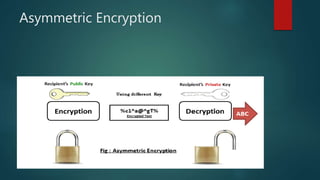
 Asymmetric Encryption
 Hashing
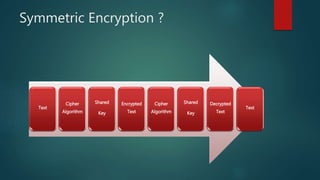
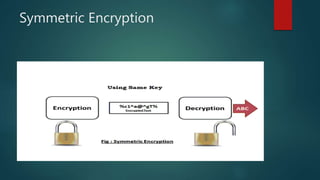
Symmetric Encryption ?
Text
Cipher
Algorithm
Shared
Key
Encrypted
Text
Cipher
Algorithm
Shared
Key
Decrypted
Text
Text
Symmetric Encryption
Symmetric Encryption-Uses
 Cloud backup Services
 To encrypt computer or storage device
 To create secure Channel between two endpoints
Symmetric Encryption-Drawbacks
 Encryption becomes useless
 Attacker gains the key over network
 Software or Platform itself is compromised
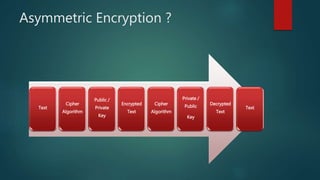
Text
Cipher
Algorithm
Public /
Private
Key
Encrypted
Text
Cipher
Algorithm
Private /
Public
Key
Decrypted
Text
Text
Asymmetric Encryption ?
Asymmetric Encryption
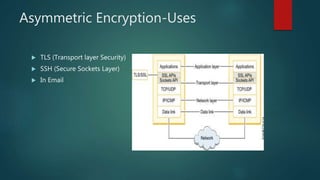
Asymmetric Encryption-Uses
 TLS (Transport layer Security)
 SSH (Secure Sockets Layer)
 In Email
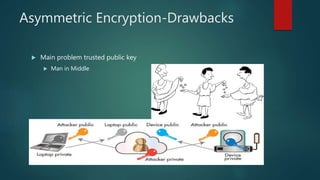
Asymmetric Encryption-Drawbacks
 Main problem trusted public key
 Man in Middle
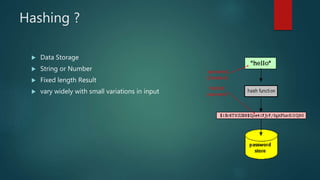
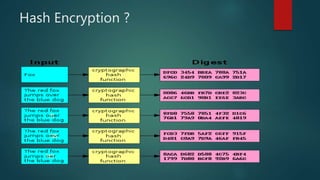
Hashing ?
 Data Storage
 String or Number
 Fixed length Result
 vary widely with small variations in input
Hash Encryption ?
Hash Encryption
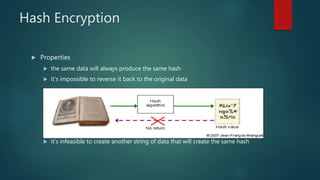
 Properties
 the same data will always produce the same hash
 it’s impossible to reverse it back to the original data
 it’s infeasible to create another string of data that will create the same hash
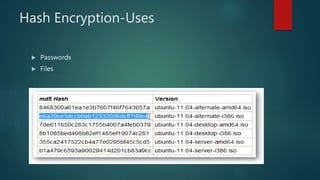
Hash Encryption-Uses
 Passwords
 Files
Hash Encryption-Weakness
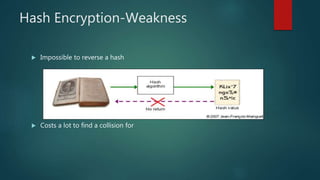
 Impossible to reverse a hash
 Costs a lot to find a collision for
Difference b/w Encryption vs Hashing
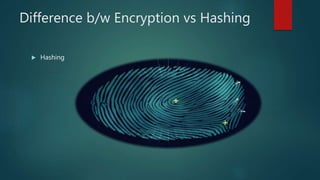
 Hashing
Difference b/w Encryption vs Hashing
 Encryption
Encryption
Encryption

Encryption

Editor's Notes

  • #13 Hashing is like matching a finger print whereas encrypting it is to scramble the message. Use hashing to determine if the message/file is authentic. Use encryption to protect/hide the content.
  • #16 Hashing is used in conjunction with authentication to produce strong evidence that a given message has not been modified. This is accomplished by taking a given input, encrypting it with a given key, hashing it, and then encrypting the key with with the recipient’s public key and signing the hash with the sender’s private key. When the recipient opens the message, they can then decrypt the key with their private key, which allows them to decrypt the message. They then hash the message themselves and compare it to the hash that was signed by the sender. If they match it is an unmodified message, sent by the correct person.