BOD
COD
DO
Waste water
treatment
Submitted To
Dr.(Mrs.) Poonam Syal
Associate Professor
Submitted by
DIVYA SHAKTI
162511
OUTLINE
– Water
– Overview of photosynthesis and
respiration
– Water pollution
– Oxygen Demand
– Biochemical oxygen demand (BOD)
– Typical values for BOD
– Methods of measurement of BOD
– Chemical oxygen demand(COD)
– Typical values for COD
– Methods of measurement of COD
– Dissolved oxygen(DO)
– Typical values for DO
– Methods of measurement of DO
– Nature of waste water
– Problems from different pollutants
– Waste water treatment
– Waste water treatment process
– Treatments
– When the treatment is done
– Ongoing work
Water?
– Water is a transparent and nearly colorless chemical substance that is the main
constituent of Earth's streams. Lakes, and oceans and the fluids of most living
organisms.
– Its chemical formula is H2O, meaning that its molecule contains one oxygen and
two hydrogen atoms, that are connected by covalent bonds.
– Safe drinking water is essential to humans and other life forms even though it
provides no calories or organic nutrients.
OVERVIEW OF
PHOTOSYNTHESIS
AND RESPIRATION
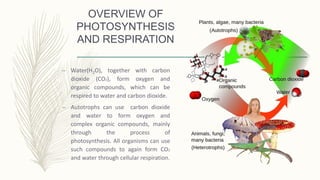
– Water(H2O), together with carbon
dioxide (CO2), form oxygen and
organic compounds, which can be
respired to water and carbon dioxide.
– Autotrophs can use carbon dioxide
and water to form oxygen and
complex organic compounds, mainly
through the process of
photosynthesis. All organisms can use
such compounds to again form CO2
and water through cellular respiration.
WATER POLLUTION
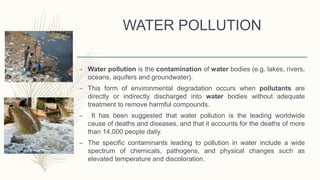
– Water pollution is the contamination of water bodies (e.g. lakes, rivers,
oceans, aquifers and groundwater).
– This form of environmental degradation occurs when pollutants are
directly or indirectly discharged into water bodies without adequate
treatment to remove harmful compounds.
– It has been suggested that water pollution is the leading worldwide
cause of deaths and diseases, and that it accounts for the deaths of more
than 14,000 people daily.
– The specific contaminants leading to pollution in water include a wide
spectrum of chemicals, pathogens, and physical changes such as
elevated temperature and discoloration.
Oxygen Demand
– It is a measure of the amount of “reduced” organic and
inorganic matter in a water
– Relates to oxygen consumption in a river or lake as a result of
a pollution discharge
– Measured in several ways
 BOD - Biochemical Oxygen Demand
 COD - Chemical Oxygen Demand
 Dissolved oxygen
BIOCHEMICAL OXYGEN
DEMAND (BOD)
– Most natural waters contain small quantities of organic compounds. Aquatic
microorganisms have evolved to use some of these compounds as food.
– Microorganisms living in oxygenated waters use dissolved oxygen to oxidative
degrade the organic compounds, releasing energy which is used for growth and
reproduction.
– Biochemical oxygen demand is the amount of oxygen required for microbial
metabolism of organic compounds in water.
Continued….
– It is used in water quality management and assessment, ecology and
environmental science.
– BOD is not an accurate quantitative test, although it is considered as an
indication of the quality of a water source.
– It is most commonly expressed in milligrams of oxygen consumed per liter of
sample during 5 days of incubation at 20 °C or 3 days of incubation at 27 °C.
TYPICAL VALUES
– Most pristine rivers will have a 5-day carbonaceous BOD below 1 mg/L.
– Moderately polluted rivers may have a BOD value in the range of 2 to 8 mg/L.
– Rivers may be considered severely polluted when BOD values exceed 8 mg/L.
– Municipal sewage that is efficiently treated would have a value of about
20 mg/L or less.
– Untreated sewage varies, but averages around 600 mg/L in Europe and as low
as 200 mg/L in the U.S..
METHODS
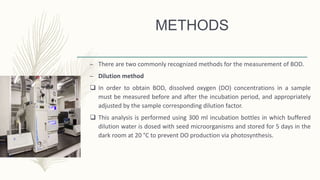
– There are two commonly recognized methods for the measurement of BOD.
– Dilution method
 In order to obtain BOD, dissolved oxygen (DO) concentrations in a sample
must be measured before and after the incubation period, and appropriately
adjusted by the sample corresponding dilution factor.
 This analysis is performed using 300 ml incubation bottles in which buffered
dilution water is dosed with seed microorganisms and stored for 5 days in the
dark room at 20 °C to prevent DO production via photosynthesis.
Continued….
 The dilution water blank is used to confirm the quality of the dilution water that
is used to dilute the other samples.
 This is necessary because impurities in the dilution water may cause significant
alterations in the results. The GGA control is a standardized solution to
determine the quality of the seed, where its recommended BODconcentration
is 198 mg/l ± 30.5 mg/l.
Continued….
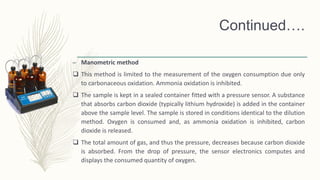
– Manometric method
 This method is limited to the measurement of the oxygen consumption due only
to carbonaceous oxidation. Ammonia oxidation is inhibited.
 The sample is kept in a sealed container fitted with a pressure sensor. A substance
that absorbs carbon dioxide (typically lithium hydroxide) is added in the container
above the sample level. The sample is stored in conditions identical to the dilution
method. Oxygen is consumed and, as ammonia oxidation is inhibited, carbon
dioxide is released.
 The total amount of gas, and thus the pressure, decreases because carbon dioxide
is absorbed. From the drop of pressure, the sensor electronics computes and
displays the consumed quantity of oxygen.
Continued….
– The main advantages of this method compared to the dilution method are:
 Simplicity: no dilution of sample required,
 Direct reading of BOD value.
 Continuous display of BOD value at the current incubation time.
CHEMICAL OXYGEN DEMAND
(COD)
– In environmental chemistry, the chemical oxygen demand (COD) is an indicative
measure of the amount of oxygen that can be consumed by reactions in a
measured solution.
– COD gives the oxygen required for the complete oxidation of both
biodegradable and non-biodegradable matter.
– COD is a measure of the oxygen equivalent of the organic matter content of a
sample that is susceptible to oxidation by a strong chemical oxidant.
– It is an indirect method to measure the amount of organic compounds in water.
– It is expressed in milligrams per liter (mg/L), which indicates the mass of
oxygen consumed per liter of solution.
Typical Value
– Many governments impose strict regulations regarding the maximum chemical
oxygen demand allowed in waste water before they can be returned to the
environment.
– For example, in Switzerland, a maximum oxygen demand between 200 and
1000 mg/L must be reached before waste water or industrial water can be
returned to the environment.
Method
– COD measurements are commonly made on samples of waste waters or of
natural waters contaminated by domestic or industrial wastes.
 Chemical oxygen demand is measured as a standardized laboratory assay in
which a closed water sample is incubated with a strong chemical oxidant under
specific conditions of temperature and for a particular period of time.
 A commonly used oxidant in COD assays is potassium dichromate (K2Cr2O7)
which is used in combination with boiling sulphuric acid (H2SO4). Because this
chemical oxidant is not specific to oxygen-consuming chemicals that are organic
or inorganic, both of these sources of oxygen demand are measured in a COD
assay.
Dissolved oxygen
– Dissolved oxygen (DO) analysis measures the amount of gaseous oxygen (O2)
dissolved in an aqueous solution. Oxygen gets into water by diffusion from the
surrounding air, by aeration (rapid movement), and as a product of photosynthesis.
– Fish and other aquatic animals depend on dissolved oxygen (the oxygen present in
water) to live. The amount of dissolved oxygen in streams is dependent on the water
temperature, the quantity of sediment in the stream, the amount of oxygen taken
out of the system by respiring and decaying organisms, and the amount of oxygen
put back into the system by photosynthesizing plants, stream flow, and aeration.
– DO is measured in standard solution units such as milligrams O2 per liter (mg/L),
milliliters O2 per liter (ml/L), mill moles O2 per liter (mmol/L), and moles O2 per cubic
meter (mol/m3).
– DO is measured by way of its oxidation potential with a probe that allows diffusion
of oxygen into it.
Typical Values
– Trout need DO levels in excess of 8 mg/liter,
– Striped bass prefer DO levels above 5 mg/l,
– And most warm water fish need DO in excess of 2 mg/l.
Methods
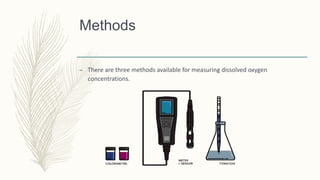
– There are three methods available for measuring dissolved oxygen
concentrations.
Continued…
– Colorimetric method
The colorimetric method offers a basic approximation of dissolved oxygen
concentrations in a sample. This method is quick and inexpensive for basic
projects, but limited in scope and subject to error due to other redoxing agents
that may be present in the water.
– Titration
The traditional method is the Winkler titration. While this method was
considered the most accurate and precise for many years, it is also subject to
human error and is more difficult to execute than the other methods,
particularly in the field.
Continued….
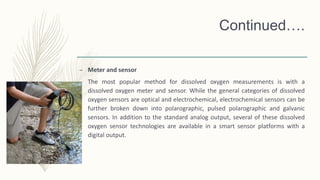
– Meter and sensor
The most popular method for dissolved oxygen measurements is with a
dissolved oxygen meter and sensor. While the general categories of dissolved
oxygen sensors are optical and electrochemical, electrochemical sensors can be
further broken down into polarographic, pulsed polarographic and galvanic
sensors. In addition to the standard analog output, several of these dissolved
oxygen sensor technologies are available in a smart sensor platforms with a
digital output.
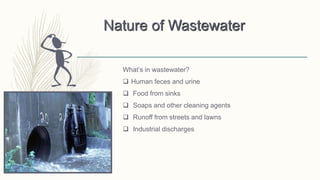
Nature of Wastewater
What’s in wastewater?
 Human feces and urine
 Food from sinks
 Soaps and other cleaning agents
 Runoff from streets and lawns
 Industrial discharges
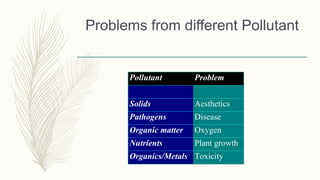
Problems from different Pollutant
Pollutant Problem
Solids Aesthetics
Pathogens Disease
Organic matter Oxygen
Nutrients Plant growth
Organics/Metals Toxicity
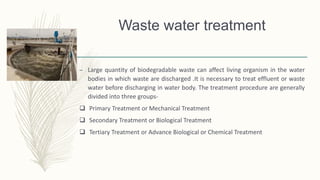
Waste water treatment
– Large quantity of biodegradable waste can affect living organism in the water
bodies in which waste are discharged .It is necessary to treat effluent or waste
water before discharging in water body. The treatment procedure are generally
divided into three groups-
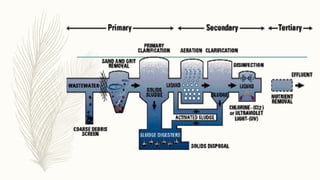
 Primary Treatment or Mechanical Treatment
 Secondary Treatment or Biological Treatment
 Tertiary Treatment or Advance Biological or Chemical Treatment
Treatments
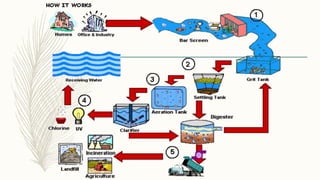
– Primary Treatment- In primary treatment suspended solid and floating material
is removed. Effluent is passes through a screen which is used to remove certain
material like wood pieces, plastic , paper, floating debris. Then effluent is
passed through chamber which is known as grit chamber.-Fatty and oily
substance can be removed by flotation method. In order to trap fatty and oily
substance a instrument called Centrifugal Separator is used in this process fatty
substance are reached to outside and clean water remain in the center of
cyclone.- The water is passed in Settling Tank in which water remain for a long
time in which suspended particles are settled down this process is known as
Sedimentation.
Continued…
– Secondary Treatment or Biological Treatment It is the process in which
microorganism play a very important role for the treatment of effluent.
Microorganism like bacteria, fungi decompose the organic waste and convert
into simpler form. The main function of secondary treatment is to convert the
reaming organic matter of sewage into stable form by oxidation and nitrification.
Biological Treatment Can be classified into
1. Aerobic Treatment
a) Activated Sludge Process
b) b) Trickling Filter
2. Anaerobic Treatment
Continued…
– Tertiary Treatment (Advance waste water treatment)The main function of
tertiary treatment is to decrease the load of nitrogen and phosphorous
compound present in the effluent by the following process.
a) Precipitation
b) Nitrogen Stripping
c) Chlorination
When the treatment is done…
– Effluent back to stream after
 A final carbon filtration and
 Chlorination/de chlorination
– Sludge – very nutrient rich
 Applied directly to land as fertilizer
 Incinerated (good fuel after drying)
 Composted
ONGOING WORK-
A review on emerging contaminants in wastewaters and the environment:
Current knowledge, understudied areas and recommendations for future
monitoring.
– It is anticipated that environmental legislation will be widened to cover a range of
municipal derived emerging contaminant (EC). However, sound knowledge of their fate
during wastewater treatment and within the environment is currently lacking. Due to the
limitations of previously used sampling methods, reported removals of ECs by wastewater
treatment works (WwTWs) have uncertainties. Therefore, removal performance of
different WwTW process types at various operational conditions needs re-evaluated with
suitable sampling protocols. This will help establish steps required for EC amelioration.
The growing trend of improving sustainability and reducing energy demand of wastewater
treatment will see an increase in the application of novel treatment methods. For
example, algae ponds for secondary effluent polishing are a promising treatment method
which can indirectly produce energy through the production of biogas.
– For example, measuring bio-solids and amended soils for their occurrence is needed as
well as supporting analysis. Detailed case studies of amended soils in field conditions
which investigate leaching and runoff, impact to surrounding surface water quality, in soil
degradation, toxicity to terrestrial organisms and the potential uptake by plants and entry
into the human food chain are needed
Bod cod do waste water treartment

Bod cod do waste water treartment

  • 1.
    BOD COD DO Waste water treatment Submitted To Dr.(Mrs.)Poonam Syal Associate Professor Submitted by DIVYA SHAKTI 162511
  • 2.
    OUTLINE – Water – Overviewof photosynthesis and respiration – Water pollution – Oxygen Demand – Biochemical oxygen demand (BOD) – Typical values for BOD – Methods of measurement of BOD – Chemical oxygen demand(COD) – Typical values for COD – Methods of measurement of COD – Dissolved oxygen(DO) – Typical values for DO – Methods of measurement of DO – Nature of waste water – Problems from different pollutants – Waste water treatment – Waste water treatment process – Treatments – When the treatment is done – Ongoing work
  • 3.
    Water? – Water isa transparent and nearly colorless chemical substance that is the main constituent of Earth's streams. Lakes, and oceans and the fluids of most living organisms. – Its chemical formula is H2O, meaning that its molecule contains one oxygen and two hydrogen atoms, that are connected by covalent bonds. – Safe drinking water is essential to humans and other life forms even though it provides no calories or organic nutrients.
  • 4.
    OVERVIEW OF PHOTOSYNTHESIS AND RESPIRATION –Water(H2O), together with carbon dioxide (CO2), form oxygen and organic compounds, which can be respired to water and carbon dioxide. – Autotrophs can use carbon dioxide and water to form oxygen and complex organic compounds, mainly through the process of photosynthesis. All organisms can use such compounds to again form CO2 and water through cellular respiration.
  • 5.
    WATER POLLUTION – Waterpollution is the contamination of water bodies (e.g. lakes, rivers, oceans, aquifers and groundwater). – This form of environmental degradation occurs when pollutants are directly or indirectly discharged into water bodies without adequate treatment to remove harmful compounds. – It has been suggested that water pollution is the leading worldwide cause of deaths and diseases, and that it accounts for the deaths of more than 14,000 people daily. – The specific contaminants leading to pollution in water include a wide spectrum of chemicals, pathogens, and physical changes such as elevated temperature and discoloration.
  • 6.
    Oxygen Demand – Itis a measure of the amount of “reduced” organic and inorganic matter in a water – Relates to oxygen consumption in a river or lake as a result of a pollution discharge – Measured in several ways  BOD - Biochemical Oxygen Demand  COD - Chemical Oxygen Demand  Dissolved oxygen
  • 7.
    BIOCHEMICAL OXYGEN DEMAND (BOD) –Most natural waters contain small quantities of organic compounds. Aquatic microorganisms have evolved to use some of these compounds as food. – Microorganisms living in oxygenated waters use dissolved oxygen to oxidative degrade the organic compounds, releasing energy which is used for growth and reproduction. – Biochemical oxygen demand is the amount of oxygen required for microbial metabolism of organic compounds in water.
  • 8.
    Continued…. – It isused in water quality management and assessment, ecology and environmental science. – BOD is not an accurate quantitative test, although it is considered as an indication of the quality of a water source. – It is most commonly expressed in milligrams of oxygen consumed per liter of sample during 5 days of incubation at 20 °C or 3 days of incubation at 27 °C.
  • 9.
    TYPICAL VALUES – Mostpristine rivers will have a 5-day carbonaceous BOD below 1 mg/L. – Moderately polluted rivers may have a BOD value in the range of 2 to 8 mg/L. – Rivers may be considered severely polluted when BOD values exceed 8 mg/L. – Municipal sewage that is efficiently treated would have a value of about 20 mg/L or less. – Untreated sewage varies, but averages around 600 mg/L in Europe and as low as 200 mg/L in the U.S..
  • 10.
    METHODS – There aretwo commonly recognized methods for the measurement of BOD. – Dilution method  In order to obtain BOD, dissolved oxygen (DO) concentrations in a sample must be measured before and after the incubation period, and appropriately adjusted by the sample corresponding dilution factor.  This analysis is performed using 300 ml incubation bottles in which buffered dilution water is dosed with seed microorganisms and stored for 5 days in the dark room at 20 °C to prevent DO production via photosynthesis.
  • 11.
    Continued….  The dilutionwater blank is used to confirm the quality of the dilution water that is used to dilute the other samples.  This is necessary because impurities in the dilution water may cause significant alterations in the results. The GGA control is a standardized solution to determine the quality of the seed, where its recommended BODconcentration is 198 mg/l ± 30.5 mg/l.
  • 12.
    Continued…. – Manometric method This method is limited to the measurement of the oxygen consumption due only to carbonaceous oxidation. Ammonia oxidation is inhibited.  The sample is kept in a sealed container fitted with a pressure sensor. A substance that absorbs carbon dioxide (typically lithium hydroxide) is added in the container above the sample level. The sample is stored in conditions identical to the dilution method. Oxygen is consumed and, as ammonia oxidation is inhibited, carbon dioxide is released.  The total amount of gas, and thus the pressure, decreases because carbon dioxide is absorbed. From the drop of pressure, the sensor electronics computes and displays the consumed quantity of oxygen.
  • 13.
    Continued…. – The mainadvantages of this method compared to the dilution method are:  Simplicity: no dilution of sample required,  Direct reading of BOD value.  Continuous display of BOD value at the current incubation time.
  • 14.
    CHEMICAL OXYGEN DEMAND (COD) –In environmental chemistry, the chemical oxygen demand (COD) is an indicative measure of the amount of oxygen that can be consumed by reactions in a measured solution. – COD gives the oxygen required for the complete oxidation of both biodegradable and non-biodegradable matter. – COD is a measure of the oxygen equivalent of the organic matter content of a sample that is susceptible to oxidation by a strong chemical oxidant. – It is an indirect method to measure the amount of organic compounds in water. – It is expressed in milligrams per liter (mg/L), which indicates the mass of oxygen consumed per liter of solution.
  • 15.
    Typical Value – Manygovernments impose strict regulations regarding the maximum chemical oxygen demand allowed in waste water before they can be returned to the environment. – For example, in Switzerland, a maximum oxygen demand between 200 and 1000 mg/L must be reached before waste water or industrial water can be returned to the environment.
  • 16.
    Method – COD measurementsare commonly made on samples of waste waters or of natural waters contaminated by domestic or industrial wastes.  Chemical oxygen demand is measured as a standardized laboratory assay in which a closed water sample is incubated with a strong chemical oxidant under specific conditions of temperature and for a particular period of time.  A commonly used oxidant in COD assays is potassium dichromate (K2Cr2O7) which is used in combination with boiling sulphuric acid (H2SO4). Because this chemical oxidant is not specific to oxygen-consuming chemicals that are organic or inorganic, both of these sources of oxygen demand are measured in a COD assay.
  • 17.
    Dissolved oxygen – Dissolvedoxygen (DO) analysis measures the amount of gaseous oxygen (O2) dissolved in an aqueous solution. Oxygen gets into water by diffusion from the surrounding air, by aeration (rapid movement), and as a product of photosynthesis. – Fish and other aquatic animals depend on dissolved oxygen (the oxygen present in water) to live. The amount of dissolved oxygen in streams is dependent on the water temperature, the quantity of sediment in the stream, the amount of oxygen taken out of the system by respiring and decaying organisms, and the amount of oxygen put back into the system by photosynthesizing plants, stream flow, and aeration. – DO is measured in standard solution units such as milligrams O2 per liter (mg/L), milliliters O2 per liter (ml/L), mill moles O2 per liter (mmol/L), and moles O2 per cubic meter (mol/m3). – DO is measured by way of its oxidation potential with a probe that allows diffusion of oxygen into it.
  • 18.
    Typical Values – Troutneed DO levels in excess of 8 mg/liter, – Striped bass prefer DO levels above 5 mg/l, – And most warm water fish need DO in excess of 2 mg/l.
  • 19.
    Methods – There arethree methods available for measuring dissolved oxygen concentrations.
  • 20.
    Continued… – Colorimetric method Thecolorimetric method offers a basic approximation of dissolved oxygen concentrations in a sample. This method is quick and inexpensive for basic projects, but limited in scope and subject to error due to other redoxing agents that may be present in the water. – Titration The traditional method is the Winkler titration. While this method was considered the most accurate and precise for many years, it is also subject to human error and is more difficult to execute than the other methods, particularly in the field.
  • 21.
    Continued…. – Meter andsensor The most popular method for dissolved oxygen measurements is with a dissolved oxygen meter and sensor. While the general categories of dissolved oxygen sensors are optical and electrochemical, electrochemical sensors can be further broken down into polarographic, pulsed polarographic and galvanic sensors. In addition to the standard analog output, several of these dissolved oxygen sensor technologies are available in a smart sensor platforms with a digital output.
  • 22.
    Nature of Wastewater What’sin wastewater?  Human feces and urine  Food from sinks  Soaps and other cleaning agents  Runoff from streets and lawns  Industrial discharges
  • 23.
    Problems from differentPollutant Pollutant Problem Solids Aesthetics Pathogens Disease Organic matter Oxygen Nutrients Plant growth Organics/Metals Toxicity
  • 24.
    Waste water treatment –Large quantity of biodegradable waste can affect living organism in the water bodies in which waste are discharged .It is necessary to treat effluent or waste water before discharging in water body. The treatment procedure are generally divided into three groups-  Primary Treatment or Mechanical Treatment  Secondary Treatment or Biological Treatment  Tertiary Treatment or Advance Biological or Chemical Treatment
  • 27.
    Treatments – Primary Treatment-In primary treatment suspended solid and floating material is removed. Effluent is passes through a screen which is used to remove certain material like wood pieces, plastic , paper, floating debris. Then effluent is passed through chamber which is known as grit chamber.-Fatty and oily substance can be removed by flotation method. In order to trap fatty and oily substance a instrument called Centrifugal Separator is used in this process fatty substance are reached to outside and clean water remain in the center of cyclone.- The water is passed in Settling Tank in which water remain for a long time in which suspended particles are settled down this process is known as Sedimentation.
  • 28.
    Continued… – Secondary Treatmentor Biological Treatment It is the process in which microorganism play a very important role for the treatment of effluent. Microorganism like bacteria, fungi decompose the organic waste and convert into simpler form. The main function of secondary treatment is to convert the reaming organic matter of sewage into stable form by oxidation and nitrification. Biological Treatment Can be classified into 1. Aerobic Treatment a) Activated Sludge Process b) b) Trickling Filter 2. Anaerobic Treatment
  • 29.
    Continued… – Tertiary Treatment(Advance waste water treatment)The main function of tertiary treatment is to decrease the load of nitrogen and phosphorous compound present in the effluent by the following process. a) Precipitation b) Nitrogen Stripping c) Chlorination
  • 30.
    When the treatmentis done… – Effluent back to stream after  A final carbon filtration and  Chlorination/de chlorination – Sludge – very nutrient rich  Applied directly to land as fertilizer  Incinerated (good fuel after drying)  Composted
  • 31.
    ONGOING WORK- A reviewon emerging contaminants in wastewaters and the environment: Current knowledge, understudied areas and recommendations for future monitoring. – It is anticipated that environmental legislation will be widened to cover a range of municipal derived emerging contaminant (EC). However, sound knowledge of their fate during wastewater treatment and within the environment is currently lacking. Due to the limitations of previously used sampling methods, reported removals of ECs by wastewater treatment works (WwTWs) have uncertainties. Therefore, removal performance of different WwTW process types at various operational conditions needs re-evaluated with suitable sampling protocols. This will help establish steps required for EC amelioration. The growing trend of improving sustainability and reducing energy demand of wastewater treatment will see an increase in the application of novel treatment methods. For example, algae ponds for secondary effluent polishing are a promising treatment method which can indirectly produce energy through the production of biogas. – For example, measuring bio-solids and amended soils for their occurrence is needed as well as supporting analysis. Detailed case studies of amended soils in field conditions which investigate leaching and runoff, impact to surrounding surface water quality, in soil degradation, toxicity to terrestrial organisms and the potential uptake by plants and entry into the human food chain are needed