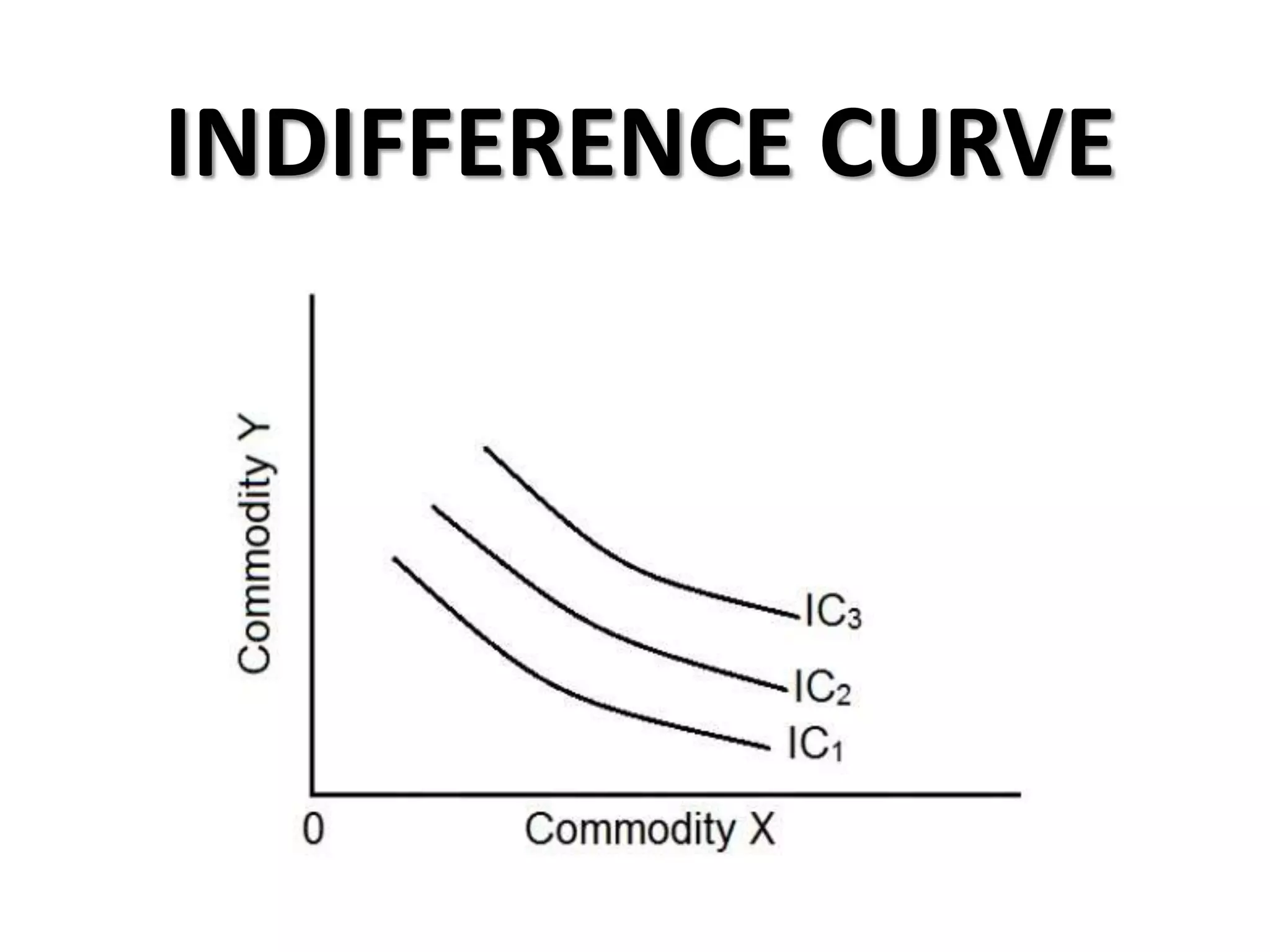

INDIFFERENCE CURVE
DEFINITION
• Indifference Curve (IC) is graph showing
various combinations of two things (usually
consumer goods) that yield equal
satisfaction or utility to an individual. The
curve is drawn to show the indifferent
position of the consumer having the choice
of two products to get maximum
satisfaction.
Example
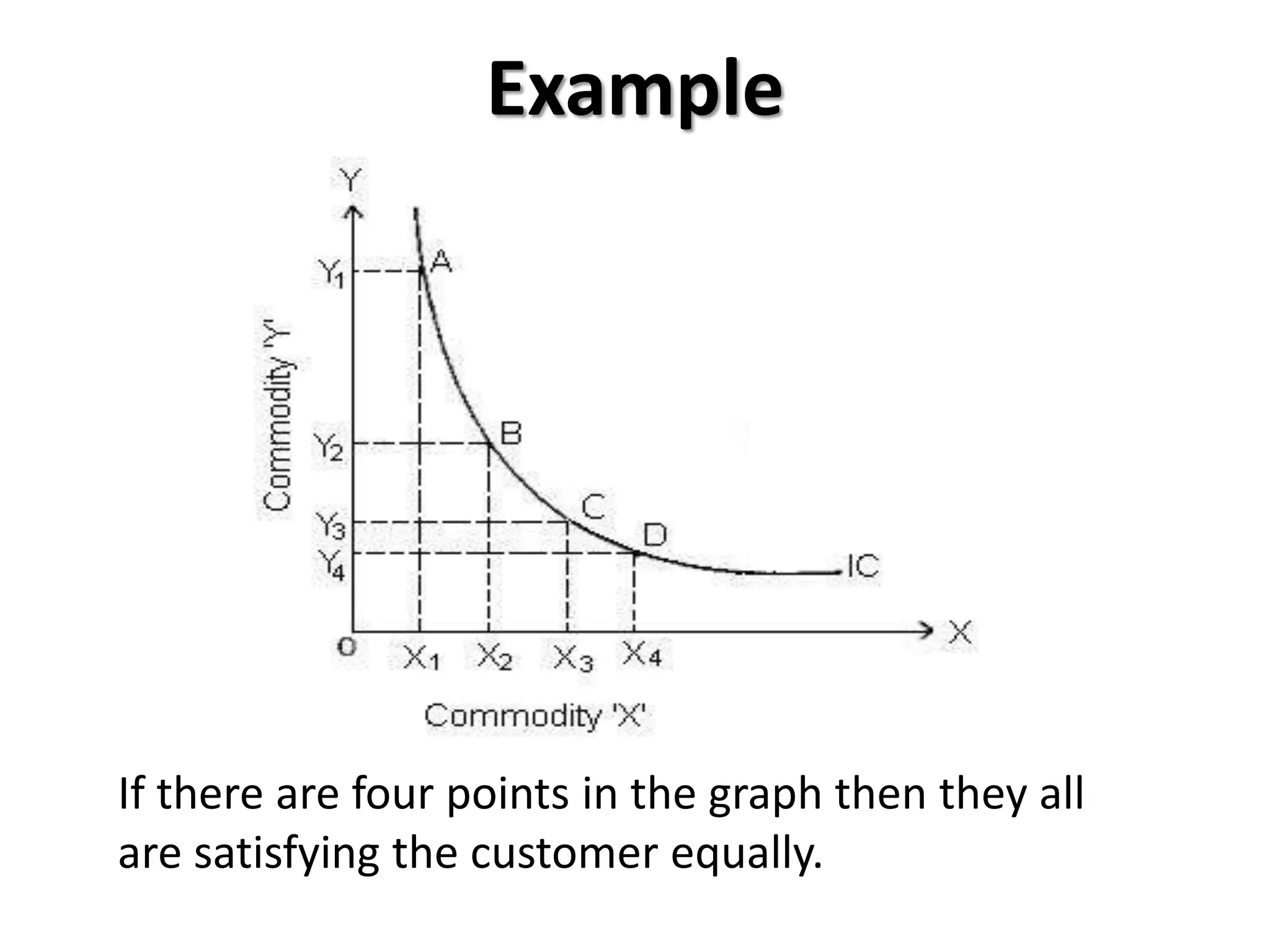
If there are four points in the graph then they all
are satisfying the customer equally.
MARGINAL RATE OF SUBSTITUTION
(MRS)
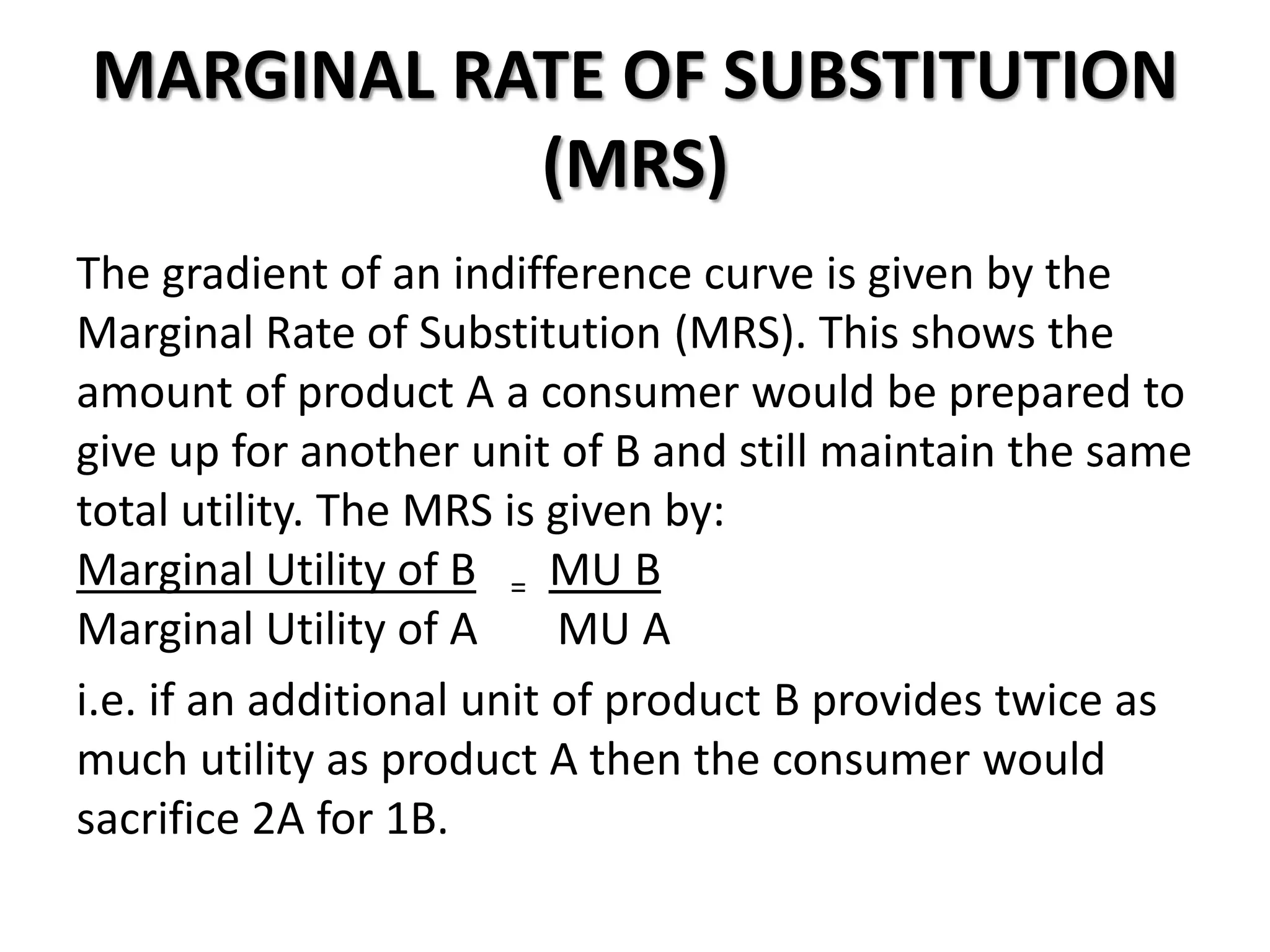
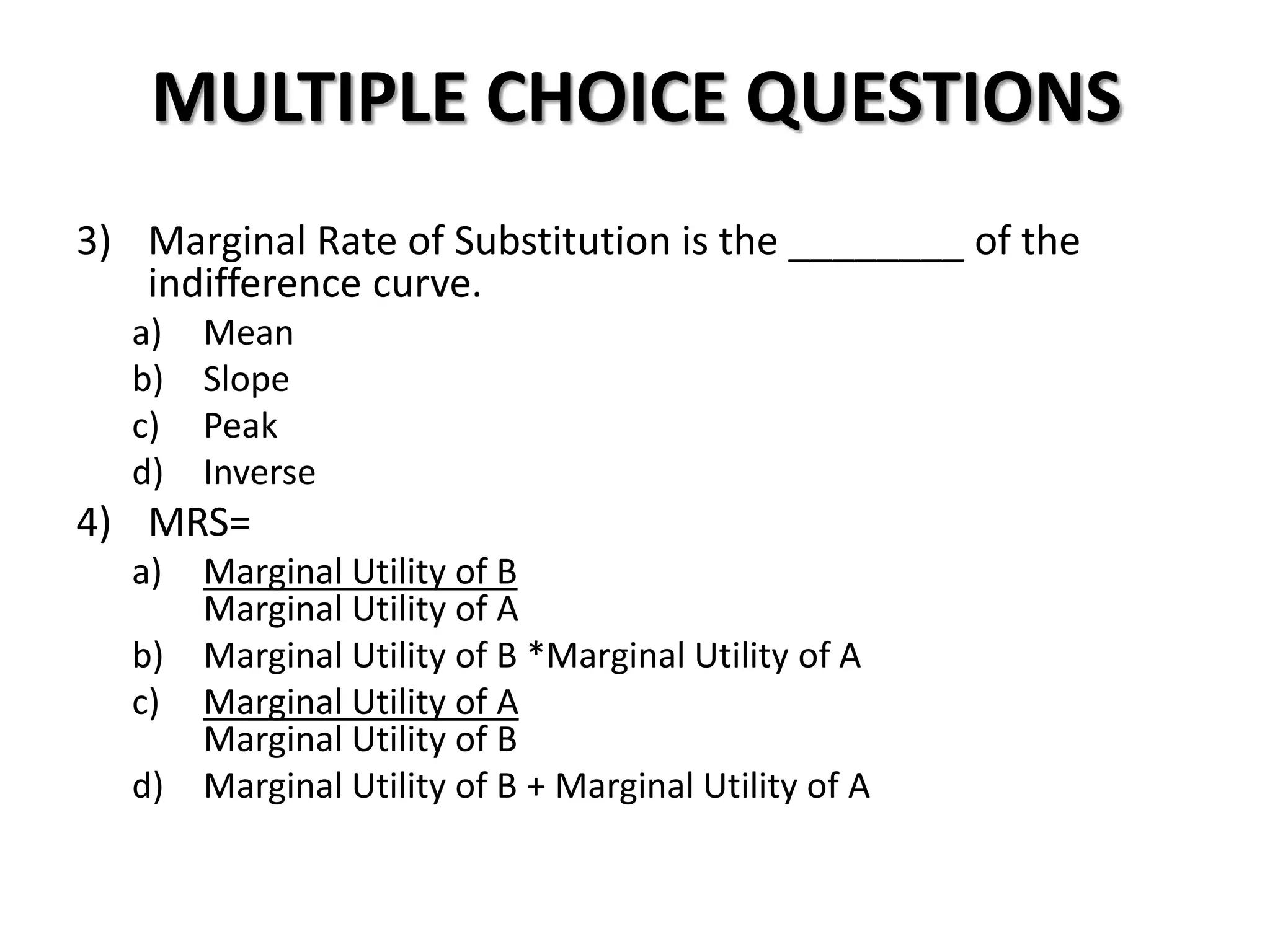
The gradient of an indifference curve is given by the
Marginal Rate of Substitution (MRS). This shows the
amount of product A a consumer would be prepared to
give up for another unit of B and still maintain the same
total utility. The MRS is given by:
Marginal Utility of B = MU B
Marginal Utility of A MU A
i.e. if an additional unit of product B provides twice as
much utility as product A then the consumer would
sacrifice 2A for 1B.
CONSUMER’S EQUILIBRIUM and
BUDGET LINE
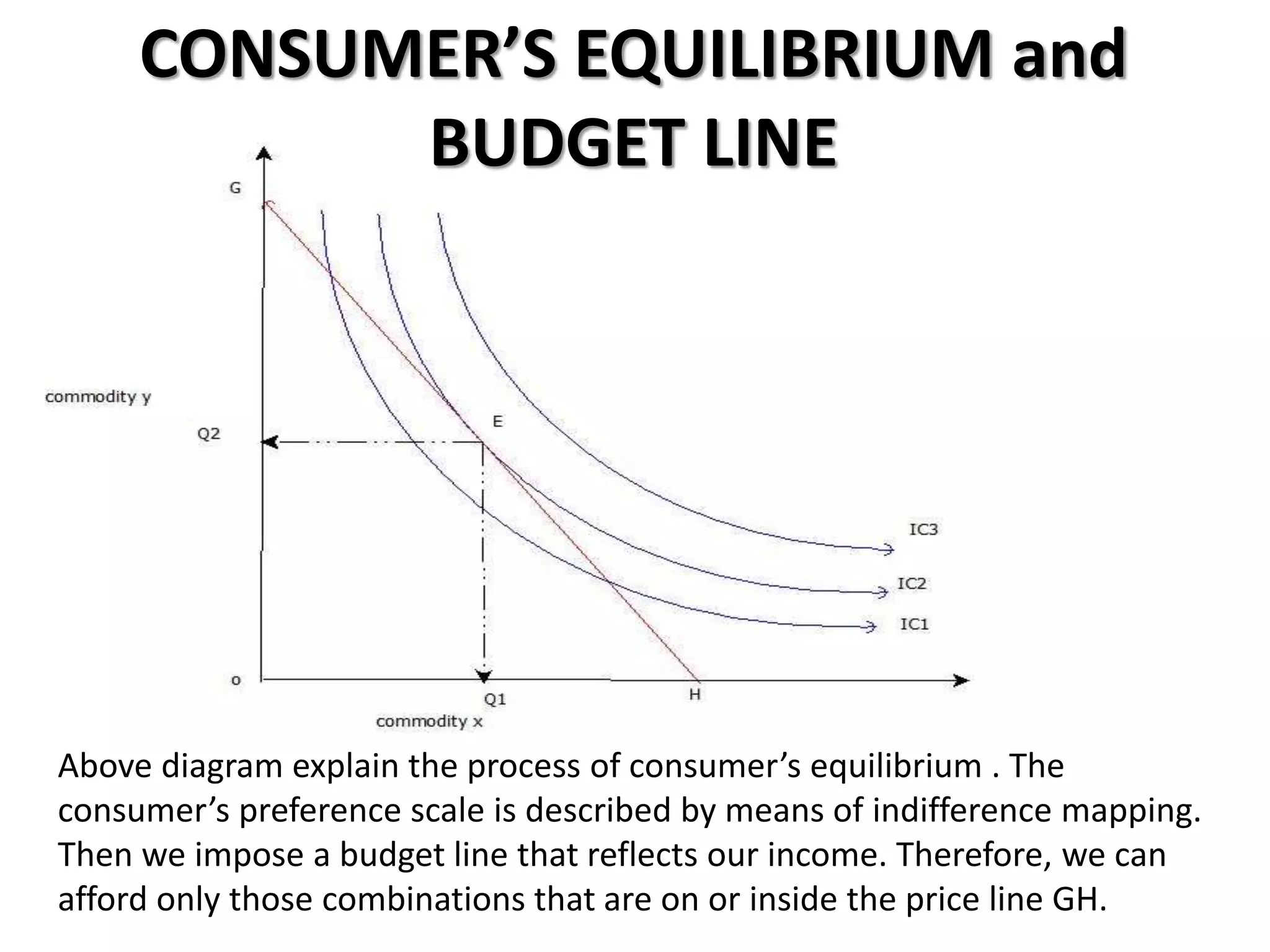
Above diagram explain the process of consumer’s equilibrium . The
consumer’s preference scale is described by means of indifference mapping.
Then we impose a budget line that reflects our income. Therefore, we can
afford only those combinations that are on or inside the price line GH.
FOUR IMPORTANT POINTS TO
REMEMBER
• The Marginal Rate of Substitution is of a
diminishing nature.
• The Indifferent Curve is always convex to the
origin and thus never makes a straight line.
• Any point on the curve shows the same level of
satisfaction obtained by a consumer, but the
different levels of curve represents the different
levels of satisfaction.
• The Indifference Curve can only touch the prize
line.
FACTORS AFFECTING THE
INDIFFERENCE CURVE
• Prize Effect: the effect due to the price change
of one commodity.
• Income Effect: the effect due to the change in
income of the consumer.
• Substitution Effect: the effect due only to the
relative price change in the commodities.
PRICE EFFECT
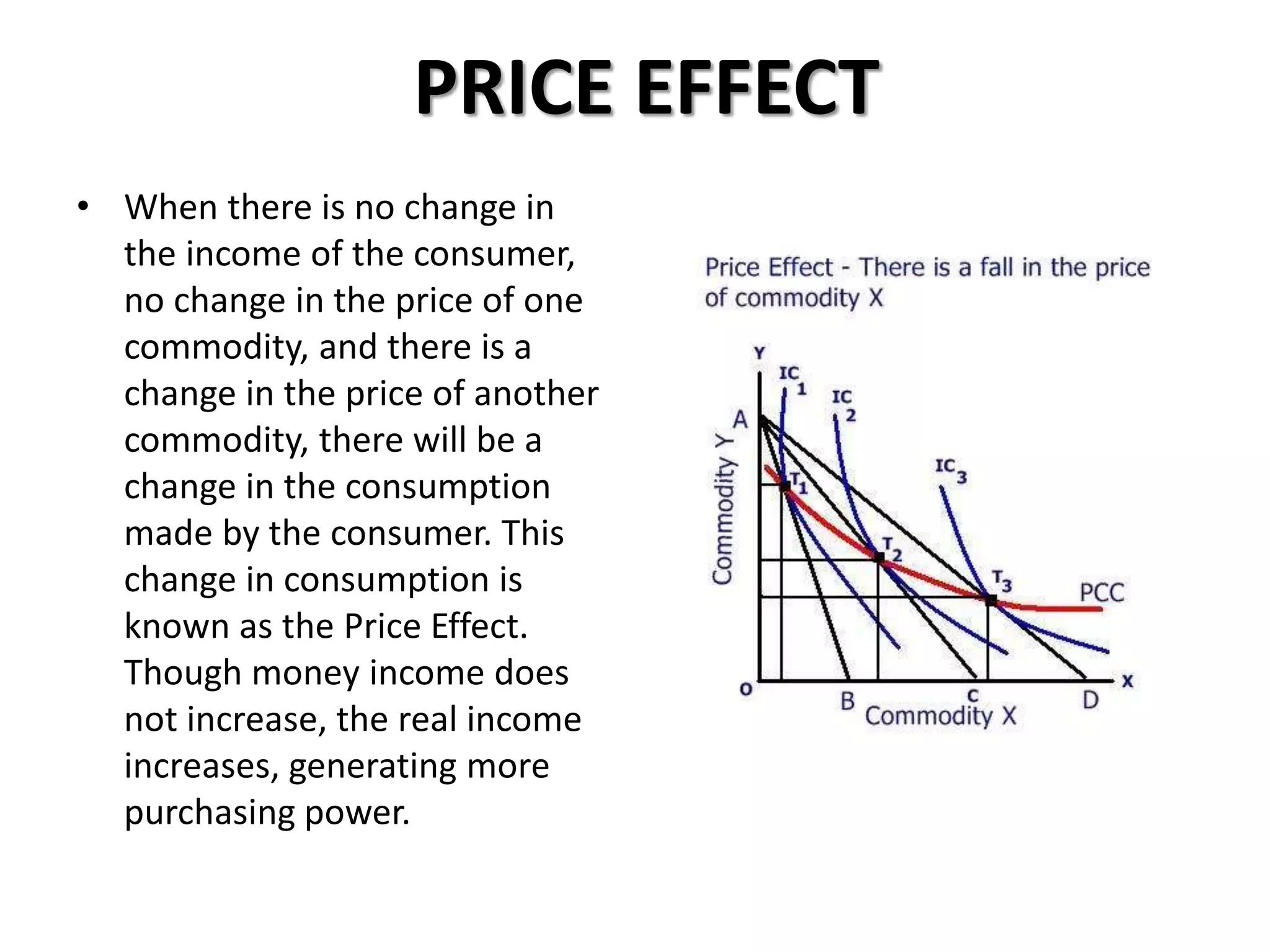
• When there is no change in
the income of the consumer,
no change in the price of one
commodity, and there is a
change in the price of another
commodity, there will be a
change in the consumption
made by the consumer. This
change in consumption is
known as the Price Effect.
Though money income does
not increase, the real income
increases, generating more
purchasing power.
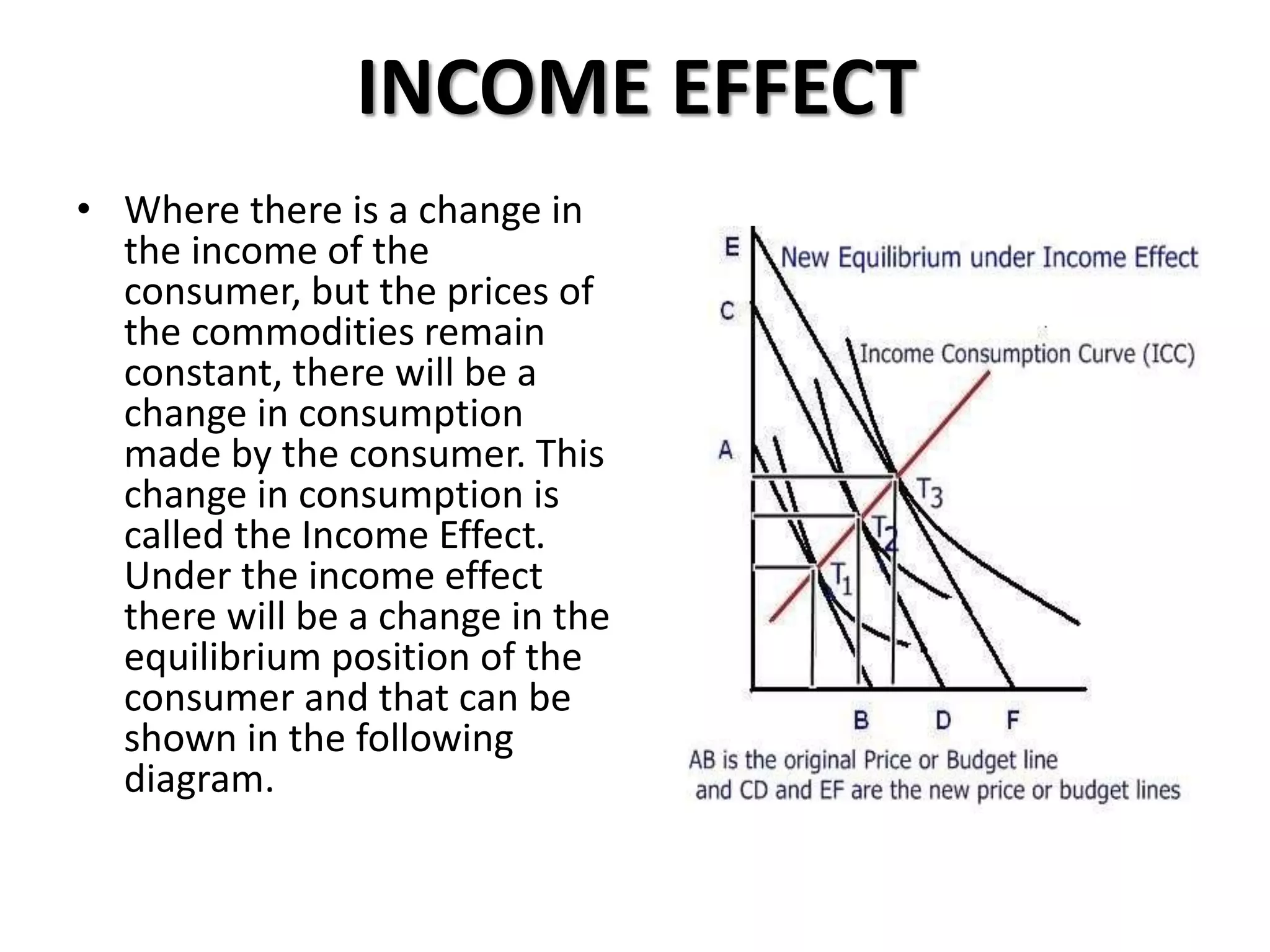
INCOME EFFECT
• Where there is a change in
the income of the
consumer, but the prices of
the commodities remain
constant, there will be a
change in consumption
made by the consumer. This
change in consumption is
called the Income Effect.
Under the income effect
there will be a change in the
equilibrium position of the
consumer and that can be
shown in the following
diagram.
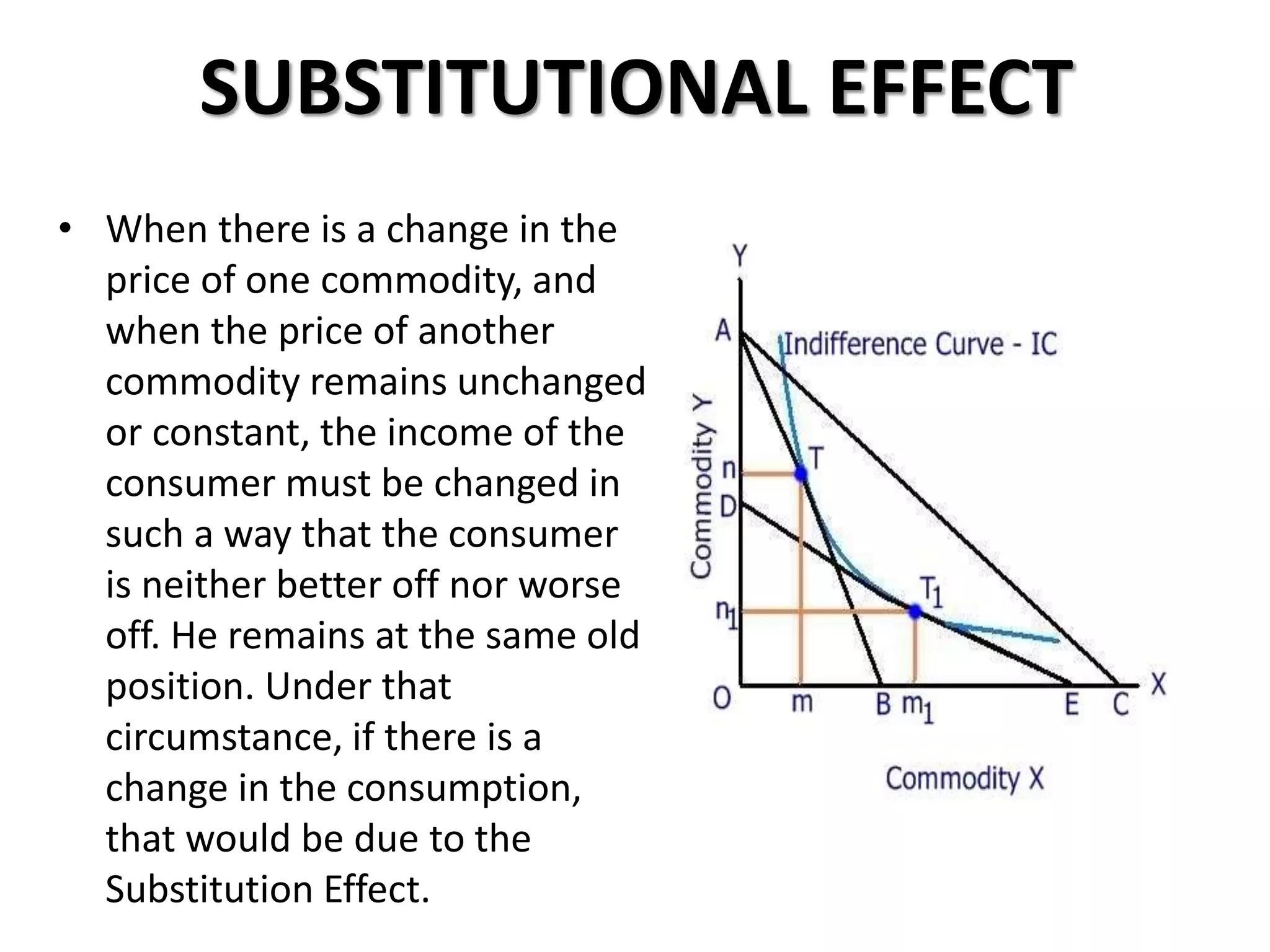
SUBSTITUTIONAL EFFECT
• When there is a change in the
price of one commodity, and
when the price of another
commodity remains unchanged
or constant, the income of the
consumer must be changed in
such a way that the consumer
is neither better off nor worse
off. He remains at the same old
position. Under that
circumstance, if there is a
change in the consumption,
that would be due to the
Substitution Effect.
MULTIPLE CHOICE QUESTIONS
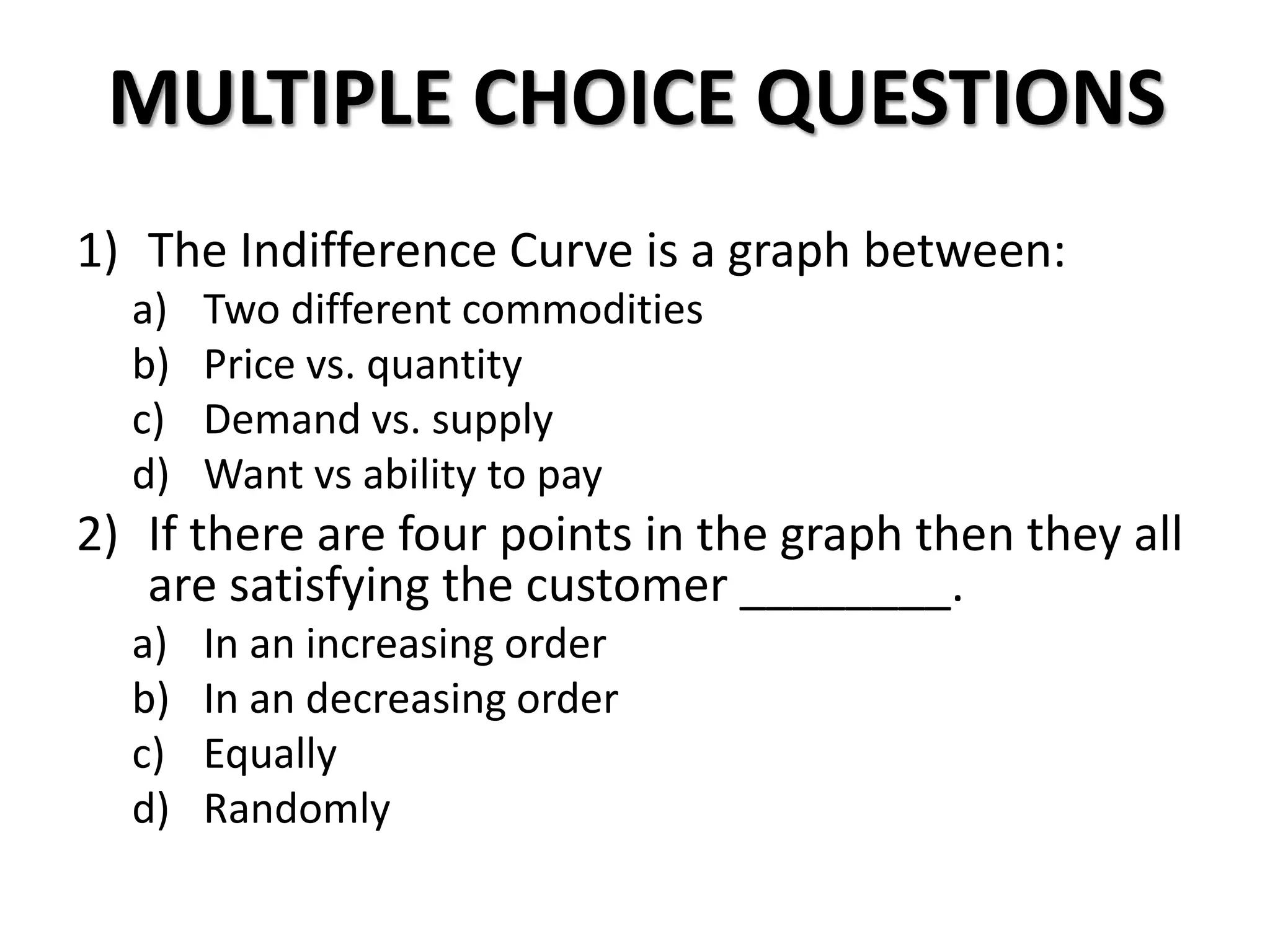
1) The Indifference Curve is a graph between:
a) Two different commodities
b) Price vs. quantity
c) Demand vs. supply
d) Want vs ability to pay
2) If there are four points in the graph then they all
are satisfying the customer ________.
a) In an increasing order
b) In an decreasing order
c) Equally
d) Randomly
MULTIPLE CHOICE QUESTIONS
3) Marginal Rate of Substitution is the ________ of the
indifference curve.
a) Mean
b) Slope
c) Peak
d) Inverse
4) MRS=
a) Marginal Utility of B
Marginal Utility of A
b) Marginal Utility of B *Marginal Utility of A
c) Marginal Utility of A
Marginal Utility of B
d) Marginal Utility of B + Marginal Utility of A
MULTIPLE CHOICE QUESTIONS
5) Which of the following is not true for the indifference
curve?
a) The Marginal Rate of Substitution is of a diminishing nature.
b) The Indifferent Curve is always convex to the origin and thus
never makes a straight line.
c) The Indifference Curve can only touch the prize line.
d) The points on the curve shows the level of satisfaction
obtained by a consumer.
6) Which of the following is not a factor affecting the
indifference curve?
a) Income of the consumer
b) Demand and supply of the product
c) Price of the product
d) Difference in the relative price of the products
MULTIPLE CHOICE QUESTIONS
7) Which of the following is true for Price Effect?
a) When there is no change in the price of one commodity, and
there is a change in the price of another commodity, there will
be a change in the consumption made by the consumer.
b) When there is no change in the price of one commodity, and
there is no change in the price of another commodity, there
will be a change in the consumption made by the consumer.
c) When there is a change in the price of one commodity, and
there is a change in the price of another commodity, there will
be a change in the consumption made by the consumer.
d) When there is a change in the income of the consumer and no
change in the price of one commodities, there will be a change
in the consumption made by the consumer.
MULTIPLE CHOICE QUESTIONS
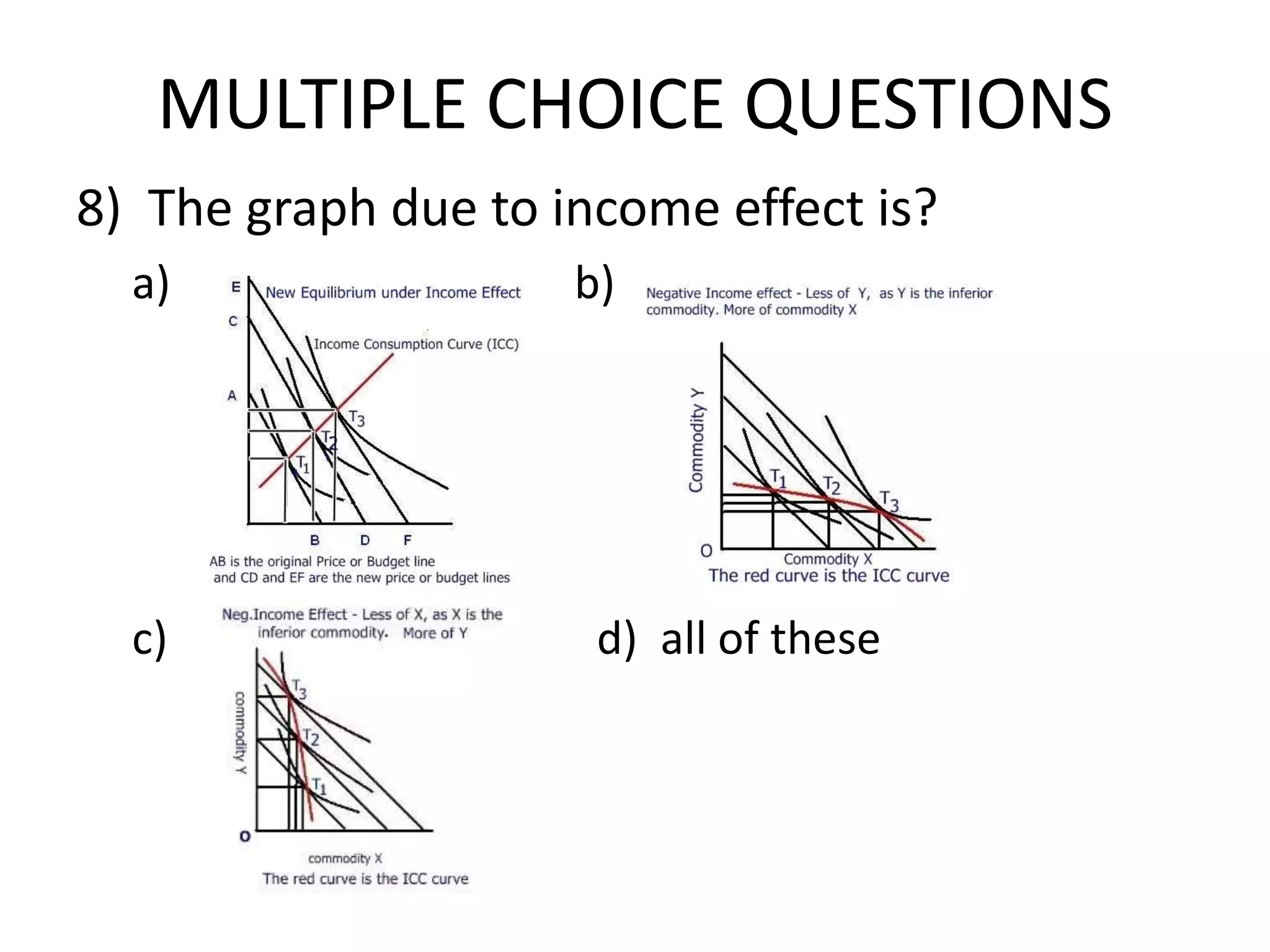
8) The graph due to income effect is?
a) b)
c) d) all of these
MULTIPLE CHOICE QUESTIONS
9) “the effect due to only the relative price change
in the commodities.” refers to?
a) Income effect
b) Substitution effect
c) Price effect
d) None of these
10) A consumer will consume the combination of
goods at the point of tangency between the
budget line and the indifference
curve.(True/False).
Indifference curve

Indifference curve

  • 1.
  • 2.
    DEFINITION • Indifference Curve(IC) is graph showing various combinations of two things (usually consumer goods) that yield equal satisfaction or utility to an individual. The curve is drawn to show the indifferent position of the consumer having the choice of two products to get maximum satisfaction.
  • 3.
    Example If there arefour points in the graph then they all are satisfying the customer equally.
  • 4.
    MARGINAL RATE OFSUBSTITUTION (MRS) The gradient of an indifference curve is given by the Marginal Rate of Substitution (MRS). This shows the amount of product A a consumer would be prepared to give up for another unit of B and still maintain the same total utility. The MRS is given by: Marginal Utility of B = MU B Marginal Utility of A MU A i.e. if an additional unit of product B provides twice as much utility as product A then the consumer would sacrifice 2A for 1B.
  • 5.
    CONSUMER’S EQUILIBRIUM and BUDGETLINE Above diagram explain the process of consumer’s equilibrium . The consumer’s preference scale is described by means of indifference mapping. Then we impose a budget line that reflects our income. Therefore, we can afford only those combinations that are on or inside the price line GH.
  • 6.
    FOUR IMPORTANT POINTSTO REMEMBER • The Marginal Rate of Substitution is of a diminishing nature. • The Indifferent Curve is always convex to the origin and thus never makes a straight line. • Any point on the curve shows the same level of satisfaction obtained by a consumer, but the different levels of curve represents the different levels of satisfaction. • The Indifference Curve can only touch the prize line.
  • 7.
    FACTORS AFFECTING THE INDIFFERENCECURVE • Prize Effect: the effect due to the price change of one commodity. • Income Effect: the effect due to the change in income of the consumer. • Substitution Effect: the effect due only to the relative price change in the commodities.
  • 8.
    PRICE EFFECT • Whenthere is no change in the income of the consumer, no change in the price of one commodity, and there is a change in the price of another commodity, there will be a change in the consumption made by the consumer. This change in consumption is known as the Price Effect. Though money income does not increase, the real income increases, generating more purchasing power.
  • 9.
    INCOME EFFECT • Wherethere is a change in the income of the consumer, but the prices of the commodities remain constant, there will be a change in consumption made by the consumer. This change in consumption is called the Income Effect. Under the income effect there will be a change in the equilibrium position of the consumer and that can be shown in the following diagram.
  • 10.
    SUBSTITUTIONAL EFFECT • Whenthere is a change in the price of one commodity, and when the price of another commodity remains unchanged or constant, the income of the consumer must be changed in such a way that the consumer is neither better off nor worse off. He remains at the same old position. Under that circumstance, if there is a change in the consumption, that would be due to the Substitution Effect.
  • 11.
    MULTIPLE CHOICE QUESTIONS 1)The Indifference Curve is a graph between: a) Two different commodities b) Price vs. quantity c) Demand vs. supply d) Want vs ability to pay 2) If there are four points in the graph then they all are satisfying the customer ________. a) In an increasing order b) In an decreasing order c) Equally d) Randomly
  • 12.
    MULTIPLE CHOICE QUESTIONS 3)Marginal Rate of Substitution is the ________ of the indifference curve. a) Mean b) Slope c) Peak d) Inverse 4) MRS= a) Marginal Utility of B Marginal Utility of A b) Marginal Utility of B *Marginal Utility of A c) Marginal Utility of A Marginal Utility of B d) Marginal Utility of B + Marginal Utility of A
  • 13.
    MULTIPLE CHOICE QUESTIONS 5)Which of the following is not true for the indifference curve? a) The Marginal Rate of Substitution is of a diminishing nature. b) The Indifferent Curve is always convex to the origin and thus never makes a straight line. c) The Indifference Curve can only touch the prize line. d) The points on the curve shows the level of satisfaction obtained by a consumer. 6) Which of the following is not a factor affecting the indifference curve? a) Income of the consumer b) Demand and supply of the product c) Price of the product d) Difference in the relative price of the products
  • 14.
    MULTIPLE CHOICE QUESTIONS 7)Which of the following is true for Price Effect? a) When there is no change in the price of one commodity, and there is a change in the price of another commodity, there will be a change in the consumption made by the consumer. b) When there is no change in the price of one commodity, and there is no change in the price of another commodity, there will be a change in the consumption made by the consumer. c) When there is a change in the price of one commodity, and there is a change in the price of another commodity, there will be a change in the consumption made by the consumer. d) When there is a change in the income of the consumer and no change in the price of one commodities, there will be a change in the consumption made by the consumer.
  • 15.
    MULTIPLE CHOICE QUESTIONS 8)The graph due to income effect is? a) b) c) d) all of these
  • 16.
    MULTIPLE CHOICE QUESTIONS 9)“the effect due to only the relative price change in the commodities.” refers to? a) Income effect b) Substitution effect c) Price effect d) None of these 10) A consumer will consume the combination of goods at the point of tangency between the budget line and the indifference curve.(True/False).