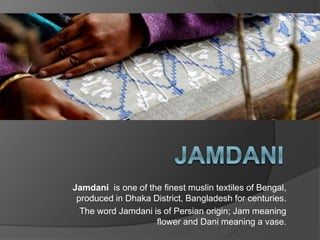
Jamdani is one of the finest muslin textiles of Bengal,
produced in Dhaka District, Bangladesh for centuries.
The word Jamdani is of Persian origin; Jam meaning
flower and Dani meaning a vase.
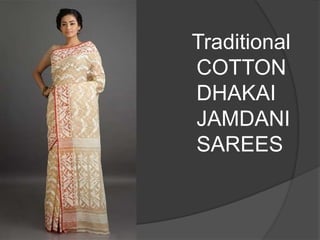
Traditional
COTTON
DHAKAI
JAMDANI
SAREES
 The Jamdani weaving tradition is of Bengali origin. The
weaving technique is called Jamdani, which is an age-old
technique. Now the same weaving technique is
popularized with the name Neelambari in North and
Uppada in South India.
 It is one of the most time and labor-intensive forms of
hand loom weaving.
 In the first half of the nineteenth century, James
Taylor described the figured or flowered jamdani; in the
late nineteenth century, T. N. Mukharji referred to this
fabric as jamdani muslin.
 The mid 19th century saw the decline of Jamdani mainly
due to import of cheaper but inferior yarn from Europe and
the decline of the Mughal empire. The weavers were
forced to sell their work at lower prices.
 The origin of the Jamdani is still a mystery.
The earliest mention of origin of Jamdani and
its development as an industry is found in
Kautilya's Arthashastra (book of economics,
about 3rd century BC), where it is stated that
this fine cloth was used in Bangla and Pundra.
 Its mention is also found in the book of
Periplus of the Eritean Sea and in the
accounts of Arab, Chinese and Italian travelers
and traders.
For traditional Jamdani
weaving, a very
elementary pit loom is
used and the work is
carried on by the
weaver and his
apprentice.
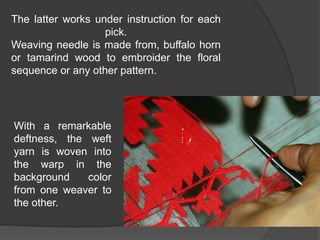
The latter works under instruction for each
pick.
Weaving needle is made from, buffalo horn
or tamarind wood to embroider the floral
sequence or any other pattern.
With a remarkable
deftness, the weft
yarn is woven into
the warp in the
background color
from one weaver to
the other.
supplementary weft technique of weaving is used, where
the artistic motifs are produced by a non-structural weft, in
addition to the standard weft that holds the warp threads
together.
The pattern of the design drawn on paper is pinned
beneath the warp threads and as the weaving proceeds the
designs are worked in like embroidery.
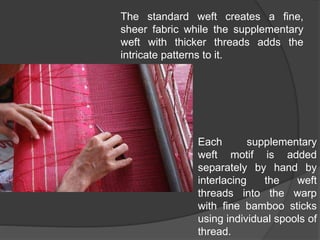
The standard weft creates a fine,
sheer fabric while the supplementary
weft with thicker threads adds the
intricate patterns to it.
Each supplementary
weft motif is added
separately by hand by
interlacing the weft
threads into the warp
with fine bamboo sticks
using individual spools of
thread.
The result is a myriad of vibrant patterns that
appear to float on a shimmering surface.
Dhakai Jamdani
Dhakai Jamdani sarees are distinct from
other varieties by its very fine texture
resembling muslin and the elaborate and
ornate workmanship.
These sarees have multicolored linear or
floral motifs all over the body and border and
have an exquisitely designed elaborate pallu.
The mango motif signifying fertility, growth,
and marital bliss is a very popular design in
Jamdani sarees.
Tangail Jamdani:
These sarees have Jamdani
motifs on Tangail fabric, hence,
known as Tangail Jamdani.
The traditional tangail borders
had a "paddo" or lotus pattern,
"pradeep' or lamp pattern.
From the use of a single color on
the border, they began to use 2 to
three colors to give it 'meenakari'
effect.
Having a tighter weave than any
other jamdani Dhaniakhali
Jamdani is hardier.
Its bold body colors and
contrasting borders and absurdly
low prices make them very
affordable.
Dhaniakhali Jamdani:
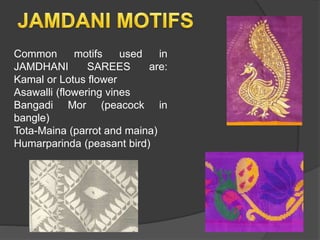
Common motifs used in
JAMDHANI SAREES are:
Kamal or Lotus flower
Asawalli (flowering vines
Bangadi Mor (peacock in
bangle)
Tota-Maina (parrot and maina)
Humarparinda (peasant bird)
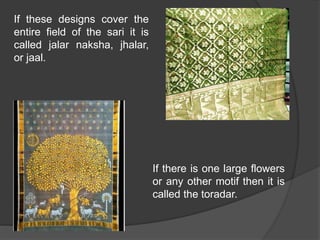
If these designs cover the
entire field of the sari it is
called jalar naksha, jhalar,
or jaal.
If there is one large flowers
or any other motif then it is
called the toradar.
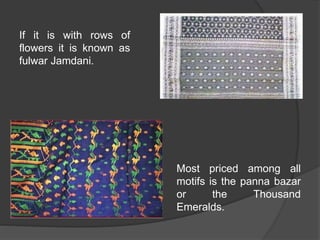
Most priced among all
motifs is the panna bazar
or the Thousand
Emeralds.
If it is with rows of
flowers it is known as
fulwar Jamdani.
The base fabric is traditionally
white, black, or grey with gold
borders.
The motifs are often woven with
maroon, white, green, black,
silver and golden coloured
threads.
LABOUR
WAGES
According to a national daily, a
senior taanti or "ostad" earns
about Tk 2,500 to Tk 3,000 per
month. Junior weavers get
much less, around Tk 1,600.
As a result, many weavers do
not want their children to come
to this profession.
Thankfully, the government and other
organizations are trying to revive the old glory of
Dhakai Jamdani. In a bid to avoid the
middlemen, they are trying to establish direct
contact with the weavers.
Organizations like Radiant Institute of Design,
Shanto Mariam University of creative
technology,National Institute of Design (NID) and
others are helping designers create new
Jamdani designs.
THANK YOU

JAMDANI

  • 1.
    Jamdani is oneof the finest muslin textiles of Bengal, produced in Dhaka District, Bangladesh for centuries. The word Jamdani is of Persian origin; Jam meaning flower and Dani meaning a vase.
  • 2.
  • 3.
     The Jamdaniweaving tradition is of Bengali origin. The weaving technique is called Jamdani, which is an age-old technique. Now the same weaving technique is popularized with the name Neelambari in North and Uppada in South India.  It is one of the most time and labor-intensive forms of hand loom weaving.  In the first half of the nineteenth century, James Taylor described the figured or flowered jamdani; in the late nineteenth century, T. N. Mukharji referred to this fabric as jamdani muslin.  The mid 19th century saw the decline of Jamdani mainly due to import of cheaper but inferior yarn from Europe and the decline of the Mughal empire. The weavers were forced to sell their work at lower prices.
  • 4.
     The originof the Jamdani is still a mystery. The earliest mention of origin of Jamdani and its development as an industry is found in Kautilya's Arthashastra (book of economics, about 3rd century BC), where it is stated that this fine cloth was used in Bangla and Pundra.  Its mention is also found in the book of Periplus of the Eritean Sea and in the accounts of Arab, Chinese and Italian travelers and traders.
  • 5.
    For traditional Jamdani weaving,a very elementary pit loom is used and the work is carried on by the weaver and his apprentice.
  • 6.
    The latter worksunder instruction for each pick. Weaving needle is made from, buffalo horn or tamarind wood to embroider the floral sequence or any other pattern. With a remarkable deftness, the weft yarn is woven into the warp in the background color from one weaver to the other.
  • 7.
    supplementary weft techniqueof weaving is used, where the artistic motifs are produced by a non-structural weft, in addition to the standard weft that holds the warp threads together. The pattern of the design drawn on paper is pinned beneath the warp threads and as the weaving proceeds the designs are worked in like embroidery.
  • 8.
    The standard weftcreates a fine, sheer fabric while the supplementary weft with thicker threads adds the intricate patterns to it. Each supplementary weft motif is added separately by hand by interlacing the weft threads into the warp with fine bamboo sticks using individual spools of thread.
  • 9.
    The result isa myriad of vibrant patterns that appear to float on a shimmering surface.
  • 10.
    Dhakai Jamdani Dhakai Jamdanisarees are distinct from other varieties by its very fine texture resembling muslin and the elaborate and ornate workmanship. These sarees have multicolored linear or floral motifs all over the body and border and have an exquisitely designed elaborate pallu. The mango motif signifying fertility, growth, and marital bliss is a very popular design in Jamdani sarees.
  • 11.
    Tangail Jamdani: These sareeshave Jamdani motifs on Tangail fabric, hence, known as Tangail Jamdani. The traditional tangail borders had a "paddo" or lotus pattern, "pradeep' or lamp pattern. From the use of a single color on the border, they began to use 2 to three colors to give it 'meenakari' effect.
  • 12.
    Having a tighterweave than any other jamdani Dhaniakhali Jamdani is hardier. Its bold body colors and contrasting borders and absurdly low prices make them very affordable. Dhaniakhali Jamdani:
  • 13.
    Common motifs usedin JAMDHANI SAREES are: Kamal or Lotus flower Asawalli (flowering vines Bangadi Mor (peacock in bangle) Tota-Maina (parrot and maina) Humarparinda (peasant bird)
  • 14.
    If these designscover the entire field of the sari it is called jalar naksha, jhalar, or jaal. If there is one large flowers or any other motif then it is called the toradar.
  • 15.
    Most priced amongall motifs is the panna bazar or the Thousand Emeralds. If it is with rows of flowers it is known as fulwar Jamdani.
  • 16.
    The base fabricis traditionally white, black, or grey with gold borders. The motifs are often woven with maroon, white, green, black, silver and golden coloured threads.
  • 17.
    LABOUR WAGES According to anational daily, a senior taanti or "ostad" earns about Tk 2,500 to Tk 3,000 per month. Junior weavers get much less, around Tk 1,600. As a result, many weavers do not want their children to come to this profession.
  • 18.
    Thankfully, the governmentand other organizations are trying to revive the old glory of Dhakai Jamdani. In a bid to avoid the middlemen, they are trying to establish direct contact with the weavers. Organizations like Radiant Institute of Design, Shanto Mariam University of creative technology,National Institute of Design (NID) and others are helping designers create new Jamdani designs.
  • 19.