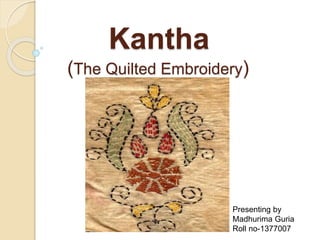
Kantha
(The Quilted Embroidery)
Presenting by
Madhurima Guria
Roll no-1377007
Introduction
 Kantha, a type of embroidered quilt, is a
centuries-old Bengali art tradition in
Bangladesh and West Bengal, India.
 The use of kantha is popular in Kantha
saris traditionally worn by women in Bengal,
but any garment or cloth with kantha
embroidery, predominantly having a border
of decorative running stitch motifs, may be
called a kantha garment.
Origin
 Kantha is perhaps the oldest forms of Indian embroidery
as it can be traced back to the first and second A.D. The
thought behind this needlework was to reuse old clothes
and materials and turn them into something new. This is
what makes kantha embroidery only one of its kind.
 Kantha work is approximately 500 years old, and there is
a myth surrounding it which points out that Lord Buddha
and his disciples used old rags with different kinds of
patch work to cover themselves with at night, and this
gave the kantha embroidery its origin.
 Traditionally women would take 4 to 5 sarees, layer them
together and create different running stitches on them
which they then used as blankets to cover their children
with. However, what started as a way to make life more
comfortable went on to become a big trend in clothes and
furniture as well.
Blankets
Craftswomen at NGO
Hand embroidered kantha done on silk
fabric
Types of Kantha
i) Lep Kantha
ii)Sujni Kantha
iii)Baytan Kantha
iv)Durjani Kantha
v)Arshilata Kantha
vi)Oar Kantha
vii)Rumal Kantha
Lep Kantha
Bayton Kantha Sujni Kantha
Kantha Cloth
 The contrast of elaborate colored
stitchwork on a plain background gives
these highly ornamented Kanthas their
strength and clarity.
 The availability of inexpensive, undyed
cotton cloth was a precondition, if not a
catalyst, for such works. These supple,
handloom woven fabric was valued for
its softness, and also because the
loose weave enabled subtle textures to
be imparted to the layered cloth.
Running stitch on dabu
printed cotton fabric
Kantha on silk fabric
Kantha Stitches
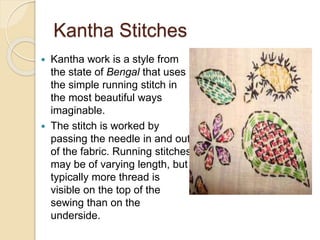
 Kantha work is a style from
the state of Bengal that uses
the simple running stitch in
the most beautiful ways
imaginable.
 The stitch is worked by
passing the needle in and out
of the fabric. Running stitches
may be of varying length, but
typically more thread is
visible on the top of the
sewing than on the
underside.
Running Stitch
 Sometimes, stem, herringbone and cross
stitch are also used. Typical thread colors
are red, green, black and blue. Commonly
used designs are peacocks, elephants, fish,
lotus, creepers, leaves, flowers and temples.
Stitches used on kantha
Motifs:-
 a)Tree of life:-A
simple tree is a symbol
of ever-growing life that
seizes to exist. It is
called "the tree of life".
It is a symbol of fertility,
and hence continuity of
life. The tree of life
concept is sacred to
most cultures. Its
significance transcends
conscious reality
b) Lotus motif:- The lotus has a lot of relevance
in the Hindu religion. Goddess Laxmi, the goddess
of financial well being holds a lotus in her hand , so
the lotus symbolizes her. The lotus is also the
symbol of eternal order and of the union of earth,
water and, sky.
 C) Fish motif:- Fishes are essential staple
diet of rural Bengal. Fishes are considered
auspicious for any ceremony, religious or
personal.
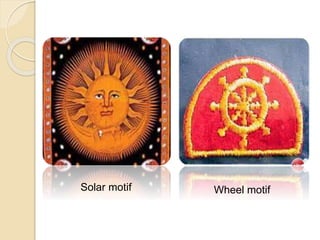
Other motifs are:-
Kalka motif Swastika motif
Solar motif Wheel motif
Borders:-
Rice stalk
Scorpion
Peas
Eyes
Wavy or bent
Amulet
Shamuk taga
Chok taga
Eye border
Wrench border
Miscellenious border
Wave borders
Diamond border
Shamuk taga
Chok taga
Eye border
Wrench border
Miscellenious border
Wave borders
Diamond border
Shamuk taga
Chok taga
Eye border
Wrench border
Miscellenious border
Wave borders
Diamond border
Shamuk taga
Chok taga
Eye border
Wrench border
Miscellaneous
border
Wave border
Diamond border
Raw Materials:-
 Tracing Sheet- per tracing
sheet cost is Rs. 2
 Zinc Oxide powder- 1 packet
Rs. 40
 Kerosene- per litre kerosene
cost is Rs. 30 ( For making the
mixture of tracing the design
equal amount of powder is
used with kerosene, in order to
make a thick mixture.)
 Cloth (mulmul, tussar silk ,
Hyderabadi silk and may more)
cashmet-90rs per meter
Needles Threads
Women’s voices in kantha
 It is made by women who wear cotton saris,
especially village women for whom life has often
meant sending a son or husband to work in town or
on the river and sea as fisherman or boatman.
 The Kanthas of today, designed by
professionals(often men) & sold at prices
considered high by local standards, are very
different from the early Kanthas, made for love
rather than money and designed by the women
who were actually embroidering them.
Women Artisans
Sources of Inspiration:-
 Day to day life was the biggest source of inspiration
behind this craft. The motifs designed on clothes or
bed spreads were of birds, animals, folk scenes, fishes
and imagery that depicted different views of livelihood
for the people living in Bengal. Reprocessing was
another form of motivation, since initially women
recycled their old clothes and turned them into
something more practical, like covers for furniture, or
blankets. Economical, practical and yet beautiful is
what Kantha embroidery is all about.
Innovations:-
Kantha work has been around for ages
and has been favourite amongst those
who love taking fashion and style to
levels beyond the ordinary.
Conventionally, the motifs used were of
animals or birds, but now with modern-
day designers, experiments in designs
are also being done. One can see cave
art, Egyptian murals, Hindu mythology
and even pop art being illustrated through
this fine stitch work.
Kantha work
Fashionable Kantha
Present Day Scenario:-
 Kantha embroidery has definitely taken the
fashion industry by storm. Shabari Datta, an
Indian fashion designer, has displayed beautiful
ensembles of Kantha work, along with other
Indian traditional embroideries, in several of her
fashion shows.
 She took the traditonal Kantha embroidery and
gave it a unique twist by including it on dhotis,
kurtas, sherwanis and even hot pants!
Moreover, Hilary Clinton, on one of her visits in
India, was greatly impresses by the rich cultural
display in Bengal, especially through its
embroidery and handcraft.
Kantha stitch is done
on the bag
Cardholder Kantha
Hand embroidered kantha
silk saree
 Market Survey:-During my field study
I have done a market survey on
Kantha stitch. I visited many shops
and interviewed them for knowing the
market demand of kantha stitch on
products. The general observation
was that the upper middle class and
the elite class are the majority buyers
of kantha stitch product and they
mostly prefer it on bedcover and saris
made of tussar silk which cost starts
from 1800 Rs.
Design intervention:-
Sketch of the
product
 Customer Profile:-
My product is kurti
which will be made on
cotton. Floral design
with best quality of
threads will be used
and multi coloured
threads will be also
used on kurti.
Therefore, it will be
affordable for the
upper middle class
and elite class people.
 Costing of the Product:-Good
quality of cotton will be used for
making the kurti and intricate design
of kantha stitch will be made using
best quality of threads. Good quality
of the raw materials will be used.
Therefore, the costing of the product
will be from 700rs. to 800rs.
Kantha ppt

Kantha ppt

  • 1.
    Kantha (The Quilted Embroidery) Presentingby Madhurima Guria Roll no-1377007
  • 2.
    Introduction  Kantha, atype of embroidered quilt, is a centuries-old Bengali art tradition in Bangladesh and West Bengal, India.  The use of kantha is popular in Kantha saris traditionally worn by women in Bengal, but any garment or cloth with kantha embroidery, predominantly having a border of decorative running stitch motifs, may be called a kantha garment.
  • 3.
    Origin  Kantha isperhaps the oldest forms of Indian embroidery as it can be traced back to the first and second A.D. The thought behind this needlework was to reuse old clothes and materials and turn them into something new. This is what makes kantha embroidery only one of its kind.  Kantha work is approximately 500 years old, and there is a myth surrounding it which points out that Lord Buddha and his disciples used old rags with different kinds of patch work to cover themselves with at night, and this gave the kantha embroidery its origin.  Traditionally women would take 4 to 5 sarees, layer them together and create different running stitches on them which they then used as blankets to cover their children with. However, what started as a way to make life more comfortable went on to become a big trend in clothes and furniture as well.
  • 4.
  • 5.
  • 6.
    Hand embroidered kanthadone on silk fabric
  • 7.
    Types of Kantha i)Lep Kantha ii)Sujni Kantha iii)Baytan Kantha iv)Durjani Kantha v)Arshilata Kantha vi)Oar Kantha vii)Rumal Kantha
  • 8.
  • 9.
  • 10.
    Kantha Cloth  Thecontrast of elaborate colored stitchwork on a plain background gives these highly ornamented Kanthas their strength and clarity.  The availability of inexpensive, undyed cotton cloth was a precondition, if not a catalyst, for such works. These supple, handloom woven fabric was valued for its softness, and also because the loose weave enabled subtle textures to be imparted to the layered cloth.
  • 11.
    Running stitch ondabu printed cotton fabric Kantha on silk fabric
  • 12.
    Kantha Stitches  Kanthawork is a style from the state of Bengal that uses the simple running stitch in the most beautiful ways imaginable.  The stitch is worked by passing the needle in and out of the fabric. Running stitches may be of varying length, but typically more thread is visible on the top of the sewing than on the underside.
  • 13.
  • 14.
     Sometimes, stem,herringbone and cross stitch are also used. Typical thread colors are red, green, black and blue. Commonly used designs are peacocks, elephants, fish, lotus, creepers, leaves, flowers and temples.
  • 15.
  • 16.
    Motifs:-  a)Tree oflife:-A simple tree is a symbol of ever-growing life that seizes to exist. It is called "the tree of life". It is a symbol of fertility, and hence continuity of life. The tree of life concept is sacred to most cultures. Its significance transcends conscious reality
  • 17.
    b) Lotus motif:-The lotus has a lot of relevance in the Hindu religion. Goddess Laxmi, the goddess of financial well being holds a lotus in her hand , so the lotus symbolizes her. The lotus is also the symbol of eternal order and of the union of earth, water and, sky.
  • 18.
     C) Fishmotif:- Fishes are essential staple diet of rural Bengal. Fishes are considered auspicious for any ceremony, religious or personal.
  • 19.
    Other motifs are:- Kalkamotif Swastika motif
  • 20.
  • 21.
  • 22.
    Shamuk taga Chok taga Eyeborder Wrench border Miscellenious border Wave borders Diamond border Shamuk taga Chok taga Eye border Wrench border Miscellenious border Wave borders Diamond border Shamuk taga Chok taga Eye border Wrench border Miscellenious border Wave borders Diamond border Shamuk taga Chok taga Eye border Wrench border Miscellaneous border Wave border Diamond border
  • 23.
    Raw Materials:-  TracingSheet- per tracing sheet cost is Rs. 2  Zinc Oxide powder- 1 packet Rs. 40  Kerosene- per litre kerosene cost is Rs. 30 ( For making the mixture of tracing the design equal amount of powder is used with kerosene, in order to make a thick mixture.)  Cloth (mulmul, tussar silk , Hyderabadi silk and may more) cashmet-90rs per meter
  • 24.
  • 25.
    Women’s voices inkantha  It is made by women who wear cotton saris, especially village women for whom life has often meant sending a son or husband to work in town or on the river and sea as fisherman or boatman.  The Kanthas of today, designed by professionals(often men) & sold at prices considered high by local standards, are very different from the early Kanthas, made for love rather than money and designed by the women who were actually embroidering them.
  • 26.
  • 27.
    Sources of Inspiration:- Day to day life was the biggest source of inspiration behind this craft. The motifs designed on clothes or bed spreads were of birds, animals, folk scenes, fishes and imagery that depicted different views of livelihood for the people living in Bengal. Reprocessing was another form of motivation, since initially women recycled their old clothes and turned them into something more practical, like covers for furniture, or blankets. Economical, practical and yet beautiful is what Kantha embroidery is all about.
  • 28.
    Innovations:- Kantha work hasbeen around for ages and has been favourite amongst those who love taking fashion and style to levels beyond the ordinary. Conventionally, the motifs used were of animals or birds, but now with modern- day designers, experiments in designs are also being done. One can see cave art, Egyptian murals, Hindu mythology and even pop art being illustrated through this fine stitch work.
  • 29.
  • 30.
  • 31.
    Present Day Scenario:- Kantha embroidery has definitely taken the fashion industry by storm. Shabari Datta, an Indian fashion designer, has displayed beautiful ensembles of Kantha work, along with other Indian traditional embroideries, in several of her fashion shows.  She took the traditonal Kantha embroidery and gave it a unique twist by including it on dhotis, kurtas, sherwanis and even hot pants! Moreover, Hilary Clinton, on one of her visits in India, was greatly impresses by the rich cultural display in Bengal, especially through its embroidery and handcraft.
  • 32.
    Kantha stitch isdone on the bag Cardholder Kantha
  • 33.
  • 34.
     Market Survey:-Duringmy field study I have done a market survey on Kantha stitch. I visited many shops and interviewed them for knowing the market demand of kantha stitch on products. The general observation was that the upper middle class and the elite class are the majority buyers of kantha stitch product and they mostly prefer it on bedcover and saris made of tussar silk which cost starts from 1800 Rs.
  • 35.
  • 36.
     Customer Profile:- Myproduct is kurti which will be made on cotton. Floral design with best quality of threads will be used and multi coloured threads will be also used on kurti. Therefore, it will be affordable for the upper middle class and elite class people.
  • 37.
     Costing ofthe Product:-Good quality of cotton will be used for making the kurti and intricate design of kantha stitch will be made using best quality of threads. Good quality of the raw materials will be used. Therefore, the costing of the product will be from 700rs. to 800rs.