Inclusion and differentiation 
in the classroom 
‘Differentiation is the process whereby teachers 
meet the need for progress through the curriculum 
by selecting appropriate teaching methods to match 
the individual student’s learning strategies, within a 
group situation’. 
Visser 1993 
David Drake - 2014 
Advanced Skills Teacher and Lead Practitioner 
http://humanitiesast.wordpress.com
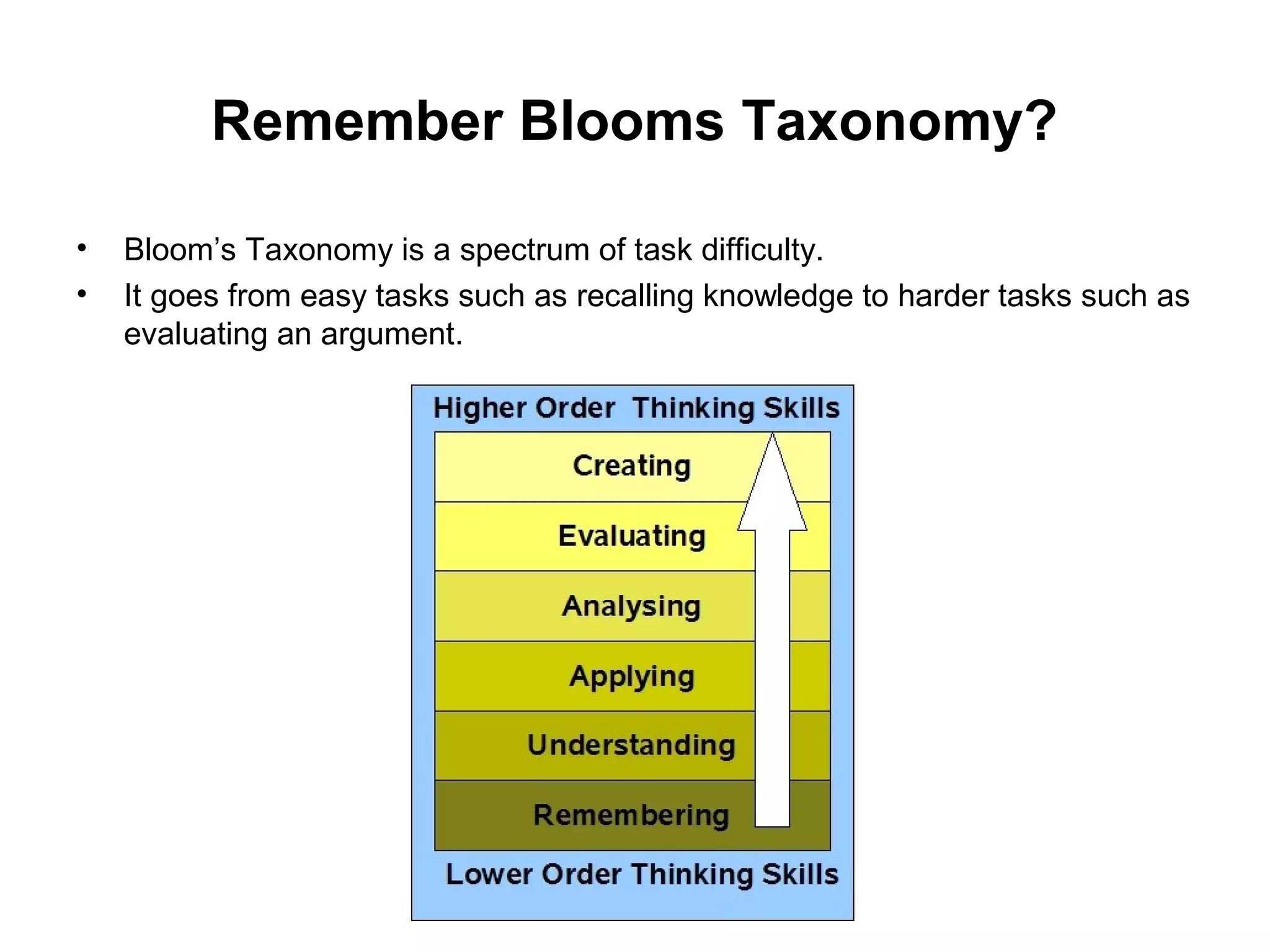
Remember Blooms Taxonomy? 
• Bloom’s Taxonomy is a spectrum of task difficulty. 
• It goes from easy tasks such as recalling knowledge to harder tasks such as 
evaluating an argument.
In order to ensure inclusion, there should be a mix of: 
Mastery Tasks 
• Can be mastered by all learners in a short period of time 
regardless of their prior learning. 
• Allows weaker learners to succeed. 
• Without this success they will probably give up. 
Developmental tasks 
• Stretch the more able, develop the skills required for 
academic success, and for the world of work. 
• These tasks develop the skills required for progression 
to the next educational level. 
• They also create deep learning, that is, real 
understanding.
Mastery tasks 
For example: 
• Copy and label a diagram of a hydroelectric power station 
‘Mastery’ tasks have the following characteristics: 
• They are easy, typically involving only knowledge and 
comprehension 
• They are not dependent on prior learning 
• They can be attained in a short time, perhaps minutes. 
• 100% of the students should be able to get them 100% right! 
• Because they are time rather than ability dependent mastery tasks 
allow weaker students can enjoy the success, reinforcement, self 
belief and motivation which makes learning possible.
Developmental tasks 
For example: 
• Survey leisure time opportunities in Your nearest city, 
and report on your findings 
Developmental tasks have the following 
characteristics.: 
• They are more difficult 
• They are highly dependent on prior learning 
• Students can’t get 100%. Development is slow and 
requires considerable effort. 
• They involve higher order skills such as evaluation, 
synthesis, etc.
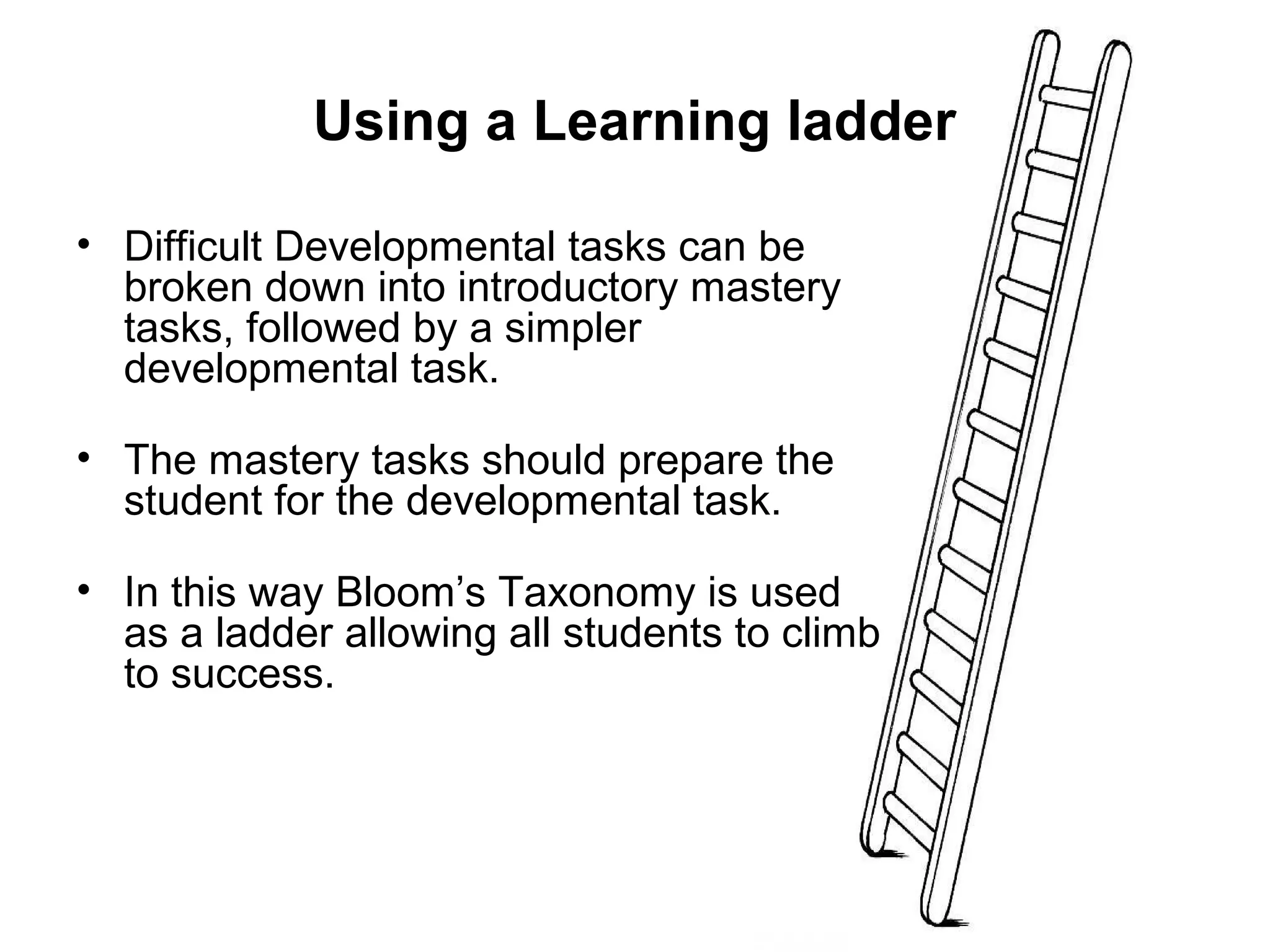
Using a Learning ladder 
• Difficult Developmental tasks can be 
broken down into introductory mastery 
tasks, followed by a simpler 
developmental task. 
• The mastery tasks should prepare the 
student for the developmental task. 
• In this way Bloom’s Taxonomy is used 
as a ladder allowing all students to climb 
to success.
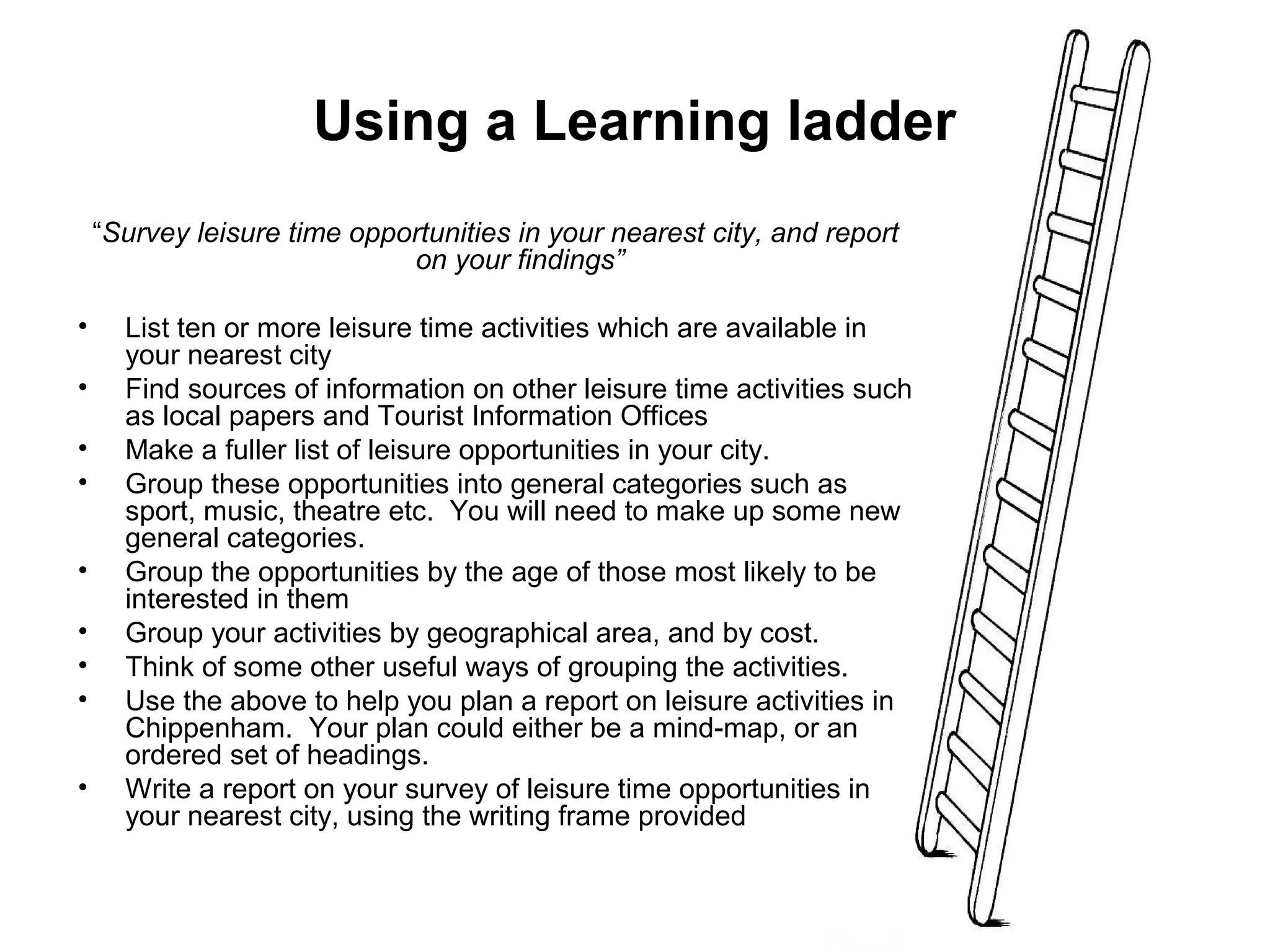
Using a Learning ladder 
“Survey leisure time opportunities in your nearest city, and report 
on your findings” 
• List ten or more leisure time activities which are available in 
your nearest city 
• Find sources of information on other leisure time activities such 
as local papers and Tourist Information Offices 
• Make a fuller list of leisure opportunities in your city. 
• Group these opportunities into general categories such as 
sport, music, theatre etc. You will need to make up some new 
general categories. 
• Group the opportunities by the age of those most likely to be 
interested in them 
• Group your activities by geographical area, and by cost. 
• Think of some other useful ways of grouping the activities. 
• Use the above to help you plan a report on leisure activities in 
Chippenham. Your plan could either be a mind-map, or an 
ordered set of headings. 
• Write a report on your survey of leisure time opportunities in 
your nearest city, using the writing frame provided
Helping students with their writing 
• Writing assignments, essays, and reports is a challenge for students at 
every level. 
• Differentiation requires that we break down the difficult task of writing 
extended pieces of work, giving students a ‘ladder’ up to this high-order skill. 
There are a number of ways of assisting students with their writing, including: 
• Breaking the writing task down into a series of tasks. 
• Help sheets 
• Planning clocks 
• Writing frames 
• Showing students exemplar work and asking them to grade this and learn 
from it 
• Making your assessment criteria and grade descriptors explicit and clear 
• Assessment proformas
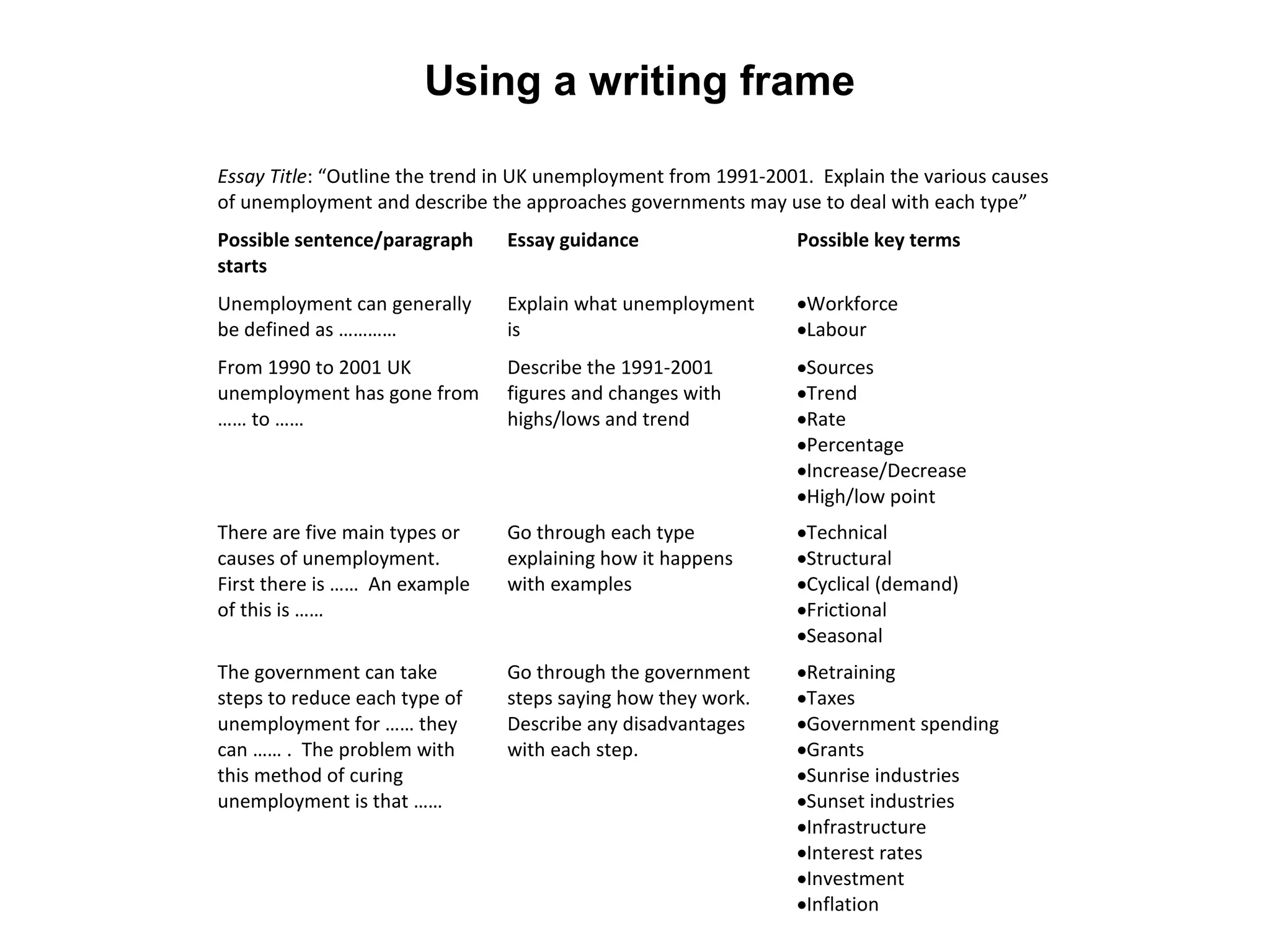
Using a writing frame 
Essay Title: “Outline the trend in UK unemployment from 1991-2001. Explain the various causes 
of unemployment and describe the approaches governments may use to deal with each type” 
Possible sentence/paragraph 
Essay guidance Possible key terms 
starts 
Unemployment can generally 
be defined as ………… 
Explain what unemployment 
is 
·Workforce 
·Labour 
From 1990 to 2001 UK 
unemployment has gone from 
…… to …… 
Describe the 1991-2001 
figures and changes with 
highs/lows and trend 
·Sources 
·Trend 
·Rate 
·Percentage 
·Increase/Decrease 
·High/low point 
There are five main types or 
causes of unemployment. 
First there is …… An example 
of this is …… 
Go through each type 
explaining how it happens 
with examples 
·Technical 
·Structural 
·Cyclical (demand) 
·Frictional 
·Seasonal 
The government can take 
steps to reduce each type of 
unemployment for …… they 
can …… . The problem with 
this method of curing 
unemployment is that …… 
Go through the government 
steps saying how they work. 
Describe any disadvantages 
with each step. 
·Retraining 
·Taxes 
·Government spending 
·Grants 
·Sunrise industries 
·Sunset industries 
·Infrastructure 
·Interest rates 
·Investment 
·Inflation
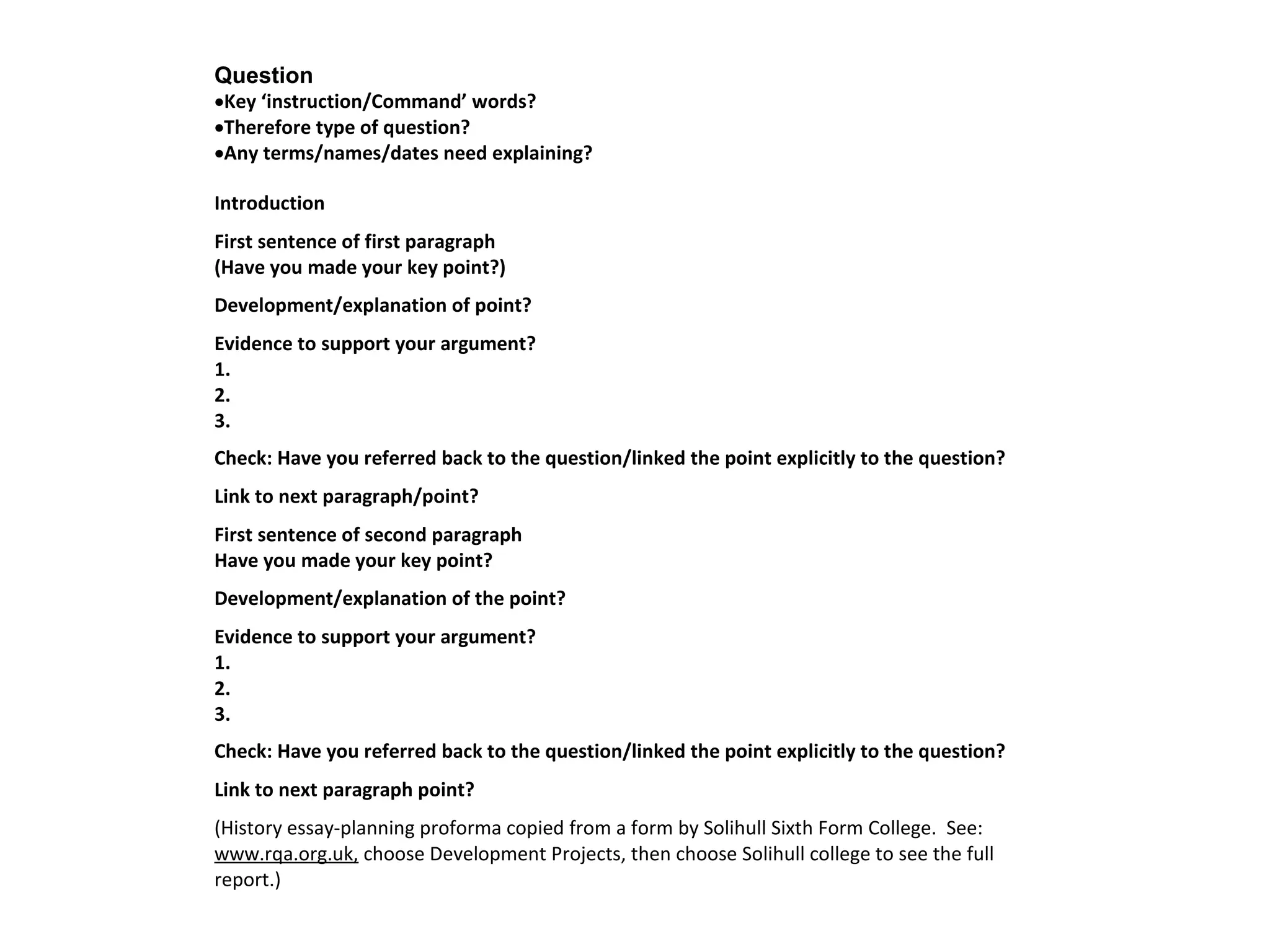
Question 
·Key ‘instruction/Command’ words? 
·Therefore type of question? 
·Any terms/names/dates need explaining? 
Introduction 
First sentence of first paragraph 
(Have you made your key point?) 
Development/explanation of point? 
Evidence to support your argument? 
1. 
2. 
3. 
Check: Have you referred back to the question/linked the point explicitly to the question? 
Link to next paragraph/point? 
First sentence of second paragraph 
Have you made your key point? 
Development/explanation of the point? 
Evidence to support your argument? 
1. 
2. 
3. 
Check: Have you referred back to the question/linked the point explicitly to the question? 
Link to next paragraph point? 
(History essay-planning proforma copied from a form by Solihull Sixth Form College. See: 
www.rqa.org.uk, choose Development Projects, then choose Solihull college to see the full 
report.)
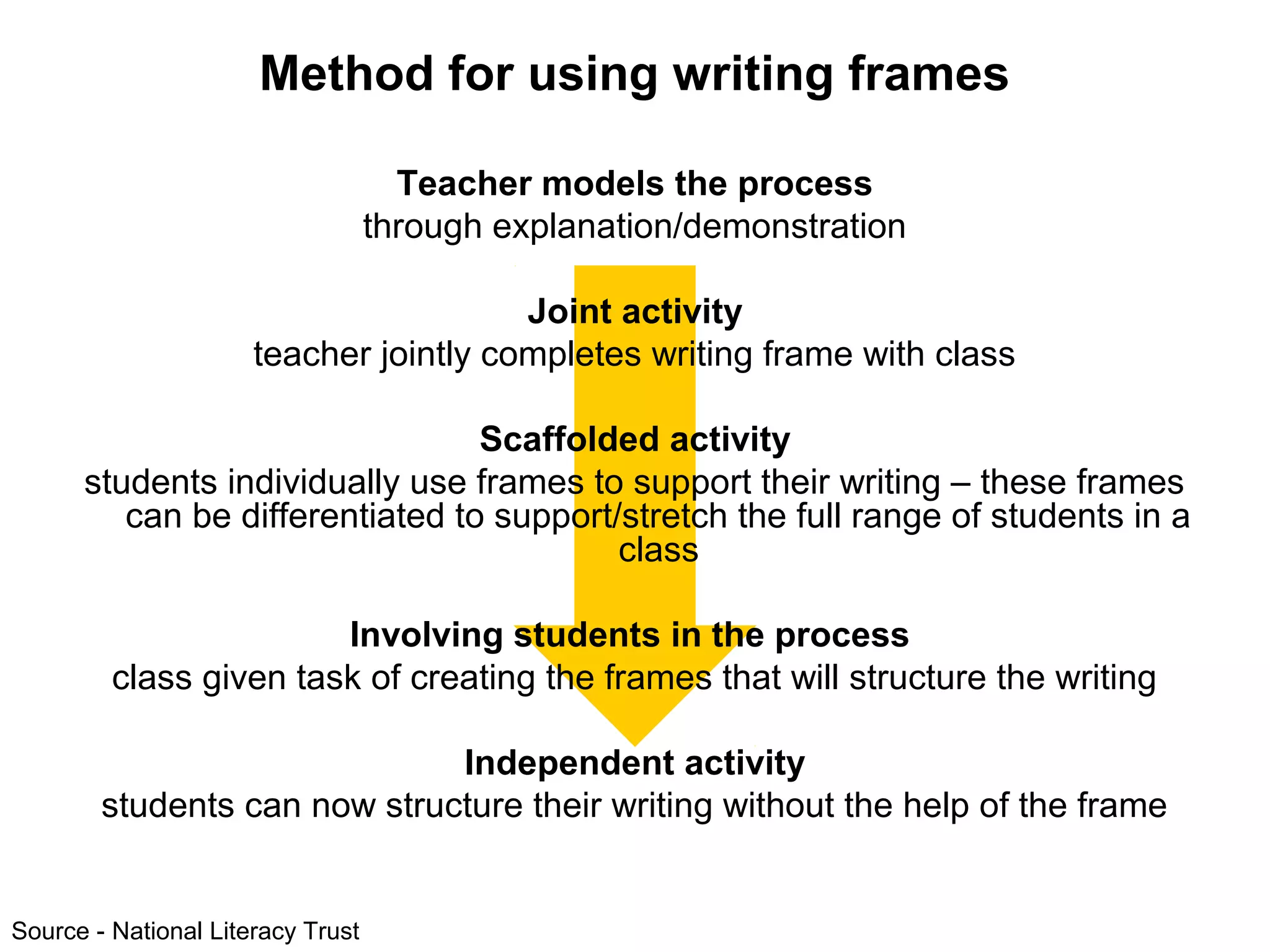
Method for using writing frames 
Teacher models the process 
through explanation/demonstration 
Joint activity 
teacher jointly completes writing frame with class 
Scaffolded activity 
students individually use frames to support their writing – these frames 
can be differentiated to support/stretch the full range of students in a 
class 
Involving students in the process 
class given task of creating the frames that will structure the writing 
Independent activity 
students can now structure their writing without the help of the frame 
Source - National Literacy Trust
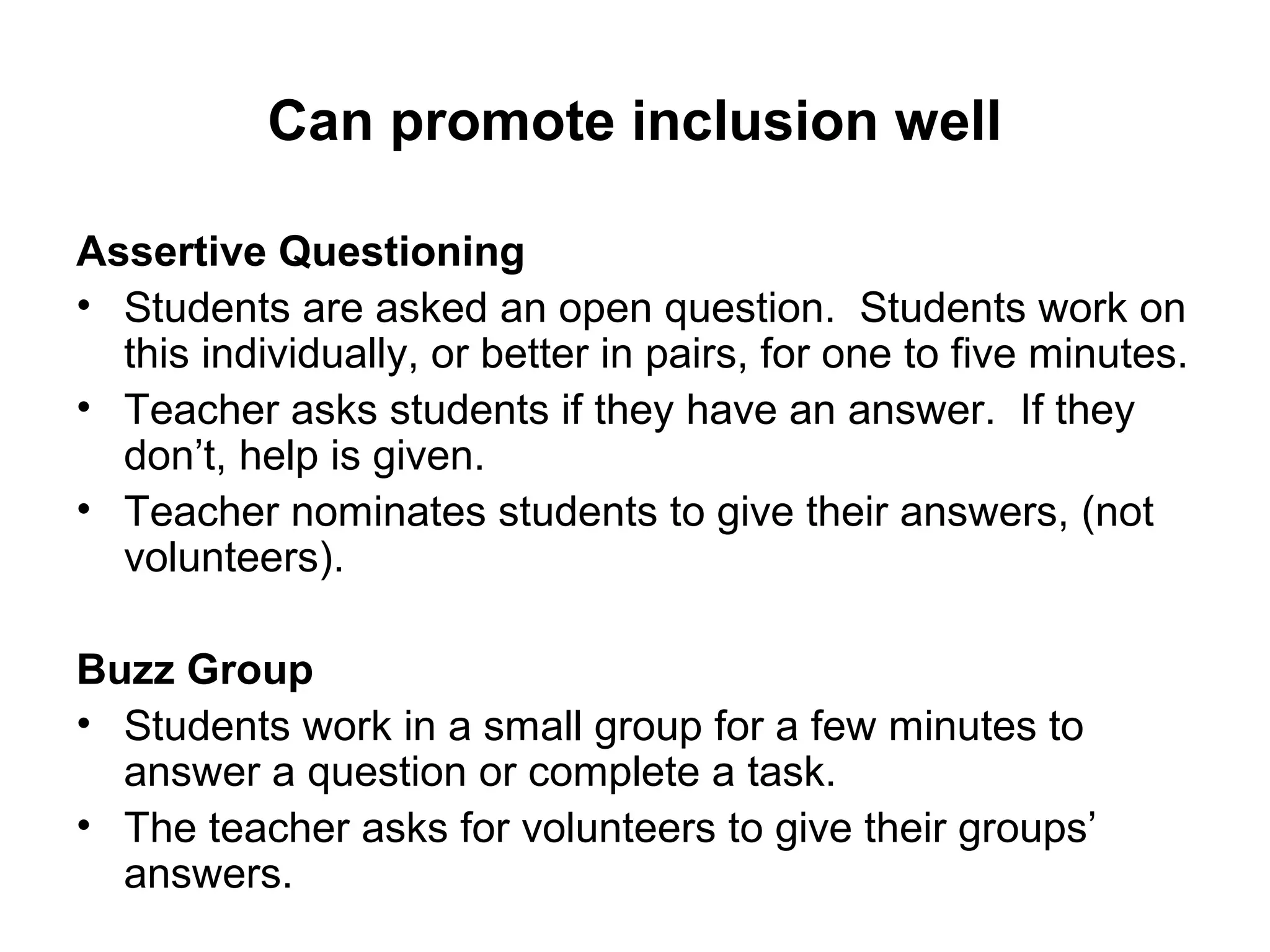
Can promote inclusion well 
Assertive Questioning 
• Students are asked an open question. Students work on 
this individually, or better in pairs, for one to five minutes. 
• Teacher asks students if they have an answer. If they 
don’t, help is given. 
• Teacher nominates students to give their answers, (not 
volunteers). 
Buzz Group 
• Students work in a small group for a few minutes to 
answer a question or complete a task. 
• The teacher asks for volunteers to give their groups’ 
answers.
Explaining Tasks 
• Students explain the key points of a lesson to each other 
at the end of that lesson. 
• In both cases the teacher then gives model 
Individual writing task for students 
• Students are asked to write an assignment, essay or 
similar in class or on their own. 
Worksheet 
• Students are given a worksheet with a range of 
graduated questions: that is, starting easy and getting 
harder.
Experiment/practical ‘discovery style’ 
• Students are given a task to do but not told how to do it. 
• Students plan a method, then check this with the teacher before 
starting. 
• Students who cannot work out how to do it are given a ‘recipe’ style 
help sheet or helped in some other way. 
Student Presentation 
• Students are given a topic to explain to the class. They may work 
alone or in a small group to prepare, plan and deliver the 
presentation. 
• Materials and plans are checked by the teacher before the 
presentation.
Improving inclusion using weaker methods 
Teacher questions, students answer: 
• mix mastery and developmental questions; use substantial ‘wait time’ and 
have high expectations of the quality of the answers; use ‘assertive 
questioning’; etc 
Students watching a video or film: 
• Give students questions that the film will answer before showing it. Make 
some questions mastery and some developmental. 
Past Paper exam questions: 
• If there are no easy questions, write some, and ask students to do these 
before the past paper question. Many exam questions differentiate well, it 
depends on the exam. 
Experiment/practical ‘recipe style’: 
• Use the ‘discovery style’ or set developmental ‘extension tasks’ for students 
who have competed the ‘recipe’ satisfactorily.
By task 
1. Use an able pupil to quickly recap on the previous lesson’s learning 
for the other pupils. 
2. Many starter activities require pupils to find a number of examples. 
An able pupil can be set a higher target, eg Level 4 pupils find five 
synonyms for the word ‘pleased’, Level 7 pupils find 10 
3. If you are taking feedback during the lesson, enlist an able pupil to 
record ideas on the board while you lead the discussion. 
4. Ask able pupils to model their writing or thinking, by explaining their 
answer/solution to a task to a neighbour.
5. The best way to prove understanding of a topic is to teach it. Get 
able pupils to teach the less able a key learning point. 
6. Use AG&T pupils to provide the plenary. Alert them at the start of 
the lesson to be ready to present their findings to the class at the 
end of the lesson. 
7. Ask able pupils to come up with questions to ask during the plenary 
to test other pupils’ understanding of the lesson. 
8. Use higher-level questioning and direct questions at particular 
pupils rather than waiting for the hands up approach. Be ready to 
probe beyond the first answer in order to make them really think: 
‘Why do you think that?’ ‘How did you come to that conclusion?’
Anchor activities 
A task to which a student automatically moves when an 
assigned task is finished 
TRAITS OF EFFECTIVE ANCHOR ACTIVITIES: 
• Related to key knowledge, understanding, and skill, 
• Interesting—appeals to student curiosity, interest, learning 
preference, 
• Allows choice—students can select from a range of options 
• Seldom Graded—teachers should examine the work as they move 
around the room. 
• Students may get a grade (Effort grade/Credit) for working 
effectively, but seldom for the work itself. 
• The motivation is interest and/or improved achievement.
Examples of Anchor activities 
• Reading from supplementary material 
• Working on final products 
• Free reading 
• Journal writing 
• Vocabulary extension 
• Learning about the people behind ideas 
• Independent mini project related to the topic 
• Current events reading 
• Designing a starter, quiz or plenary 
• An idea for an improvement, invention, innovation
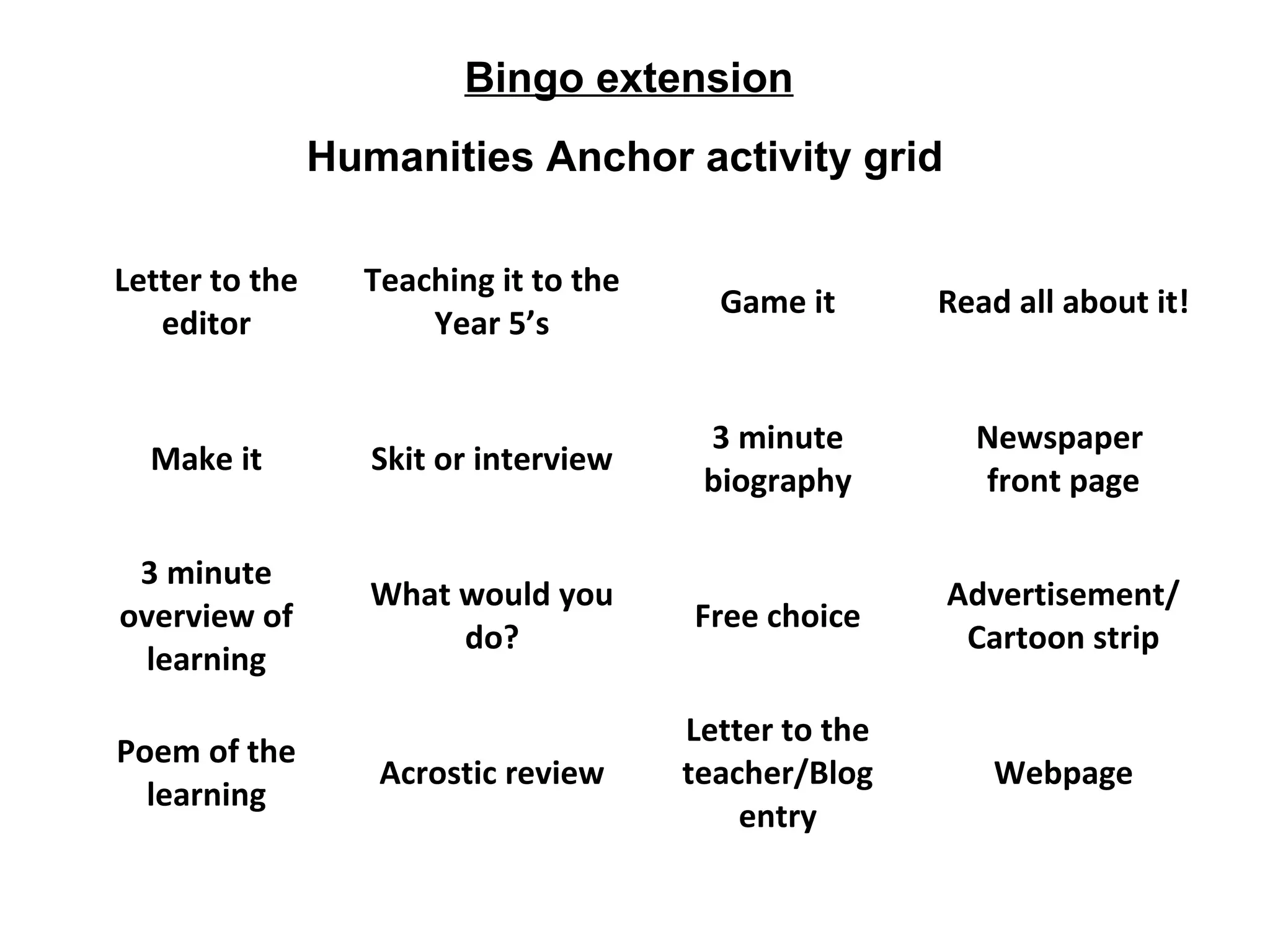
Bingo extension 
Humanities Anchor activity grid 
Letter to the 
editor 
Teaching it to the 
Year 5’s 
Game it Read all about it! 
Make it Skit or interview 
3 minute 
biography 
Newspaper 
front page 
3 minute 
overview of 
learning 
What would you 
do? 
Free choice 
Advertisement/ 
Cartoon strip 
Poem of the 
learning 
Acrostic review 
Letter to the 
teacher/Blog 
entry 
Webpage
By support & task 
1. While other pupils are working on a simple starter use the time to explain to 
able pupils how they can excel in the lesson, which lower-level tasks they 
can bypass and which tasks they should tackle to stretch them. 
2. Ascribe the roles of chairperson or lead learner to able pupils who will then 
take on the mantle of responsibility and help maintain momentum and focus 
during tasks. 
3. Plan your groups carefully. Sometimes able pupils will learn most 
productively together, sharing and extending their more developed thinking; 
sometimes it is helpful for them to advise a less-able pupil and have to work 
harder to successfully articulate their ideas 
4. Rather than repeating or summarising instructions yourself in front of the 
whole class, get an able pupil to do so.
By outcome 
1. Use the now familiar ‘Must do’, ‘Could do’, ‘Should do’ 
ascribed to classroom tasks or homework to direct the 
type and length of activities pupils might complete. 
2. Provide opportunities for pupils to respond in ways other 
than writing: display work, role play, short video films etc. 
3. Remember that ‘less is more’ in some cases. Prescribe 
the number of words to be used to make G&T pupils 
think hard about what they write, and make every word 
count.
A real example 
Context: 
Planned for inclusion 
Developing independent learning skills 
Little teacher input 
Mixed ability groupings 
Relevant – real life example 
OfSted Oct 2012 grading: ‘Outstanding’
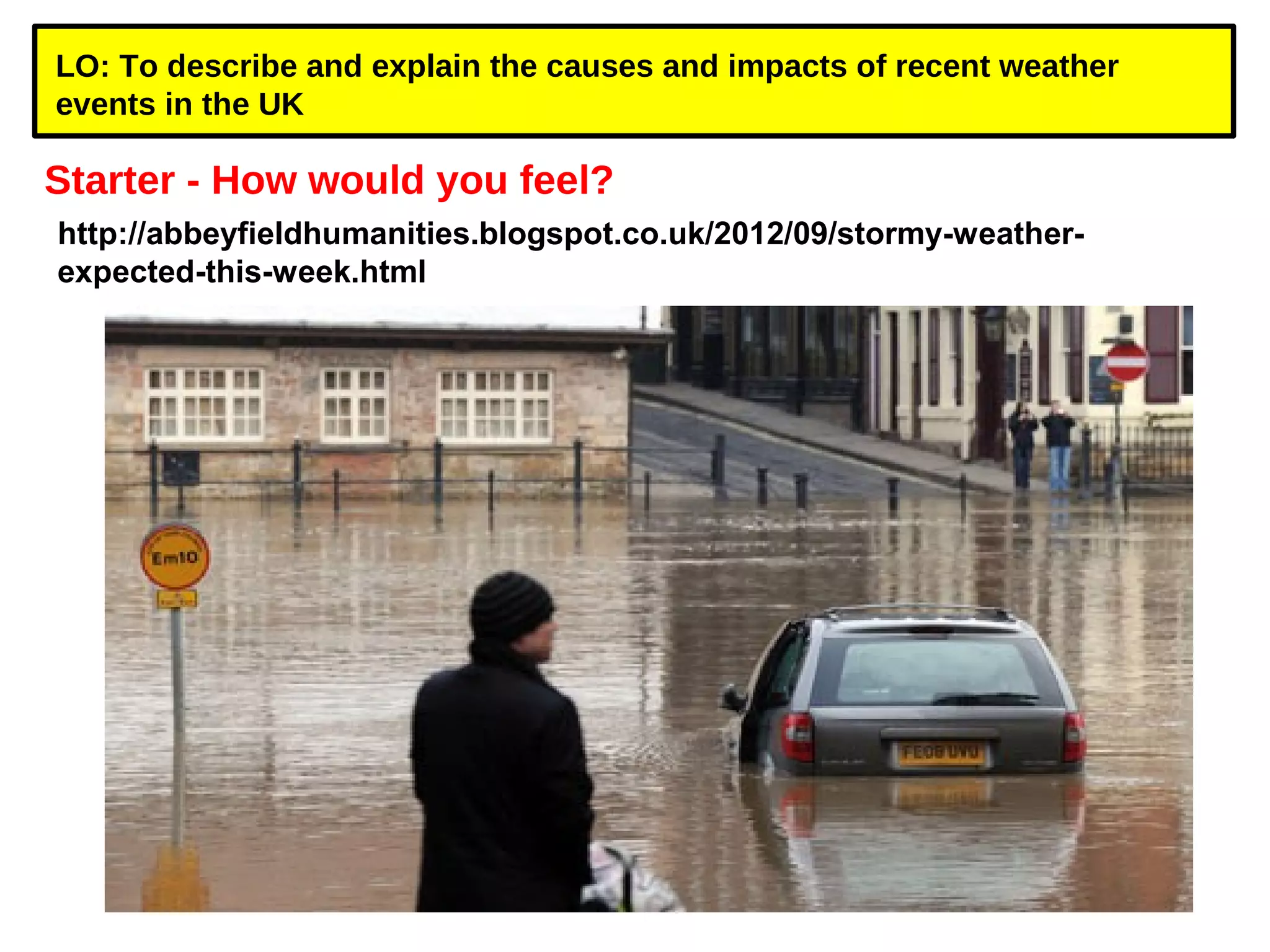
LO: To describe and explain the causes and impacts of recent weather 
events in the UK 
Starter - How would you feel? 
http://abbeyfieldhumanities.blogspot.co.uk/2012/09/stormy-weather-expected- 
this-week.html
LO: To describe and explain the causes and impacts of recent weather 
events in the UK 
Success criteria 
Your presentation is clear and easy to understand 
Your presentation covers both causes and effects 
You work well as a team - all contributing equally to the tasks set 
You describe and explain the causes and effects - using appropriate 
connectives 
You link effects with specific places in the UK - labelling the locations 
accurately on the map
LO: To describe and explain the causes and impacts of recent weather 
events in the UK 
YOUR TASK: 
In your groups, you will need to investigate the causes and effects of 
the stormy weather this week 
Your resources: 
·Sugar paper 
·UK blank map 
·Newspaper articles 
·Laptop 
You should designate tasks within the group to work towards a common goal - 
making sure that you fulfil the requirements of your role within the team 
http://abbeyfieldhumanities.blogspot.co.uk/2012/09/stormy-weather-expected-this-week.html
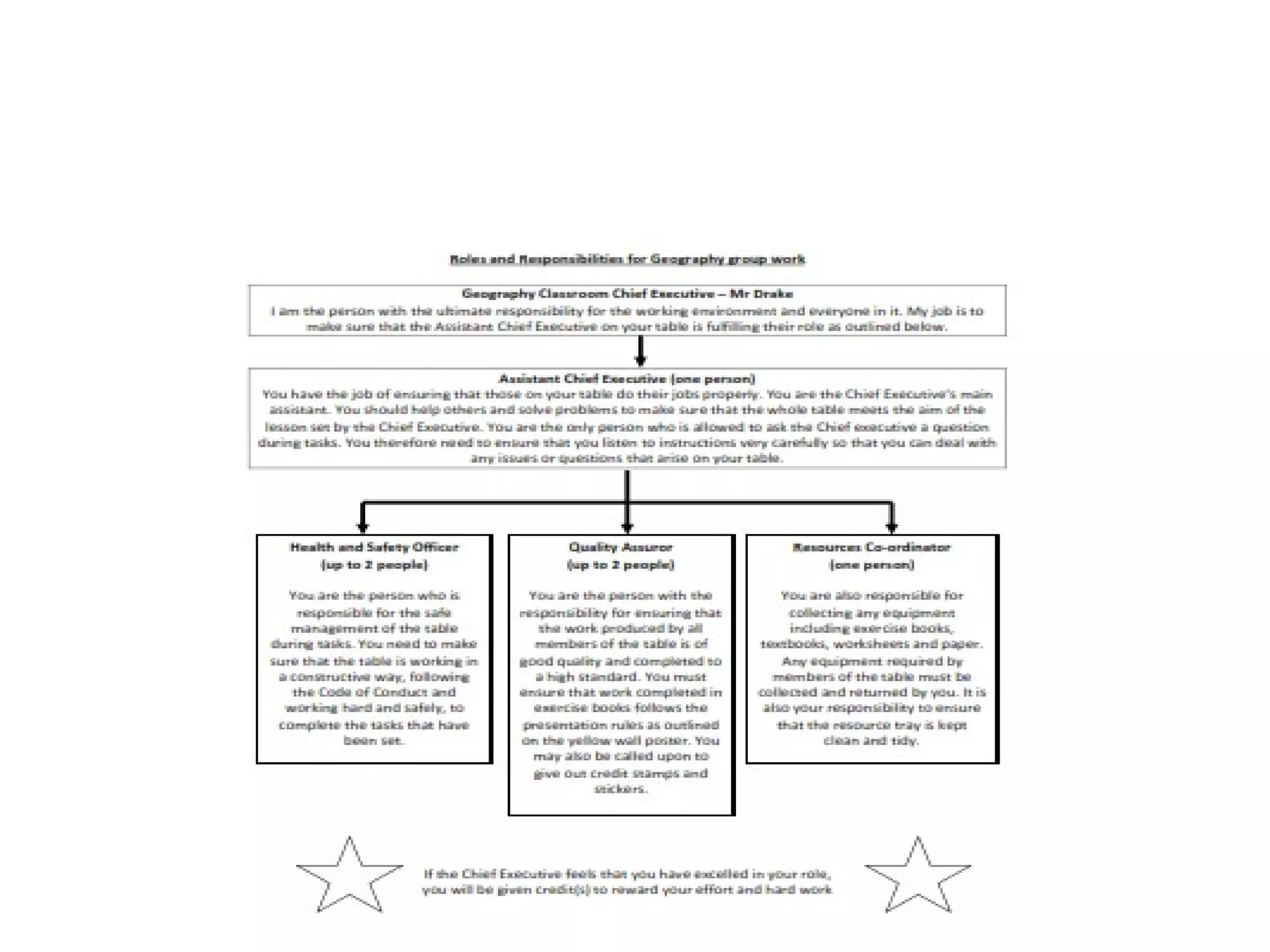
Roles and Responsibilities for Geography group work 
Geography Classroom Chief Executive – Mr Drake 
I am the person with the ultimate responsibility for the working 
environment and everyone in it. My job is to make sure that the Assistant 
Chief Executive on your table is fulfilling their role as outlined below. 
Assistant Chief Executive (one person) 
You have the job of ensuring that those on your table do their jobs properly. 
You are the Chief Executive’s main assistant. You should help others and 
solve problems to make sure that the whole table meets the aim of the 
lesson set by the Chief Executive. You are the only person who is allowed 
to ask the Chief executive a question during tasks. You therefore need to 
ensure that you listen to instructions very carefully so that you can deal with 
any issues or questions that arise on your table.
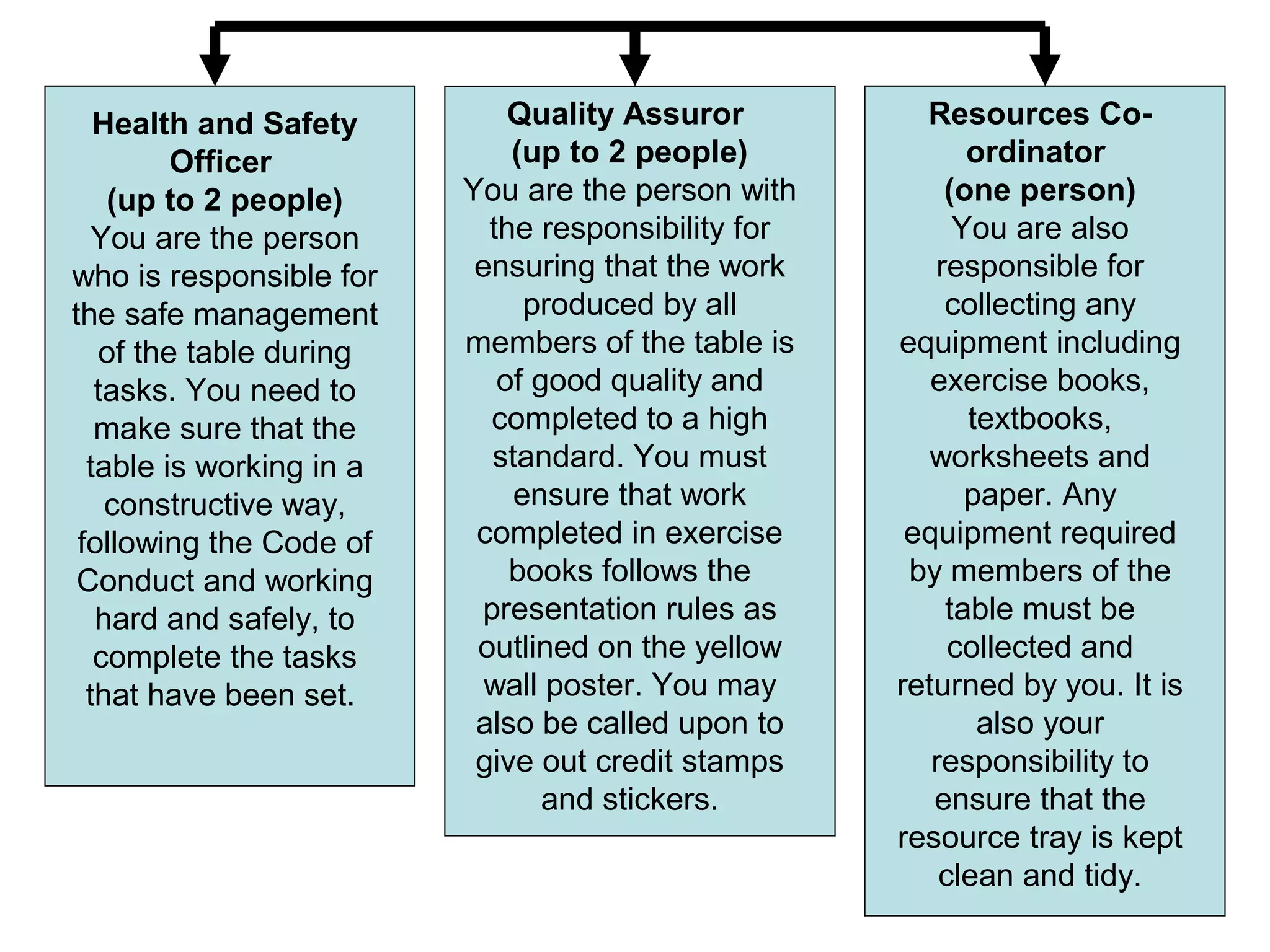
Health and Safety 
Officer 
(up to 2 people) 
You are the person 
who is responsible for 
the safe management 
of the table during 
tasks. You need to 
make sure that the 
table is working in a 
constructive way, 
following the Code of 
Conduct and working 
hard and safely, to 
complete the tasks 
that have been set. 
Quality Assuror 
(up to 2 people) 
You are the person with 
the responsibility for 
ensuring that the work 
produced by all 
members of the table is 
of good quality and 
completed to a high 
standard. You must 
ensure that work 
completed in exercise 
books follows the 
presentation rules as 
outlined on the yellow 
wall poster. You may 
also be called upon to 
give out credit stamps 
and stickers. 
Resources Co-ordinator 
(one person) 
You are also 
responsible for 
collecting any 
equipment including 
exercise books, 
textbooks, 
worksheets and 
paper. Any 
equipment required 
by members of the 
table must be 
collected and 
returned by you. It is 
also your 
responsibility to 
ensure that the 
resource tray is kept 
clean and tidy.
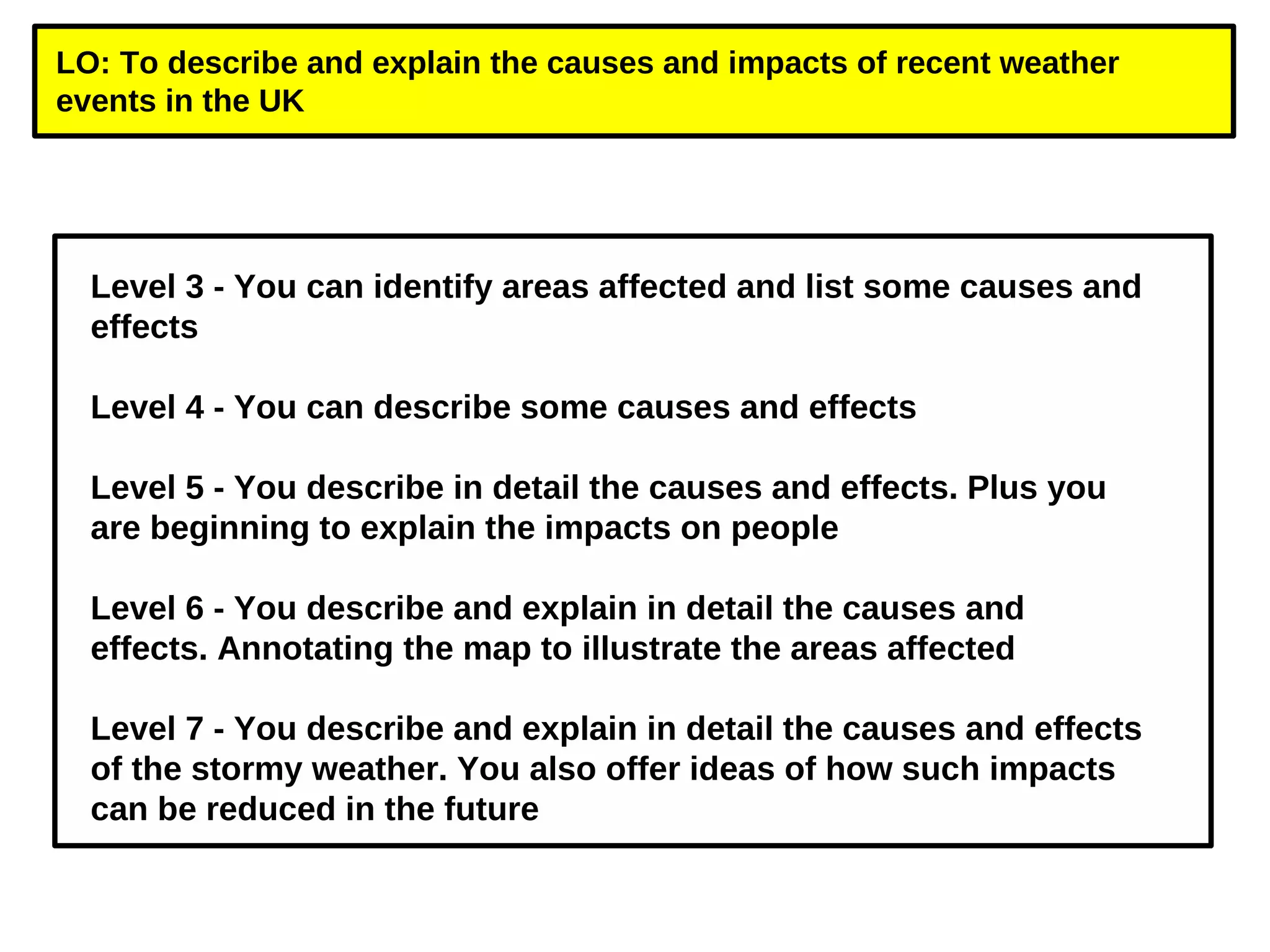
LO: To describe and explain the causes and impacts of recent weather 
events in the UK 
Level 3 - You can identify areas affected and list some causes and 
effects 
Level 4 - You can describe some causes and effects 
Level 5 - You describe in detail the causes and effects. Plus you 
are beginning to explain the impacts on people 
Level 6 - You describe and explain in detail the causes and 
effects. Annotating the map to illustrate the areas affected 
Level 7 - You describe and explain in detail the causes and effects 
of the stormy weather. You also offer ideas of how such impacts 
can be reduced in the future
Inclusion and differentiation 
in the classroom 
http://humanitiesast.wordpress.com 
for lesson ideas, training materials etc 
On Twitter: 
@_DavidDrake 
@TeachingBites 
@CarteriPads 
@geogabout 
David Drake 2014 
Advanced Skills Teacher and Lead Practitioner

Inclusion and differentiation in the classroom

  • 1.
    Inclusion and differentiation in the classroom ‘Differentiation is the process whereby teachers meet the need for progress through the curriculum by selecting appropriate teaching methods to match the individual student’s learning strategies, within a group situation’. Visser 1993 David Drake - 2014 Advanced Skills Teacher and Lead Practitioner http://humanitiesast.wordpress.com
  • 2.
    Remember Blooms Taxonomy? • Bloom’s Taxonomy is a spectrum of task difficulty. • It goes from easy tasks such as recalling knowledge to harder tasks such as evaluating an argument.
  • 3.
    In order toensure inclusion, there should be a mix of: Mastery Tasks • Can be mastered by all learners in a short period of time regardless of their prior learning. • Allows weaker learners to succeed. • Without this success they will probably give up. Developmental tasks • Stretch the more able, develop the skills required for academic success, and for the world of work. • These tasks develop the skills required for progression to the next educational level. • They also create deep learning, that is, real understanding.
  • 4.
    Mastery tasks Forexample: • Copy and label a diagram of a hydroelectric power station ‘Mastery’ tasks have the following characteristics: • They are easy, typically involving only knowledge and comprehension • They are not dependent on prior learning • They can be attained in a short time, perhaps minutes. • 100% of the students should be able to get them 100% right! • Because they are time rather than ability dependent mastery tasks allow weaker students can enjoy the success, reinforcement, self belief and motivation which makes learning possible.
  • 5.
    Developmental tasks Forexample: • Survey leisure time opportunities in Your nearest city, and report on your findings Developmental tasks have the following characteristics.: • They are more difficult • They are highly dependent on prior learning • Students can’t get 100%. Development is slow and requires considerable effort. • They involve higher order skills such as evaluation, synthesis, etc.
  • 6.
    Using a Learningladder • Difficult Developmental tasks can be broken down into introductory mastery tasks, followed by a simpler developmental task. • The mastery tasks should prepare the student for the developmental task. • In this way Bloom’s Taxonomy is used as a ladder allowing all students to climb to success.
  • 7.
    Using a Learningladder “Survey leisure time opportunities in your nearest city, and report on your findings” • List ten or more leisure time activities which are available in your nearest city • Find sources of information on other leisure time activities such as local papers and Tourist Information Offices • Make a fuller list of leisure opportunities in your city. • Group these opportunities into general categories such as sport, music, theatre etc. You will need to make up some new general categories. • Group the opportunities by the age of those most likely to be interested in them • Group your activities by geographical area, and by cost. • Think of some other useful ways of grouping the activities. • Use the above to help you plan a report on leisure activities in Chippenham. Your plan could either be a mind-map, or an ordered set of headings. • Write a report on your survey of leisure time opportunities in your nearest city, using the writing frame provided
  • 8.
    Helping students withtheir writing • Writing assignments, essays, and reports is a challenge for students at every level. • Differentiation requires that we break down the difficult task of writing extended pieces of work, giving students a ‘ladder’ up to this high-order skill. There are a number of ways of assisting students with their writing, including: • Breaking the writing task down into a series of tasks. • Help sheets • Planning clocks • Writing frames • Showing students exemplar work and asking them to grade this and learn from it • Making your assessment criteria and grade descriptors explicit and clear • Assessment proformas
  • 9.
    Using a writingframe Essay Title: “Outline the trend in UK unemployment from 1991-2001. Explain the various causes of unemployment and describe the approaches governments may use to deal with each type” Possible sentence/paragraph Essay guidance Possible key terms starts Unemployment can generally be defined as ………… Explain what unemployment is ·Workforce ·Labour From 1990 to 2001 UK unemployment has gone from …… to …… Describe the 1991-2001 figures and changes with highs/lows and trend ·Sources ·Trend ·Rate ·Percentage ·Increase/Decrease ·High/low point There are five main types or causes of unemployment. First there is …… An example of this is …… Go through each type explaining how it happens with examples ·Technical ·Structural ·Cyclical (demand) ·Frictional ·Seasonal The government can take steps to reduce each type of unemployment for …… they can …… . The problem with this method of curing unemployment is that …… Go through the government steps saying how they work. Describe any disadvantages with each step. ·Retraining ·Taxes ·Government spending ·Grants ·Sunrise industries ·Sunset industries ·Infrastructure ·Interest rates ·Investment ·Inflation
  • 10.
    Question ·Key ‘instruction/Command’words? ·Therefore type of question? ·Any terms/names/dates need explaining? Introduction First sentence of first paragraph (Have you made your key point?) Development/explanation of point? Evidence to support your argument? 1. 2. 3. Check: Have you referred back to the question/linked the point explicitly to the question? Link to next paragraph/point? First sentence of second paragraph Have you made your key point? Development/explanation of the point? Evidence to support your argument? 1. 2. 3. Check: Have you referred back to the question/linked the point explicitly to the question? Link to next paragraph point? (History essay-planning proforma copied from a form by Solihull Sixth Form College. See: www.rqa.org.uk, choose Development Projects, then choose Solihull college to see the full report.)
  • 11.
    Method for usingwriting frames Teacher models the process through explanation/demonstration Joint activity teacher jointly completes writing frame with class Scaffolded activity students individually use frames to support their writing – these frames can be differentiated to support/stretch the full range of students in a class Involving students in the process class given task of creating the frames that will structure the writing Independent activity students can now structure their writing without the help of the frame Source - National Literacy Trust
  • 12.
    Can promote inclusionwell Assertive Questioning • Students are asked an open question. Students work on this individually, or better in pairs, for one to five minutes. • Teacher asks students if they have an answer. If they don’t, help is given. • Teacher nominates students to give their answers, (not volunteers). Buzz Group • Students work in a small group for a few minutes to answer a question or complete a task. • The teacher asks for volunteers to give their groups’ answers.
  • 13.
    Explaining Tasks •Students explain the key points of a lesson to each other at the end of that lesson. • In both cases the teacher then gives model Individual writing task for students • Students are asked to write an assignment, essay or similar in class or on their own. Worksheet • Students are given a worksheet with a range of graduated questions: that is, starting easy and getting harder.
  • 14.
    Experiment/practical ‘discovery style’ • Students are given a task to do but not told how to do it. • Students plan a method, then check this with the teacher before starting. • Students who cannot work out how to do it are given a ‘recipe’ style help sheet or helped in some other way. Student Presentation • Students are given a topic to explain to the class. They may work alone or in a small group to prepare, plan and deliver the presentation. • Materials and plans are checked by the teacher before the presentation.
  • 15.
    Improving inclusion usingweaker methods Teacher questions, students answer: • mix mastery and developmental questions; use substantial ‘wait time’ and have high expectations of the quality of the answers; use ‘assertive questioning’; etc Students watching a video or film: • Give students questions that the film will answer before showing it. Make some questions mastery and some developmental. Past Paper exam questions: • If there are no easy questions, write some, and ask students to do these before the past paper question. Many exam questions differentiate well, it depends on the exam. Experiment/practical ‘recipe style’: • Use the ‘discovery style’ or set developmental ‘extension tasks’ for students who have competed the ‘recipe’ satisfactorily.
  • 16.
    By task 1.Use an able pupil to quickly recap on the previous lesson’s learning for the other pupils. 2. Many starter activities require pupils to find a number of examples. An able pupil can be set a higher target, eg Level 4 pupils find five synonyms for the word ‘pleased’, Level 7 pupils find 10 3. If you are taking feedback during the lesson, enlist an able pupil to record ideas on the board while you lead the discussion. 4. Ask able pupils to model their writing or thinking, by explaining their answer/solution to a task to a neighbour.
  • 17.
    5. The bestway to prove understanding of a topic is to teach it. Get able pupils to teach the less able a key learning point. 6. Use AG&T pupils to provide the plenary. Alert them at the start of the lesson to be ready to present their findings to the class at the end of the lesson. 7. Ask able pupils to come up with questions to ask during the plenary to test other pupils’ understanding of the lesson. 8. Use higher-level questioning and direct questions at particular pupils rather than waiting for the hands up approach. Be ready to probe beyond the first answer in order to make them really think: ‘Why do you think that?’ ‘How did you come to that conclusion?’
  • 18.
    Anchor activities Atask to which a student automatically moves when an assigned task is finished TRAITS OF EFFECTIVE ANCHOR ACTIVITIES: • Related to key knowledge, understanding, and skill, • Interesting—appeals to student curiosity, interest, learning preference, • Allows choice—students can select from a range of options • Seldom Graded—teachers should examine the work as they move around the room. • Students may get a grade (Effort grade/Credit) for working effectively, but seldom for the work itself. • The motivation is interest and/or improved achievement.
  • 19.
    Examples of Anchoractivities • Reading from supplementary material • Working on final products • Free reading • Journal writing • Vocabulary extension • Learning about the people behind ideas • Independent mini project related to the topic • Current events reading • Designing a starter, quiz or plenary • An idea for an improvement, invention, innovation
  • 20.
    Bingo extension HumanitiesAnchor activity grid Letter to the editor Teaching it to the Year 5’s Game it Read all about it! Make it Skit or interview 3 minute biography Newspaper front page 3 minute overview of learning What would you do? Free choice Advertisement/ Cartoon strip Poem of the learning Acrostic review Letter to the teacher/Blog entry Webpage
  • 21.
    By support &task 1. While other pupils are working on a simple starter use the time to explain to able pupils how they can excel in the lesson, which lower-level tasks they can bypass and which tasks they should tackle to stretch them. 2. Ascribe the roles of chairperson or lead learner to able pupils who will then take on the mantle of responsibility and help maintain momentum and focus during tasks. 3. Plan your groups carefully. Sometimes able pupils will learn most productively together, sharing and extending their more developed thinking; sometimes it is helpful for them to advise a less-able pupil and have to work harder to successfully articulate their ideas 4. Rather than repeating or summarising instructions yourself in front of the whole class, get an able pupil to do so.
  • 22.
    By outcome 1.Use the now familiar ‘Must do’, ‘Could do’, ‘Should do’ ascribed to classroom tasks or homework to direct the type and length of activities pupils might complete. 2. Provide opportunities for pupils to respond in ways other than writing: display work, role play, short video films etc. 3. Remember that ‘less is more’ in some cases. Prescribe the number of words to be used to make G&T pupils think hard about what they write, and make every word count.
  • 23.
    A real example Context: Planned for inclusion Developing independent learning skills Little teacher input Mixed ability groupings Relevant – real life example OfSted Oct 2012 grading: ‘Outstanding’
  • 24.
    LO: To describeand explain the causes and impacts of recent weather events in the UK Starter - How would you feel? http://abbeyfieldhumanities.blogspot.co.uk/2012/09/stormy-weather-expected- this-week.html
  • 25.
    LO: To describeand explain the causes and impacts of recent weather events in the UK Success criteria Your presentation is clear and easy to understand Your presentation covers both causes and effects You work well as a team - all contributing equally to the tasks set You describe and explain the causes and effects - using appropriate connectives You link effects with specific places in the UK - labelling the locations accurately on the map
  • 26.
    LO: To describeand explain the causes and impacts of recent weather events in the UK YOUR TASK: In your groups, you will need to investigate the causes and effects of the stormy weather this week Your resources: ·Sugar paper ·UK blank map ·Newspaper articles ·Laptop You should designate tasks within the group to work towards a common goal - making sure that you fulfil the requirements of your role within the team http://abbeyfieldhumanities.blogspot.co.uk/2012/09/stormy-weather-expected-this-week.html
  • 28.
    Roles and Responsibilitiesfor Geography group work Geography Classroom Chief Executive – Mr Drake I am the person with the ultimate responsibility for the working environment and everyone in it. My job is to make sure that the Assistant Chief Executive on your table is fulfilling their role as outlined below. Assistant Chief Executive (one person) You have the job of ensuring that those on your table do their jobs properly. You are the Chief Executive’s main assistant. You should help others and solve problems to make sure that the whole table meets the aim of the lesson set by the Chief Executive. You are the only person who is allowed to ask the Chief executive a question during tasks. You therefore need to ensure that you listen to instructions very carefully so that you can deal with any issues or questions that arise on your table.
  • 29.
    Health and Safety Officer (up to 2 people) You are the person who is responsible for the safe management of the table during tasks. You need to make sure that the table is working in a constructive way, following the Code of Conduct and working hard and safely, to complete the tasks that have been set. Quality Assuror (up to 2 people) You are the person with the responsibility for ensuring that the work produced by all members of the table is of good quality and completed to a high standard. You must ensure that work completed in exercise books follows the presentation rules as outlined on the yellow wall poster. You may also be called upon to give out credit stamps and stickers. Resources Co-ordinator (one person) You are also responsible for collecting any equipment including exercise books, textbooks, worksheets and paper. Any equipment required by members of the table must be collected and returned by you. It is also your responsibility to ensure that the resource tray is kept clean and tidy.
  • 30.
    LO: To describeand explain the causes and impacts of recent weather events in the UK Level 3 - You can identify areas affected and list some causes and effects Level 4 - You can describe some causes and effects Level 5 - You describe in detail the causes and effects. Plus you are beginning to explain the impacts on people Level 6 - You describe and explain in detail the causes and effects. Annotating the map to illustrate the areas affected Level 7 - You describe and explain in detail the causes and effects of the stormy weather. You also offer ideas of how such impacts can be reduced in the future
  • 31.
    Inclusion and differentiation in the classroom http://humanitiesast.wordpress.com for lesson ideas, training materials etc On Twitter: @_DavidDrake @TeachingBites @CarteriPads @geogabout David Drake 2014 Advanced Skills Teacher and Lead Practitioner