By: Carissa Zevallos and Yanilis Romero
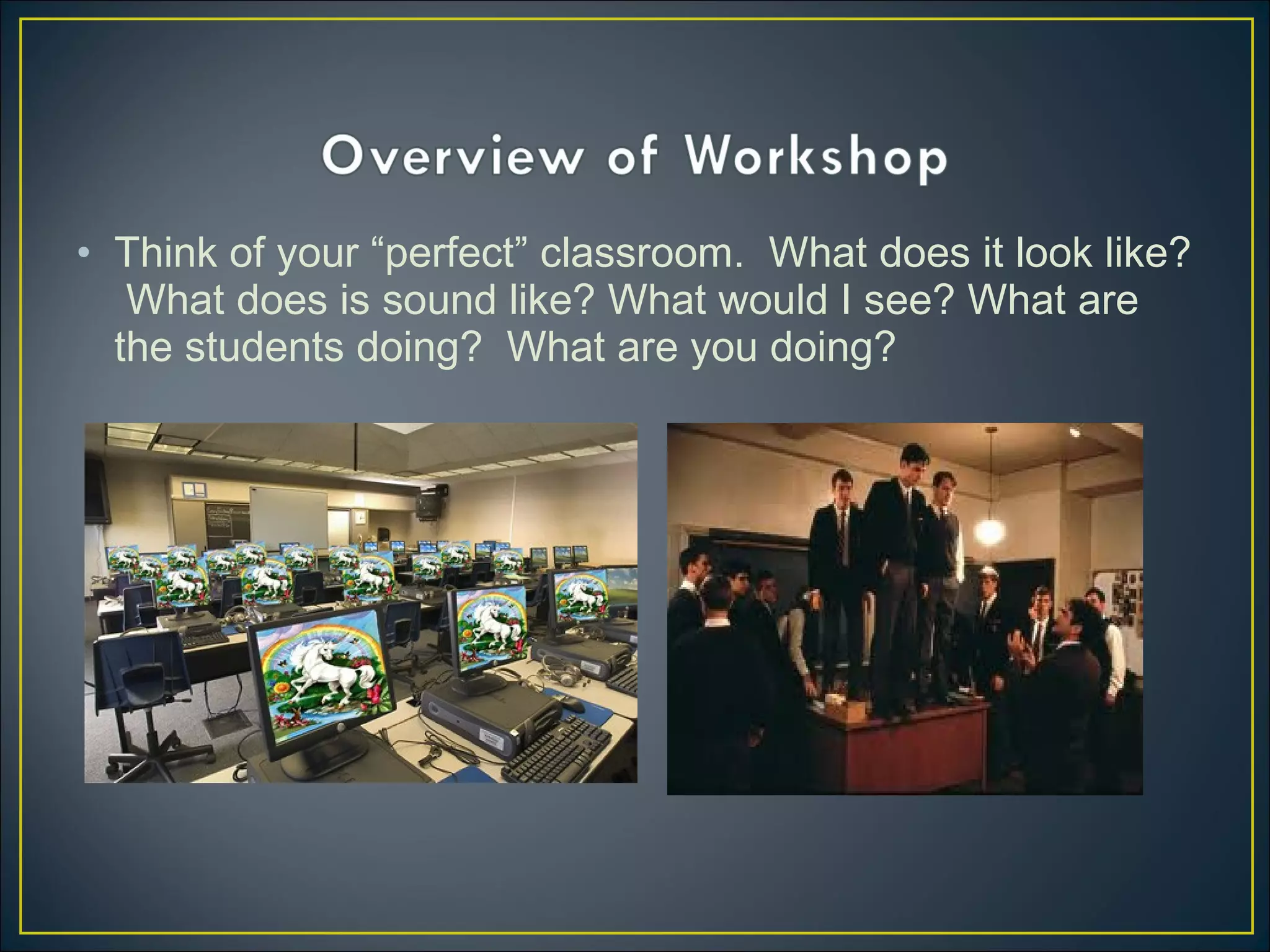
• Think of your “perfect” classroom. What does it look like?
What does is sound like? What would I see? What are
the students doing? What are you doing?
• For the past 12 years Doug Lemov, author of Te ach Like
a Cham pio n has been standing in the back of hundreds
of classrooms, watching thousands of hours of teachers,
and analyzing their instruction with more enthusiasm and
attention to detail than anyone else in the history of
American education.
• He focused his research on low-income, successful
schools. He is the managing director of Uncommon
Schools (a network of 16 public schools serving low-
income, at-risk youth.)
• He has identified the tools that master teachers use to
make their classrooms into cathedrals of learning.
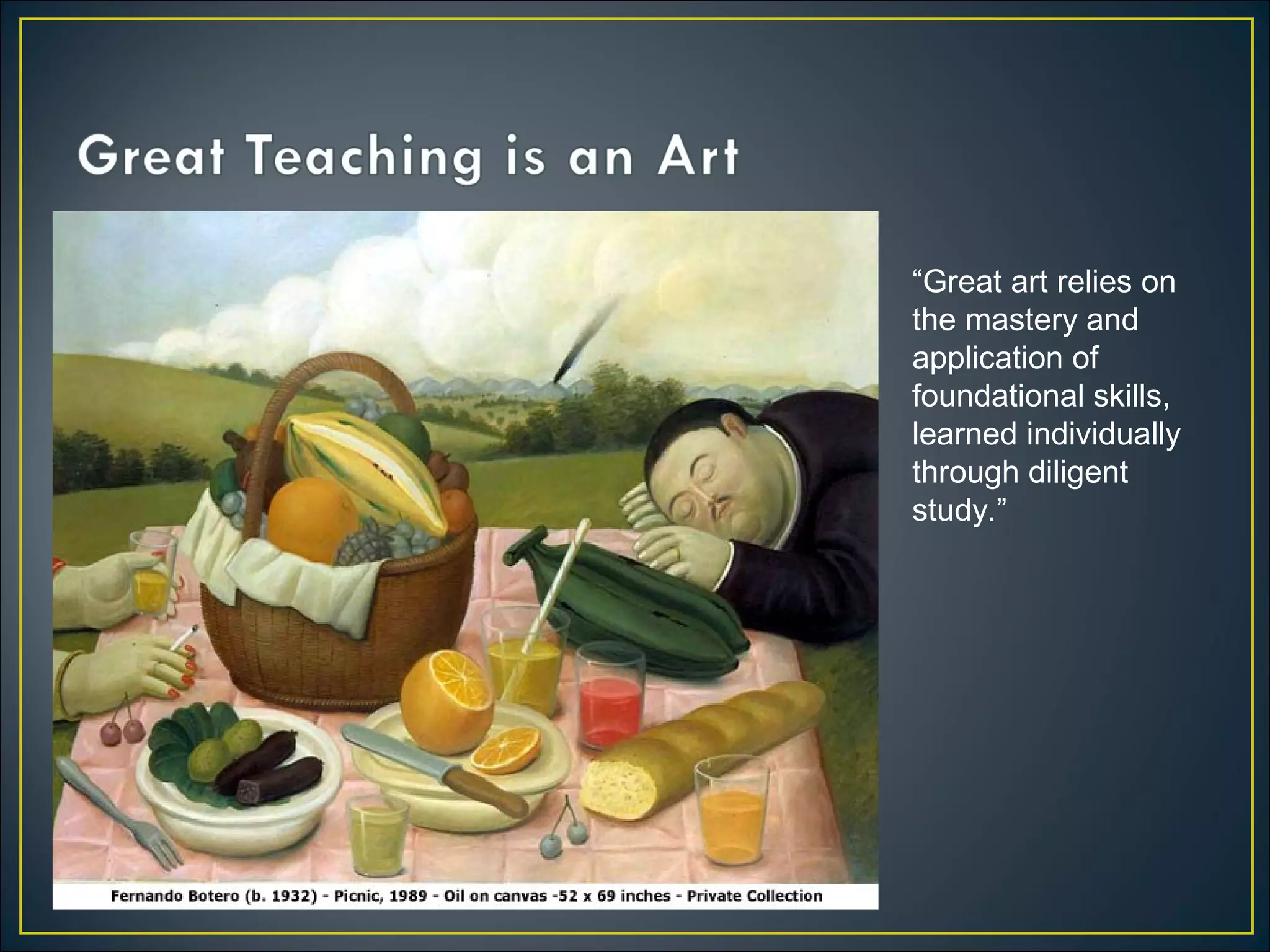
“Great art relies on
the mastery and
application of
foundational skills,
learned individually
through diligent
study.”
• As teachers we get a lot of advice about “what works”.
• The most helpful advice for me were concrete
techniques. Example: “When you want the students to
follow your directions, stand still. If you’re walking around
passing out papers, it looks like the directions are no
more important than all of the other things you’re doing.”
• The techniques that follow are things you say or do in a
particular way. Pick and choose the techniques that best
suits your teaching. Focus on what you already do well
and choose a technique that will refine your teaching to
make it exceptional. We all have weaknesses-don’t
focus on those!
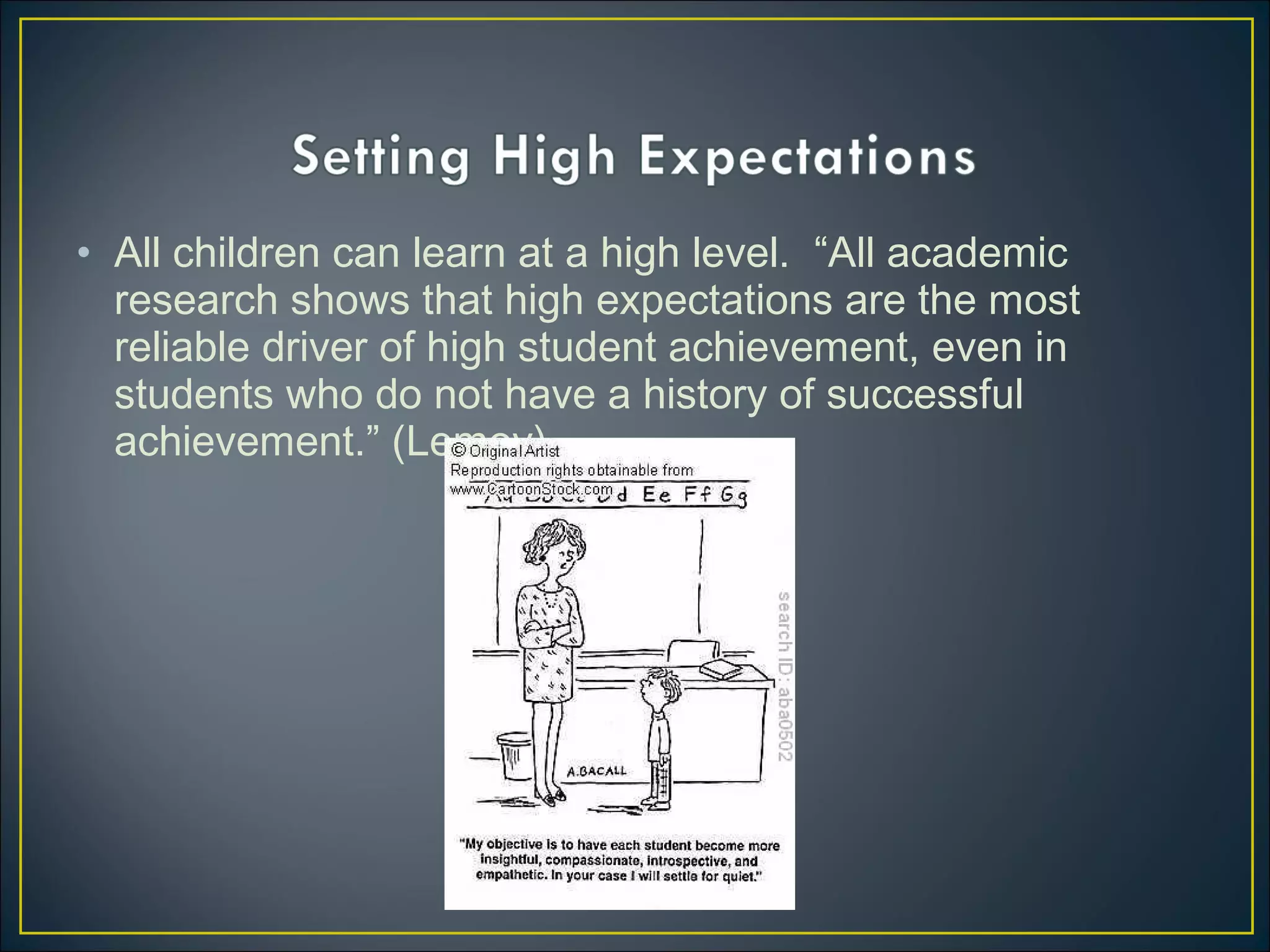
• All children can learn at a high level. “All academic
research shows that high expectations are the most
reliable driver of high student achievement, even in
students who do not have a history of successful
achievement.” (Lemov)
• Do not allow a student to say “I don’t know,” or shrug off
an answer.
NO OPT OUT- A sequence that begins with a student
unable to answer a question should end with the student
answering that question as often as possible.
Let’s watch it in action! (Video clip 1)
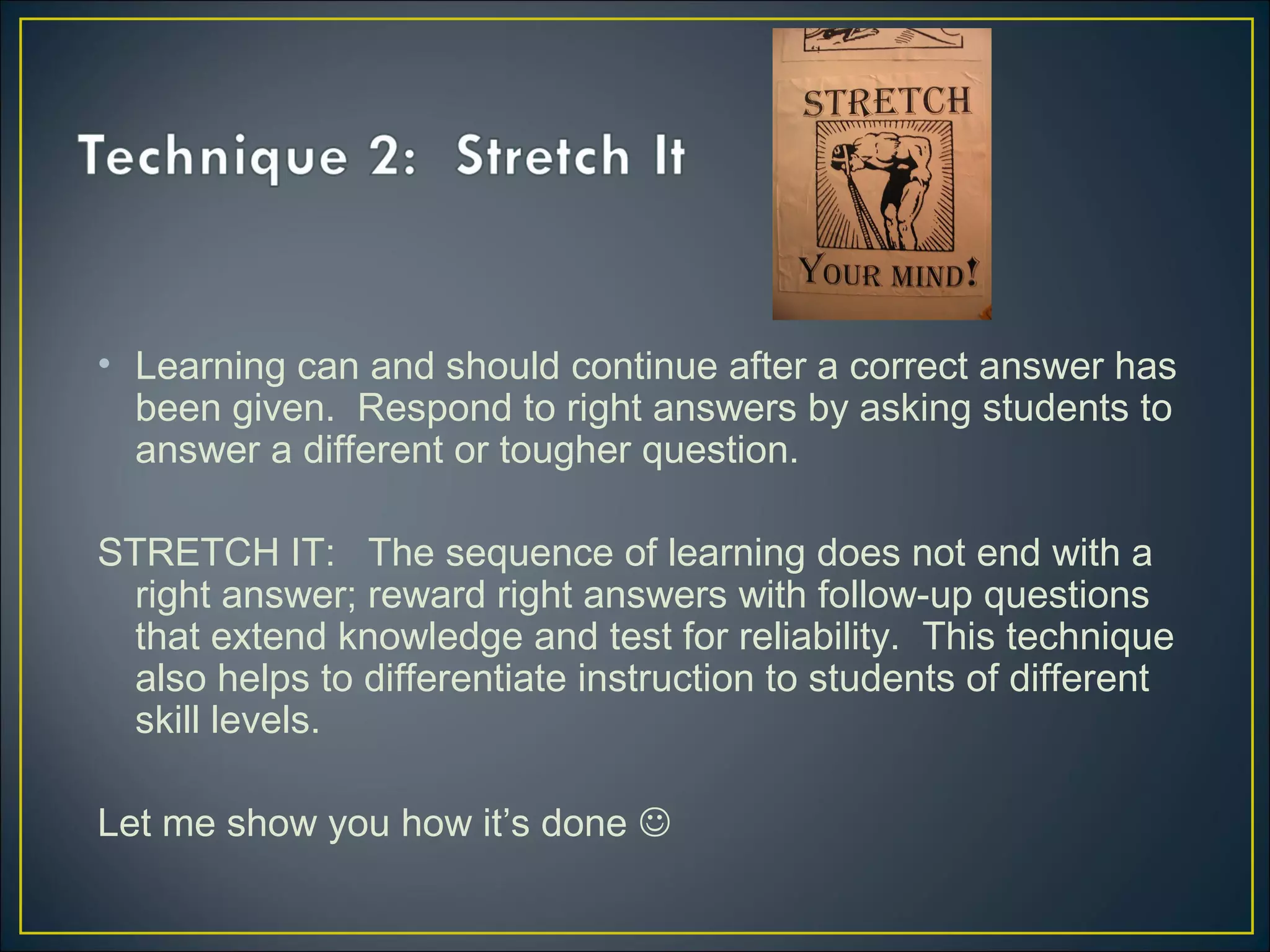
• Learning can and should continue after a correct answer has
been given. Respond to right answers by asking students to
answer a different or tougher question.
STRETCH IT: The sequence of learning does not end with a
right answer; reward right answers with follow-up questions
that extend knowledge and test for reliability. This technique
also helps to differentiate instruction to students of different
skill levels.
Let me show you how it’s done 
• It’s not just what students say that matters, but how they
communicate it. To succeed, students must take their
knowledge and express it in the language of opportunity.
The essays required to enter college (and every paper
written once there) demand complete sentences and
fluent syntax. Conversations with potential employers
require subject-verb agreement.
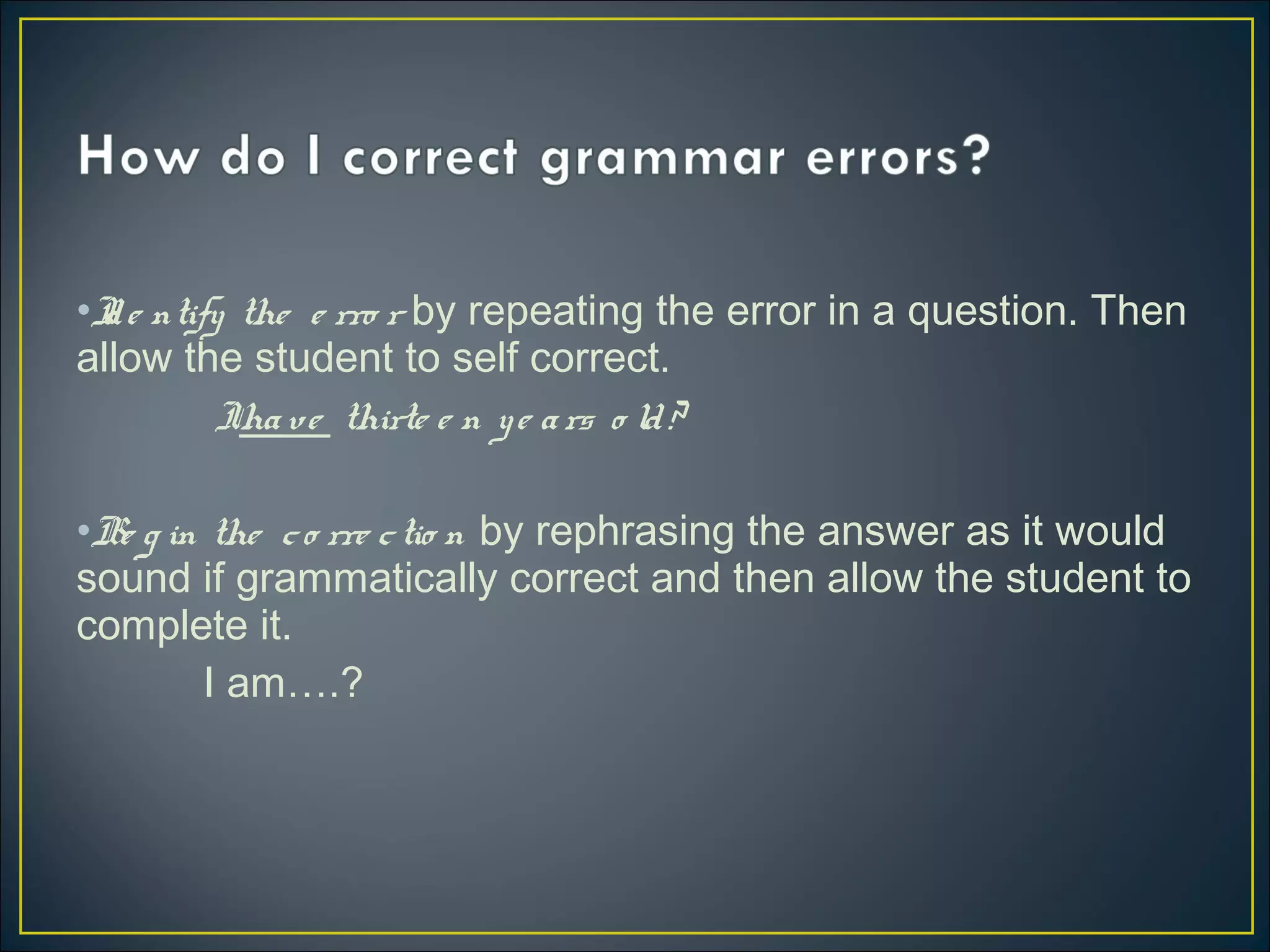
•Ide ntify the e rro r by repeating the error in a question. Then
allow the student to self correct.
Ihave thirte e n ye ars o ld?
•Be g in the co rre ctio n by rephrasing the answer as it would
sound if grammatically correct and then allow the student to
complete it.
I am….?
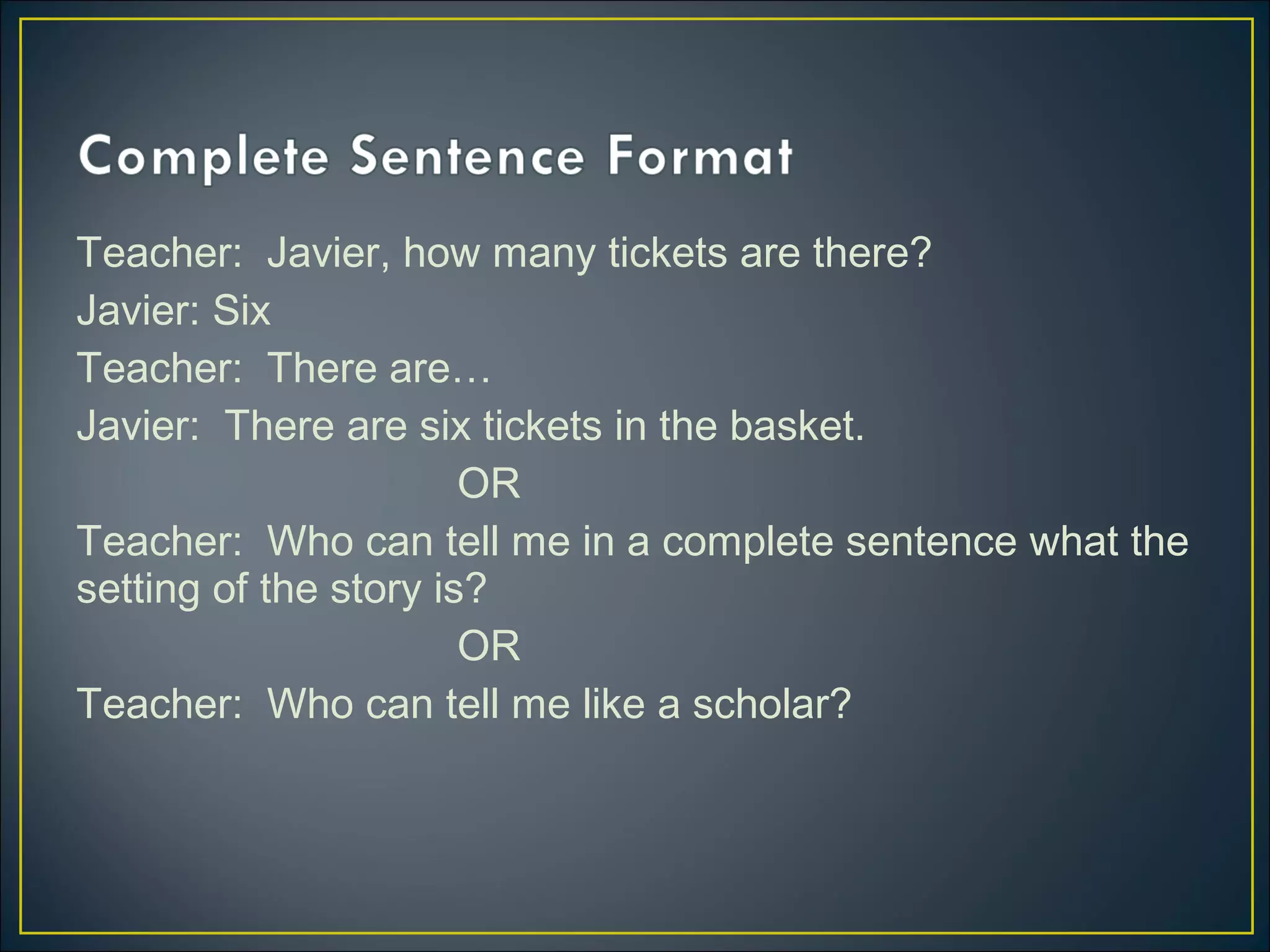
Teacher: Javier, how many tickets are there?
Javier: Six
Teacher: There are…
Javier: There are six tickets in the basket.
OR
Teacher: Who can tell me in a complete sentence what the
setting of the story is?
OR
Teacher: Who can tell me like a scholar?
• Which technique would you like to try tomorrow in your
lesson? (No Opt Out, Stretch It, or Format Matters)
Why? Turn to the person next to you and plan out how
you will use it.
• Great teachers engage students so that they feel like part
of the lesson. They make a habit of focused involvement
in the classroom. Students need to be engaged in the
WORK of the class not just the frills and exciting
moments. Easier said than done, right?
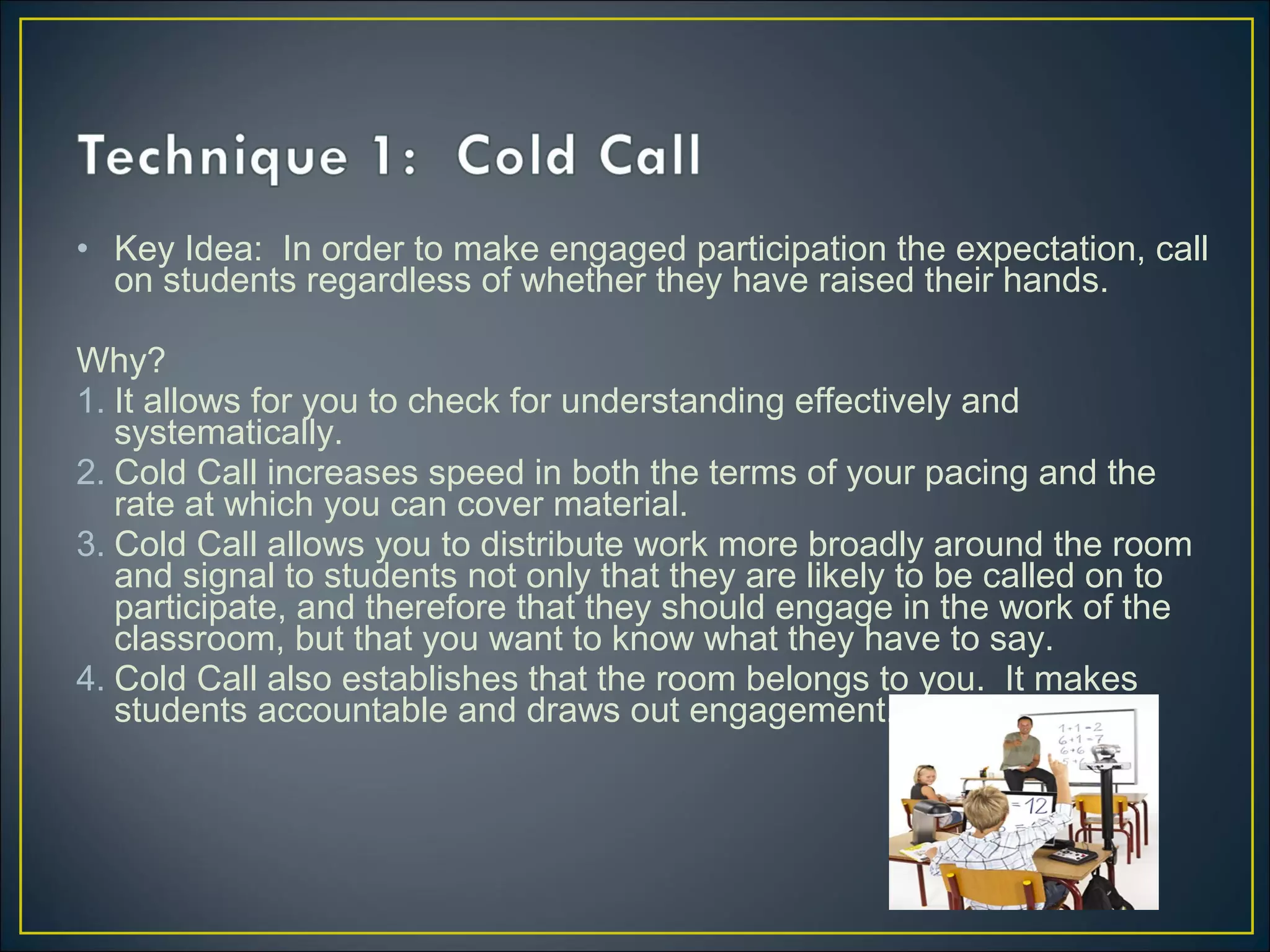
• Key Idea: In order to make engaged participation the expectation, call
on students regardless of whether they have raised their hands.
Why?
1. It allows for you to check for understanding effectively and
systematically.
2. Cold Call increases speed in both the terms of your pacing and the
rate at which you can cover material.
3. Cold Call allows you to distribute work more broadly around the room
and signal to students not only that they are likely to be called on to
participate, and therefore that they should engage in the work of the
classroom, but that you want to know what they have to say.
4. Cold Call also establishes that the room belongs to you. It makes
students accountable and draws out engagement.
Co ld Callis PREDICTABLE
Do not use this as a discipline strategy. (Don’t call on the
student that is already off-task) Instead ,cold call for a few
minutes of your class almost every day, students will come
to expect it and change their behavior in advance; they will
prepare to be asked questions at any time by paying
attention and readying themselves mentally. Best time to
do this is at the beginning of class.
Leave emotions out of it! The less it seems tied to what a
student has or has not done the better.
Keep a chart of who you called on.
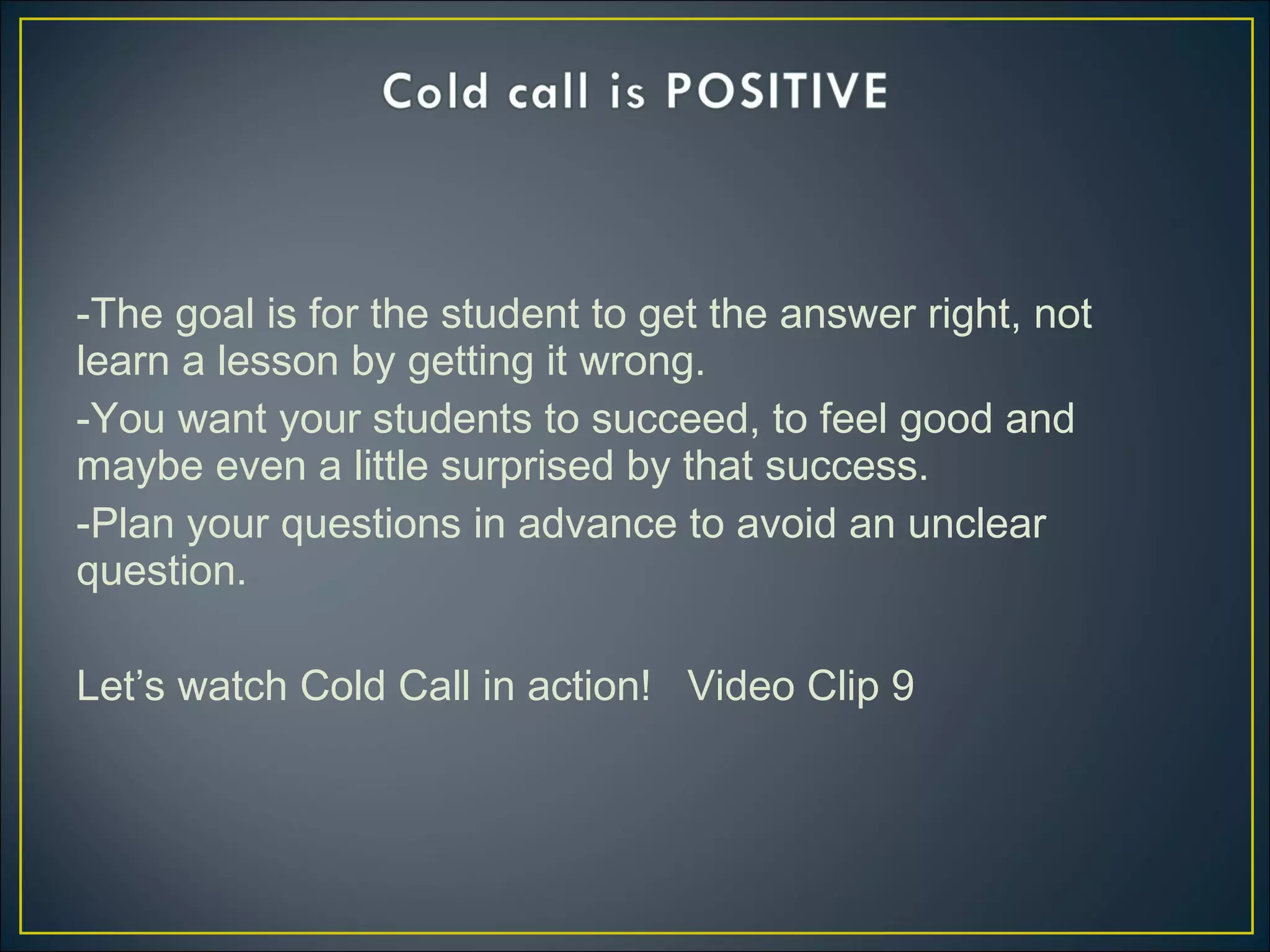
Use popsicle sticks with written student names to show the
randomness of who you are calling on.
-The goal is for the student to get the answer right, not
learn a lesson by getting it wrong.
-You want your students to succeed, to feel good and
maybe even a little surprised by that success.
-Plan your questions in advance to avoid an unclear
question.
Let’s watch Cold Call in action! Video Clip 9
• Key Idea: Use group choral response- you ask; they
answer in unison- to build a culture of energetic, positive
engagement.
Let’s watch it first! Video Clip 9. As you watch think about
how Calland Re spo nse is an effective tool to engage
students.
• Academic Review and reinforcement: Everyone gets to
give an answer. When only an individual student gives a
strong answer, asking the rest of the class to repeat that
answer reinforces the importance of the answer.
• High-energy fun: Calland Re spo nse is energetic, active
and spirited. It feels like being part of a cheering crowd.
Students like this because they feel energized and want
to be there.
• Behavioral reinforcement: Students become compliant to
respond to a prompt, on cue, over and over again. This
reinforces the teacher’s authority and command.
1. Repeat
2. Report
3. Reinforce
4. Review
5. Solve
*** Make sure you have a signal (Class!, Everybody!,
Ready, set…One, two, ready you… or a finger point)
• Pepper- fast paced games to reinforce key ideas
- Pick sticks
-Head to Head
-Sit down
• Increase wait time after asking a question
• Everybody Writes
• Vegas
• Think about some questions you want to ask your
students. Choose one of the Engagement Strategies and
plan how you will use it in your lesson.
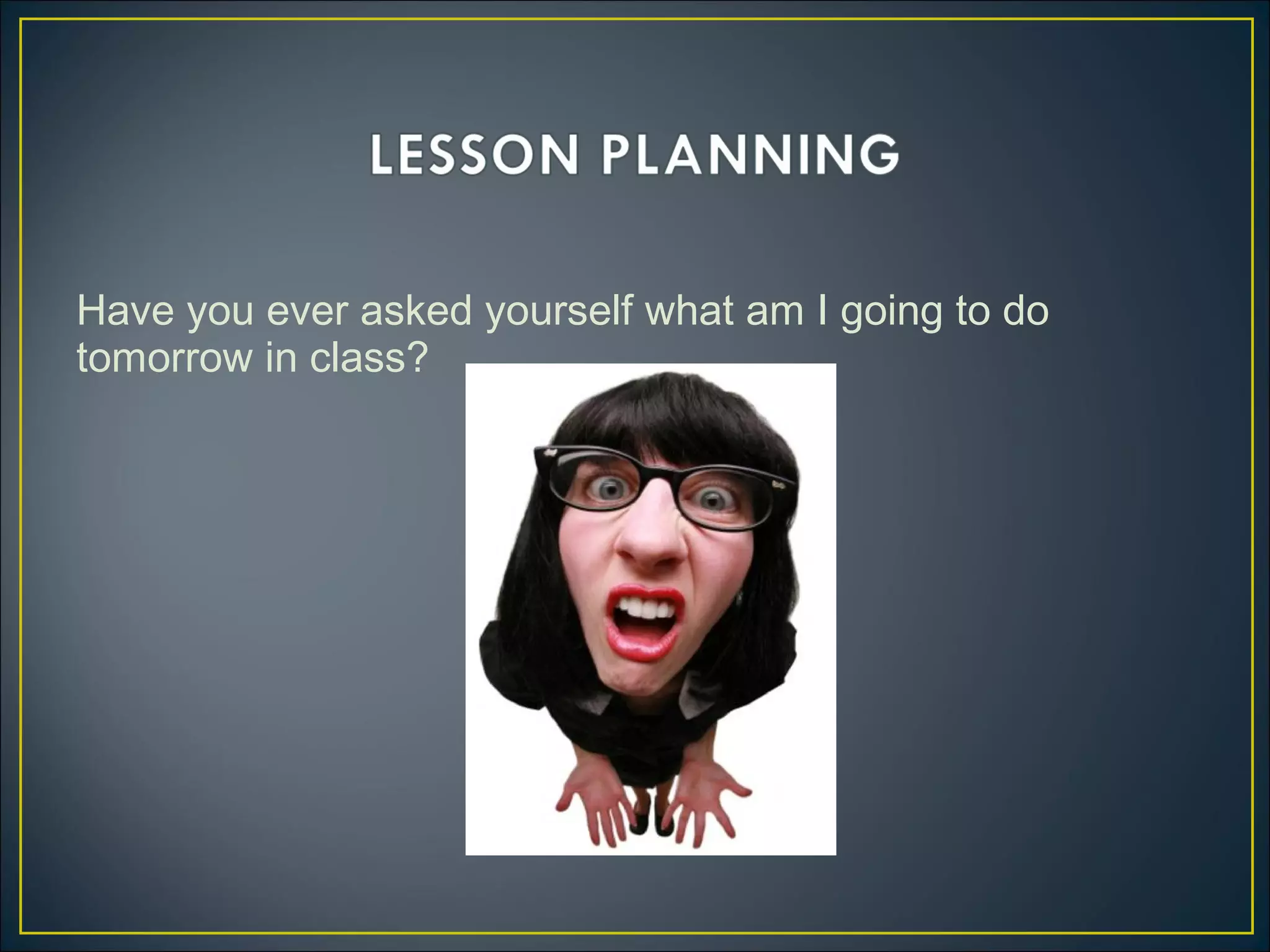
Have you ever asked yourself what am I going to do
tomorrow in class?
• BEGIN WITH THE END (The Objective)
Ask yourself a question that can be measured: “What do
I want my students to know or be able to do by the end of
the lesson / unit?”
-Why are you teaching the material you’re teaching?
-What’s the outcome you desire?
-How does this outcome relate to what you’ll teach
tomorrow and to what your students need to have
learned to be ready for the next grade?
• Unit planning means methodically asking how one day’s
lesson builds off the previous day’s, prepares for the next
day’s, and how these three fit into a larger sequence of
objectives that lead to mastery.
1.OBJECTIVE-Refining and perfecting the objective based
on the degree to which the objective the day before was
mastered.
2.ASSESSMENT-Planning a short daily assessment that
will effectively determine whether the objective was
mastered.
3.ACTIVITY-Planning the activity, or, more precisely, a
sequence of activities, that lead to mastery of the
objective.
• Manageable – something that can be taught in a single
lesson. Break a larger objective into smaller objectives.
• Measurable- you should be able to measure whether or
not your students have met the objective by the end of
class (a short activity, question, or set of questions that
students must complete and leave with you before
departing.
• Made First- designed to guide the activity not justify it.
• Most Important- focus on what’s most important (based
on your standards and what students need to succeed in
life)
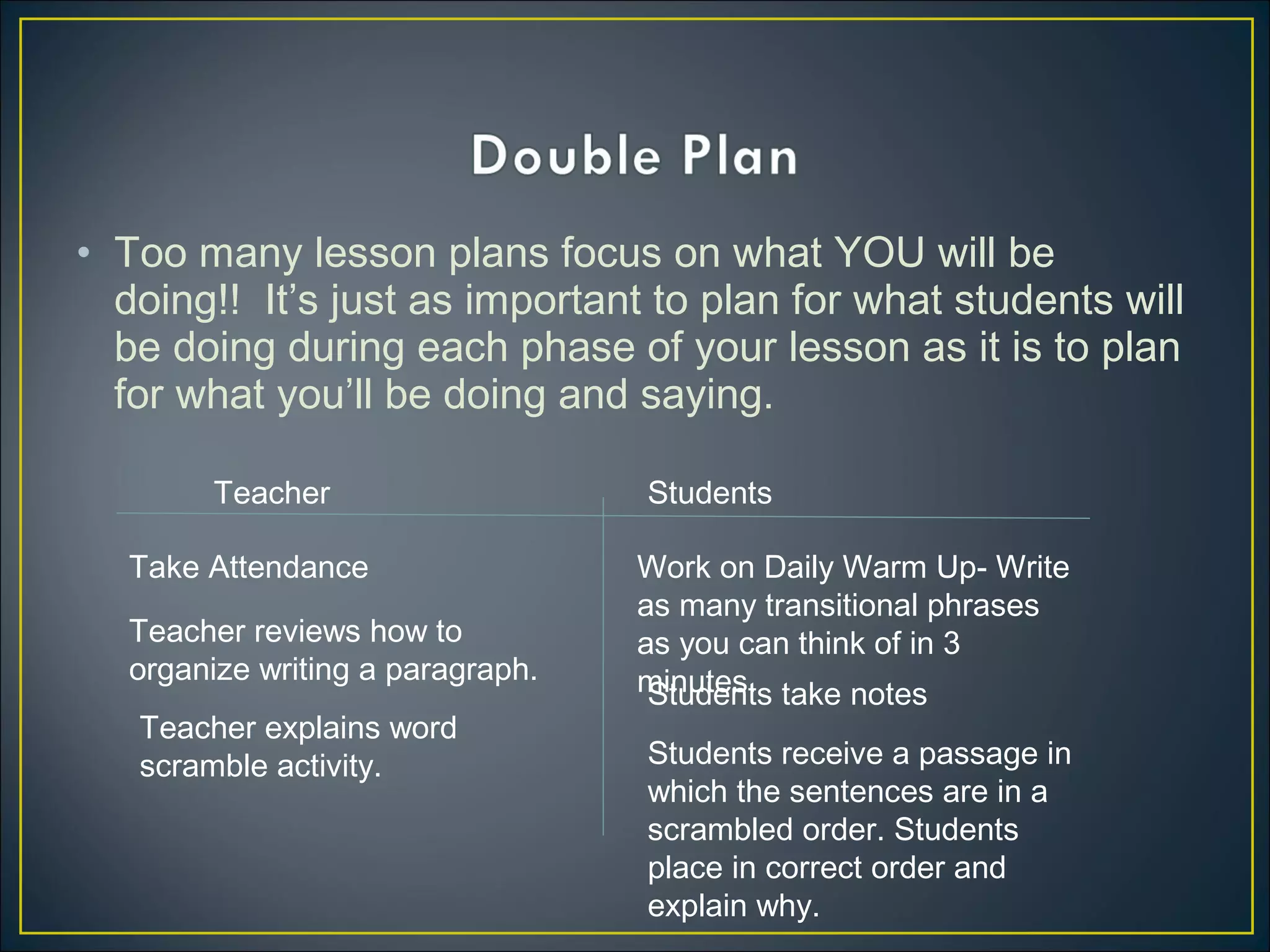
• Too many lesson plans focus on what YOU will be
doing!! It’s just as important to plan for what students will
be doing during each phase of your lesson as it is to plan
for what you’ll be doing and saying.
Teacher Students
Take Attendance Work on Daily Warm Up- Write
as many transitional phrases
as you can think of in 3
minutes.
Teacher reviews how to
organize writing a paragraph.
Students take notes
Teacher explains word
scramble activity. Students receive a passage in
which the sentences are in a
scrambled order. Students
place in correct order and
explain why.
• Think of a recent lesson you taught, and write out all of
the actions from a student’s perspective, starting in each
case with an action verb: “Listened to” and “Wrote” for
example. Now write what you did. How would you
change your lesson based on the lesson plan ideas
given?
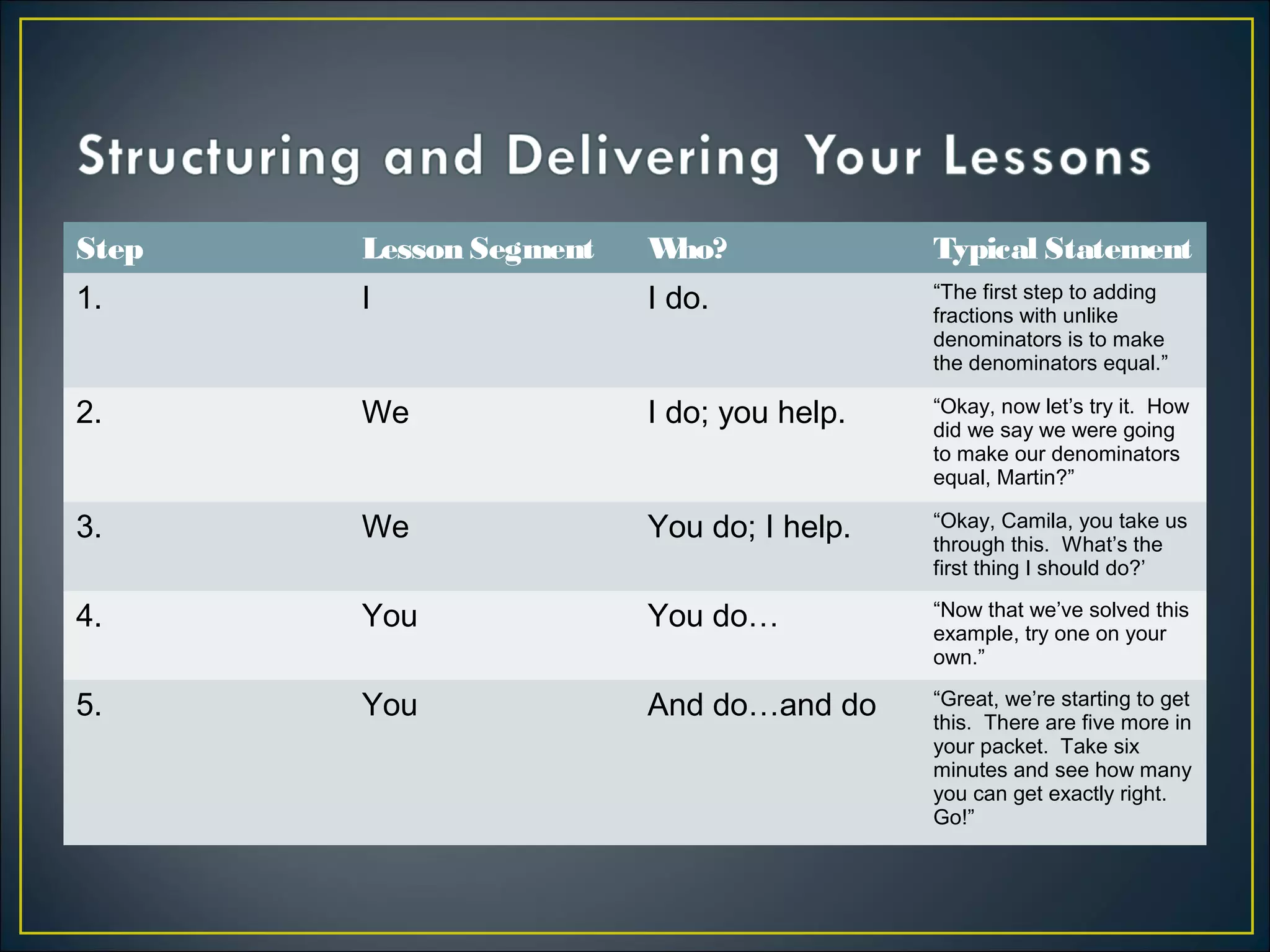
Step Lesson Segment Who? Typical Statement
1. I I do. “The first step to adding
fractions with unlike
denominators is to make
the denominators equal.”
2. We I do; you help. “Okay, now let’s try it. How
did we say we were going
to make our denominators
equal, Martin?”
3. We You do; I help. “Okay, Camila, you take us
through this. What’s the
first thing I should do?’
4. You You do… “Now that we’ve solved this
example, try one on your
own.”
5. You And do…and do “Great, we’re starting to get
this. There are five more in
your packet. Take six
minutes and see how many
you can get exactly right.
Go!”
• Choose a topic in your class that you will be teaching.
Create an I Do/ We Do/ You Do lesson structure. Bonus:
Design a 3-5 minute hook and an exit ticket.

Effective teaching that engages students (1)

  • 1.
    By: Carissa Zevallosand Yanilis Romero
  • 3.
    • Think ofyour “perfect” classroom. What does it look like? What does is sound like? What would I see? What are the students doing? What are you doing?
  • 4.
    • For thepast 12 years Doug Lemov, author of Te ach Like a Cham pio n has been standing in the back of hundreds of classrooms, watching thousands of hours of teachers, and analyzing their instruction with more enthusiasm and attention to detail than anyone else in the history of American education. • He focused his research on low-income, successful schools. He is the managing director of Uncommon Schools (a network of 16 public schools serving low- income, at-risk youth.) • He has identified the tools that master teachers use to make their classrooms into cathedrals of learning.
  • 5.
    “Great art relieson the mastery and application of foundational skills, learned individually through diligent study.”
  • 6.
    • As teacherswe get a lot of advice about “what works”. • The most helpful advice for me were concrete techniques. Example: “When you want the students to follow your directions, stand still. If you’re walking around passing out papers, it looks like the directions are no more important than all of the other things you’re doing.” • The techniques that follow are things you say or do in a particular way. Pick and choose the techniques that best suits your teaching. Focus on what you already do well and choose a technique that will refine your teaching to make it exceptional. We all have weaknesses-don’t focus on those!
  • 7.
    • All childrencan learn at a high level. “All academic research shows that high expectations are the most reliable driver of high student achievement, even in students who do not have a history of successful achievement.” (Lemov)
  • 8.
    • Do notallow a student to say “I don’t know,” or shrug off an answer. NO OPT OUT- A sequence that begins with a student unable to answer a question should end with the student answering that question as often as possible. Let’s watch it in action! (Video clip 1)
  • 9.
    • Learning canand should continue after a correct answer has been given. Respond to right answers by asking students to answer a different or tougher question. STRETCH IT: The sequence of learning does not end with a right answer; reward right answers with follow-up questions that extend knowledge and test for reliability. This technique also helps to differentiate instruction to students of different skill levels. Let me show you how it’s done 
  • 10.
    • It’s notjust what students say that matters, but how they communicate it. To succeed, students must take their knowledge and express it in the language of opportunity. The essays required to enter college (and every paper written once there) demand complete sentences and fluent syntax. Conversations with potential employers require subject-verb agreement.
  • 11.
    •Ide ntify thee rro r by repeating the error in a question. Then allow the student to self correct. Ihave thirte e n ye ars o ld? •Be g in the co rre ctio n by rephrasing the answer as it would sound if grammatically correct and then allow the student to complete it. I am….?
  • 12.
    Teacher: Javier, howmany tickets are there? Javier: Six Teacher: There are… Javier: There are six tickets in the basket. OR Teacher: Who can tell me in a complete sentence what the setting of the story is? OR Teacher: Who can tell me like a scholar?
  • 13.
    • Which techniquewould you like to try tomorrow in your lesson? (No Opt Out, Stretch It, or Format Matters) Why? Turn to the person next to you and plan out how you will use it.
  • 14.
    • Great teachersengage students so that they feel like part of the lesson. They make a habit of focused involvement in the classroom. Students need to be engaged in the WORK of the class not just the frills and exciting moments. Easier said than done, right?
  • 15.
    • Key Idea:In order to make engaged participation the expectation, call on students regardless of whether they have raised their hands. Why? 1. It allows for you to check for understanding effectively and systematically. 2. Cold Call increases speed in both the terms of your pacing and the rate at which you can cover material. 3. Cold Call allows you to distribute work more broadly around the room and signal to students not only that they are likely to be called on to participate, and therefore that they should engage in the work of the classroom, but that you want to know what they have to say. 4. Cold Call also establishes that the room belongs to you. It makes students accountable and draws out engagement.
  • 16.
    Co ld CallisPREDICTABLE Do not use this as a discipline strategy. (Don’t call on the student that is already off-task) Instead ,cold call for a few minutes of your class almost every day, students will come to expect it and change their behavior in advance; they will prepare to be asked questions at any time by paying attention and readying themselves mentally. Best time to do this is at the beginning of class.
  • 17.
    Leave emotions outof it! The less it seems tied to what a student has or has not done the better. Keep a chart of who you called on. Use popsicle sticks with written student names to show the randomness of who you are calling on.
  • 18.
    -The goal isfor the student to get the answer right, not learn a lesson by getting it wrong. -You want your students to succeed, to feel good and maybe even a little surprised by that success. -Plan your questions in advance to avoid an unclear question. Let’s watch Cold Call in action! Video Clip 9
  • 19.
    • Key Idea:Use group choral response- you ask; they answer in unison- to build a culture of energetic, positive engagement. Let’s watch it first! Video Clip 9. As you watch think about how Calland Re spo nse is an effective tool to engage students.
  • 20.
    • Academic Reviewand reinforcement: Everyone gets to give an answer. When only an individual student gives a strong answer, asking the rest of the class to repeat that answer reinforces the importance of the answer. • High-energy fun: Calland Re spo nse is energetic, active and spirited. It feels like being part of a cheering crowd. Students like this because they feel energized and want to be there. • Behavioral reinforcement: Students become compliant to respond to a prompt, on cue, over and over again. This reinforces the teacher’s authority and command.
  • 21.
    1. Repeat 2. Report 3.Reinforce 4. Review 5. Solve *** Make sure you have a signal (Class!, Everybody!, Ready, set…One, two, ready you… or a finger point)
  • 22.
    • Pepper- fastpaced games to reinforce key ideas - Pick sticks -Head to Head -Sit down • Increase wait time after asking a question • Everybody Writes • Vegas
  • 23.
    • Think aboutsome questions you want to ask your students. Choose one of the Engagement Strategies and plan how you will use it in your lesson.
  • 24.
    Have you everasked yourself what am I going to do tomorrow in class?
  • 26.
    • BEGIN WITHTHE END (The Objective) Ask yourself a question that can be measured: “What do I want my students to know or be able to do by the end of the lesson / unit?” -Why are you teaching the material you’re teaching? -What’s the outcome you desire? -How does this outcome relate to what you’ll teach tomorrow and to what your students need to have learned to be ready for the next grade?
  • 27.
    • Unit planningmeans methodically asking how one day’s lesson builds off the previous day’s, prepares for the next day’s, and how these three fit into a larger sequence of objectives that lead to mastery. 1.OBJECTIVE-Refining and perfecting the objective based on the degree to which the objective the day before was mastered. 2.ASSESSMENT-Planning a short daily assessment that will effectively determine whether the objective was mastered. 3.ACTIVITY-Planning the activity, or, more precisely, a sequence of activities, that lead to mastery of the objective.
  • 28.
    • Manageable –something that can be taught in a single lesson. Break a larger objective into smaller objectives. • Measurable- you should be able to measure whether or not your students have met the objective by the end of class (a short activity, question, or set of questions that students must complete and leave with you before departing. • Made First- designed to guide the activity not justify it. • Most Important- focus on what’s most important (based on your standards and what students need to succeed in life)
  • 29.
    • Too manylesson plans focus on what YOU will be doing!! It’s just as important to plan for what students will be doing during each phase of your lesson as it is to plan for what you’ll be doing and saying. Teacher Students Take Attendance Work on Daily Warm Up- Write as many transitional phrases as you can think of in 3 minutes. Teacher reviews how to organize writing a paragraph. Students take notes Teacher explains word scramble activity. Students receive a passage in which the sentences are in a scrambled order. Students place in correct order and explain why.
  • 30.
    • Think ofa recent lesson you taught, and write out all of the actions from a student’s perspective, starting in each case with an action verb: “Listened to” and “Wrote” for example. Now write what you did. How would you change your lesson based on the lesson plan ideas given?
  • 31.
    Step Lesson SegmentWho? Typical Statement 1. I I do. “The first step to adding fractions with unlike denominators is to make the denominators equal.” 2. We I do; you help. “Okay, now let’s try it. How did we say we were going to make our denominators equal, Martin?” 3. We You do; I help. “Okay, Camila, you take us through this. What’s the first thing I should do?’ 4. You You do… “Now that we’ve solved this example, try one on your own.” 5. You And do…and do “Great, we’re starting to get this. There are five more in your packet. Take six minutes and see how many you can get exactly right. Go!”
  • 32.
    • Choose atopic in your class that you will be teaching. Create an I Do/ We Do/ You Do lesson structure. Bonus: Design a 3-5 minute hook and an exit ticket.

Editor's Notes

  • #4 Ask them to write down or talk to a partner about ur ideal clasrrom…
  • #5 Show book
  • #6 Ask teachers how an artist is similar to a teacher?
  • #10 Who can use stride in a sentence? Can you add some more detail to show what stride means? Can you add an adjective to the sentence to modify _____. Good now can you add a compound subject to your sentence? Can you put that in past tense?
  • #16 No more “I’m seeing the same four hands” “Doesn’t anyone else know the answer?” Some students don’t raise their hands or answer unless you push or ask.
  • #23 Demonstrate Pepper with group of teachers---they stand and I ask part of speech questions or como se dice en ingles Wait time: “I’d like to see at least 15 hands before we hear an answer.” “I’m seeing people thinking deeply and jotting down thoughts. I’ll give everyone a few more seconds to do that.” “I’ll start taking answers in 10 seconds.” Everybody Writes: Ask a thought-provoking question—give students a chance to write their answers first then cold call. Example: What makes a great leader? Vegas: Production—add dramatic tones, Like a faucet –oooh ahhhh, (has to be short, everyone participates and on point)
  • #28 Example of a unit plan
  • #32 Photocopy of chapter with further explanation will be handed out.