


Using study periods
effectively
http://headof6thform.blogspot.co.uk
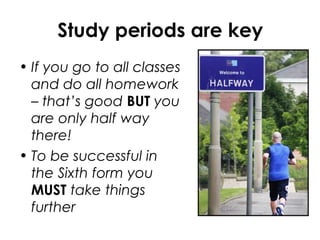
Study periods are key
• If you go to all classes
and do all homework
– that’s good BUT you
are only half way
there!
• To be successful in
the Sixth form you
MUST take things
further
Only the start!
Taught lessons are only the starting point.
You have to take responsibility yourself to
build upon these lessons if you are to be
successful
How?
So how can you make sure that you use
your study periods effectively to increase
your chances of success at exam time?
Rewrite it
• Go through your work from previous
lessons and re-write them
• Use colour to highlight key points
• Use pictures and cartoons to help you
remember important information
Summarise
• Go over the work you
have done in previous
lessons and pick out
the key points
• Bullet point your work
• Pick out key elements
and put in different
coloured boxes to
organise them
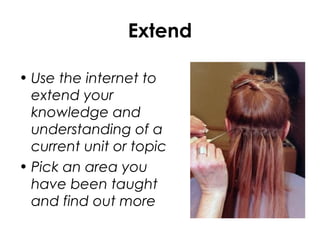
Extend
• Use the internet to
extend your
knowledge and
understanding of a
current unit or topic
• Pick an area you
have been taught
and find out more
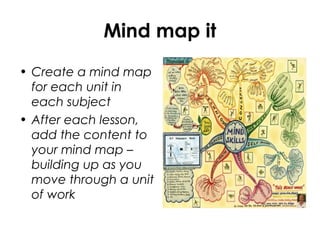
Mind map it
• Create a mind map
for each unit in
each subject
• After each lesson,
add the content to
your mind map –
building up as you
move through a unit
of work
Revision partnership
• Form a revision
partnership or revision
team with others in a
subject
• Create questions for
each other to answer
using lesson notes
• Swap and test each
other after each
lesson
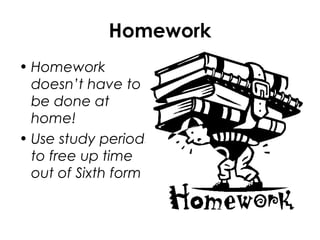
Homework
• Homework
doesn’t have to
be done at
home!
• Use study periods
to free up time
out of Sixth form
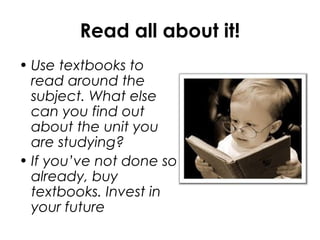
Read all about it!
• Use textbooks to
read around the
subject. What else
can you find out
about the unit you
are studying?
• If you’ve not done so
already, buy
textbooks. Invest in
your future
Revision websites
• Use revision websites to cement your
knowledge and understanding as you go.
Examples:
• http://s-cool.co.uk
• http://revisionworld.co.uk/a2-level-level-revision
• http://getrevising.co.uk/resources/level/a_ib
• http://abbeyfieldhumanities.blogspot.com
• Search online: ‘A level revision website’
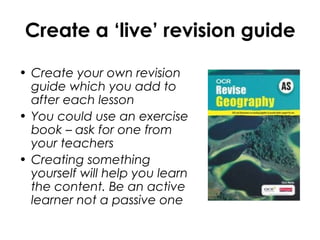
Create a ‘live’ revision guide
• Create your own revision
guide which you add to
after each lesson
• You could use an exercise
book – ask for one from
your teachers
• Creating something
yourself will help you learn
the content. Be an active
learner not a passive one
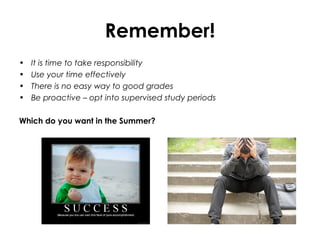
Remember!
• It is time to take responsibility
• Use your time effectively
• There is no easy way to good grades
• Be proactive – opt into supervised study periods
Which do you want in the Summer?

Using study periods

  • 1.
  • 2.
    Study periods arekey • If you go to all classes and do all homework – that’s good BUT you are only half way there! • To be successful in the Sixth form you MUST take things further
  • 3.
    Only the start! Taughtlessons are only the starting point. You have to take responsibility yourself to build upon these lessons if you are to be successful
  • 4.
    How? So how canyou make sure that you use your study periods effectively to increase your chances of success at exam time?
  • 5.
    Rewrite it • Gothrough your work from previous lessons and re-write them • Use colour to highlight key points • Use pictures and cartoons to help you remember important information
  • 6.
    Summarise • Go overthe work you have done in previous lessons and pick out the key points • Bullet point your work • Pick out key elements and put in different coloured boxes to organise them
  • 7.
    Extend • Use theinternet to extend your knowledge and understanding of a current unit or topic • Pick an area you have been taught and find out more
  • 8.
    Mind map it •Create a mind map for each unit in each subject • After each lesson, add the content to your mind map – building up as you move through a unit of work
  • 9.
    Revision partnership • Forma revision partnership or revision team with others in a subject • Create questions for each other to answer using lesson notes • Swap and test each other after each lesson
  • 10.
    Homework • Homework doesn’t haveto be done at home! • Use study periods to free up time out of Sixth form
  • 11.
    Read all aboutit! • Use textbooks to read around the subject. What else can you find out about the unit you are studying? • If you’ve not done so already, buy textbooks. Invest in your future
  • 12.
    Revision websites • Userevision websites to cement your knowledge and understanding as you go. Examples: • http://s-cool.co.uk • http://revisionworld.co.uk/a2-level-level-revision • http://getrevising.co.uk/resources/level/a_ib • http://abbeyfieldhumanities.blogspot.com • Search online: ‘A level revision website’
  • 13.
    Create a ‘live’revision guide • Create your own revision guide which you add to after each lesson • You could use an exercise book – ask for one from your teachers • Creating something yourself will help you learn the content. Be an active learner not a passive one
  • 14.
    Remember! • It istime to take responsibility • Use your time effectively • There is no easy way to good grades • Be proactive – opt into supervised study periods Which do you want in the Summer?