RVHS Twilight
We will cover two topics in this twilight:
1. Staff wellbeing
2. Effective feedback
Please sit on a table which does not contain a member of your
faculty!
Staff Wellbeing
2017-18
Survey
Results
Areas for improvement which can be addressed:
• Communications
• Admin
• Data
• Workload / marking /prep
• Number of non-contacts
• Staff room not used positively enough
• Lack of breaks
• Amount of additional weekly hours
• Meetings
• External changes
Staff skills
It would be nice to have a small wellbeing team so if
anyone has particular skills or talents that they think
would benefit colleagues please email me - eg
counselling / financial expertise / Reiki / Art clubs /
Staff choir / Book club / Staff forum / Classroom
management / Quick family meal ideas!! etc etc - it
would be great to have a mixture of teaching and
non-teaching staff involved….
If you don’t feel that you have the time but have ideas
please put them in the staff suggestions box in the
staffroom….
1. Early finish / Late start Open Evening / School Closure 24/11/17
2. Suggestion box in the staff room / TEACHERS Time-Savers file G.DRIVE
shared
3. Take some responsibility for our own well-being - without feeling guilty!
4. Ensure sure that in all the time spent marking, that the feedback is useful
5. Ask for CPD and training that is relevant and useful to you
6. Use school policies designed to support us
7. Keep our aspirations and expectations high
8. Leaders to include wellbeing in meeting agendas - share ideas and feedback
9. Remember that this IS STILL a respected, vocational career!
Staff governors - Chrys Perera / David Tisdale
Union representatives - Chrys Perera NASUWT /
Shari Wilson NUT/ATL
Social Club - Chrys Perera et al
Moving Forwards
….We need to make suggestions and put things in
place to help support our wellbeing - however,
this needs to be a collective and sustained
effort, also to not feel as if it’s another chore!
Please use opportunities offered to voice your
ideas.
Your participation in whatever form it takes is
much appreciated.
Feedback, marking and progress
Q. What are our expectations for feedback and marking?
Some of our expectations on feedback:-
• Be predominately encouraging and constructive
• Challenge the students to think for themselves
• Create opportunities for student dialogue
Some of our expectations on marking:-
• Marking should be diagnostic in nature and provide opportunities
for the student to understand the process required to improve
• Must be regular, kept up-to-date, and promptly returned to
students
• Marking can be carried out in the forms of: teacher marking,
teacher oral feedback, self marking and peer marking. Peer and
self marking should be written in green pen
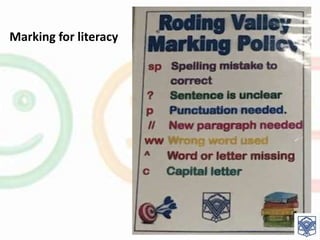
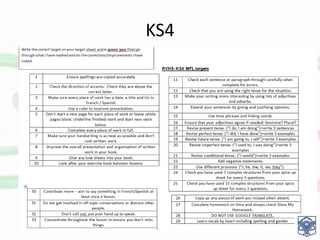
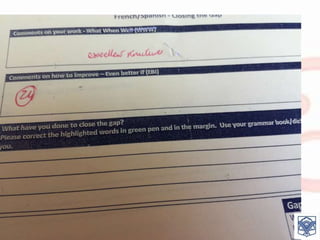
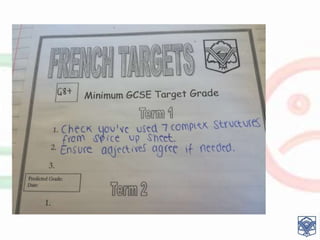
Marking for literacy
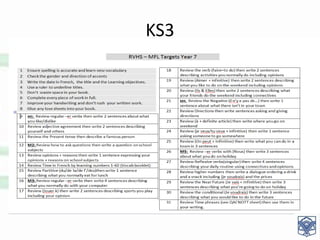
KS3
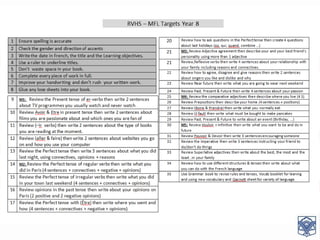
KS4
Effective Feedback
Why is feedback important?
Who is it important to? Why?
What will they do with it?
Giving students feedback in the classroom during
the learning process has been proven to increase
learning and improve student outcomes. When
given correctly, feedback guides the student in their
learning process and gives them the direction they
need to reach the target or goal of the
lesson. Feedback sends a message to the student
that you care about the learning taking place. It
also allows the student to become more engaged
and involved in the classroom.
But how do we achieve this?
• Timing.
Our timing has to be spot on! There is no point
in giving feedback for a piece of work that the
student has forgotten about because they did it
weeks ago!
Students need to receive the feedback so there
is still time for them to use it towards the target
goal
• Feedback should correct major issues and
misconceptions.
• Feedback should provide students a guide on where
to go next and what to focus on.
• Teachers must realise that 100% mastery of the
subject matter is not realistic for most.
• It is critical that students are not overwhelmed by
feedback that tries to correct everything so
prioritisation by the teacher is important.
• Examples - select two or three points in a paper to
comment on and be sure to comment on strengths as
well as weaknesses
Think about this!
• How much time do we spend on the planning
and delivery of a ‘good’ starter?
• How much time do we spend on the plenary?
• Can we rank them in order of importance?
• Which one is more important for you?
Closing the Gap
• We all use it!
• How effective is it?
• We do it for assessments but why cant we
close a gap in every lesson?
• Most of the time, it is because we do not give
ourselves enough time to close a gap in the
lesson.
• Maybe a 10 minute plenary is not enough!!
Ask yourself this
• When students are feeding back what their
partner has done, are you happy with the
response?
• If you're not happy, why would the student
whose work has been marked be happy?
• What do we do with the EBI?
• Work on it in another lesson? That might be
too late!
For example
• WWW: Quite good, good understanding
• EBI: Need to write more
• WHERE DO I GO WITH THIS???
Effective feedback
• There has to be a clear success criteria. If you use an exam
marking criteria, it might be too wordy! Break it down so that the
student understands what it is asking them to do.
• Model a good and bad response.
• Demand silence during marking because it requires concentration.
• Interrogate the assessor. Ask them to give their partner an
example of a piece of work that they need to work on.
• Train the students to feedback around the marking criteria.
• Plan your lesson so that there is enough time for the students to
effectively feedback to one another. Reflect on what they need to
do to make it better and then allow them to rectify or improve
their work. Then get them to share their work with the class so
that they feel as though they have reflected, learned from, and
closed the gap in their knowledge.
What not to do!
Feedback on language analysis
• WWW: good understanding and lots of
quotes.
• EBI: Use more descriptive words and make it
longer.
What to do
AO2 Selecting words and phrases and
explaining their effects
• WWW: Your AO1 is strong. You have understood
the character and why the audience are not
supposed to like him. You have also selected
appropriate quotes to support your answer.
• EBI: Your AO2 is not as secure. Although you
have selected words and phrases, you have not
identified the technique or explained the effect
it is supposed to have on the audience.
• Look at the verb ‘scanned’ and explain why the
writer chose that word.
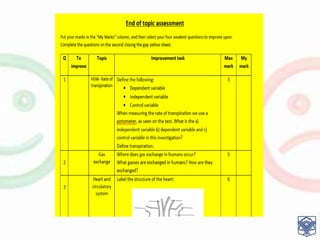
End of topic CTG
• Students complete topic
• Complete end of topic test
• Test is marked
• CTG completed
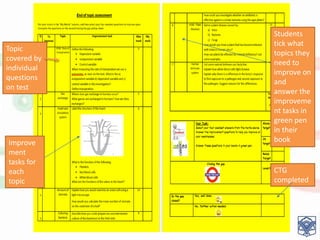
Topic
covered by
individual
questions
on test
Improve
ment
tasks for
each
topic
Students
tick what
topics they
need to
improve on
and
answer the
improveme
nt tasks in
green pen
in their
book
CTG
completed
6 mark CTG
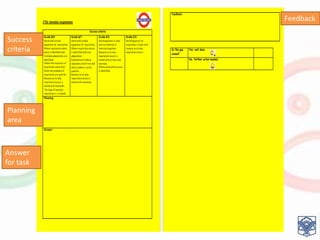
Success
criteria
Planning
area
Answer
for task
Feedback
Personalised learning
Choose your own learning journey for
this lesson
Level 4
What is your target
grade?
Level 5
Level 6
Complete
section 1
of
booklet
Complete
section 2
of
booklet
Complete
section 3
of
booklet
When you’ve
finished, find a
friend who has
finished too and
compare
questions
SAFETY NET
• Friends
• Exercise books
• Revision pages at side of
room
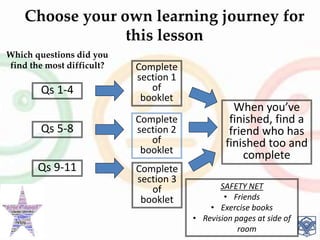
Choose your own learning journey for
this lesson
Qs 1-4
Which questions did you
find the most difficult?
Qs 5-8
Qs 9-11
Complete
section 1
of
booklet
Complete
section 2
of
booklet
Complete
section 3
of
booklet
When you’ve
finished, find a
friend who has
finished too and
complete
SAFETY NET
• Friends
• Exercise books
• Revision pages at side of
room
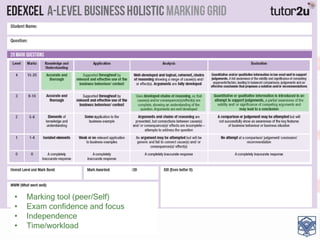
Marking rubrics/grids
• Marking tool (peer/Self)
• Exam confidence and focus
• Independence
• Time/workload
AS/A level marking
One way of doing it
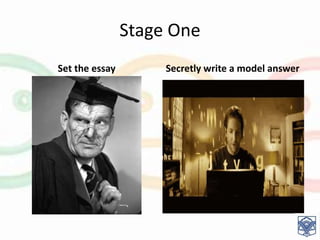
Stage One
Set the essay Secretly write a model answer
Stage Two
Mark the essays thoroughly on a separate
sheet but don’t return it yet but do give them
their essays back
Give them the model answer and get them to
highlight what they did not include and what
they did include
Stage Three
Now let them use the mark scheme to
mark each others work. You could do
this twice at first. Tell them not to be
harsh or lenient.
Now ask them what they think
they got as a grade
Stage Four
Tell them what they actually got by
giving them back the separate mark
sheet you spent ages doing
Tell them that this always happens at
first. It isn’t easy but you can do it if you
are prepared to work
Repeat the process with less and less
Next time you could give them a mark
scheme without such exhaustive feedback
(with or without a model answer) and
hopefully they will improve.
In other words, gradually remove the support
each time depending on what you feel is
best. They should get better and better.
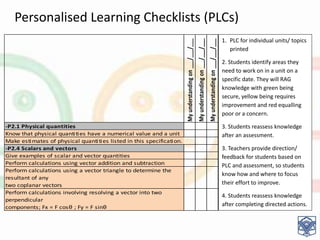
Personalised Learning Checklists (PLCs)
Myunderstandingon___/___/___
-P2.1 Physical quantities
Know that physical quantities have a numerical value and a unit
Make estimates of physical quantities listed in this specification.
-P2.4 Scalars and vectors
Give examples of scalar and vector quantities
Perform calculations using vector addition and subtraction
Perform calculations using a vector triangle to determine the
resultant of any
two coplanar vectors
Perform calculations involving resolving a vector into two
perpendicular
components; Fx = F cosθ ; Fy = F sinθ
1. PLC for individual units/ topics
printed
2. Students identify areas they
need to work on in a unit on a
specific date. They will RAG
knowledge with green being
secure, yellow being requires
improvement and red equalling
poor or a concern.
3. Students reassess knowledge
after an assessment.
3. Teachers provide direction/
feedback for students based on
PLC and assessment, so students
know how and where to focus
their effort to improve.
4. Students reassess knowledge
after completing directed actions.
Effective feedback and staff well-being twilight

Effective feedback and staff well-being twilight

  • 1.
    RVHS Twilight We willcover two topics in this twilight: 1. Staff wellbeing 2. Effective feedback Please sit on a table which does not contain a member of your faculty!
  • 2.
  • 4.
    Survey Results Areas for improvementwhich can be addressed: • Communications • Admin • Data • Workload / marking /prep • Number of non-contacts • Staff room not used positively enough • Lack of breaks • Amount of additional weekly hours • Meetings • External changes
  • 5.
    Staff skills It wouldbe nice to have a small wellbeing team so if anyone has particular skills or talents that they think would benefit colleagues please email me - eg counselling / financial expertise / Reiki / Art clubs / Staff choir / Book club / Staff forum / Classroom management / Quick family meal ideas!! etc etc - it would be great to have a mixture of teaching and non-teaching staff involved…. If you don’t feel that you have the time but have ideas please put them in the staff suggestions box in the staffroom….
  • 6.
    1. Early finish/ Late start Open Evening / School Closure 24/11/17 2. Suggestion box in the staff room / TEACHERS Time-Savers file G.DRIVE shared 3. Take some responsibility for our own well-being - without feeling guilty! 4. Ensure sure that in all the time spent marking, that the feedback is useful 5. Ask for CPD and training that is relevant and useful to you 6. Use school policies designed to support us 7. Keep our aspirations and expectations high 8. Leaders to include wellbeing in meeting agendas - share ideas and feedback 9. Remember that this IS STILL a respected, vocational career!
  • 7.
    Staff governors -Chrys Perera / David Tisdale Union representatives - Chrys Perera NASUWT / Shari Wilson NUT/ATL Social Club - Chrys Perera et al
  • 8.
    Moving Forwards ….We needto make suggestions and put things in place to help support our wellbeing - however, this needs to be a collective and sustained effort, also to not feel as if it’s another chore! Please use opportunities offered to voice your ideas. Your participation in whatever form it takes is much appreciated.
  • 9.
    Feedback, marking andprogress Q. What are our expectations for feedback and marking? Some of our expectations on feedback:- • Be predominately encouraging and constructive • Challenge the students to think for themselves • Create opportunities for student dialogue Some of our expectations on marking:- • Marking should be diagnostic in nature and provide opportunities for the student to understand the process required to improve • Must be regular, kept up-to-date, and promptly returned to students • Marking can be carried out in the forms of: teacher marking, teacher oral feedback, self marking and peer marking. Peer and self marking should be written in green pen
  • 10.
  • 11.
  • 13.
  • 16.
    Effective Feedback Why isfeedback important? Who is it important to? Why? What will they do with it?
  • 17.
    Giving students feedbackin the classroom during the learning process has been proven to increase learning and improve student outcomes. When given correctly, feedback guides the student in their learning process and gives them the direction they need to reach the target or goal of the lesson. Feedback sends a message to the student that you care about the learning taking place. It also allows the student to become more engaged and involved in the classroom.
  • 18.
    But how dowe achieve this? • Timing. Our timing has to be spot on! There is no point in giving feedback for a piece of work that the student has forgotten about because they did it weeks ago! Students need to receive the feedback so there is still time for them to use it towards the target goal
  • 19.
    • Feedback shouldcorrect major issues and misconceptions. • Feedback should provide students a guide on where to go next and what to focus on. • Teachers must realise that 100% mastery of the subject matter is not realistic for most. • It is critical that students are not overwhelmed by feedback that tries to correct everything so prioritisation by the teacher is important. • Examples - select two or three points in a paper to comment on and be sure to comment on strengths as well as weaknesses
  • 20.
    Think about this! •How much time do we spend on the planning and delivery of a ‘good’ starter? • How much time do we spend on the plenary? • Can we rank them in order of importance? • Which one is more important for you?
  • 21.
    Closing the Gap •We all use it! • How effective is it? • We do it for assessments but why cant we close a gap in every lesson? • Most of the time, it is because we do not give ourselves enough time to close a gap in the lesson. • Maybe a 10 minute plenary is not enough!!
  • 22.
    Ask yourself this •When students are feeding back what their partner has done, are you happy with the response? • If you're not happy, why would the student whose work has been marked be happy? • What do we do with the EBI? • Work on it in another lesson? That might be too late!
  • 23.
    For example • WWW:Quite good, good understanding • EBI: Need to write more • WHERE DO I GO WITH THIS???
  • 24.
    Effective feedback • Therehas to be a clear success criteria. If you use an exam marking criteria, it might be too wordy! Break it down so that the student understands what it is asking them to do. • Model a good and bad response. • Demand silence during marking because it requires concentration. • Interrogate the assessor. Ask them to give their partner an example of a piece of work that they need to work on. • Train the students to feedback around the marking criteria. • Plan your lesson so that there is enough time for the students to effectively feedback to one another. Reflect on what they need to do to make it better and then allow them to rectify or improve their work. Then get them to share their work with the class so that they feel as though they have reflected, learned from, and closed the gap in their knowledge.
  • 25.
    What not todo! Feedback on language analysis • WWW: good understanding and lots of quotes. • EBI: Use more descriptive words and make it longer.
  • 26.
    What to do AO2Selecting words and phrases and explaining their effects • WWW: Your AO1 is strong. You have understood the character and why the audience are not supposed to like him. You have also selected appropriate quotes to support your answer. • EBI: Your AO2 is not as secure. Although you have selected words and phrases, you have not identified the technique or explained the effect it is supposed to have on the audience. • Look at the verb ‘scanned’ and explain why the writer chose that word.
  • 27.
    End of topicCTG • Students complete topic • Complete end of topic test • Test is marked • CTG completed
  • 28.
    Topic covered by individual questions on test Improve ment tasksfor each topic Students tick what topics they need to improve on and answer the improveme nt tasks in green pen in their book CTG completed
  • 30.
  • 31.
  • 33.
  • 34.
    Choose your ownlearning journey for this lesson Level 4 What is your target grade? Level 5 Level 6 Complete section 1 of booklet Complete section 2 of booklet Complete section 3 of booklet When you’ve finished, find a friend who has finished too and compare questions SAFETY NET • Friends • Exercise books • Revision pages at side of room
  • 35.
    Choose your ownlearning journey for this lesson Qs 1-4 Which questions did you find the most difficult? Qs 5-8 Qs 9-11 Complete section 1 of booklet Complete section 2 of booklet Complete section 3 of booklet When you’ve finished, find a friend who has finished too and complete SAFETY NET • Friends • Exercise books • Revision pages at side of room
  • 36.
  • 37.
    • Marking tool(peer/Self) • Exam confidence and focus • Independence • Time/workload
  • 38.
    AS/A level marking Oneway of doing it
  • 39.
    Stage One Set theessay Secretly write a model answer
  • 40.
    Stage Two Mark theessays thoroughly on a separate sheet but don’t return it yet but do give them their essays back Give them the model answer and get them to highlight what they did not include and what they did include
  • 41.
    Stage Three Now letthem use the mark scheme to mark each others work. You could do this twice at first. Tell them not to be harsh or lenient. Now ask them what they think they got as a grade
  • 42.
    Stage Four Tell themwhat they actually got by giving them back the separate mark sheet you spent ages doing Tell them that this always happens at first. It isn’t easy but you can do it if you are prepared to work
  • 43.
    Repeat the processwith less and less Next time you could give them a mark scheme without such exhaustive feedback (with or without a model answer) and hopefully they will improve. In other words, gradually remove the support each time depending on what you feel is best. They should get better and better.
  • 45.
    Personalised Learning Checklists(PLCs) Myunderstandingon___/___/___ Myunderstandingon___/___/___ Myunderstandingon___/___/___ -P2.1 Physical quantities Know that physical quantities have a numerical value and a unit Make estimates of physical quantities listed in this specification. -P2.4 Scalars and vectors Give examples of scalar and vector quantities Perform calculations using vector addition and subtraction Perform calculations using a vector triangle to determine the resultant of any two coplanar vectors Perform calculations involving resolving a vector into two perpendicular components; Fx = F cosθ ; Fy = F sinθ 1. PLC for individual units/ topics printed 2. Students identify areas they need to work on in a unit on a specific date. They will RAG knowledge with green being secure, yellow being requires improvement and red equalling poor or a concern. 3. Students reassess knowledge after an assessment. 3. Teachers provide direction/ feedback for students based on PLC and assessment, so students know how and where to focus their effort to improve. 4. Students reassess knowledge after completing directed actions.