Revision techniques
Some ideas for use with students in
        lead up to exams


                       David Drake
                Advanced Skills Teacher
       http://humanitiesastwiltshire.blogspot.com
Use the whole learning environment

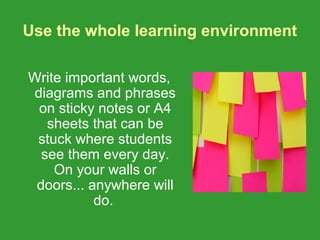
Write important words,
diagrams and phrases
 on sticky notes or A4
   sheets that can be
 stuck where students
  see them every day.
    On your walls or
 doors... anywhere will
           do.
Mind Mapping
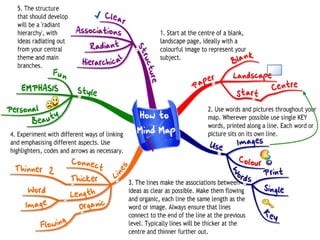
• This is a powerful technique that allows you to make the
  best use of your brain power.

• The Mind Mapping technique harnesses the full range of
  your cortical skills, making you more productive and
  creative.

Resources:
How to make a mind map
http://www.mind-mapping.co.uk/make-mind-map.htm
Video tutorial:
http://www.youtube.com/watch?v=wLWV0XN7K1g
Exemplar material

• Photocopy the work and give to students who
  have to identify why they are good answers by
  underlining in one colour key vocabulary, in
  another colour underlining connectives, in
  another etc. Don’t just read it – do something
  with it!
• Build up an exemplar student booklet which can
  be distributed within and between classes
Video the learning
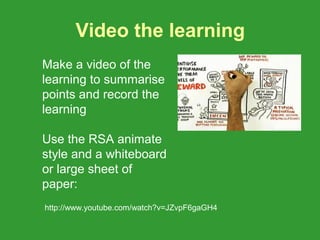
Make a video of the
learning to summarise
points and record the
learning

Use the RSA animate
style and a whiteboard
or large sheet of
paper:
http://www.youtube.com/watch?v=JZvpF6gaGH4
The Henry distillery
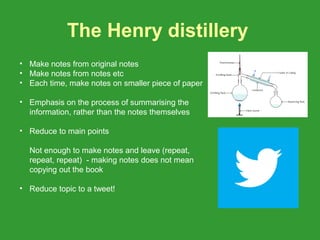
• Make notes from original notes
• Make notes from notes etc
• Each time, make notes on smaller piece of paper

• Emphasis on the process of summarising the
  information, rather than the notes themselves

• Reduce to main points

  Not enough to make notes and leave (repeat,
  repeat, repeat) - making notes does not mean
  copying out the book

• Reduce topic to a tweet!
Fill in the gaps
• Give students a written answer which has
  chunks of text missing
• Students fill in the gaps to make an A*-C grade
  answer
• Clues dotted around the room on the walls, only
  allowed to get up and look once though!
• Allows everyone to be successful. “Look, you’ve
  just created a C grade answer – you see, you
  CAN do it! (SEAL)
Ivor N.O. Idea
• Give students an exam answer(s) that has
  been written by ficticious student – Ivor
  N.O. Idea
• Paper has a variety of mistakes on it or is
  badly written
• Get students to identify the mistakes and
  make corrections – be the teacher
Building the answer

Take basic answer

Students to add detail to an
answer or use connectives to
elaborate a response
Grade it and feedback activity
• Students answer a written question
• Answers swapped and peer assessment
  takes place
• Verbal feedback to be given by student to
  their partner
• Key element - Opportunity to rewrite using
  the feedback they have been given
Consequences game
• Supply a question
• Students create an introduction on the top the paper and
  fold over
• Pass to next student who writes next stage - then fold
  over
• Pass to next student who adds next stage, fold over
• Game continues until the requirements of the question
  have been met.
• Final person unfolds the answer and reads. Examples
  read to class and students decide if a good answer and
  why/why not
Pub quiz
• Create questions for homework
• Create teams of 5
• Have a round per lesson and record
  scores on a leader board
• Successive rounds lead to a grand final
  between highest scoring teams
The student as teacher
• Create a new seating plan where students of different
  abilities are sat next to each other. Reading each others
  work regularly to feedback. Get the students to do the
  teaching!
• More able students can also be tasked with creating the
  plenary for a designated lesson or revision session
• Place more able boy with less able girl? – Study shows
  the boy will then help the girl and learn by teaching
Game-show
• Students to create a game-show format as
  a vehicle to deliver revision questions
• Could be done as whole class, but best
  within groups
• Process of making the format and
  questions is as important as the final
  game
Steps to success
• Create ‘steps to success’ templates or
  ‘success ladders’ to show students what
  they have to do in stages when answering
  a question
• Model the requirements through question
  and answer starters and pleneries
• Students to create their own ‘steps to
  success’ ladder for another question
Building an answer as a team
• Set a question
• Each student can only contribute one word
  each time to the answer
• Go around the room building an answer.
  The teacher intervenes as appropriate
  points to provide structure through the use
  of sentence starters and connectives
Mnemonics
• Use mnemonics to help remember certain
  patterns or sequences.
• A mnemonic is a way of helping you remember
  information using abbreviations, words or
  phrases.
  For example, to remember the colours of the
  rainbow, you could use the mnemonic: Richard
  of York Gave Battle In Vain, using the first letters
  of each word to remember the colours Red,
  Orange, Yellow, Green, Blue, Indigo and Violet.
Learning journey

Pick a journey or story that you
know well – route to school?

Associate an image with places
along the route in order to
remember key information.
Picture it

Revision through images

Working in teams to draw a key word
where others guess (Pictionary)
Key terms
Associate terms, images and definitions
– create a crib sheet to use in future (cut
and paste)

Repeating the process important

Do on computer?

Repeat and aim to get faster each time
Revision techniques
Some ideas for use with students in
        lead up to exams


                       David Drake
                Advanced Skills Teacher
       http://humanitiesastwiltshire.blogspot.com

Revision techniques staff version 2013

  • 1.
    Revision techniques Some ideasfor use with students in lead up to exams David Drake Advanced Skills Teacher http://humanitiesastwiltshire.blogspot.com
  • 2.
    Use the wholelearning environment Write important words, diagrams and phrases on sticky notes or A4 sheets that can be stuck where students see them every day. On your walls or doors... anywhere will do.
  • 3.
    Mind Mapping • Thisis a powerful technique that allows you to make the best use of your brain power. • The Mind Mapping technique harnesses the full range of your cortical skills, making you more productive and creative. Resources: How to make a mind map http://www.mind-mapping.co.uk/make-mind-map.htm Video tutorial: http://www.youtube.com/watch?v=wLWV0XN7K1g
  • 5.
    Exemplar material • Photocopythe work and give to students who have to identify why they are good answers by underlining in one colour key vocabulary, in another colour underlining connectives, in another etc. Don’t just read it – do something with it! • Build up an exemplar student booklet which can be distributed within and between classes
  • 6.
    Video the learning Makea video of the learning to summarise points and record the learning Use the RSA animate style and a whiteboard or large sheet of paper: http://www.youtube.com/watch?v=JZvpF6gaGH4
  • 7.
    The Henry distillery •Make notes from original notes • Make notes from notes etc • Each time, make notes on smaller piece of paper • Emphasis on the process of summarising the information, rather than the notes themselves • Reduce to main points Not enough to make notes and leave (repeat, repeat, repeat) - making notes does not mean copying out the book • Reduce topic to a tweet!
  • 8.
    Fill in thegaps • Give students a written answer which has chunks of text missing • Students fill in the gaps to make an A*-C grade answer • Clues dotted around the room on the walls, only allowed to get up and look once though! • Allows everyone to be successful. “Look, you’ve just created a C grade answer – you see, you CAN do it! (SEAL)
  • 9.
    Ivor N.O. Idea •Give students an exam answer(s) that has been written by ficticious student – Ivor N.O. Idea • Paper has a variety of mistakes on it or is badly written • Get students to identify the mistakes and make corrections – be the teacher
  • 10.
    Building the answer Takebasic answer Students to add detail to an answer or use connectives to elaborate a response
  • 11.
    Grade it andfeedback activity • Students answer a written question • Answers swapped and peer assessment takes place • Verbal feedback to be given by student to their partner • Key element - Opportunity to rewrite using the feedback they have been given
  • 12.
    Consequences game • Supplya question • Students create an introduction on the top the paper and fold over • Pass to next student who writes next stage - then fold over • Pass to next student who adds next stage, fold over • Game continues until the requirements of the question have been met. • Final person unfolds the answer and reads. Examples read to class and students decide if a good answer and why/why not
  • 13.
    Pub quiz • Createquestions for homework • Create teams of 5 • Have a round per lesson and record scores on a leader board • Successive rounds lead to a grand final between highest scoring teams
  • 14.
    The student asteacher • Create a new seating plan where students of different abilities are sat next to each other. Reading each others work regularly to feedback. Get the students to do the teaching! • More able students can also be tasked with creating the plenary for a designated lesson or revision session • Place more able boy with less able girl? – Study shows the boy will then help the girl and learn by teaching
  • 15.
    Game-show • Students tocreate a game-show format as a vehicle to deliver revision questions • Could be done as whole class, but best within groups • Process of making the format and questions is as important as the final game
  • 16.
    Steps to success •Create ‘steps to success’ templates or ‘success ladders’ to show students what they have to do in stages when answering a question • Model the requirements through question and answer starters and pleneries • Students to create their own ‘steps to success’ ladder for another question
  • 17.
    Building an answeras a team • Set a question • Each student can only contribute one word each time to the answer • Go around the room building an answer. The teacher intervenes as appropriate points to provide structure through the use of sentence starters and connectives
  • 18.
    Mnemonics • Use mnemonicsto help remember certain patterns or sequences. • A mnemonic is a way of helping you remember information using abbreviations, words or phrases. For example, to remember the colours of the rainbow, you could use the mnemonic: Richard of York Gave Battle In Vain, using the first letters of each word to remember the colours Red, Orange, Yellow, Green, Blue, Indigo and Violet.
  • 19.
    Learning journey Pick ajourney or story that you know well – route to school? Associate an image with places along the route in order to remember key information.
  • 20.
    Picture it Revision throughimages Working in teams to draw a key word where others guess (Pictionary)
  • 21.
    Key terms Associate terms,images and definitions – create a crib sheet to use in future (cut and paste) Repeating the process important Do on computer? Repeat and aim to get faster each time
  • 22.
    Revision techniques Some ideasfor use with students in lead up to exams David Drake Advanced Skills Teacher http://humanitiesastwiltshire.blogspot.com