The Initial Steps in Developing a
Classroom Test: Deciding Whatto Test
and How toTest it
Josie Highsmith
Chapter 7
EDU 402
Objectives& KeyChapterConcepts
1. Describe “Bloom’s Taxonomy of Cognitive Objectives.” Explainand give examples of each
category.
2. Discuss major considerations involved with assembling an assessment.
3. Discuss major considerations involved with preparing your students and administering an
assessment.
4. Be ableto apply strategies for reducing test anxiety.
5. Be able to apply strategies for reducing the likelihood
of cheating.
VocabularyWords
Application
Web 2.0Tool
-Slideshare-
What is it and How can you
use it in the classroom?
Bloom’sTaxonomy
• A taxonomyof cognitiveobjectives
• Provides a usefulway of describingthe complexityof anobjective by
classifyingit intoa category ranging from simpleto COMPLEX
• Teachers aim to teach the higher level categories
becausethey promote higher level thinking
Why is it Helpful?
“…it presents a framework that helps remind
teachers to include items reflecting more
complex educational objectives in their
tests.”
There are six categories within Bloom’s
Taxonomy…
Can you name
them? …
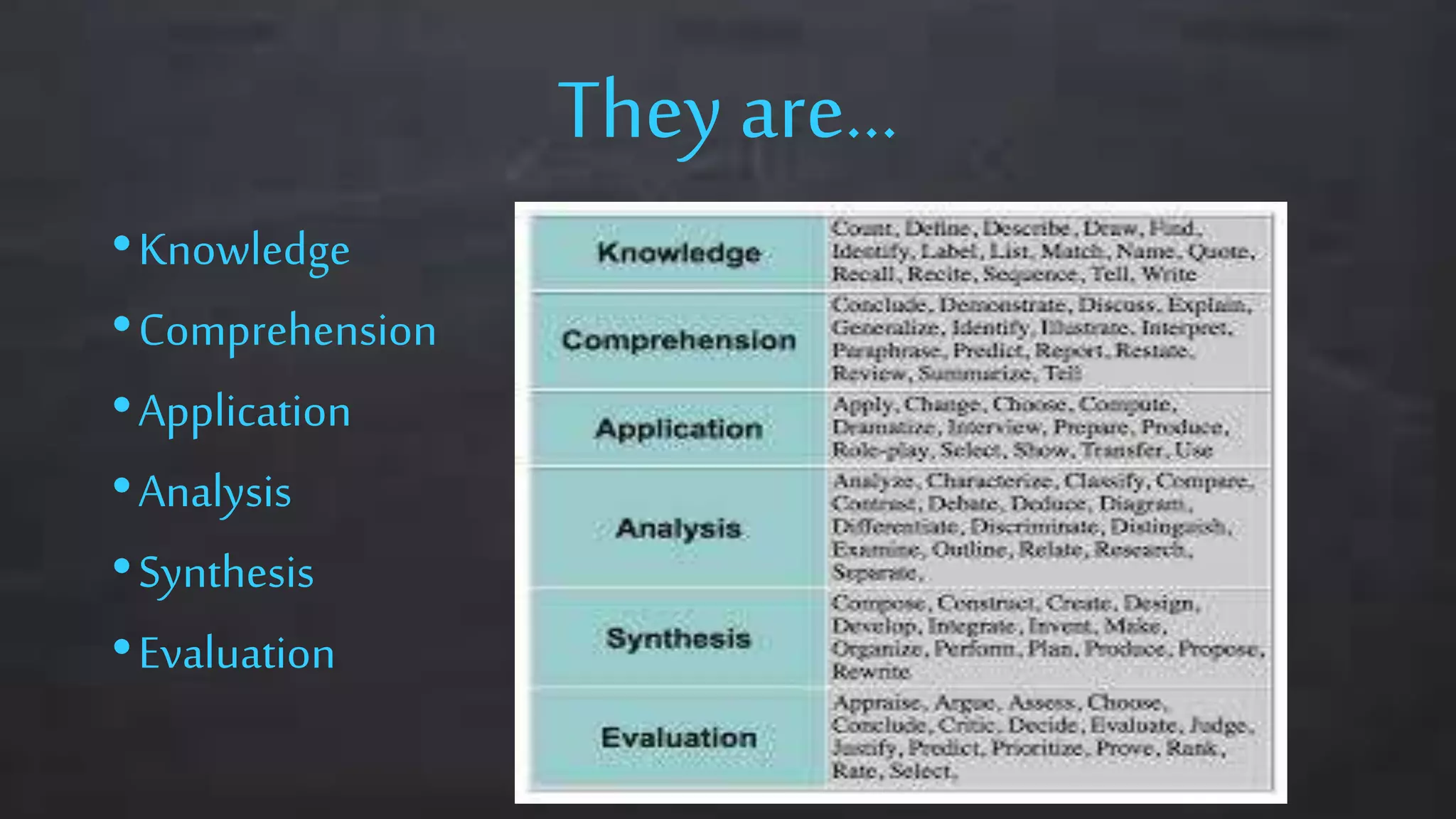
They are…
•Knowledge
•Comprehension
•Application
•Analysis
•Synthesis
•Evaluation
Knowledge
• Simplest level of Bloom’s Taxonomy
• Involves rote memory wherethe studentis required to memorizekeyfacts or
terms and learn newones
• Examples of Objectives Include:
-namingstatecapitals
-namingpresidents by order served
Comprehension
• Objectives in this levelrequire understandingand notjust memorization
• Verbs are used for what studentsare expected to do such as summarize,
interpret, or explain material
• Examples of objectives include:
-explainhow interestrates affect unemployment
-Summarizetheuse of each symbol on a map
Application
• These objectives involve rules, principles, or concepts to solve a problem thatthe
studenthas not already encountered
• Examples of Objectives include:
-Write directions for traveling by numbered road from
Any city to city
-Apply addition and subtractionof double digits to
Real world mathproblems
Analysis
• Objectivesinvolve the reductionof concepts intopartsand showing the
relationshipof partsto the whole
• Examplesof objectivesinclude:
-Describe maps in term of functionand form
-distinguishdifferent approachesof establishing
validity
Synthesis
• This level involves the creationof new ideas or results from existing
concepts
• Examplesof Objectives Include:
-Construct a map of a nonexistent country with given
characteristics
-Propose a plan tohelp stop pollutionin the air
Evaluation
• Highest level of Bloom’s Taxonomy
• Requires the student tomake evaluative judgments regarding the
qualityor value of something for a statedpurpose
• Examplesof Objectives Include:
-The studentwill evaluate the usefulness ofa map
To enable them to travel toa selecteddestination
What toThink AboutWhen AssemblingAn Assessment…
1. Follow your table of specifications
2. Provide clear directions to your students
3. State the question or taskasclearly as possible
4. Develop items or tasksthat canbe scored decisively
5. Avoid using cues or hints to correct answers
6. Arrange the items in a systematic manner
7. Include items that willpromote valid and reliable results
8. Thinkabout how many items you should include
How to Prepareyour studentsfor an Assessment
• Encourage the students to perform their best
• Follow strategies for reducing test anxiety
• Hold a review or practice session for the students before the test begins
• Give the students examples of test questions
• Make sure the testing environment is comfortable to all
students
• Administer the test fairly
Test Anxiety: What it isandHow you canreduceit
• Test anxiety is acommon type of anxietyamong students and it can become helpful when
studying for a test, however, it can hurt a student’s performance during a test if it reaches a
certain level
• How you can help:
-Relaxationtraining (breathing techniques)
-do not make the test a do-or-die situation
-arrange the items from easy to difficult
-provide multiple assessments over a grading period
-avoid unnecessary discussion before letting them begin
Strategies for PreventingCheating
• Keep the assessment materials secure
• Provide appropriate supervision during examinations
• Have your students clear off their desks before distributing the tests
• Do not assign another student to hand out tests; you should hand them out
yourself and to each individual student
• If permitted to have scratchpaper, have them turn it in
with the test
• Create two forms of the test
• Make sure spacing between students is appropriate
Find out howyou caninspire your studentsto overcometest
anxietyand evenovercomeit yourself in theprocess…
https://www.youtube.com/watch?v=oFMjbs3hoiU
Takea lookat howthis group offifth gradeteachershas a
unique way ofhelpingtheir students overcometest
anxiety…
https://www.youtube.com/watch?v=Qb16D43FCWQ
Sources
Reynolds, c. r., Livingston, r. b., & Willson, v. (2009). Measurement and assessment in
education. (2nd Ed.). Upper Saddle River, NJ.: Pearson.

Classroom Tests and Bloom's Taxonomy

  • 1.
    The Initial Stepsin Developing a Classroom Test: Deciding Whatto Test and How toTest it Josie Highsmith Chapter 7 EDU 402
  • 2.
    Objectives& KeyChapterConcepts 1. Describe“Bloom’s Taxonomy of Cognitive Objectives.” Explainand give examples of each category. 2. Discuss major considerations involved with assembling an assessment. 3. Discuss major considerations involved with preparing your students and administering an assessment. 4. Be ableto apply strategies for reducing test anxiety. 5. Be able to apply strategies for reducing the likelihood of cheating.
  • 3.
  • 4.
    Web 2.0Tool -Slideshare- What isit and How can you use it in the classroom?
  • 5.
    Bloom’sTaxonomy • A taxonomyofcognitiveobjectives • Provides a usefulway of describingthe complexityof anobjective by classifyingit intoa category ranging from simpleto COMPLEX • Teachers aim to teach the higher level categories becausethey promote higher level thinking
  • 6.
    Why is itHelpful? “…it presents a framework that helps remind teachers to include items reflecting more complex educational objectives in their tests.”
  • 7.
    There are sixcategories within Bloom’s Taxonomy… Can you name them? …
  • 8.
  • 9.
    Knowledge • Simplest levelof Bloom’s Taxonomy • Involves rote memory wherethe studentis required to memorizekeyfacts or terms and learn newones • Examples of Objectives Include: -namingstatecapitals -namingpresidents by order served
  • 10.
    Comprehension • Objectives inthis levelrequire understandingand notjust memorization • Verbs are used for what studentsare expected to do such as summarize, interpret, or explain material • Examples of objectives include: -explainhow interestrates affect unemployment -Summarizetheuse of each symbol on a map
  • 11.
    Application • These objectivesinvolve rules, principles, or concepts to solve a problem thatthe studenthas not already encountered • Examples of Objectives include: -Write directions for traveling by numbered road from Any city to city -Apply addition and subtractionof double digits to Real world mathproblems
  • 12.
    Analysis • Objectivesinvolve thereductionof concepts intopartsand showing the relationshipof partsto the whole • Examplesof objectivesinclude: -Describe maps in term of functionand form -distinguishdifferent approachesof establishing validity
  • 13.
    Synthesis • This levelinvolves the creationof new ideas or results from existing concepts • Examplesof Objectives Include: -Construct a map of a nonexistent country with given characteristics -Propose a plan tohelp stop pollutionin the air
  • 14.
    Evaluation • Highest levelof Bloom’s Taxonomy • Requires the student tomake evaluative judgments regarding the qualityor value of something for a statedpurpose • Examplesof Objectives Include: -The studentwill evaluate the usefulness ofa map To enable them to travel toa selecteddestination
  • 15.
    What toThink AboutWhenAssemblingAn Assessment… 1. Follow your table of specifications 2. Provide clear directions to your students 3. State the question or taskasclearly as possible 4. Develop items or tasksthat canbe scored decisively 5. Avoid using cues or hints to correct answers 6. Arrange the items in a systematic manner 7. Include items that willpromote valid and reliable results 8. Thinkabout how many items you should include
  • 16.
    How to Prepareyourstudentsfor an Assessment • Encourage the students to perform their best • Follow strategies for reducing test anxiety • Hold a review or practice session for the students before the test begins • Give the students examples of test questions • Make sure the testing environment is comfortable to all students • Administer the test fairly
  • 17.
    Test Anxiety: Whatit isandHow you canreduceit • Test anxiety is acommon type of anxietyamong students and it can become helpful when studying for a test, however, it can hurt a student’s performance during a test if it reaches a certain level • How you can help: -Relaxationtraining (breathing techniques) -do not make the test a do-or-die situation -arrange the items from easy to difficult -provide multiple assessments over a grading period -avoid unnecessary discussion before letting them begin
  • 18.
    Strategies for PreventingCheating •Keep the assessment materials secure • Provide appropriate supervision during examinations • Have your students clear off their desks before distributing the tests • Do not assign another student to hand out tests; you should hand them out yourself and to each individual student • If permitted to have scratchpaper, have them turn it in with the test • Create two forms of the test • Make sure spacing between students is appropriate
  • 19.
    Find out howyoucaninspire your studentsto overcometest anxietyand evenovercomeit yourself in theprocess… https://www.youtube.com/watch?v=oFMjbs3hoiU
  • 20.
    Takea lookat howthisgroup offifth gradeteachershas a unique way ofhelpingtheir students overcometest anxiety… https://www.youtube.com/watch?v=Qb16D43FCWQ
  • 21.
    Sources Reynolds, c. r.,Livingston, r. b., & Willson, v. (2009). Measurement and assessment in education. (2nd Ed.). Upper Saddle River, NJ.: Pearson.