DIFFERENTIATION
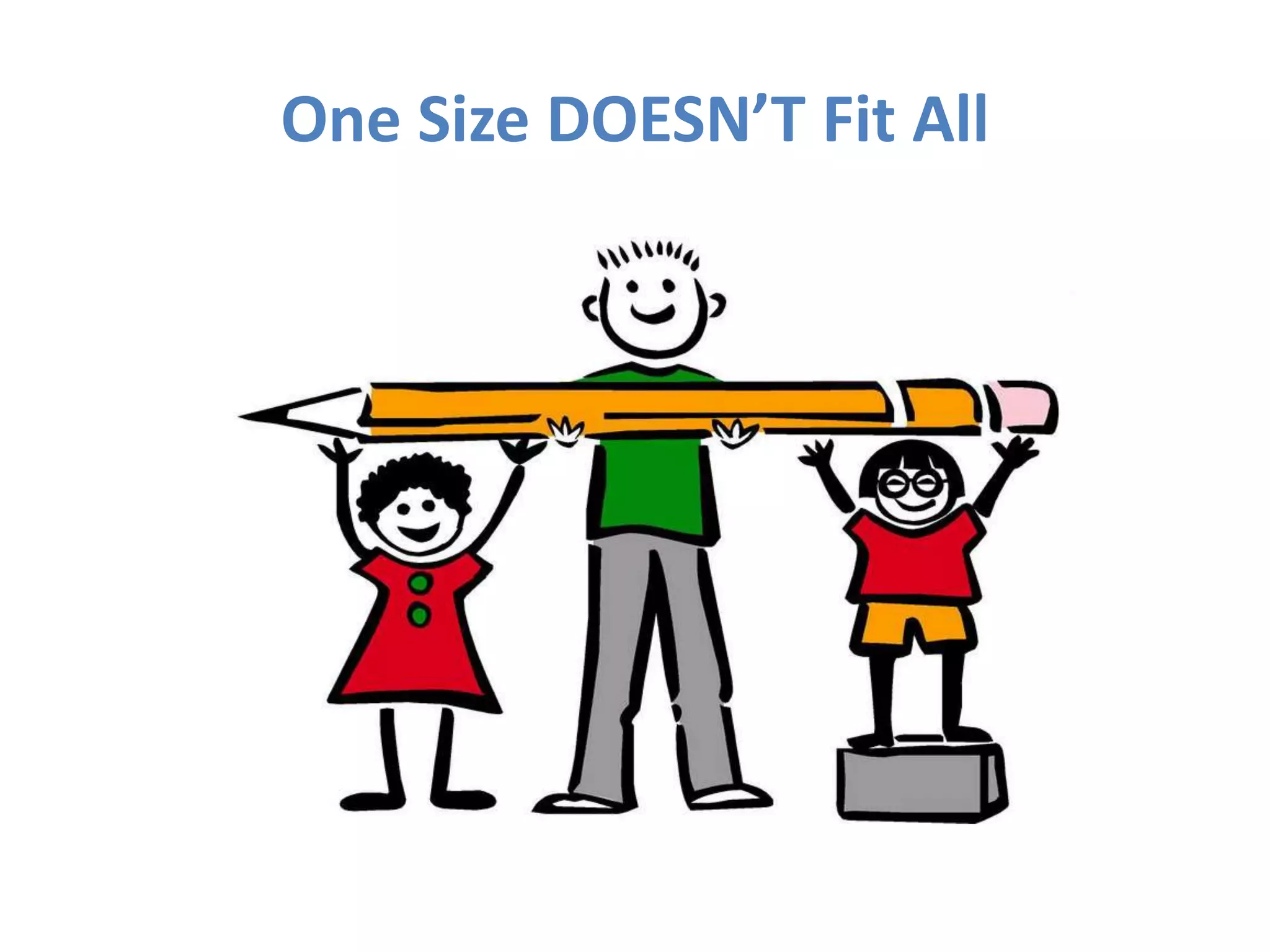
One Size DOESN’T Fit All
Workshop OutlineTheoretical inputPracticalwork – group workPresentation of findingsPracticalideas
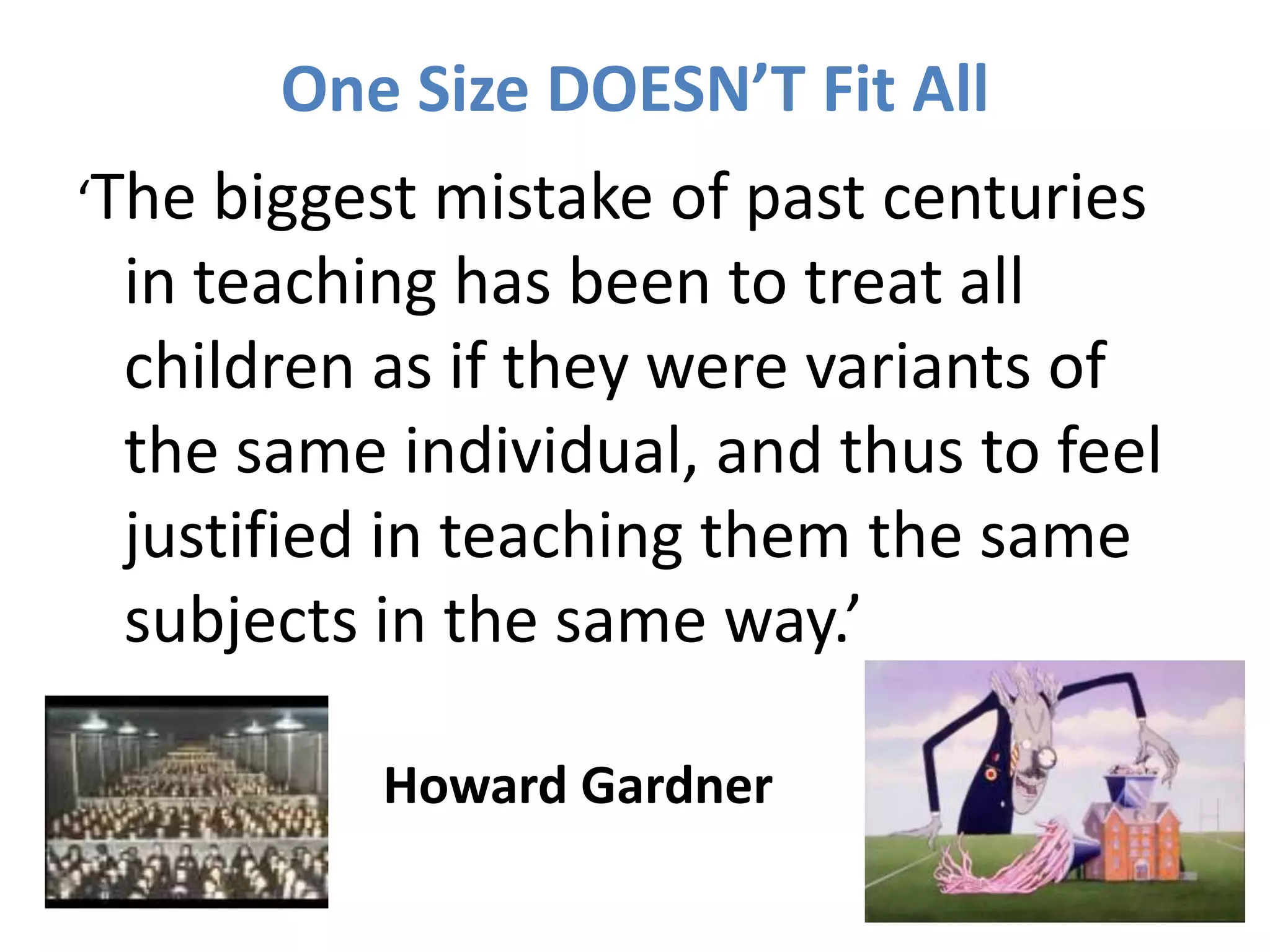
One Size DOESN’T Fit All‘The biggestmistake of past centuries in teaching has been to treat all children as if theywerevariants of  the sameindividual, and thus to feeljustified in teachingthem the samesubjects in the sameway.’ Howard Gardner
Differentiation: WHAT?CONTENT
PROCESS
PRODUCTCarol Ann TomlinsonDifferentiation ACCORDING TO:Learning profile (learning style; MI)
Interests
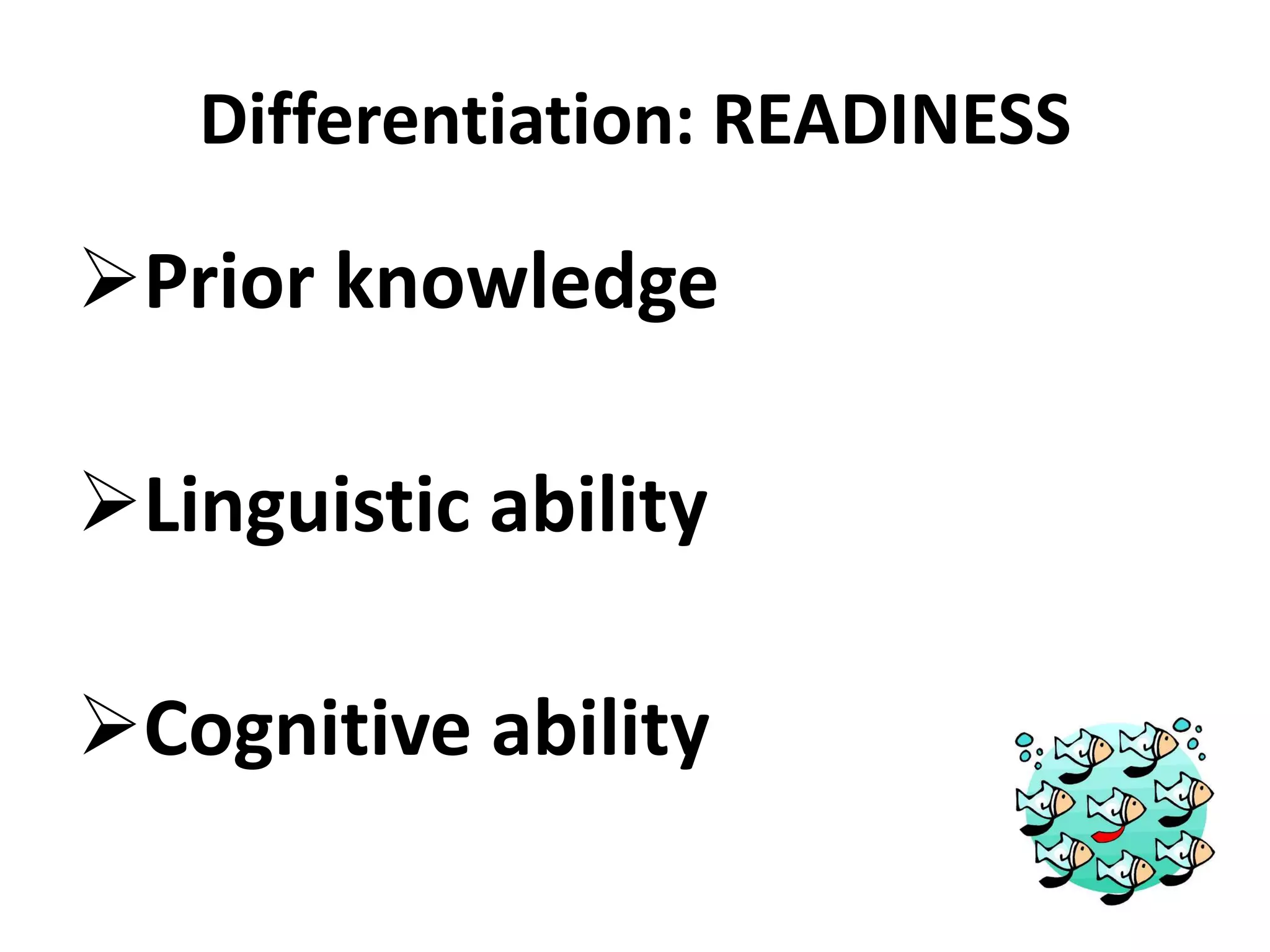
ReadinessDifferentiation: READINESSPrior knowledge
Linguisticability
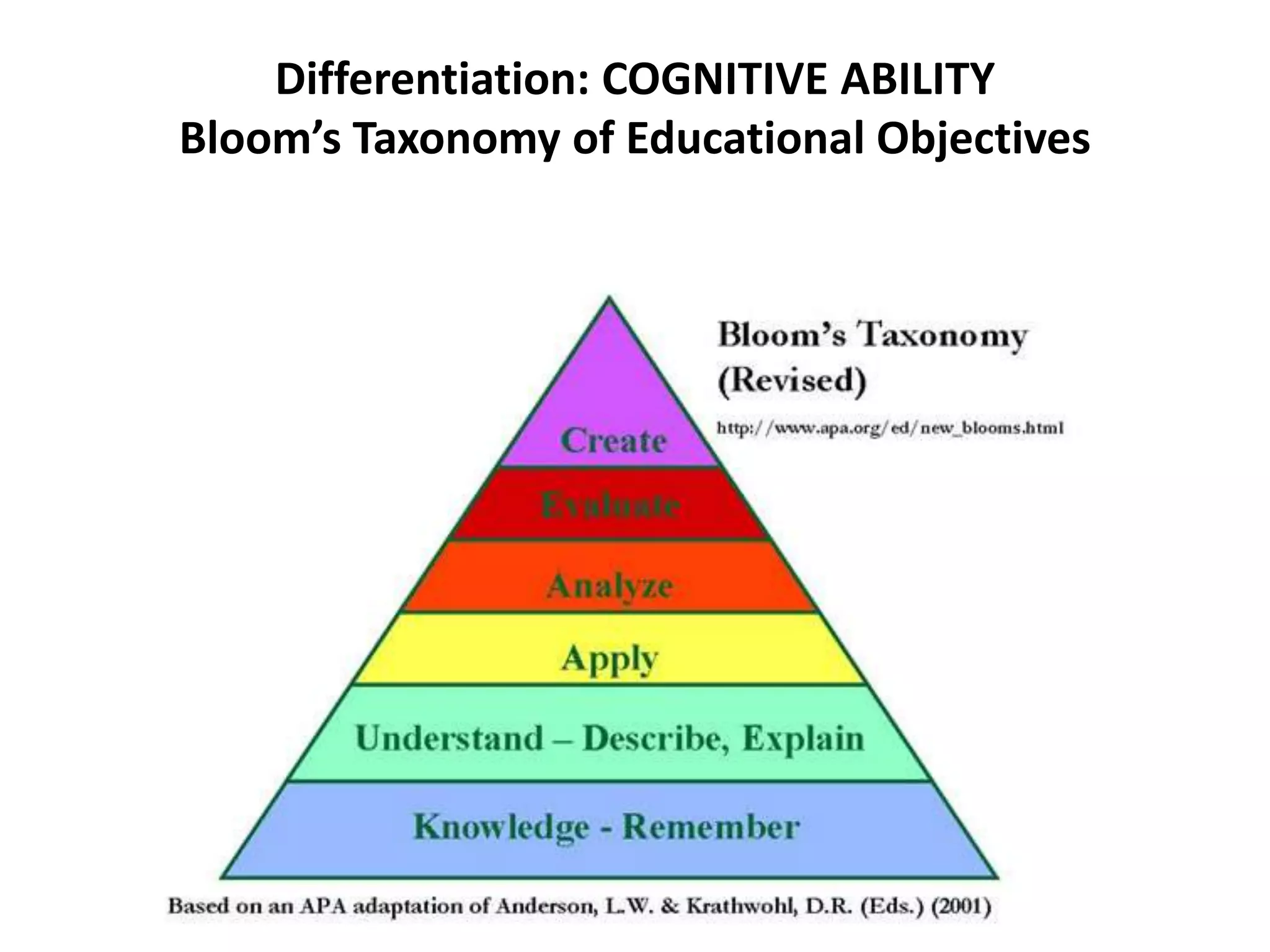
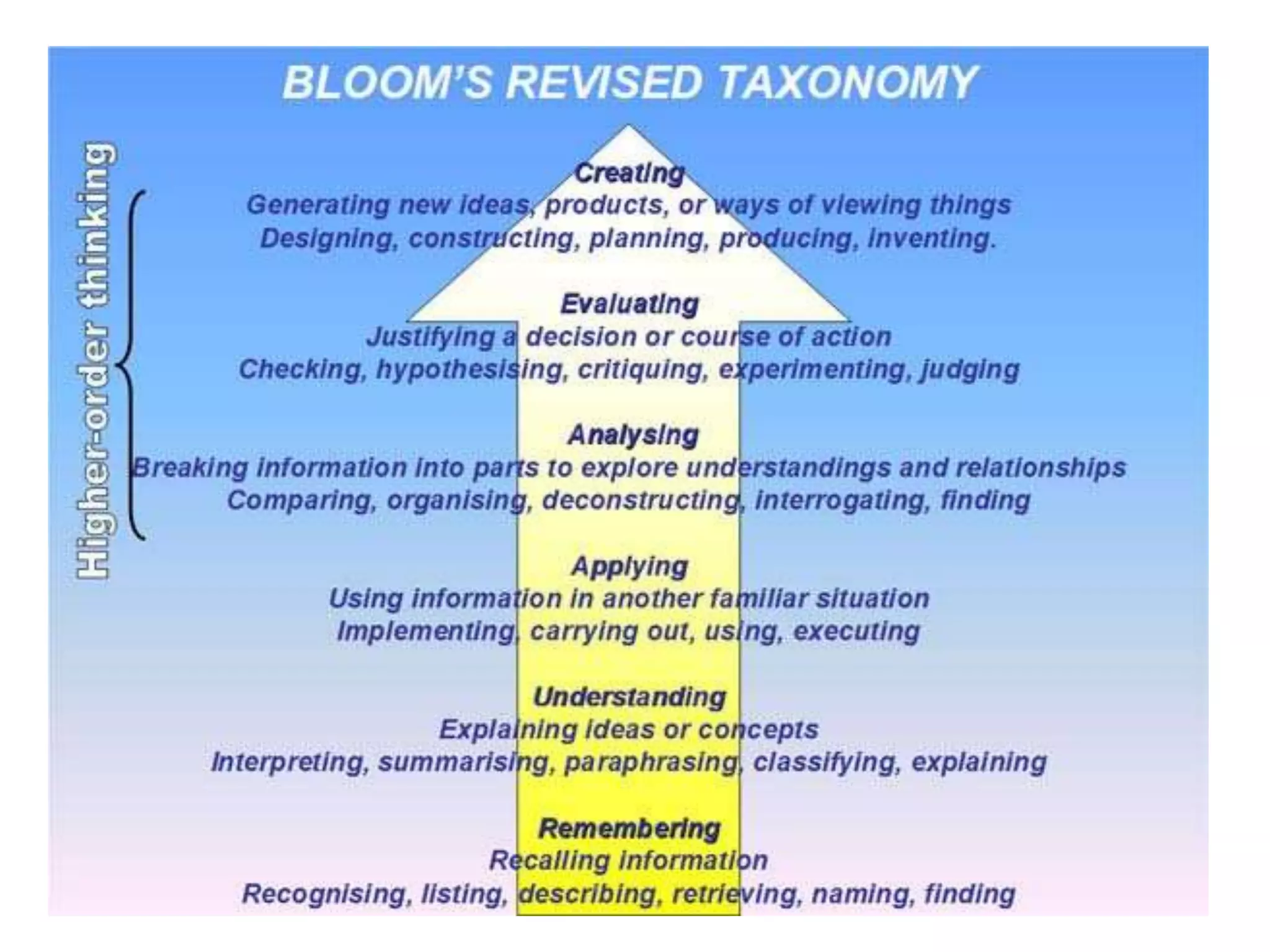
Cognitive abilityDifferentiation: COGNITIVE ABILITYBloom’sTaxonomy of Educational Objectives
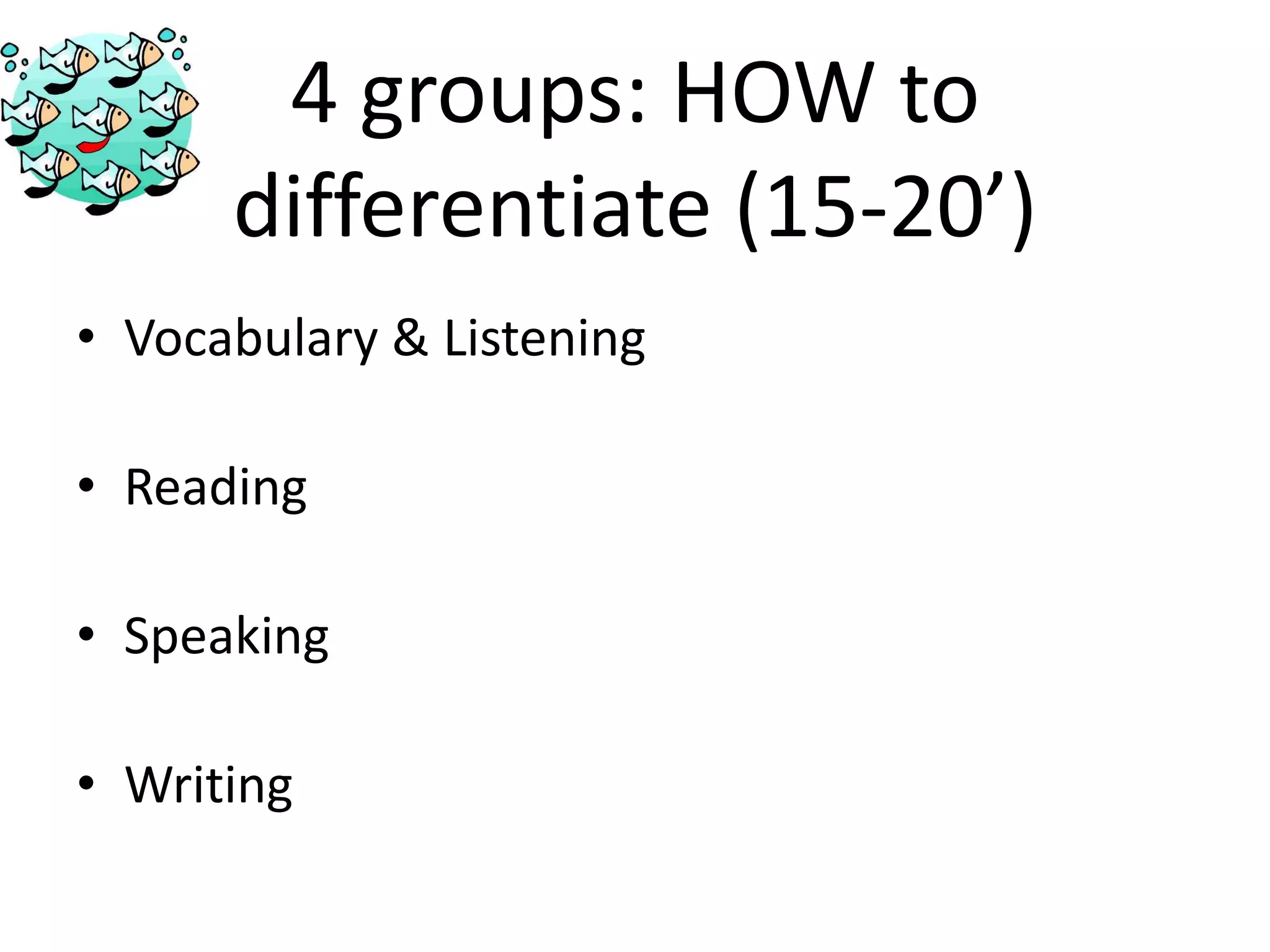
4 groups: HOW to    differentiate (15-20’)Vocabulary & ListeningReadingSpeakingWriting
Differentiation: READINESSPrior knowledge
Linguisticability
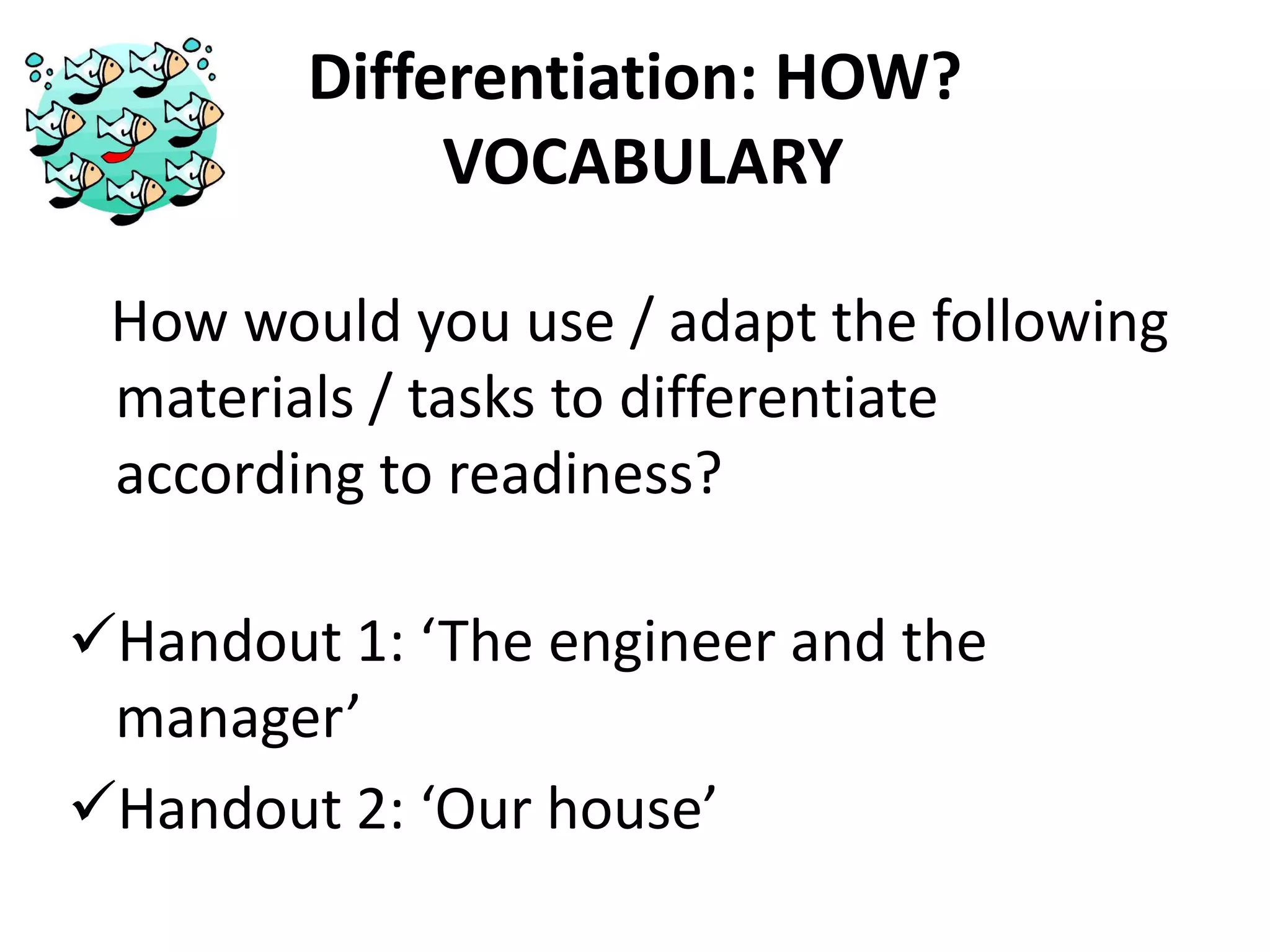
Cognitive abilityDifferentiation: HOW? VOCABULARY   How would you use / adapt the following materials / tasks to differentiateaccording to readiness? Handout 1: ‘The engineer and the manager’
Handout 2: ‘Our house’ VOCABULARYGive weaker ST easier and / or fewer words to find (Handout 1)
Give them first letter of missing words (Handout 1)
Give them German and / or French translations of missing words (Handouts 1 & 2)
Give them missing words jumbled up (Handouts 1 & 2)
Let them work in pairs (Handouts 1 & 2)
Give them missing words for each category plus an ‘odd man out’ to find (Handout 2) LISTENING   How would you use / adapt the following material in order to differentiateaccording to readiness?Song: ‘Brothers in arms’ (Dire Straits)
OtherlisteningtasksLISTENINGProvide weaker students with the transcript of the text (f.ex. lyrics of the song) and / or a glossary for it and / or the worksheet about it before they listen to it
Provide different TASKS: listen to the song and tick (✓) the correct word (*); listen to the song and match the second half of the sentences to the first ones (**); listen, underline the incorrect words and correct them (***)LISTENINGProvide different levels of QUESTIONS : Who?; Where?; When? (lower-order thinking skill)  What?; Why? (higher-order thinking skill)
MC questions: use wordsfrom script or paraphrase
ST tick off elements in a grid or take notesREADING   How would you use / adapt the following material in order to differentiateaccording to readiness?Text: ‘Throwawaychildren ?’
Novel / Short story READINGDifferentiating CONTENT:Level the contents: use differentlevels of simplifiedreaders & original text (f.ex. R Dahl’s short stories: ‘Way up to heaven’) or different level versions of the same text (cf. onestopenglish.com)
Provideweaker ST withglossary
Provideweaker ST withdictionaries
Providedifferenttextswithdifferentfoci (& levels of cognitive or linguisticdifficulty) on the sametopic(-> whole class presentations)READINGDifferentiating PROCESS / PRODUCT:Texts
Different TASKS: reassemble jumbled text (stronger ST can have one extra paragraph that does not fit); find titles or match titles with paragraphs; find a headline for newspaper article or select the best one out of a list; answer different types of questions (tick ideas; True / False; MC …); put events into chronologicalorder
Different immediateresponses:What do youremember? Whatdidyoufindmostinteresting? (cf. Bloom’staxonomy: differentorderthinkingskills)READINGDifferentiating PROCESS / PRODUCT:Novels
Differenttasks in readingcircle / book club: discussion leader; clarifier; summarizer …

Differentiation in the classroom

  • 1.
  • 2.
  • 3.
    Workshop OutlineTheoretical inputPracticalwork– group workPresentation of findingsPracticalideas
  • 4.
    One Size DOESN’TFit All‘The biggestmistake of past centuries in teaching has been to treat all children as if theywerevariants of the sameindividual, and thus to feeljustified in teachingthem the samesubjects in the sameway.’ Howard Gardner
  • 5.
  • 6.
  • 7.
    PRODUCTCarol Ann TomlinsonDifferentiationACCORDING TO:Learning profile (learning style; MI)
  • 8.
  • 9.
  • 10.
  • 11.
    Cognitive abilityDifferentiation: COGNITIVEABILITYBloom’sTaxonomy of Educational Objectives
  • 13.
    4 groups: HOWto differentiate (15-20’)Vocabulary & ListeningReadingSpeakingWriting
  • 14.
  • 15.
  • 16.
    Cognitive abilityDifferentiation: HOW?VOCABULARY How would you use / adapt the following materials / tasks to differentiateaccording to readiness? Handout 1: ‘The engineer and the manager’
  • 17.
    Handout 2: ‘Ourhouse’ VOCABULARYGive weaker ST easier and / or fewer words to find (Handout 1)
  • 18.
    Give them firstletter of missing words (Handout 1)
  • 19.
    Give them Germanand / or French translations of missing words (Handouts 1 & 2)
  • 20.
    Give them missingwords jumbled up (Handouts 1 & 2)
  • 21.
    Let them workin pairs (Handouts 1 & 2)
  • 22.
    Give them missingwords for each category plus an ‘odd man out’ to find (Handout 2) LISTENING How would you use / adapt the following material in order to differentiateaccording to readiness?Song: ‘Brothers in arms’ (Dire Straits)
  • 23.
    OtherlisteningtasksLISTENINGProvide weaker studentswith the transcript of the text (f.ex. lyrics of the song) and / or a glossary for it and / or the worksheet about it before they listen to it
  • 24.
    Provide different TASKS:listen to the song and tick (✓) the correct word (*); listen to the song and match the second half of the sentences to the first ones (**); listen, underline the incorrect words and correct them (***)LISTENINGProvide different levels of QUESTIONS : Who?; Where?; When? (lower-order thinking skill) What?; Why? (higher-order thinking skill)
  • 25.
    MC questions: usewordsfrom script or paraphrase
  • 26.
    ST tick offelements in a grid or take notesREADING How would you use / adapt the following material in order to differentiateaccording to readiness?Text: ‘Throwawaychildren ?’
  • 27.
    Novel / Shortstory READINGDifferentiating CONTENT:Level the contents: use differentlevels of simplifiedreaders & original text (f.ex. R Dahl’s short stories: ‘Way up to heaven’) or different level versions of the same text (cf. onestopenglish.com)
  • 28.
  • 29.
  • 30.
    Providedifferenttextswithdifferentfoci (& levelsof cognitive or linguisticdifficulty) on the sametopic(-> whole class presentations)READINGDifferentiating PROCESS / PRODUCT:Texts
  • 31.
    Different TASKS: reassemblejumbled text (stronger ST can have one extra paragraph that does not fit); find titles or match titles with paragraphs; find a headline for newspaper article or select the best one out of a list; answer different types of questions (tick ideas; True / False; MC …); put events into chronologicalorder
  • 32.
    Different immediateresponses:What doyouremember? Whatdidyoufindmostinteresting? (cf. Bloom’staxonomy: differentorderthinkingskills)READINGDifferentiating PROCESS / PRODUCT:Novels
  • 33.
    Differenttasks in readingcircle/ book club: discussion leader; clarifier; summarizer …
  • 34.
    Novelreading: one (strong)ST is a character in ‘hot seat’, other ST ask questions – according to ability - to find out more, to challenge the characteretc
  • 35.
    Novelreading: reading journalwithdifferentcreativetasksappealing to differentlearner types & MI: make a summary; write an interview with a character; a day in the life of (a character) …. SPEAKING How would you use / adapt the following tasks in order to differentiateaccording to readiness? Presenting a novel / short story / text or topic
  • 36.
    Role-play: f.ex. orderingfood in a snack bar
  • 37.
  • 38.
    Debating / Discussinga topicsuch as ‘Shouldmilitary service becompulsory?’SPEAKINGPresenting a novel / short story / text or topic
  • 39.
    Different level readers(from different levels of simplified to original text; topic texts of varying levels of difficulty, with or without glossary …)
  • 40.
    Different aspects ofnovel (cf. Bloom’staxonomy): givesummary; compile character description & development; analyse themes; pick & discuss a (favourite) passage … ; compare novel to film versionSPEAKINGRole-play: f.ex. ordering food in a snack bar✓Provide weaker ST with prompt cards: picture prompts; cue words & phrases Describing a picture (in speaking or writing)
  • 41.
    Prompt cards: cuewords (nouns; verbs …) & phrases & questions (f.ex. What are the people wearing?)SPEAKINGDebating / Discussing a topicDiscuss a question in small groups, f.ex.‘Shouldmilitary service becompulsory?’(Topiccanbeadaptedaccording to interest; cognitive ability; priorknowledge / researchdone)Assignroles: 1 ST = note taker (mustn’tspeak )1 ST checks & corrects notes all other ST provide arguments for / against1 ST = speaker; presents arguments to the classWhole class presentation
  • 42.
    WRITING How would you adapt the following tasks in order to differentiateaccording to readiness?Essaywriting
  • 43.
    Holiday postcardwriting /describingdaily routines
  • 44.
    Writingtasks as afollow-up to reading
  • 45.
    Differentiateaccording to professionalneeds/ furthereducation(ES /EST)WRITINGEssaywriting
  • 46.
    Provide arguments and/ or linguistic input (discourse markers; relevant topicvocabulary; topic sentences) for weaker ST
  • 47.
    Researching arguments: strongerST do theirownresearch; provideweaker ST withusefulmaterial
  • 48.
    Stronger ST areasked to provide more arguments; weaker ST mayonlypresent one side of the argument in a first stage WRITINGESSAY writingafterspeaking (debating):
  • 49.
    If diff. groupspresentdifferentessaytopics, strongSTscanbeasked to take notes while groups present and write an essay on anothertopicthan the one theydiscussed in their groups; weakerSTswill use notes provided by groupWRITINGHoliday postcard writing / describing daily routines
  • 50.
    Provide visual orlinguistic prompts (words; phrases; parts of sentences) for weakerST
  • 51.
  • 52.
    Differenttasks: CV, letters,reports … WRITING: follow-up tasksAfterreading:
  • 53.
    Providechoice of follow-uptasks: write a summary, blog entry, a letter to the editor, an interview with a politician / an activist / a parent …FurtherIdeas for Differentiating‘Bus stop’: get ST whofinishes a taskearly in class to stand in a spot in the classroom (bus stop); next ST finishingearly joins first ST to discussanswersetc; pairs can exchange with pairs
  • 54.
    Station learning: providedifferent content, process or product; STsdo all or only some of the tasksFurtherIdeas for Differentiating‘Arbeitsplan’: provide ST with exercises and activities they can engage in autonomously during, for instance, all the English lessons of an entire week. These exercises and activities are subdivided into ‘Pflichtaufgaben’ and ‘Wahlaufgaben’. ST themselves decide on the form of interaction, pace and order.BibliographyMethod Guide, Methodenfür den kooperativenundindividualisierendenEnglischunterricht in den Klassen 5-12,Schöningh, ISBN 978-3-14-041263-6
  • 55.
    Method Guide, SchüleraktivierendeMethoden für den Englischunterricht in den Klassen 5-10, Schöningh, ISBN 978-3-14-041262-9
  • 56.
    Praxis Schule 5-10Extra: Differenzieren und individualisieren, I Ahlring, Westermann, ISBN 3-14-161001-0
  • 57.
    Differentiated Instructional Strategies,Gregory & Chapman, Corwin Press, ISBN 1-4129-3640-3
  • 58.
    The Differentiated Classroom,C A Tomlinson, ASCD, ISBN 978-0-87120-342-7See ETD website for ppsslidesetc:http://sites.google.com/site/englishteachersday/

Editor's Notes

  • #6 Content: WHAT ST are supposed to learnProcess: activities to make ST makesense out of information + ideasProducts: vehiclesthroughwhich ST demonstrate and extendwhatthey have learned (Tomlinson)
  • #7 Learning profile: how welearn; talk to others or study on yourown, withwriting; seebigpicture first or part-to-wholeapproach; logical, analyticalapproach or creative, application-orientedapproach
  • #9 B S Bloom, American educationalistHandout a sheetwithpracticalexamples of tasksrelating to theselevels
  • #11 Bring FLIPCHARTS and feltpens
  • #13 Handout 1 (engineertext) & handout 2 (our house): first page only; textbook suggestions handed out after the groups presentations
  • #14 Hand out textbookexamplesCan beapplied to a ‘find the matchingwords’ exercise
  • #16 Weaker ST: readtapescriptbefore and turn overST canchoosewhichtasktheywant to do / fosterlearnerresponsbility / Listeningatanylevel: different types of questions / responsewithdifferent cognitive requirementstrue / false ; MC questions (use wordsfrom script or paraphrase for strongerLs)note-taking (lowerlevelLstickelements of a grid)graded questions; f.e.xLearner A: ‘Paul doesn’tlikehisstepfather’. T / FLearner B: ‘Whatdoes Paul think of hisstepfather?’Hand out question starters according to Bloom’staxonomyMORE FOOD FOR THOUGHT see last slide (takenfrommy P13 seminar on listeningskills)
  • #17 Weaker ST: readtapescriptbefore and turn overST canchoosewhichtasktheywant to do / fosterlearnerresponsbility / Listeningatanylevel: different types of questions / responsewithdifferent cognitive requirementstrue / false ; MC questions (use wordsfrom script or paraphrase for strongerLs)note-taking (lowerlevelLstickelements of a grid)graded questions; f.e.xLearner A: ‘Paul doesn’tlikehisstepfather’. T / FLearner B: ‘Whatdoes Paul think of hisstepfather?’Hand out question starters according to Bloom’staxonomyMORE FOOD FOR THOUGHT see last slide (takenfrommy P13 seminar on listeningskills)
  • #19 Practicalexample: newspaper articles on the London riots; letters to the editor; politicalcomments are more challenging, generally, thanmere news reports
  • #21 Clarifier looks up words in dictionaryf.ex.; youcangive prompts to questioner: why? What , when? I’dlike to know …; connectorestablishes connections to other stories, other passages in the story / noveletc (differentorderthinkingskills)Hand out copies on book club roles and readingcircleroles
  • #24 Is there a need to providevisualmaterial?
  • #25 Notetaker= talkativestudent; to giveothers an opportunity to speak, native speakerPresenter = (weaker or quiet ST, given confidence by the factthatstronger ST prepared the notes)