Developing Inclusive Education
Carol Quirk
cquirk@mcie.org
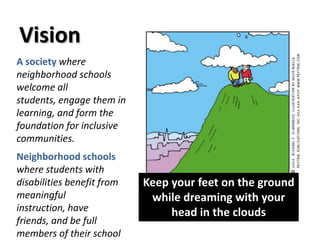
Vision
A society where
neighborhood schools
welcome all
students, engage them in
learning, and form the
foundation for inclusive
communities.
Neighborhood schools
where students with
disabilities benefit from
meaningful
instruction, have
friends, and be full
members of their school
Keep your feet on the ground
while dreaming with your
head in the clouds
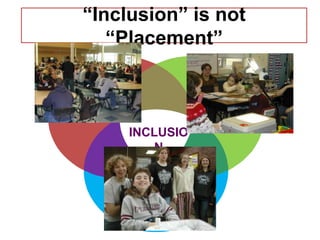
“Inclusion” is not
“Placement”
Physical Access
to
ENVIRONMENTS
Meaningful
ACADEMIC
participation
Positive SOCIAL
RELATIONSHIPS
INCLUSIO
N
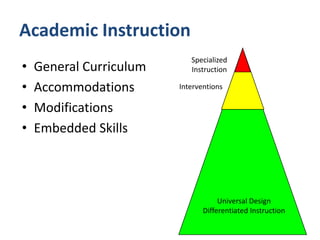
Academic Instruction
• General Curriculum
• Accommodations
• Modifications
• Embedded Skills
Universal Design
Differentiated Instruction
Interventions
Specialized
Instruction
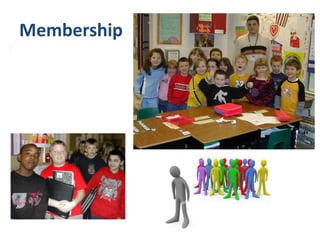
Membership
7
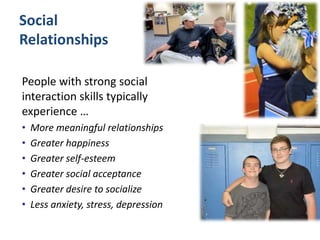
Social
Relationships
People with strong social
interaction skills typically
experience …
• More meaningful relationships
• Greater happiness
• Greater self-esteem
• Greater social acceptance
• Greater desire to socialize
• Less anxiety, stress, depression
Inclusive Education means…
• Natural Proportions
• No “Inclusion” classes
• Participation
Active
Meaningful
WITH PEERS
• Also outside of school
activities
NOT “Inclusion”
Maryland Coalition for Inclusive Education
The extent of a school’s success will
be directly related
to the extent that the school has
moved toward
a collaborative model
across school teams.
CHANGE: a grown-up problem
Who
• is responsible?
• decides what to teach?
• makes modifications?
What if one of the collaborating teachers does not:
Use differentiated lesson planning based on UDL
Use positive and preventive approach to problem
behavior
Want to collaborate?
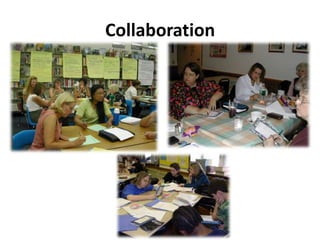
Collaboration
BARRIERS
• Staff Resistance: shared ownership/responsibility issues, different
philosophy, lack of knowledge about current & effective practices.
Especially re:students with significant needs and behavior issues
• Parental understanding of the benefits of receiving special
education services in general education classes/accessing
curriculum
• Knowledge/skill: Lack of understanding how to implement co-
teaching and collaboration and differentiated lesson planning
• Limited collaborative planning time
BARRIERS
• Role of paraeducators and issues related to supervision and
duties
• Case management caseload
• Quality general education instruction: lack of differentiation
and quality strategies
• Need for grading policies & procedures for students with
disabilities particularly when not performing at grade level
• Administrator resistance to change
• Scheduling practices: Need to change how staff and students are
assigned & time is found
What makes the difference in
District planning?
• General Ed Leadership: Superintendent
• Steering Committee
• General Education & Special Education Supervisors
• Action Planning Process
• System-wide professional development
• Stakeholder Engagement
• Clarify and Communicate the VISION
What makes the difference in
School planning?
• Administrative support
• Needs Assessments (survey and group process)
• School based teams to plan inclusive practices
• Action Plans and focused planning team
• Technical Assistance/Job-embedded staff development
• Reinforcing the need for regular collaborative planning for
students who are challenging academically or behaviorally
• Articulation planning at the end of the school year
• 15% guideline to maintain natural proportions of students
with IEPs in general education classes
School Structures
• Collaborative planning (TIME)
• Collaborative planning (PRACTICES)
• Differentiated Instruction (DI) with a curriculum based on
principles of Universal Design for Learning (UDL)
• Multi-tierred Systems of Support (MTSS) for academic and
behavioral strategies and interventions
• Interventions that are based on evidence of effectiveness
• Shared roles and responsibilities
Maryland Coalition for Inclusive Education
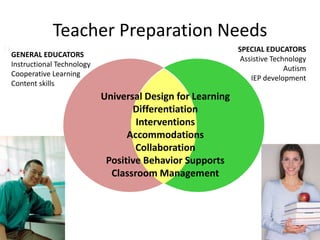
Teacher Preparation Needs
Universal Design for Learning
Differentiation
Interventions
Accommodations
Collaboration
Positive Behavior Supports
Classroom Management
GENERAL EDUCATORS
Instructional Technology
Cooperative Learning
Content skills
SPECIAL EDUCATORS
Assistive Technology
Autism
IEP development
11
Research: what does it say?
How does inclusive education affect
children with disabilities AND
children without disabilities??
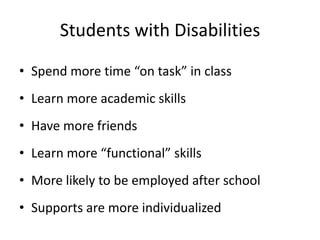
Students with Disabilities
• Spend more time “on task” in class
• Learn more academic skills
• Have more friends
• Learn more “functional” skills
• More likely to be employed after school
• Supports are more individualized
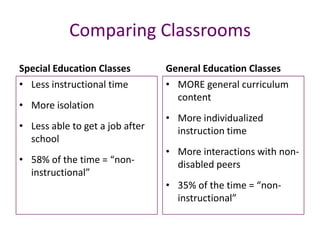
Comparing Classrooms
Special Education Classes
• Less instructional time
• More isolation
• Less able to get a job after
school
• 58% of the time = “non-
instructional”
General Education Classes
• MORE general curriculum
content
• More individualized
instruction time
• More interactions with non-
disabled peers
• 35% of the time = “non-
instructional”
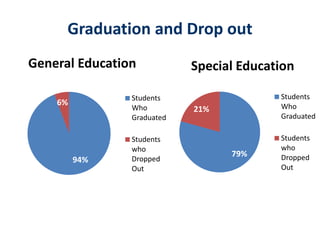
79%
21%
Special Education
Students
Who
Graduated
Students
who
Dropped
Out
94%
6%
General Education
Students
Who
Graduated
Students
who
Dropped
Out
Graduation and Drop out
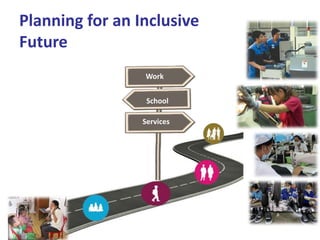
Planning for an Inclusive
Future
Work
School
Services
Normalization
a normal rhythm to the day and year
a normal routine to life
the normal developmental experiences of the life cycle
having one’s choices, wishes and desires taken into
consideration and respected
normal economic standards
standards of facilities similar to those experienced by
others
Community Participation
• By being educated with nondisabled
peers, people with disabilities will be more
likely to become involved in and valued by
their communities.
Self-Determination
• Strategies that enable students to regulate
their own behavior, set their own
goals, monitor their own performance, and
identify solutions to current problems.
Natural Peer Supports
• Teachers and peers can provide
accommodations to reduce reliance on
additional adult support.
Community Awareness and Public
Relations
• Informing and involving the community of
service providers, businesses, and employers
leads to positive attitudes toward integrating
people with disabilities into the community
and workplace in the future
Inclusion in General Education
Instruction
• More time spent in school and class with
nondisabled peers leads to better outcomes
for learning during school years and
employment after school.
Community Collaboration
and Shared Responsibility
• When students and their families take active
roles in determining educational goals, the
school and other service providers can plan
instruction and functional life skills activities.
Presuming Competence
• Schools and families make the LEAST
DANGEROUS ASSUMPTION when they have
high expectations and assume that the
student is learning (even when they are not
sure!)
Current Practices
• What are the traditional practices?
–WHERE children with disabilities go to
school
–What they are taught (same or
different)
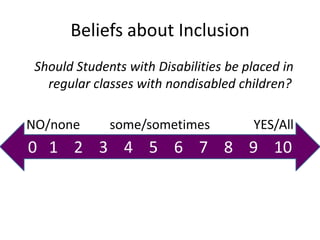
Beliefs about Inclusion
Should Students with Disabilities be placed in
regular classes with nondisabled children?
NO/none some/sometimes YES/All
0 1 2 3 4 5 6 7 8 9 10
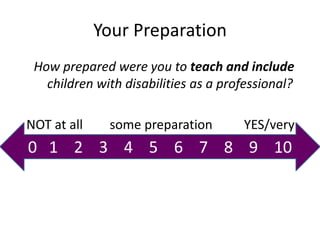
Your Preparation
How prepared were you to teach and include
children with disabilities as a professional?
NOT at all some preparation YES/very
0 1 2 3 4 5 6 7 8 9 10
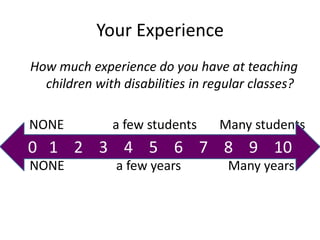
Your Experience
How much experience do you have at teaching
children with disabilities in regular classes?
NONE a few students Many students
NONE a few years Many years
0 1 2 3 4 5 6 7 8 9 10
What do we need to do next?
Put one idea on each paper
THANK YOU!
Inclusive
Education
for ALL
Children!

Carol Quirk: Developing Inclusive Education

  • 1.
  • 2.
    Vision A society where neighborhoodschools welcome all students, engage them in learning, and form the foundation for inclusive communities. Neighborhood schools where students with disabilities benefit from meaningful instruction, have friends, and be full members of their school Keep your feet on the ground while dreaming with your head in the clouds
  • 3.
    “Inclusion” is not “Placement” PhysicalAccess to ENVIRONMENTS Meaningful ACADEMIC participation Positive SOCIAL RELATIONSHIPS INCLUSIO N
  • 4.
    Academic Instruction • GeneralCurriculum • Accommodations • Modifications • Embedded Skills Universal Design Differentiated Instruction Interventions Specialized Instruction
  • 5.
  • 6.
    Social Relationships People with strongsocial interaction skills typically experience … • More meaningful relationships • Greater happiness • Greater self-esteem • Greater social acceptance • Greater desire to socialize • Less anxiety, stress, depression
  • 7.
    Inclusive Education means… •Natural Proportions • No “Inclusion” classes • Participation Active Meaningful WITH PEERS • Also outside of school activities NOT “Inclusion”
  • 8.
    Maryland Coalition forInclusive Education The extent of a school’s success will be directly related to the extent that the school has moved toward a collaborative model across school teams.
  • 9.
    CHANGE: a grown-upproblem Who • is responsible? • decides what to teach? • makes modifications? What if one of the collaborating teachers does not: Use differentiated lesson planning based on UDL Use positive and preventive approach to problem behavior Want to collaborate?
  • 10.
  • 11.
    BARRIERS • Staff Resistance:shared ownership/responsibility issues, different philosophy, lack of knowledge about current & effective practices. Especially re:students with significant needs and behavior issues • Parental understanding of the benefits of receiving special education services in general education classes/accessing curriculum • Knowledge/skill: Lack of understanding how to implement co- teaching and collaboration and differentiated lesson planning • Limited collaborative planning time
  • 12.
    BARRIERS • Role ofparaeducators and issues related to supervision and duties • Case management caseload • Quality general education instruction: lack of differentiation and quality strategies • Need for grading policies & procedures for students with disabilities particularly when not performing at grade level • Administrator resistance to change • Scheduling practices: Need to change how staff and students are assigned & time is found
  • 13.
    What makes thedifference in District planning? • General Ed Leadership: Superintendent • Steering Committee • General Education & Special Education Supervisors • Action Planning Process • System-wide professional development • Stakeholder Engagement • Clarify and Communicate the VISION
  • 14.
    What makes thedifference in School planning? • Administrative support • Needs Assessments (survey and group process) • School based teams to plan inclusive practices • Action Plans and focused planning team • Technical Assistance/Job-embedded staff development • Reinforcing the need for regular collaborative planning for students who are challenging academically or behaviorally • Articulation planning at the end of the school year • 15% guideline to maintain natural proportions of students with IEPs in general education classes
  • 15.
    School Structures • Collaborativeplanning (TIME) • Collaborative planning (PRACTICES) • Differentiated Instruction (DI) with a curriculum based on principles of Universal Design for Learning (UDL) • Multi-tierred Systems of Support (MTSS) for academic and behavioral strategies and interventions • Interventions that are based on evidence of effectiveness • Shared roles and responsibilities Maryland Coalition for Inclusive Education
  • 16.
    Teacher Preparation Needs UniversalDesign for Learning Differentiation Interventions Accommodations Collaboration Positive Behavior Supports Classroom Management GENERAL EDUCATORS Instructional Technology Cooperative Learning Content skills SPECIAL EDUCATORS Assistive Technology Autism IEP development 11
  • 17.
    Research: what doesit say? How does inclusive education affect children with disabilities AND children without disabilities??
  • 18.
    Students with Disabilities •Spend more time “on task” in class • Learn more academic skills • Have more friends • Learn more “functional” skills • More likely to be employed after school • Supports are more individualized
  • 19.
    Comparing Classrooms Special EducationClasses • Less instructional time • More isolation • Less able to get a job after school • 58% of the time = “non- instructional” General Education Classes • MORE general curriculum content • More individualized instruction time • More interactions with non- disabled peers • 35% of the time = “non- instructional”
  • 20.
  • 21.
    Planning for anInclusive Future Work School Services
  • 22.
    Normalization a normal rhythmto the day and year a normal routine to life the normal developmental experiences of the life cycle having one’s choices, wishes and desires taken into consideration and respected normal economic standards standards of facilities similar to those experienced by others
  • 23.
    Community Participation • Bybeing educated with nondisabled peers, people with disabilities will be more likely to become involved in and valued by their communities.
  • 24.
    Self-Determination • Strategies thatenable students to regulate their own behavior, set their own goals, monitor their own performance, and identify solutions to current problems.
  • 25.
    Natural Peer Supports •Teachers and peers can provide accommodations to reduce reliance on additional adult support.
  • 26.
    Community Awareness andPublic Relations • Informing and involving the community of service providers, businesses, and employers leads to positive attitudes toward integrating people with disabilities into the community and workplace in the future
  • 27.
    Inclusion in GeneralEducation Instruction • More time spent in school and class with nondisabled peers leads to better outcomes for learning during school years and employment after school.
  • 28.
    Community Collaboration and SharedResponsibility • When students and their families take active roles in determining educational goals, the school and other service providers can plan instruction and functional life skills activities.
  • 29.
    Presuming Competence • Schoolsand families make the LEAST DANGEROUS ASSUMPTION when they have high expectations and assume that the student is learning (even when they are not sure!)
  • 30.
    Current Practices • Whatare the traditional practices? –WHERE children with disabilities go to school –What they are taught (same or different)
  • 31.
    Beliefs about Inclusion ShouldStudents with Disabilities be placed in regular classes with nondisabled children? NO/none some/sometimes YES/All 0 1 2 3 4 5 6 7 8 9 10
  • 32.
    Your Preparation How preparedwere you to teach and include children with disabilities as a professional? NOT at all some preparation YES/very 0 1 2 3 4 5 6 7 8 9 10
  • 33.
    Your Experience How muchexperience do you have at teaching children with disabilities in regular classes? NONE a few students Many students NONE a few years Many years 0 1 2 3 4 5 6 7 8 9 10
  • 34.
    What do weneed to do next? Put one idea on each paper
  • 35.

Editor's Notes