INCLUSIVE EDUCATION 
4th National Conference 
Workshop in Special Education 
Ma. Paz A. Manaligod, PhD 
Miriam College
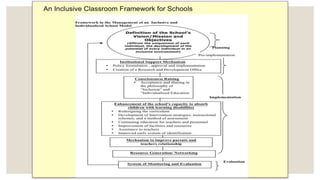
Inclusion defined: 
◦ Education of students with disabilities in general 
education settings (Mastropieri & Scruggs, 2000) 
All students with a disability have a right to be 
educated in the general education setting with 
appropriate support and services.
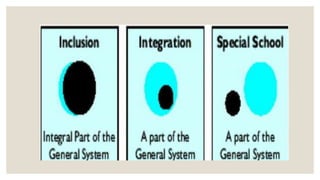
What is Inclusive Education? 
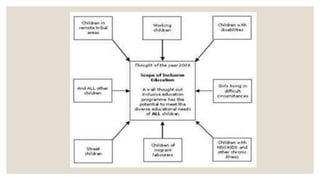
◦ Inclusion means including all children and young people in their 
local mainstream school. 
◦ Inclusion means young people and adults with disabilities being 
included in mainstream society. 
◦ Inclusion is an ongoing process. 
◦ Inclusive schools help the development of communities where all 
people are equally valued and have the same opportunities for 
participation.
INTERNATIONAL DOCUMENTS on INCLUSIVE EDUCATION 
◦UN Conventions on the Rights of the Child (1989) 
◦World Declaration on Education for All (1990) 
◦UNESCO Salamanca Statement and Framework for 
Action (1994) 
“Inclusion and participation are essential to human dignity and to the enjoyment and 
exercise of human rights. Within the field of education this is reflected in the development of 
strategies to bring about a genuine equalisation of opportunity” (United Nations Educational Scientific and Cultural 
Organisation (UNESCO), 1994:11)
Our EDUCATION POLICIES 
◦The right to education is a basic human right. 
◦All children and youth shall have access to quality 
education. 
◦Inclusive education shall be concerned with all 
learners, with focus on those who have traditionally 
been excluded from educational opportunities. 
◦Support system shall be organized and delivered 
holistically.
PUBLIC POLICY SUPPORT on INCLUSIVE EDUCATION 
◦ The 1987 Philippine Constitution Art. IV. Sec 2 mandates the state to encourage non-formal, informal and 
indigenous learning systems as well as learning independent and out of school youth study programs and to provide adult citizens, the 
disabled and OSY with training on civics, vocational efficiency and other skills. 
◦ P.D. 603 - The Child and Youth Welfare Code PD 603 (1974) – Article 3 accounts for the rights of the 
child. 
◦ RA. 7610 – Special Protection of Children against Child Abuse, 
Exploitation and Discrimination Act Art 1 section 2 states that a comprehensive program shall be 
formulated to protect children against any form of abuse which endanger child survival and normal development 
◦ R.A. 7277- The Magna Carta for Disabled Persons amended by R.A 9442 
Provides for the rehabilitation, self-development and self-reliance of disabled persons and their integration into the mainstream of 
society 
◦ Policies and Guidelines in Special Education Art 1 Sec 5 states that the ultimate goal of SPED shall 
be the integration or mainsteaming of learners with special needs into the regular school system and eventually into the community
Moving towards Inclusion 
◦ Human Rights movement in the 1960s. 
◦ Changing views on people with disabilities within the wider 
society. 
◦ Focusing on similarities between children with disabilities and 
other children, rather than differences. 
(Frederickson & Cline, 2002)
Research on the advantages of Inclusion 
(Salend, 2005 & Smith et al., 2006) 
◦Students with disabilities who are included in the 
general education curricula can benefit socially 
and academically without facing the stigma of 
segregated or pull-out classrooms. 
◦Standards for behavior and instruction are 
higher, and students with classifications have 
more opportunity to reach higher standards and 
become independent learners.
◦Students without disabilities can benefit from 
inclusive settings. 
Academic performance is equal or superior to 
comparative groups of students educated in a 
noninclusive setting. 
Students with disabilities do not significantly limit 
or interrupt instructional time for 
nondisabled peers in inclusive settings. 
Friendships and awareness of diversity are also 
benefits of the inclusive classroom.
◦ All students are learners who benefit from a 
meaningful, challenging, and appropriate 
curriculum and differentiated instruction 
techniques that address their unique strengths 
and needs (Salend, 2005) 
Inclusion education is the collaborative effort of 
general educators, parents, related service 
providers and all school community members who 
share a role in the successful education of 
students with special needs.
Inclusive Education and the Research Evidence 
◦No evidence that segregated education fosters social or 
academic progress over mainstream school education. 
◦Some studies show advantages to inclusive placements 
if accompanied by an appropriate individualised 
programme. 
◦Other studies have reported that there is a small to 
moderate advantage to inclusion on both social and 
academic outcomes. 
( Frederickson & Cline, 2002)
Inclusive Education and the Research Evidence 
◦Evidence suggests that inclusion supported progress 
of children without disabilities. 
◦Inclusion found to have positive impact and 
facilitates the education of all children. 
◦Teacher time not affected by presence of students 
with special educational needs 
( Frederickson & Cline, 2002)
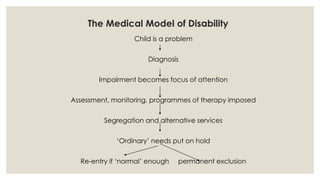
The Medical Model of Disability 
Child is a problem 
Diagnosis 
Impairment becomes focus of attention 
Assessment, monitoring, programmes of therapy imposed 
Segregation and alternative services 
‘Ordinary’ needs put on hold 
Re-entry if ‘normal’ enough permanent exclusion
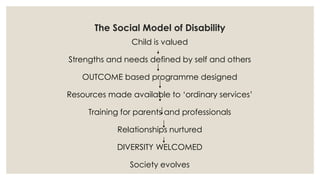
The Social Model of Disability 
Child is valued 
Strengths and needs defined by self and others 
OUTCOME based programme designed 
Resources made available to ‘ordinary services’ 
Training for parents and professionals 
Relationships nurtured 
DIVERSITY WELCOMED 
Society evolves
Paz / Introduction 20
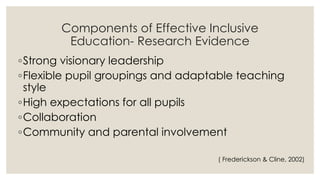
Components of Effective Inclusive 
Education- Research Evidence 
◦Strong visionary leadership 
◦Flexible pupil groupings and adaptable teaching 
style 
◦High expectations for all pupils 
◦Collaboration 
◦Community and parental involvement 
( Frederickson & Cline, 2002)
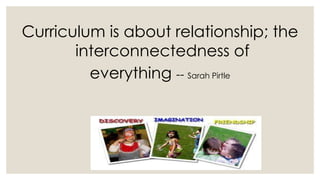
Curriculum is about relationship; the 
interconnectedness of 
everything -- Sarah Pirtle
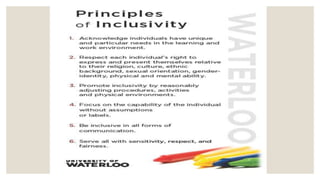
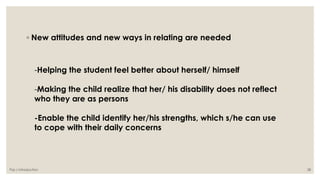
◦ New attitudes and new ways in relating are needed 
-Helping the student feel better about herself/ himself 
-Making the child realize that her/ his disability does not reflect 
who they are as persons 
-Enable the child identify her/his strengths, which s/he can use 
to cope with their daily concerns 
Paz / Introduction 28
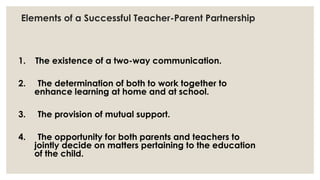
Elements of a Successful Teacher-Parent Partnership 
1. The existence of a two-way communication. 
2. The determination of both to work together to 
enhance learning at home and at school. 
3. The provision of mutual support. 
4. The opportunity for both parents and teachers to 
jointly decide on matters pertaining to the education 
of the child.
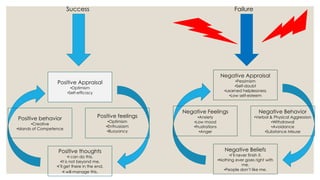
Success Failure 
Negative Appraisal 
•Pessimism 
•Self-doubt 
•Learned helplessness 
•Low self-esteem 
Negative Behavior 
•Verbal & Physical Aggression 
•Withdrawal 
•Avoidance 
•Substance Misuse 
Negative Feelings 
Negative Beliefs 
•I’ll never finish it. 
•Nothing ever goes right with 
me. 
•People don’t like me. 
•Anxiety 
•Low mood 
•Frustrations 
•Anger 
Positive Appraisal 
•Optimism 
•Self-efficacy 
Positive feelings 
•Optimism 
•Enthusiasm 
•Buoyancy 
Positive thoughts 
•I can do this. 
•It is not beyond me. 
•I’ll get there in the end. 
•I will manage this. 
Positive behavior 
•Creative 
•Islands of Competence
Paz / Introduction 33 
◦ 
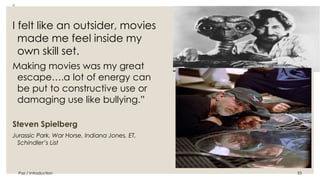
I felt like an outsider, movies 
made me feel inside my 
own skill set. 
Making movies was my great 
escape….a lot of energy can 
be put to constructive use or 
damaging use like bullying.” 
Steven Spielberg 
Jurassic Park, War Horse, Indiana Jones, ET, 
Schindler’s List
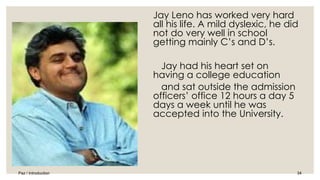
Jay Leno has worked very hard 
all his life. A mild dyslexic, he did 
not do very well in school 
getting mainly C’s and D’s. 
Jay had his heart set on 
having a college education 
and sat outside the admission 
officers’ office 12 hours a day 5 
days a week until he was 
accepted into the University. 
Paz / Introduction 34
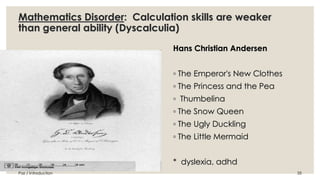
Mathematics Disorder: Calculation skills are weaker 
than general ability (Dyscalculia) 
Hans Christian Andersen 
◦ The Emperor's New Clothes 
◦ The Princess and the Pea 
◦ Thumbelina 
◦ The Snow Queen 
◦ The Ugly Duckling 
◦ The Little Mermaid 
* dyslexia, adhd 
Paz / Introduction 35
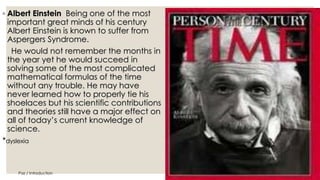
◦ Albert Einstein Being one of the most 
important great minds of his century 
Albert Einstein is known to suffer from 
Aspergers Syndrome. 
He would not remember the months in 
the year yet he would succeed in 
solving some of the most complicated 
mathematical formulas of the time 
without any trouble. He may have 
never learned how to properly tie his 
shoelaces but his scientific contributions 
and theories still have a major effect on 
all of today’s current knowledge of 
science. 
*dyslexia 
Paz / Introduction 36
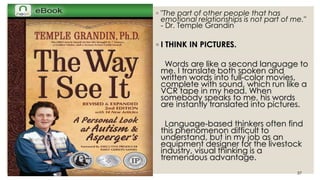
◦ "The part of other people that has 
emotional relationships is not part of me." 
- Dr. Temple Grandin 
◦ I THINK IN PICTURES. 
Words are like a second language to 
me. I translate both spoken and 
written words into full-color movies, 
complete with sound, which run like a 
VCR tape in my head. When 
somebody speaks to me, his words 
are instantly translated into pictures. 
Language-based thinkers often find 
this phenomenon difficult to 
understand, but in my job as an 
equipment designer for the livestock 
industry, visual thinking is a 
tremendous advantage. 
Paz / Introduction 37
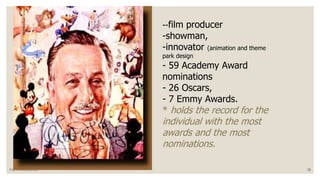
--film producer 
-showman, 
-innovator (animation and theme 
park design 
- 59 Academy Award 
nominations 
- 26 Oscars, 
- 7 Emmy Awards. 
* holds the record for the 
individual with the most 
awards and the most 
nominations. 
Paz / Introduction 38
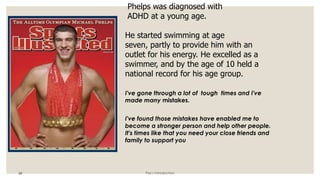
Phelps was diagnosed with 
ADHD at a young age. 
He started swimming at age 
seven, partly to provide him with an 
outlet for his energy. He excelled as a 
swimmer, and by the age of 10 held a 
national record for his age group. 
I've gone through a lot of tough times and I've 
made many mistakes. 
I've found those mistakes have enabled me to 
become a stronger person and help other people. 
It's times like that you need your close friends and 
family to support you 
39 Paz / Introduction
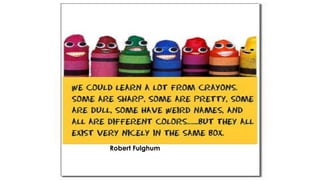
Robert Fulghum
THANK YOU FOR 
LISTENING

In clusive education

  • 1.
    INCLUSIVE EDUCATION 4thNational Conference Workshop in Special Education Ma. Paz A. Manaligod, PhD Miriam College
  • 2.
    Inclusion defined: ◦Education of students with disabilities in general education settings (Mastropieri & Scruggs, 2000) All students with a disability have a right to be educated in the general education setting with appropriate support and services.
  • 4.
    What is InclusiveEducation? ◦ Inclusion means including all children and young people in their local mainstream school. ◦ Inclusion means young people and adults with disabilities being included in mainstream society. ◦ Inclusion is an ongoing process. ◦ Inclusive schools help the development of communities where all people are equally valued and have the same opportunities for participation.
  • 7.
    INTERNATIONAL DOCUMENTS onINCLUSIVE EDUCATION ◦UN Conventions on the Rights of the Child (1989) ◦World Declaration on Education for All (1990) ◦UNESCO Salamanca Statement and Framework for Action (1994) “Inclusion and participation are essential to human dignity and to the enjoyment and exercise of human rights. Within the field of education this is reflected in the development of strategies to bring about a genuine equalisation of opportunity” (United Nations Educational Scientific and Cultural Organisation (UNESCO), 1994:11)
  • 8.
    Our EDUCATION POLICIES ◦The right to education is a basic human right. ◦All children and youth shall have access to quality education. ◦Inclusive education shall be concerned with all learners, with focus on those who have traditionally been excluded from educational opportunities. ◦Support system shall be organized and delivered holistically.
  • 9.
    PUBLIC POLICY SUPPORTon INCLUSIVE EDUCATION ◦ The 1987 Philippine Constitution Art. IV. Sec 2 mandates the state to encourage non-formal, informal and indigenous learning systems as well as learning independent and out of school youth study programs and to provide adult citizens, the disabled and OSY with training on civics, vocational efficiency and other skills. ◦ P.D. 603 - The Child and Youth Welfare Code PD 603 (1974) – Article 3 accounts for the rights of the child. ◦ RA. 7610 – Special Protection of Children against Child Abuse, Exploitation and Discrimination Act Art 1 section 2 states that a comprehensive program shall be formulated to protect children against any form of abuse which endanger child survival and normal development ◦ R.A. 7277- The Magna Carta for Disabled Persons amended by R.A 9442 Provides for the rehabilitation, self-development and self-reliance of disabled persons and their integration into the mainstream of society ◦ Policies and Guidelines in Special Education Art 1 Sec 5 states that the ultimate goal of SPED shall be the integration or mainsteaming of learners with special needs into the regular school system and eventually into the community
  • 10.
    Moving towards Inclusion ◦ Human Rights movement in the 1960s. ◦ Changing views on people with disabilities within the wider society. ◦ Focusing on similarities between children with disabilities and other children, rather than differences. (Frederickson & Cline, 2002)
  • 11.
    Research on theadvantages of Inclusion (Salend, 2005 & Smith et al., 2006) ◦Students with disabilities who are included in the general education curricula can benefit socially and academically without facing the stigma of segregated or pull-out classrooms. ◦Standards for behavior and instruction are higher, and students with classifications have more opportunity to reach higher standards and become independent learners.
  • 12.
    ◦Students without disabilitiescan benefit from inclusive settings. Academic performance is equal or superior to comparative groups of students educated in a noninclusive setting. Students with disabilities do not significantly limit or interrupt instructional time for nondisabled peers in inclusive settings. Friendships and awareness of diversity are also benefits of the inclusive classroom.
  • 13.
    ◦ All studentsare learners who benefit from a meaningful, challenging, and appropriate curriculum and differentiated instruction techniques that address their unique strengths and needs (Salend, 2005) Inclusion education is the collaborative effort of general educators, parents, related service providers and all school community members who share a role in the successful education of students with special needs.
  • 14.
    Inclusive Education andthe Research Evidence ◦No evidence that segregated education fosters social or academic progress over mainstream school education. ◦Some studies show advantages to inclusive placements if accompanied by an appropriate individualised programme. ◦Other studies have reported that there is a small to moderate advantage to inclusion on both social and academic outcomes. ( Frederickson & Cline, 2002)
  • 15.
    Inclusive Education andthe Research Evidence ◦Evidence suggests that inclusion supported progress of children without disabilities. ◦Inclusion found to have positive impact and facilitates the education of all children. ◦Teacher time not affected by presence of students with special educational needs ( Frederickson & Cline, 2002)
  • 16.
    The Medical Modelof Disability Child is a problem Diagnosis Impairment becomes focus of attention Assessment, monitoring, programmes of therapy imposed Segregation and alternative services ‘Ordinary’ needs put on hold Re-entry if ‘normal’ enough permanent exclusion
  • 18.
    The Social Modelof Disability Child is valued Strengths and needs defined by self and others OUTCOME based programme designed Resources made available to ‘ordinary services’ Training for parents and professionals Relationships nurtured DIVERSITY WELCOMED Society evolves
  • 20.
  • 21.
    Components of EffectiveInclusive Education- Research Evidence ◦Strong visionary leadership ◦Flexible pupil groupings and adaptable teaching style ◦High expectations for all pupils ◦Collaboration ◦Community and parental involvement ( Frederickson & Cline, 2002)
  • 25.
    Curriculum is aboutrelationship; the interconnectedness of everything -- Sarah Pirtle
  • 28.
    ◦ New attitudesand new ways in relating are needed -Helping the student feel better about herself/ himself -Making the child realize that her/ his disability does not reflect who they are as persons -Enable the child identify her/his strengths, which s/he can use to cope with their daily concerns Paz / Introduction 28
  • 30.
    Elements of aSuccessful Teacher-Parent Partnership 1. The existence of a two-way communication. 2. The determination of both to work together to enhance learning at home and at school. 3. The provision of mutual support. 4. The opportunity for both parents and teachers to jointly decide on matters pertaining to the education of the child.
  • 31.
    Success Failure NegativeAppraisal •Pessimism •Self-doubt •Learned helplessness •Low self-esteem Negative Behavior •Verbal & Physical Aggression •Withdrawal •Avoidance •Substance Misuse Negative Feelings Negative Beliefs •I’ll never finish it. •Nothing ever goes right with me. •People don’t like me. •Anxiety •Low mood •Frustrations •Anger Positive Appraisal •Optimism •Self-efficacy Positive feelings •Optimism •Enthusiasm •Buoyancy Positive thoughts •I can do this. •It is not beyond me. •I’ll get there in the end. •I will manage this. Positive behavior •Creative •Islands of Competence
  • 33.
    Paz / Introduction33 ◦ I felt like an outsider, movies made me feel inside my own skill set. Making movies was my great escape….a lot of energy can be put to constructive use or damaging use like bullying.” Steven Spielberg Jurassic Park, War Horse, Indiana Jones, ET, Schindler’s List
  • 34.
    Jay Leno hasworked very hard all his life. A mild dyslexic, he did not do very well in school getting mainly C’s and D’s. Jay had his heart set on having a college education and sat outside the admission officers’ office 12 hours a day 5 days a week until he was accepted into the University. Paz / Introduction 34
  • 35.
    Mathematics Disorder: Calculationskills are weaker than general ability (Dyscalculia) Hans Christian Andersen ◦ The Emperor's New Clothes ◦ The Princess and the Pea ◦ Thumbelina ◦ The Snow Queen ◦ The Ugly Duckling ◦ The Little Mermaid * dyslexia, adhd Paz / Introduction 35
  • 36.
    ◦ Albert EinsteinBeing one of the most important great minds of his century Albert Einstein is known to suffer from Aspergers Syndrome. He would not remember the months in the year yet he would succeed in solving some of the most complicated mathematical formulas of the time without any trouble. He may have never learned how to properly tie his shoelaces but his scientific contributions and theories still have a major effect on all of today’s current knowledge of science. *dyslexia Paz / Introduction 36
  • 37.
    ◦ "The partof other people that has emotional relationships is not part of me." - Dr. Temple Grandin ◦ I THINK IN PICTURES. Words are like a second language to me. I translate both spoken and written words into full-color movies, complete with sound, which run like a VCR tape in my head. When somebody speaks to me, his words are instantly translated into pictures. Language-based thinkers often find this phenomenon difficult to understand, but in my job as an equipment designer for the livestock industry, visual thinking is a tremendous advantage. Paz / Introduction 37
  • 38.
    --film producer -showman, -innovator (animation and theme park design - 59 Academy Award nominations - 26 Oscars, - 7 Emmy Awards. * holds the record for the individual with the most awards and the most nominations. Paz / Introduction 38
  • 39.
    Phelps was diagnosedwith ADHD at a young age. He started swimming at age seven, partly to provide him with an outlet for his energy. He excelled as a swimmer, and by the age of 10 held a national record for his age group. I've gone through a lot of tough times and I've made many mistakes. I've found those mistakes have enabled me to become a stronger person and help other people. It's times like that you need your close friends and family to support you 39 Paz / Introduction
  • 40.
  • 41.
    THANK YOU FOR LISTENING