Addressing the Needs of 
Students with Disabilities 
MISE High School
Multidisciplinary Team 10 
ROLE NAME 
Special Education Teacher Eman Zayed 
General Education Teacher Izdhar Deeb 
Social Worker Sara Gierhahn 
Physical/Speech/Language 
Therapist 
Marissa Charleston
Outline 
● School Information 
● Special Education 
● Inclusion 
● General Recommendations 
● Specific Recommendations 
o Attention Deficit Hyperactivity Disorder 
o Autism 
o Hearing Impairments 
● Conclusion
MISE High School 
• Student Population: 636 
• Grades 9-12 
• School Demographics: 
-African American 45% 
-Hispanic 51% 
-White 2% 
-Other 2% 
• Statistics: 
-93% Low Income 
-23% Students with Disabilities 
-4% Homeless 
-9% English Learners
MISE High School 
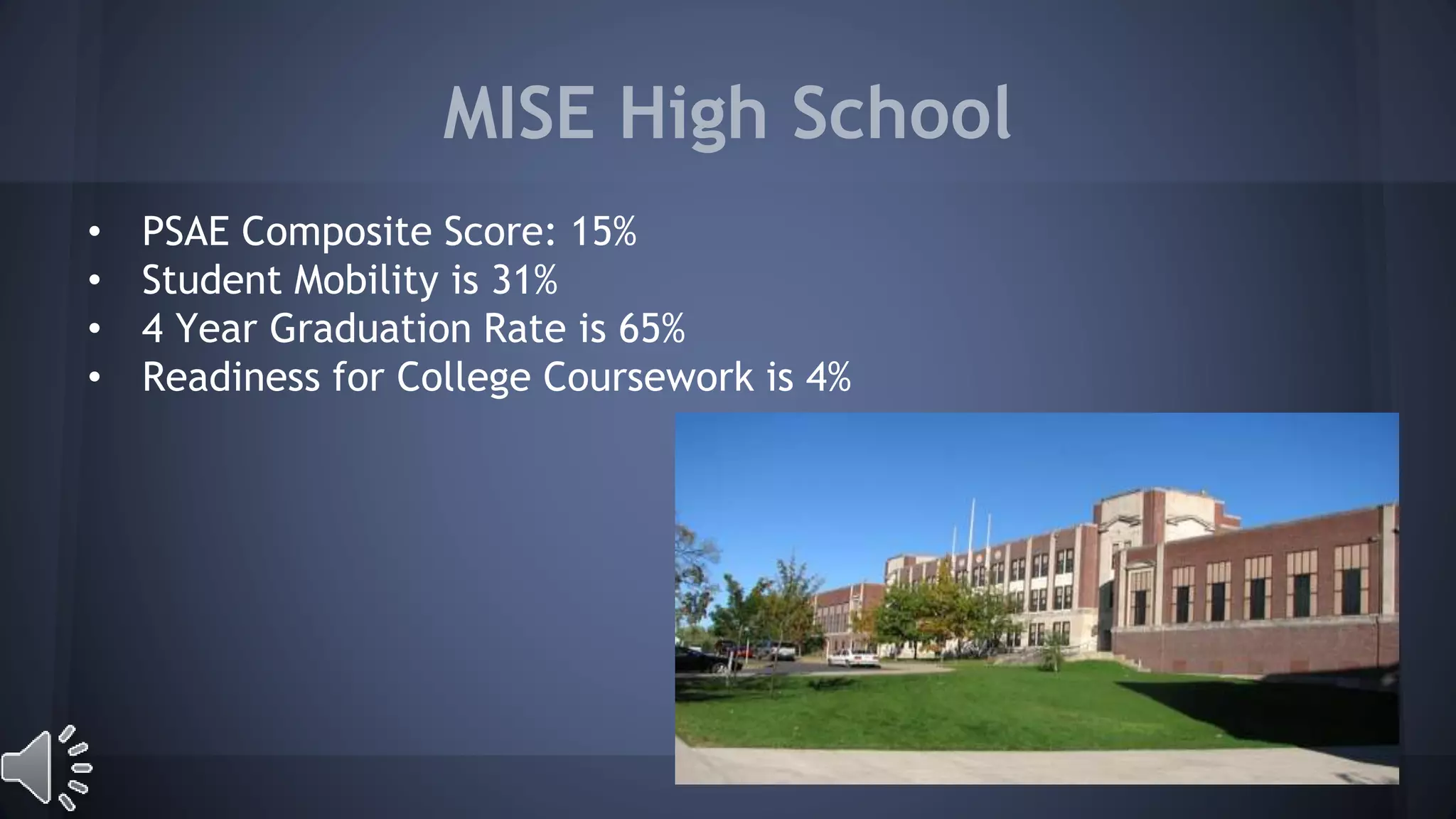
• PSAE Composite Score: 15% 
• Student Mobility is 31% 
• 4 Year Graduation Rate is 65% 
• Readiness for College Coursework is 4%
Special Education Information 
• Approximately 6 million students ages six through twenty-one 
receive some form of special education. (Turnbull 2011) 
• Laws such as IDEA were put into effect because of constant 
discrimination. 
-ESEA which was amended by NCLB 
-Rehabilitation Act 
-Tech Act
Special Education Information 
The Individual with Disabilities Education Act is a federal law that 
requires schools to serve the educational needs of eligible students 
with disabilities. 
6 Principles of IDEA 
• Zero Reject 
• Nondiscriminatory Evaluation 
• Appropriate Education 
• Least Restrictive Environment 
• Procedural Due Process 
• Parent and Student Participation
Overview of Inclusion 
Definition: 
● Based on IDEA’s principal of 
the least restrictive 
environment 
● Students with disabilities 
participate in academic, 
extracurricular, and other 
school activities with their 
nondisabled peers 
(Turnbull, Turnbull, & Wehmeyer, 2013) 
Characteristics: 
● Home-School Placement 
● Principal of Natural Proportions 
● Restructuring Teaching and 
Learning 
o Family-Professional 
Partnerships 
o Co-teaching 
● Age- and Grade-Appropriate 
Placements
Inclusion continued 
Critical components of successful inclusion: 
● Administrative support 
● Support from special education personnel 
● Accepting, positive classroom atmosphere 
● Appropriate curriculum 
● Effective general teaching skills 
● Peer assistance/tutoring 
● Disability-specific teaching skills 
(Mastropieri and Scruggs, 2001) 
Benefits of inclusion: 
● Academic 
● Social 
● Emotional 
● Behavioral 
● Promotes UDL
General Recommendations 
Circle of Friends 
educators and/or parents inviting peers to form a 
support network for a student with a disability so that 
the student will have friends (Turnbull et al., 2013).
General Recommendations 
Circle of Friends tips for 
implementation 
● Recruit students 
● identify a facilitator 
● determine the size of the group 
● decide where and when to meet 
● identify group activities 
● adjust activities as the students 
grow older 
● give students ownership of the 
circle 
Establish three ground rules: 
1. everyone has access to all of the 
materials used during the 
meetings 
2. all activities must be age 
appropriate 
3. everyone participates in all 
activities 
(Turnbull et al., 2013)
General Recommendations 
UDL: Universal Design for Learning 
Provide multiple means of representation 
● visual 
● oral 
Provide multiple means of student expression 
● Writing 
● speaking 
● illustrating 
Provide flexible means of engagement 
● videos 
● software 
● role playing, etc.
ADHD- What is it? 
“Attention deficit hyperactivity disorder (ADHD) is one of the most common 
childhood disorders and can continue through adolescence and adulthood. 
Symptoms include difficulty staying focused and paying attention, difficulty 
controlling behavior, and hyperactivity (over-activity) ("Attention Deficit 
Hyperactivity Disorder (ADHD)") 
Three types: 
● predominantly inattentive 
● predominantly hyperactive-impulsive 
● combined type 
Causes: 
● heredity 
● structural differences in the brain 
● environmental
Accommodations for ADHD 
Inattention: 
● seat them in quiet areas 
● give them more time to 
complete assignments 
Impulsive: 
● ignore inappropriate behaviors 
● reward appropriate behaviors 
Excessive motor activity: 
● let them stand in class, run 
errands, break between 
assignments 
Mood characteristics: 
● reassure and encourage them, 
speak gently 
● involve parents in student 
communication 
Organizational problems: 
● incorporate notebooks, folders, 
dividers, smart phones to help 
students remember, provide daily 
weekly reports for parents 
(Turnbull et al., 2013)
ADHD 
Goal-setting and organizational skills 
“Goal setting and organizational skills go hand in hand to promote 
better outcomes. If a students sets a goal, he is more likely to 
perform behaviors related to that goal. Goal-setting is one of the 
critical predictors of success in adulthood for students with 
AD/HD”(Turnbull et al., 2013). 
1. Identify a goal clearly and concretely 
2. Develop a series of objectives or tasks to achieve the goal 
3. Specify the actions necessary to achieve the desired outcome
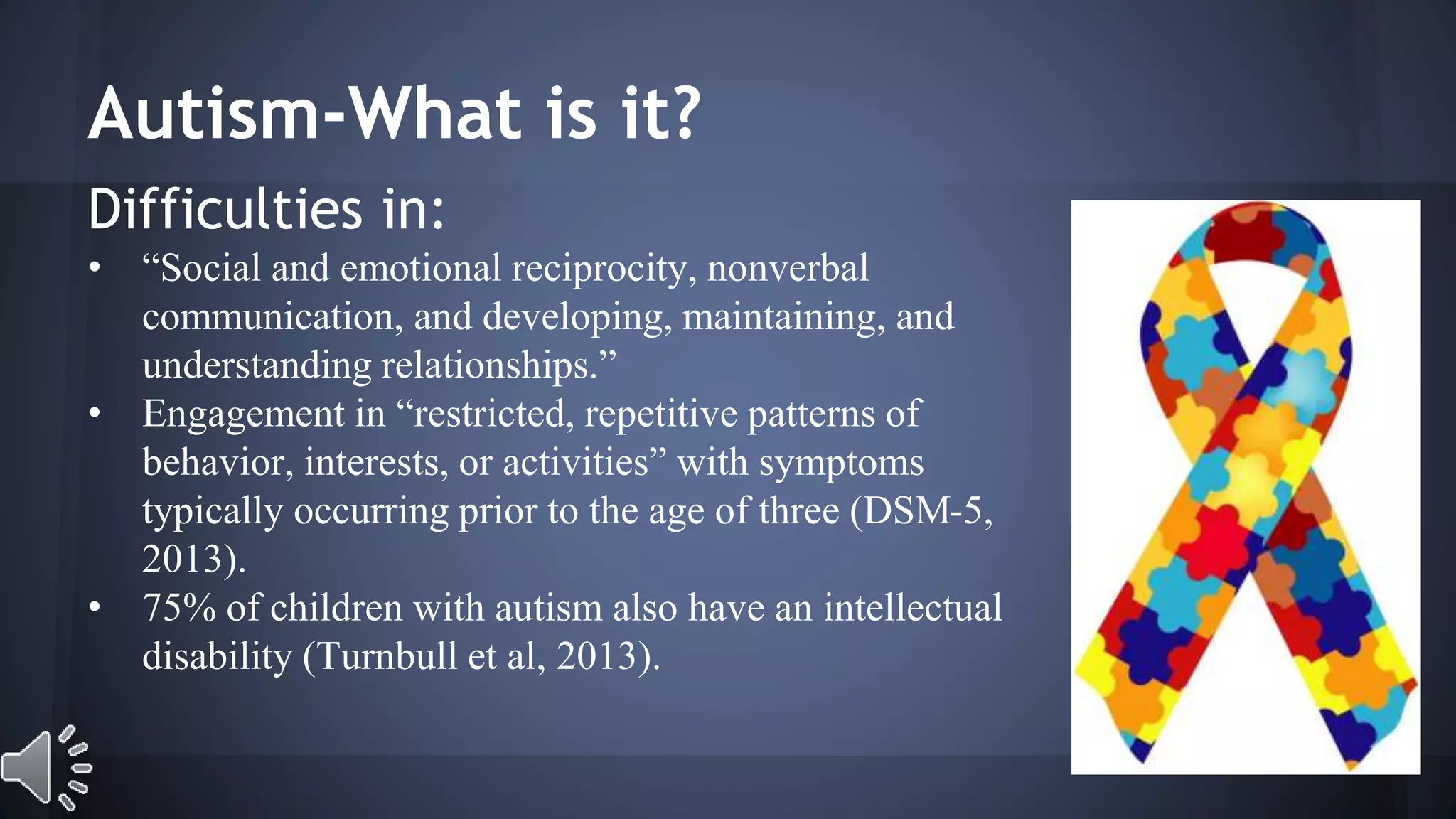
Autism-What is it? 
Difficulties in: 
• “Social and emotional reciprocity, nonverbal 
communication, and developing, maintaining, and 
understanding relationships.” 
• Engagement in “restricted, repetitive patterns of 
behavior, interests, or activities” with symptoms 
typically occurring prior to the age of three (DSM-5, 
2013). 
• 75% of children with autism also have an intellectual 
disability (Turnbull et al, 2013).
Autism-Best practices: Academics 
• Inclusion classroom:General education teacher 
-Differentiation of learning 
-Discrete trial teaching to aid in language development 
• Co-taught classroom: Collaboration of general and special educators. 
• Self contained classroom: Special education teacher 
-Managing emotions and adapting the classroom to manage 
overstimulation 
-Frequent breaks from instruction 
-Schoolwide Positive Behavior Support (Turnbull et al, 2013)
Autism-Best practices: Social/Behavioral 
• Social Workers: 
-Social skills and social stories 
-Functional Behavior Assessment-collaboration with the family 
-Social Thinking Group to practice perspective taking (Winner, 2007) 
• Family Involvement: 
-Education, resources, support groups 
-Strengths based approach 
-Generalization of skills 
• Related Services: 
-Occupational Therapy to adapt to the environment (American Occupational 
Therapy 
Association, 2010) 
-Speech pathology: Picture Exchange Communication System (Real Look 
Autism, 2011)
Hearing Impairment- What is it? 
Two terms to describe hearing loss- deaf and hard of hearing. 
• IDEA defines deafness as “a hearing impairment so severe that the student 
is impaired in processing linguistic information through hearing (with or 
without amplification) and the student’s educational performance is 
adversely affected. (Turnball et al. 2011) 
• Two types of hearing loss: 
-Unilateral 
-Bilateral 
• Causes of hearing loss include: 
-Genetic 
-Prenatal 
-Postnatal 
-Postlingual
Hearing Impairments- Academic Needs 
• Most children with hearing impairments have educational 
challenges in the areas of reading and writing (Turnbull et al 2011). 
• Because educational curriculum is very language-based, there is a 
heavy emphasis on communication. 
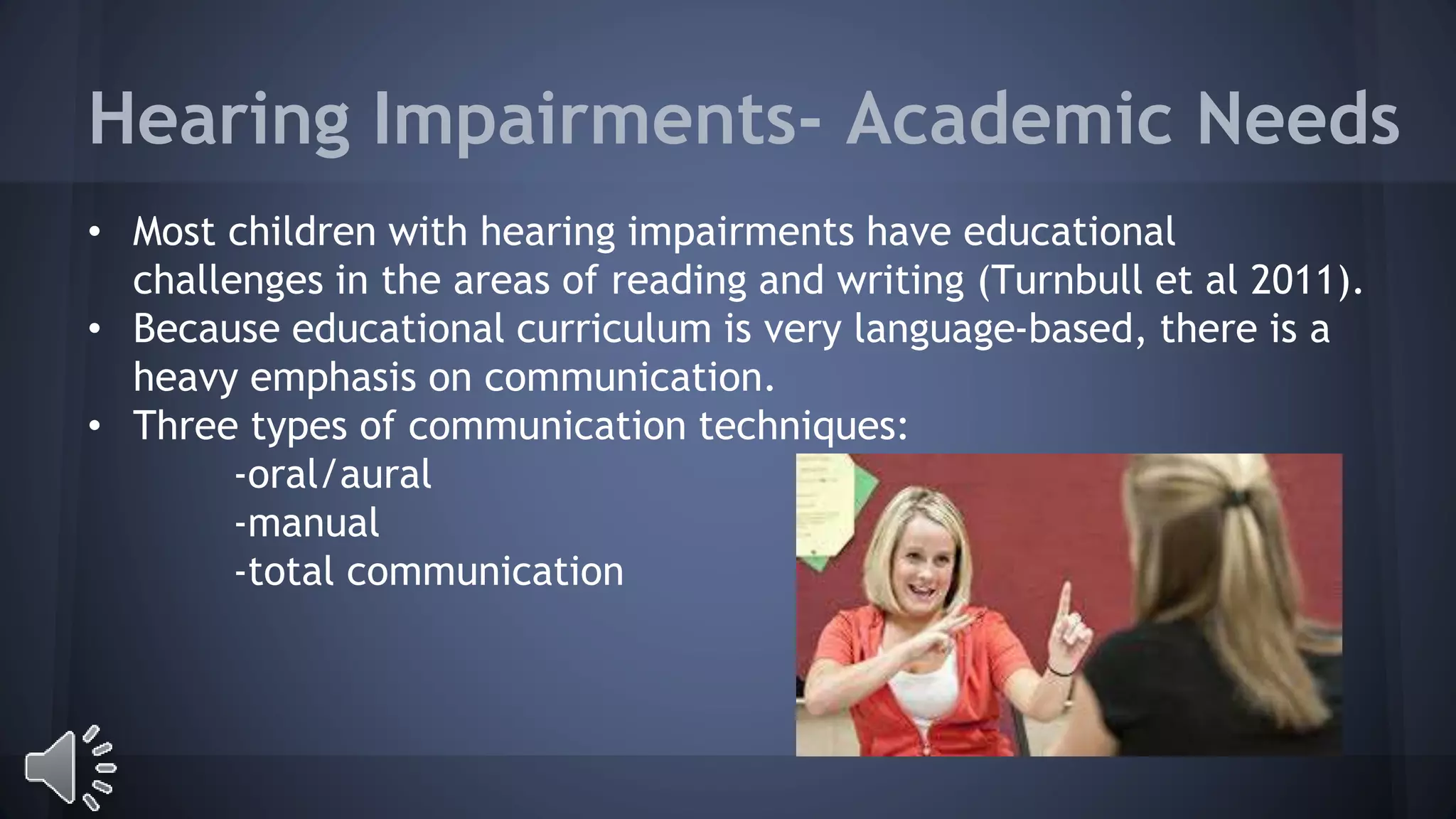
• Three types of communication techniques: 
-oral/aural 
-manual 
-total communication
Hearing Impairments 
Social/Behavioral needs- Communication 
The student’s psychosocial development may be effected 
When an average hearing student has difficulty communicating with 
the student who has a hearing impairment. 
“When communication is easy, students learn social norms, rules of 
conversation, appropriate ways of responding in various situations, 
and how to develop relationships” (Turnbull 2011).
Conclusion 
One common goal: To allow all students to succeed both academically 
and socially. 
Staff Development: 
• Psychoeducation on disabilities 
• Collaboration 
• Progress monitoring 
• Consultation
Conclusion 
Implementation: 
• Planning periods 
• Assistive technology 
• Plant operations 
Most importantly, COMMUNICATION with: 
• Students 
• Parents 
• Teachers, Social Worker, Therapists 
• Other School professionals
References 
American Occupational Therapy Association (2010). The scope of occupational therapy services for individuals with an autism spectrum disorder across the 
life course. American Journal of Occupational Therapy, 64(Suppl.), S125–S136. 
American Psychiatric Association. (2013). Diagnostic and statistical manual of mental disorders (5th ed.). Washington, DC: Author. 
Attention Deficit Hyperactivity Disorder (ADHD). (n.d.). Retrieved December 7, 2014, fromhttp://www.nimh.nih.gov/health/topics/attention-deficit-hyperactivity- 
disorder-adhd/index.shtml 
Cole, C. M., Waldron, N., & Majd, M. (2004). Academic progress of students across inclusive and traditional settings. Mental Retardation, 42(2), 136–144. 
http://dx.doi.org/10.1352/0047-6765(2004)42<136:APOSAI>2.0.CO;2 
Dore, R., Dion, E., Wagner, S., & Brunet, J. (2002). High school inclusion of adolescents with mental retardation: A multiple case study. Education and 
Training in Mental Retardation and Developmental Disabilities, 37(3), 253-261. 
Jackson, L., Ryndak, D., & Wehmeyer, M. (2009). The dynamic relationship between context, curriculum, and student learning: A case for inclusive 
education as a research-based practice. Research and Practice in Severe Disabilities, 34(1), 175–195.
References continued 
Land, S. (2004, November 25). Effective Teaching Practices for Students in Inclusive Classrooms. Retrieved December 7, 2014, from 
http://education.wm.edu/centers/ttac/resources/articles/inclusion/effectiveteach/ 
Lewis, A. C. (1994). Inclusion. Education Digest, 60(1), 71. 
Mastropieri, M. A., & Scruggs, T. E. (2001). Promoting Inclusion in Secondary Classrooms. Learning Disability Quarterly, 24(4), 265-74. doi: 
10.2307/1511115 
Obiakor, F. E., Harris, M., Mutua, K., Rotatori, A., & Algozzine, B. (2012). Making Inclusion Work in General Education Classrooms. Education and 
Treatment 
of Children 35(3), 477-490. doi: 10.1353/etc.2012.0020 
Real Look Autism, LLC. (2011). Retrieved from http://www.reallookautism.com/. 
Turnbull, A., Turnbull, H. R., Wehmeyer, M. L. & Shogren, K. A. (2013). Exceptional Lives: Special Education in Today’s Schools (7th Edition). 
Upper Saddle River, NJ: Pearson Education, In.: 
Winner, M. (2007).Thinking About YOU Thinking About ME (2nd Edition). San Jose, CA: Think Social Publishing, Inc.

Team 10 final

  • 1.
    Addressing the Needsof Students with Disabilities MISE High School
  • 2.
    Multidisciplinary Team 10 ROLE NAME Special Education Teacher Eman Zayed General Education Teacher Izdhar Deeb Social Worker Sara Gierhahn Physical/Speech/Language Therapist Marissa Charleston
  • 3.
    Outline ● SchoolInformation ● Special Education ● Inclusion ● General Recommendations ● Specific Recommendations o Attention Deficit Hyperactivity Disorder o Autism o Hearing Impairments ● Conclusion
  • 4.
    MISE High School • Student Population: 636 • Grades 9-12 • School Demographics: -African American 45% -Hispanic 51% -White 2% -Other 2% • Statistics: -93% Low Income -23% Students with Disabilities -4% Homeless -9% English Learners
  • 5.
    MISE High School • PSAE Composite Score: 15% • Student Mobility is 31% • 4 Year Graduation Rate is 65% • Readiness for College Coursework is 4%
  • 6.
    Special Education Information • Approximately 6 million students ages six through twenty-one receive some form of special education. (Turnbull 2011) • Laws such as IDEA were put into effect because of constant discrimination. -ESEA which was amended by NCLB -Rehabilitation Act -Tech Act
  • 7.
    Special Education Information The Individual with Disabilities Education Act is a federal law that requires schools to serve the educational needs of eligible students with disabilities. 6 Principles of IDEA • Zero Reject • Nondiscriminatory Evaluation • Appropriate Education • Least Restrictive Environment • Procedural Due Process • Parent and Student Participation
  • 8.
    Overview of Inclusion Definition: ● Based on IDEA’s principal of the least restrictive environment ● Students with disabilities participate in academic, extracurricular, and other school activities with their nondisabled peers (Turnbull, Turnbull, & Wehmeyer, 2013) Characteristics: ● Home-School Placement ● Principal of Natural Proportions ● Restructuring Teaching and Learning o Family-Professional Partnerships o Co-teaching ● Age- and Grade-Appropriate Placements
  • 9.
    Inclusion continued Criticalcomponents of successful inclusion: ● Administrative support ● Support from special education personnel ● Accepting, positive classroom atmosphere ● Appropriate curriculum ● Effective general teaching skills ● Peer assistance/tutoring ● Disability-specific teaching skills (Mastropieri and Scruggs, 2001) Benefits of inclusion: ● Academic ● Social ● Emotional ● Behavioral ● Promotes UDL
  • 10.
    General Recommendations Circleof Friends educators and/or parents inviting peers to form a support network for a student with a disability so that the student will have friends (Turnbull et al., 2013).
  • 11.
    General Recommendations Circleof Friends tips for implementation ● Recruit students ● identify a facilitator ● determine the size of the group ● decide where and when to meet ● identify group activities ● adjust activities as the students grow older ● give students ownership of the circle Establish three ground rules: 1. everyone has access to all of the materials used during the meetings 2. all activities must be age appropriate 3. everyone participates in all activities (Turnbull et al., 2013)
  • 12.
    General Recommendations UDL:Universal Design for Learning Provide multiple means of representation ● visual ● oral Provide multiple means of student expression ● Writing ● speaking ● illustrating Provide flexible means of engagement ● videos ● software ● role playing, etc.
  • 13.
    ADHD- What isit? “Attention deficit hyperactivity disorder (ADHD) is one of the most common childhood disorders and can continue through adolescence and adulthood. Symptoms include difficulty staying focused and paying attention, difficulty controlling behavior, and hyperactivity (over-activity) ("Attention Deficit Hyperactivity Disorder (ADHD)") Three types: ● predominantly inattentive ● predominantly hyperactive-impulsive ● combined type Causes: ● heredity ● structural differences in the brain ● environmental
  • 14.
    Accommodations for ADHD Inattention: ● seat them in quiet areas ● give them more time to complete assignments Impulsive: ● ignore inappropriate behaviors ● reward appropriate behaviors Excessive motor activity: ● let them stand in class, run errands, break between assignments Mood characteristics: ● reassure and encourage them, speak gently ● involve parents in student communication Organizational problems: ● incorporate notebooks, folders, dividers, smart phones to help students remember, provide daily weekly reports for parents (Turnbull et al., 2013)
  • 15.
    ADHD Goal-setting andorganizational skills “Goal setting and organizational skills go hand in hand to promote better outcomes. If a students sets a goal, he is more likely to perform behaviors related to that goal. Goal-setting is one of the critical predictors of success in adulthood for students with AD/HD”(Turnbull et al., 2013). 1. Identify a goal clearly and concretely 2. Develop a series of objectives or tasks to achieve the goal 3. Specify the actions necessary to achieve the desired outcome
  • 16.
    Autism-What is it? Difficulties in: • “Social and emotional reciprocity, nonverbal communication, and developing, maintaining, and understanding relationships.” • Engagement in “restricted, repetitive patterns of behavior, interests, or activities” with symptoms typically occurring prior to the age of three (DSM-5, 2013). • 75% of children with autism also have an intellectual disability (Turnbull et al, 2013).
  • 17.
    Autism-Best practices: Academics • Inclusion classroom:General education teacher -Differentiation of learning -Discrete trial teaching to aid in language development • Co-taught classroom: Collaboration of general and special educators. • Self contained classroom: Special education teacher -Managing emotions and adapting the classroom to manage overstimulation -Frequent breaks from instruction -Schoolwide Positive Behavior Support (Turnbull et al, 2013)
  • 18.
    Autism-Best practices: Social/Behavioral • Social Workers: -Social skills and social stories -Functional Behavior Assessment-collaboration with the family -Social Thinking Group to practice perspective taking (Winner, 2007) • Family Involvement: -Education, resources, support groups -Strengths based approach -Generalization of skills • Related Services: -Occupational Therapy to adapt to the environment (American Occupational Therapy Association, 2010) -Speech pathology: Picture Exchange Communication System (Real Look Autism, 2011)
  • 19.
    Hearing Impairment- Whatis it? Two terms to describe hearing loss- deaf and hard of hearing. • IDEA defines deafness as “a hearing impairment so severe that the student is impaired in processing linguistic information through hearing (with or without amplification) and the student’s educational performance is adversely affected. (Turnball et al. 2011) • Two types of hearing loss: -Unilateral -Bilateral • Causes of hearing loss include: -Genetic -Prenatal -Postnatal -Postlingual
  • 20.
    Hearing Impairments- AcademicNeeds • Most children with hearing impairments have educational challenges in the areas of reading and writing (Turnbull et al 2011). • Because educational curriculum is very language-based, there is a heavy emphasis on communication. • Three types of communication techniques: -oral/aural -manual -total communication
  • 21.
    Hearing Impairments Social/Behavioralneeds- Communication The student’s psychosocial development may be effected When an average hearing student has difficulty communicating with the student who has a hearing impairment. “When communication is easy, students learn social norms, rules of conversation, appropriate ways of responding in various situations, and how to develop relationships” (Turnbull 2011).
  • 22.
    Conclusion One commongoal: To allow all students to succeed both academically and socially. Staff Development: • Psychoeducation on disabilities • Collaboration • Progress monitoring • Consultation
  • 23.
    Conclusion Implementation: •Planning periods • Assistive technology • Plant operations Most importantly, COMMUNICATION with: • Students • Parents • Teachers, Social Worker, Therapists • Other School professionals
  • 24.
    References American OccupationalTherapy Association (2010). The scope of occupational therapy services for individuals with an autism spectrum disorder across the life course. American Journal of Occupational Therapy, 64(Suppl.), S125–S136. American Psychiatric Association. (2013). Diagnostic and statistical manual of mental disorders (5th ed.). Washington, DC: Author. Attention Deficit Hyperactivity Disorder (ADHD). (n.d.). Retrieved December 7, 2014, fromhttp://www.nimh.nih.gov/health/topics/attention-deficit-hyperactivity- disorder-adhd/index.shtml Cole, C. M., Waldron, N., & Majd, M. (2004). Academic progress of students across inclusive and traditional settings. Mental Retardation, 42(2), 136–144. http://dx.doi.org/10.1352/0047-6765(2004)42<136:APOSAI>2.0.CO;2 Dore, R., Dion, E., Wagner, S., & Brunet, J. (2002). High school inclusion of adolescents with mental retardation: A multiple case study. Education and Training in Mental Retardation and Developmental Disabilities, 37(3), 253-261. Jackson, L., Ryndak, D., & Wehmeyer, M. (2009). The dynamic relationship between context, curriculum, and student learning: A case for inclusive education as a research-based practice. Research and Practice in Severe Disabilities, 34(1), 175–195.
  • 25.
    References continued Land,S. (2004, November 25). Effective Teaching Practices for Students in Inclusive Classrooms. Retrieved December 7, 2014, from http://education.wm.edu/centers/ttac/resources/articles/inclusion/effectiveteach/ Lewis, A. C. (1994). Inclusion. Education Digest, 60(1), 71. Mastropieri, M. A., & Scruggs, T. E. (2001). Promoting Inclusion in Secondary Classrooms. Learning Disability Quarterly, 24(4), 265-74. doi: 10.2307/1511115 Obiakor, F. E., Harris, M., Mutua, K., Rotatori, A., & Algozzine, B. (2012). Making Inclusion Work in General Education Classrooms. Education and Treatment of Children 35(3), 477-490. doi: 10.1353/etc.2012.0020 Real Look Autism, LLC. (2011). Retrieved from http://www.reallookautism.com/. Turnbull, A., Turnbull, H. R., Wehmeyer, M. L. & Shogren, K. A. (2013). Exceptional Lives: Special Education in Today’s Schools (7th Edition). Upper Saddle River, NJ: Pearson Education, In.: Winner, M. (2007).Thinking About YOU Thinking About ME (2nd Edition). San Jose, CA: Think Social Publishing, Inc.