WHO ?
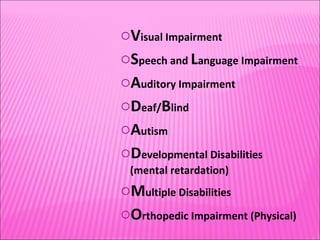
V isual Impairment  S peech and  L anguage Impairment  A uditory Impairment  D eaf/ B lind  A utism  D evelopmental Disabilities (mental retardation)  M ultiple Disabilities  O rthopedic Impairment (Physical)
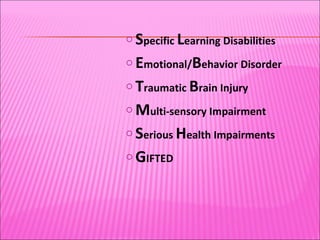
S pecific  L earning Disabilities  E motional/ B ehavior Disorder  T raumatic  B rain Injury  M ulti-sensory Impairment  S erious  H ealth Impairments G IFTED
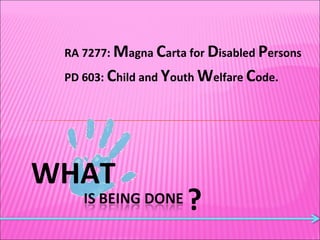
WHAT ? RA 7277:  M agna  C arta for  D isabled  P ersons PD 603:  C hild and  Y outh  W elfare  C ode.
A dhd A utism B lind  C erebral Palsy D eaf D own’s Syndrome M entally retarded
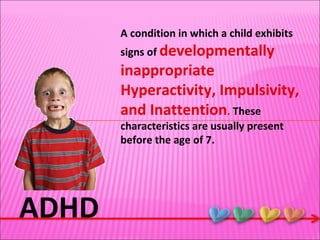
ADHD A condition in which a child exhibits signs of  developmentally inappropriate Hyperactivity, Impulsivity, and Inattention .  These characteristics are usually present before the age of 7.
Has a hard time paying attention Gets distracted easily Doesn’t  “seem” to listen Problems organizing information Dislikes tasks requiring sustained mental  effort Forgets easily & Misplaces things
Fidgets Leaves seat when required to sit Runs, climbs excessively or restless Problems playing quietly Always “on the go” Excessive talking
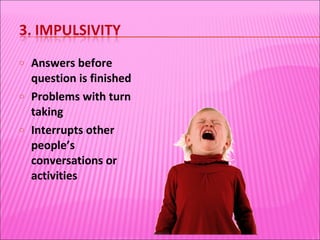
Answers before question is finished Problems with turn taking Interrupts other people’s conversations or activities
ADHD Hyperactivity, Impulsivity & Inattention. .. SO WHAT SHOULD YOU DO? Have lots of energy yourself! Don’t give the child candies, sweets Massage the child to calm him down Try to establish routines. They don’t like suprises.
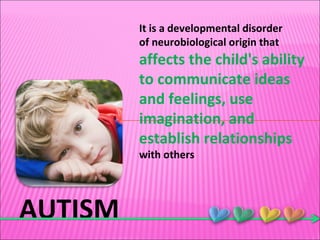
AUTISM It is a developmental disorder  of neurobiological origin that  affects the child's ability to communicate ideas and feelings, use imagination, and establish relationships  with others
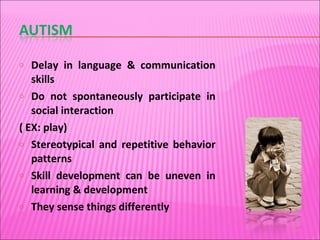
Delay in language & communication skills Do not spontaneously participate in social interaction  ( EX: play) Stereotypical and repetitive behavior patterns Skill development can be uneven in learning & development They sense things differently
AUTISM SO WHAT SHOULD YOU DO? Difficulty communicating, Imagining, Connecting Limit physical contact Give the child fewer choices to lessen confusion Speak clearly (not too loud)
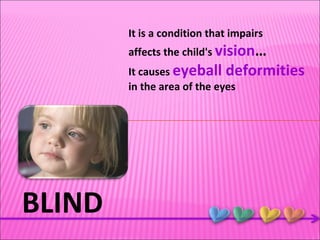
BLIND It is a condition that impairs affects the child's  vision … It causes  eyeball deformities   in the area of the eyes
Tends to be extremely dependent Fearful Easily-conscious Easily discouraged/frustrated
BLIND SO WHAT SHOULD YOU DO? Difficulty seeing, Fearful, Self-Conscious  -Introduce Yourself -Orient them with the Surroundings -Guide their safety -Show the direction when they’re speaking -NEVER direct a question intended for them to someone else present
BLIND SO WHAT SHOULD YOU DO? Difficulty seeing, Fearful, Self-Conscious  Use the person’s name or lightly touch the arm of the one you are speaking to Give Clear Verbal Instructions Don’t leave them alone (leave them next to an object they can touch)
GRIP- the blind person holds the guide’s arm slightly above the elbow so that his thumb is on the outside & his fingers curved to the inside. STANCE- the one who is blind should always be a half-step behind the guide with his shoulder directly in line with the shoulder of the sighted guide. This is very important because it allows the guide to know the location of the blind person at all times.
3.  CHANGING SIDE- the guide should stay where he is, while the blind person keeps his hands on the guide’s back , slips in behind him, transferring his hold to the other arm of the guide & moves to the other side. 4. NARROW SPACES- the sighted guide should make a definite move with his arms back wards & over to the center of his back. The blind person responds by straightening out his arm & steeping directly behind the guide. Both of them now in single file.
5.  OPENING DOORS- the blind person must be on the hinge side of the door. As the guide & blind approach the door, the guide tells the blind, “we are coming to a door.” 6. GOING UP & DOWNSTAIRS- the sighted guide should tell the blind person that they are approaching stairs & whether they are going up & down. The one who is blind should be on the hand rail side because he may feel more comfortable holding on the railing while going upstairs.
7.  SEATING- the guide takes the blind’s hands & places it on the back of the chair so that the blind has tactile contact & knows where the chair is. Then the other hand of the blind should be placed on the seat so he knows which way the chair is facing.
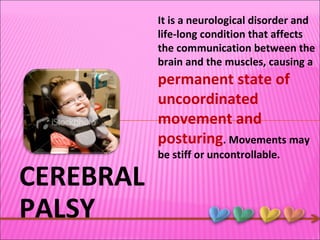
CEREBRAL PALSY It is a neurological disorder and life-long condition that affects the communication between the brain and the muscles, causing a  permanent state of uncoordinated movement and posturing . Movements may be stiff or uncontrollable.
CEREBRAL PALSY SO WHAT SHOULD YOU DO? Uncoordinated movement, Physical disability Support the child physically Always look out for the child.  Be ready to catch your child if he/she falls
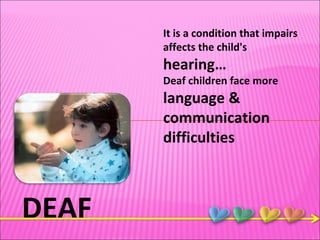
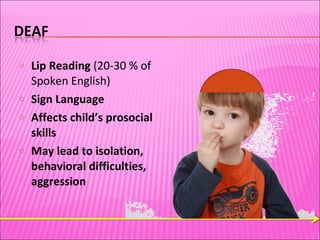
DEAF It is a condition that impairs affects the child's  hearing… Deaf children face more  language & communication difficulties
Lip Reading  (20-30 % of Spoken English) Sign Language Affects child’s prosocial skills May lead to isolation, behavioral difficulties, aggression
DEAF SO WHAT SHOULD YOU DO? Communication difficulties, isolation  Learn Sign Language Be friendly  When talking, face the child.  Don’t talk to him when he doesn’t see you.
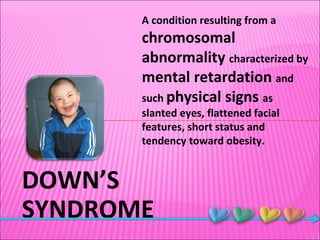
DOWN’S SYNDROME A condition resulting from a  chromosomal abnormality  characterized by  mental retardation  and such  physical signs  as slanted eyes, flattened facial features, short status and tendency toward obesity.
DOWN’S SYNDROME SO WHAT SHOULD YOU DO? Mental Retardation, slower development Simplify things Be friendly
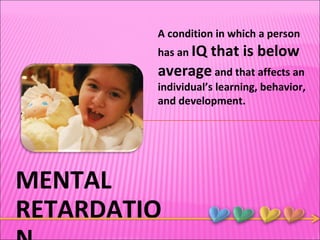
MENTAL RETARDATION A condition in which a person has an  IQ that is below average  and that affects an individual’s learning, behavior, and development.
Learning Problems Limitations in mental ability that influence daily living and adaptation
MENTAL RETARDATION SO WHAT SHOULD YOU DO? Difficulty understanding, Lower IQ Simplify things Talk in simple language
GENERAL TIPS F ocus on the  WHOLE  child View things from the  C hild’s  P erspective S implify by Breaking down tasks into simpler steps Use  P hysical  a ssistance P raise Be a  M odel
"There are only two ways to live your life. One is as though nothing is a miracle. The other is as though everything is a miracle." -  Albert Einstein

Handling Children with Special Needs

  • 1.
  • 2.
  • 3.
    V isual Impairment S peech and L anguage Impairment A uditory Impairment D eaf/ B lind A utism D evelopmental Disabilities (mental retardation) M ultiple Disabilities O rthopedic Impairment (Physical)
  • 4.
    S pecific L earning Disabilities E motional/ B ehavior Disorder T raumatic B rain Injury M ulti-sensory Impairment S erious H ealth Impairments G IFTED
  • 5.
    WHAT ? RA7277: M agna C arta for D isabled P ersons PD 603: C hild and Y outh W elfare C ode.
  • 6.
    A dhd Autism B lind C erebral Palsy D eaf D own’s Syndrome M entally retarded
  • 7.
    ADHD A conditionin which a child exhibits signs of developmentally inappropriate Hyperactivity, Impulsivity, and Inattention . These characteristics are usually present before the age of 7.
  • 8.
    Has a hardtime paying attention Gets distracted easily Doesn’t “seem” to listen Problems organizing information Dislikes tasks requiring sustained mental effort Forgets easily & Misplaces things
  • 9.
    Fidgets Leaves seatwhen required to sit Runs, climbs excessively or restless Problems playing quietly Always “on the go” Excessive talking
  • 10.
    Answers before questionis finished Problems with turn taking Interrupts other people’s conversations or activities
  • 11.
    ADHD Hyperactivity, Impulsivity& Inattention. .. SO WHAT SHOULD YOU DO? Have lots of energy yourself! Don’t give the child candies, sweets Massage the child to calm him down Try to establish routines. They don’t like suprises.
  • 12.
    AUTISM It isa developmental disorder of neurobiological origin that affects the child's ability to communicate ideas and feelings, use imagination, and establish relationships with others
  • 13.
    Delay in language& communication skills Do not spontaneously participate in social interaction ( EX: play) Stereotypical and repetitive behavior patterns Skill development can be uneven in learning & development They sense things differently
  • 14.
    AUTISM SO WHATSHOULD YOU DO? Difficulty communicating, Imagining, Connecting Limit physical contact Give the child fewer choices to lessen confusion Speak clearly (not too loud)
  • 15.
    BLIND It isa condition that impairs affects the child's vision … It causes eyeball deformities in the area of the eyes
  • 16.
    Tends to beextremely dependent Fearful Easily-conscious Easily discouraged/frustrated
  • 17.
    BLIND SO WHATSHOULD YOU DO? Difficulty seeing, Fearful, Self-Conscious -Introduce Yourself -Orient them with the Surroundings -Guide their safety -Show the direction when they’re speaking -NEVER direct a question intended for them to someone else present
  • 18.
    BLIND SO WHATSHOULD YOU DO? Difficulty seeing, Fearful, Self-Conscious Use the person’s name or lightly touch the arm of the one you are speaking to Give Clear Verbal Instructions Don’t leave them alone (leave them next to an object they can touch)
  • 19.
    GRIP- the blindperson holds the guide’s arm slightly above the elbow so that his thumb is on the outside & his fingers curved to the inside. STANCE- the one who is blind should always be a half-step behind the guide with his shoulder directly in line with the shoulder of the sighted guide. This is very important because it allows the guide to know the location of the blind person at all times.
  • 20.
    3. CHANGINGSIDE- the guide should stay where he is, while the blind person keeps his hands on the guide’s back , slips in behind him, transferring his hold to the other arm of the guide & moves to the other side. 4. NARROW SPACES- the sighted guide should make a definite move with his arms back wards & over to the center of his back. The blind person responds by straightening out his arm & steeping directly behind the guide. Both of them now in single file.
  • 21.
    5. OPENINGDOORS- the blind person must be on the hinge side of the door. As the guide & blind approach the door, the guide tells the blind, “we are coming to a door.” 6. GOING UP & DOWNSTAIRS- the sighted guide should tell the blind person that they are approaching stairs & whether they are going up & down. The one who is blind should be on the hand rail side because he may feel more comfortable holding on the railing while going upstairs.
  • 22.
    7. SEATING-the guide takes the blind’s hands & places it on the back of the chair so that the blind has tactile contact & knows where the chair is. Then the other hand of the blind should be placed on the seat so he knows which way the chair is facing.
  • 23.
    CEREBRAL PALSY Itis a neurological disorder and life-long condition that affects the communication between the brain and the muscles, causing a permanent state of uncoordinated movement and posturing . Movements may be stiff or uncontrollable.
  • 24.
    CEREBRAL PALSY SOWHAT SHOULD YOU DO? Uncoordinated movement, Physical disability Support the child physically Always look out for the child. Be ready to catch your child if he/she falls
  • 25.
    DEAF It isa condition that impairs affects the child's hearing… Deaf children face more language & communication difficulties
  • 26.
    Lip Reading (20-30 % of Spoken English) Sign Language Affects child’s prosocial skills May lead to isolation, behavioral difficulties, aggression
  • 27.
    DEAF SO WHATSHOULD YOU DO? Communication difficulties, isolation Learn Sign Language Be friendly When talking, face the child. Don’t talk to him when he doesn’t see you.
  • 28.
    DOWN’S SYNDROME Acondition resulting from a chromosomal abnormality characterized by mental retardation and such physical signs as slanted eyes, flattened facial features, short status and tendency toward obesity.
  • 29.
    DOWN’S SYNDROME SOWHAT SHOULD YOU DO? Mental Retardation, slower development Simplify things Be friendly
  • 30.
    MENTAL RETARDATION Acondition in which a person has an IQ that is below average and that affects an individual’s learning, behavior, and development.
  • 31.
    Learning Problems Limitationsin mental ability that influence daily living and adaptation
  • 32.
    MENTAL RETARDATION SOWHAT SHOULD YOU DO? Difficulty understanding, Lower IQ Simplify things Talk in simple language
  • 33.
    GENERAL TIPS Focus on the WHOLE child View things from the C hild’s P erspective S implify by Breaking down tasks into simpler steps Use P hysical a ssistance P raise Be a M odel
  • 34.
    "There are onlytwo ways to live your life. One is as though nothing is a miracle. The other is as though everything is a miracle." - Albert Einstein