Individualized
Education Program
Introduction
An IEP defines the individualized objectives of a child who has been
found with a disability, as defined by federal regulations. The IEP is
intended to help children reach educational goals more easily than
they otherwise would. The IEP describes how the student learns, how
the student best demonstrates that learning and what teachers and
service providers will do to help the student learn more effectively.
Developing an IEP requires assessing students in all areas related to the
known disabilities, simultaneously considering ability to access the
general curriculum, considering how the disability affects the student’s
learning, forming goals and objectives that correspond to the needs of
the student, and choosing a placement in the least restrictive
environment possible for the student.
Who qualifies for an IEP?
Before an IEP is written for a child with a disability, the school must first
determine whether the child qualifies for special education services. To
qualify, the child's disability must have an adverse effect on the child's
educational progress.
1. An evaluation. Parents, teachers, a counselor, a doctor or anyone
else who suspects a child is struggling can request an evaluation. The
school psychologist and other professionals may give your child
various tests. They also may observe your child in the classroom.
2. 2. A decision. The IEP team, which includes parents and school
officials, decides whether or not your child needs special education
services in order to learn the general education curriculum. IDEA says
that having any of 13 disabilities may qualify a child for special
education. The school and parents review the evaluation and
determine whether the results show that your child needs services and
supports.
Who produces an IEP?
You, the student’s parent(s). IDEA gives parents the legal right to participate in all of their
child’s IEP meetings. As the parent, you’re a full and equal member of the team. After
all, you probably know your child’s strengths and struggles better than anyone else. Your
concerns and suggestions about his education are invaluable.
•At least one of your child’s general education teachers.
•At least one special education teacher or other special education provider.
•A school district representative knowledgeable about both general education and
special education. This person also should have the power to make decisions that
involve school resources. In other words, if the school rep thinks your child should be
given speech therapy, she should have the power to make that happen.
•A school psychologist or other specialist who can interpret the student’s evaluation
and test results.
•When the child turns 16, he’ll be expected to participate as a member of his IEP team
and help develop a transition plan. A representative from an outside agency, such as a
post–high school vocational program, may join meetings.
What happens at an IEP meeting?
 Your child’s strengths. Share any success your child has had outside of school.
Let’s say your child struggles with attention issues and social skills. His IEP team will
want to know that he finds it easier to follow directions from his soccer coach
and is better at cooperating with teammates.
 Your concerns and suggestions for improving your child’s education. The
meeting is a good time to share where you still see your child struggling. Does he
still have a tough time spelling? Is he constantly losing assignments? If you have
any ideas for making these tasks easier for him, you may want to share them.
 How well modifications and accommodations (such as assistive technology) are
helping. If they aren’t helping your child as expected, the team can discuss
upgrading, discontinuing or replacing them. The team can also consider any
new instruction and technology tools that might be right for your child.
 The results of your child’s first or most recent evaluation, if there is one. Your child
should be evaluated every three years. The school psychologist or professional
conducting the evaluation will usually explain the results at the IEP meeting.
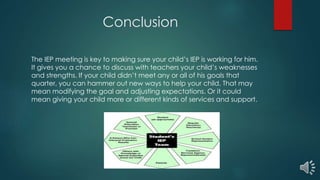
Conclusion
The IEP meeting is key to making sure your child’s IEP is working for him.
It gives you a chance to discuss with teachers your child’s weaknesses
and strengths. If your child didn’t meet any or all of his goals that
quarter, you can hammer out new ways to help your child. That may
mean modifying the goal and adjusting expectations. Or it could
mean giving your child more or different kinds of services and support.

Individualized education program

  • 1.
  • 2.
    Introduction An IEP definesthe individualized objectives of a child who has been found with a disability, as defined by federal regulations. The IEP is intended to help children reach educational goals more easily than they otherwise would. The IEP describes how the student learns, how the student best demonstrates that learning and what teachers and service providers will do to help the student learn more effectively. Developing an IEP requires assessing students in all areas related to the known disabilities, simultaneously considering ability to access the general curriculum, considering how the disability affects the student’s learning, forming goals and objectives that correspond to the needs of the student, and choosing a placement in the least restrictive environment possible for the student.
  • 3.
    Who qualifies foran IEP? Before an IEP is written for a child with a disability, the school must first determine whether the child qualifies for special education services. To qualify, the child's disability must have an adverse effect on the child's educational progress. 1. An evaluation. Parents, teachers, a counselor, a doctor or anyone else who suspects a child is struggling can request an evaluation. The school psychologist and other professionals may give your child various tests. They also may observe your child in the classroom. 2. 2. A decision. The IEP team, which includes parents and school officials, decides whether or not your child needs special education services in order to learn the general education curriculum. IDEA says that having any of 13 disabilities may qualify a child for special education. The school and parents review the evaluation and determine whether the results show that your child needs services and supports.
  • 5.
    Who produces anIEP? You, the student’s parent(s). IDEA gives parents the legal right to participate in all of their child’s IEP meetings. As the parent, you’re a full and equal member of the team. After all, you probably know your child’s strengths and struggles better than anyone else. Your concerns and suggestions about his education are invaluable. •At least one of your child’s general education teachers. •At least one special education teacher or other special education provider. •A school district representative knowledgeable about both general education and special education. This person also should have the power to make decisions that involve school resources. In other words, if the school rep thinks your child should be given speech therapy, she should have the power to make that happen. •A school psychologist or other specialist who can interpret the student’s evaluation and test results. •When the child turns 16, he’ll be expected to participate as a member of his IEP team and help develop a transition plan. A representative from an outside agency, such as a post–high school vocational program, may join meetings.
  • 6.
    What happens atan IEP meeting?  Your child’s strengths. Share any success your child has had outside of school. Let’s say your child struggles with attention issues and social skills. His IEP team will want to know that he finds it easier to follow directions from his soccer coach and is better at cooperating with teammates.  Your concerns and suggestions for improving your child’s education. The meeting is a good time to share where you still see your child struggling. Does he still have a tough time spelling? Is he constantly losing assignments? If you have any ideas for making these tasks easier for him, you may want to share them.  How well modifications and accommodations (such as assistive technology) are helping. If they aren’t helping your child as expected, the team can discuss upgrading, discontinuing or replacing them. The team can also consider any new instruction and technology tools that might be right for your child.  The results of your child’s first or most recent evaluation, if there is one. Your child should be evaluated every three years. The school psychologist or professional conducting the evaluation will usually explain the results at the IEP meeting.
  • 8.
    Conclusion The IEP meetingis key to making sure your child’s IEP is working for him. It gives you a chance to discuss with teachers your child’s weaknesses and strengths. If your child didn’t meet any or all of his goals that quarter, you can hammer out new ways to help your child. That may mean modifying the goal and adjusting expectations. Or it could mean giving your child more or different kinds of services and support.