Tapeshwar Yadav
(Lecturer)
BMLT, DNHE,
M.Sc. Medical Biochemistry
Inborn errors of metabolism
Definition:- Inborn errors of metabolism occur
from a group of rare genetic disorders in which t
he body cannot metabolize food components nor
mally.
• These disorders are usually caused by defects
in the enzymes involved in the biochemical path
ways that break down food components.
Introduction:-
• Protein contains carbon, hydrogen, oxygen and nitrogen
as the major components while sulfur and phosphorus
are minor components.
• Nitrogen is characteristics of proteins. On an average,
the nitrogen content of ordinary proteins is 16% by
weight. All proteins are polymers of amino acids.
Amino acids are linked by protein.
• A moderately active man consuming about 300g
carbohydrates, 100g fats and 100g proteins daily must
excrete about 16.5g of nitrogen daily.
• 95% is eliminated by the kidneys and the remaining 5%
for the most part as nitrogen in the feces.
Normal values of urea:-
• The normal concentration in blood plasma is 20-
40mg.
• Indians take less proteins, hence normal level in
Indians varies from 15-40 mg/dl.
Inborn errors of urea cycle :- These are divided in to
five type.
1.Hyperammonemia type-I
2.Hyperammonemia type-II
3.Citrullinemia.
4.Argininosuccinic aciduria.
5.Hyper argininemia.
Hyperammonemia type-I :-
• A familiar disorder, enzyme deficiency
carbamoyl phosphate synthase 1, produces
Hyperammonemia and symptoms of ammonia
toxicity.
• CO2+ NH3 Carbamoyl-(P)
Hyperammonemia type-II :-
• X-linked inheritance.
• Enzyme deficiency ornithine
transcarbamoylase, produces Hyperammonemia
and symptoms of ammonia toxicity.
• Ornithine Citrulline
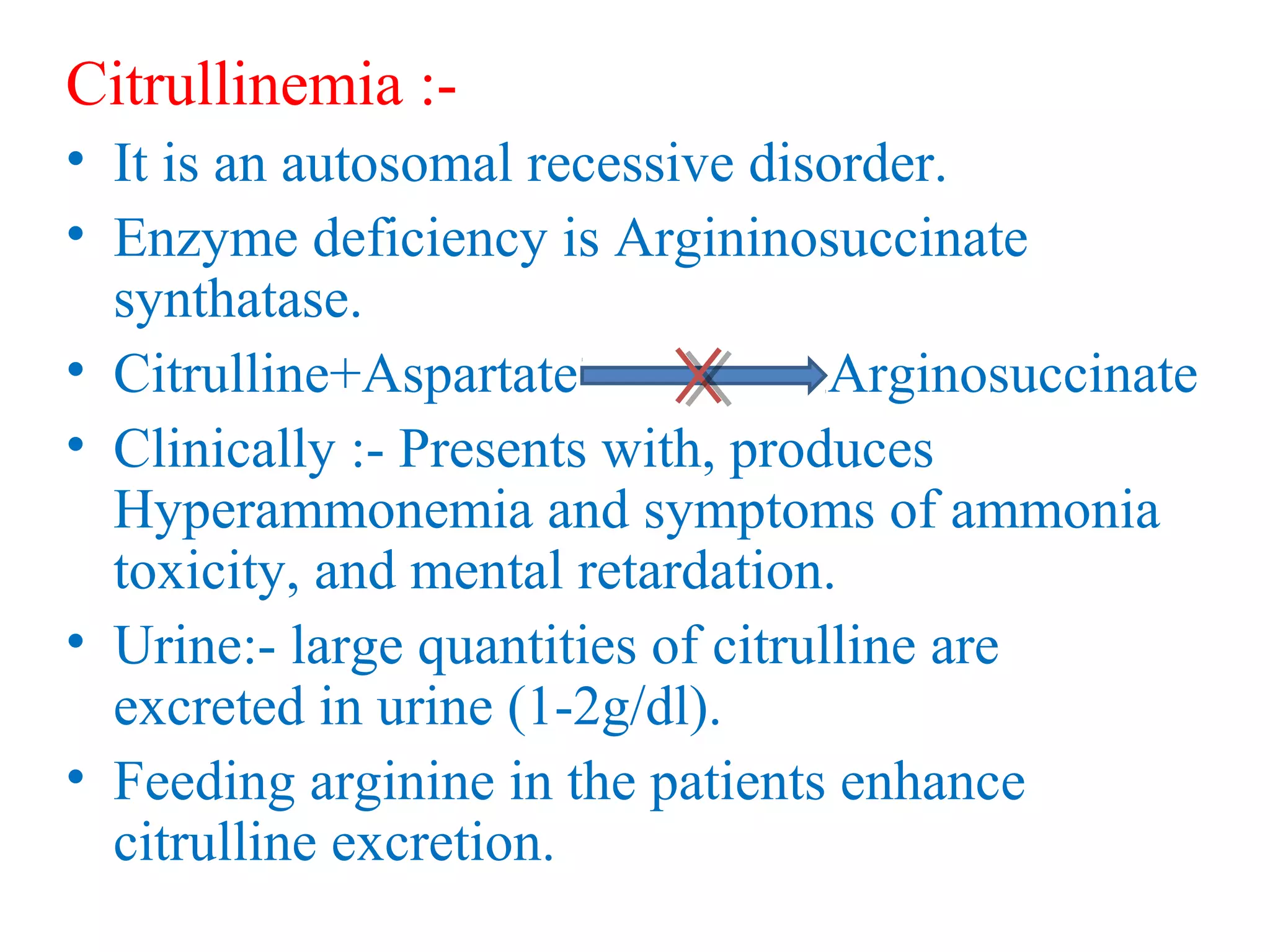
Citrullinemia :-
• It is an autosomal recessive disorder.
• Enzyme deficiency is Argininosuccinate
synthatase.
• Citrulline+Aspartate Arginosuccinate
• Clinically :- Presents with, produces
Hyperammonemia and symptoms of ammonia
toxicity, and mental retardation.
• Urine:- large quantities of citrulline are
excreted in urine (1-2g/dl).
• Feeding arginine in the patients enhance
citrulline excretion.
Argininosuccinic aciduria :-
• Autosomal recessive disorder.
• Enzyme deficiency Argininosuccinase.
• Argininosuccinate Arginine + Fumarate.
• Clinically :- Hyperammonemia, ammonia toxicity and
mental retardation.
• The enzyme deficiency has been identified in brain,
liver, kidney and RBC.
Hyper Argininemia :-
• Enzyme deficiency is Arginase.
• Arginine Ornithine + Urea
• Defect in liver and RBC.
• Clinically:- Hyperammonemia.
• Urine :- increased urinary excretion of lysine,
cystine, ornithine and Arginine.
• Low protein diet result in lowering of plasma
ammonia levels and disappearance of urinary
lysinecystinuria pattern.
Disorders of Aromatic amino acids { Phe, Tyr &
Trp } :-
1.Phenylketonuria.
2.Alkaptonuria.
3.Tyrosinemia.
4.Albinism.
5.Hartnup’s disease.
Phenylketonuria :-
• Deficiency of the enzyme phenylalanine
hydroxylase.
• In some patients dihydrobiopterin reductase
deficiency, neurological symptoms appear.
• Frequency is 1 in10,000 births.
• Introduction of better diagnostic facilities
showed that the incidence is as high as 1 in
1,500 births (WHO-2003).
Biochemical abnormalities :-
• Phenyl alanine could not be converted to tyrosine.
• So phenylalanine accumulates in blood.
• So alternate minor pathways are opened, phenyl
ketone, phenyl lactate, phenyl acetate are excreted in
urine.
• Clinical conditions :-
• Mental retardation
• Failure to walk/talk.
• Failure of growth.
• This maybe because phenyalanine interferes
with neurotransmitter synthesis.
• The child often has hypopigmentation
explained by the inhibition of tyrosinase.
• Phenyllactic acid in sweet may lead to moucy
body odur.
Laboratory diagnosis :-
• Blood phenyl alanine normal level is 1mg/dl.
• In PKU the level is >20mg/dl.
• This is identified by chromatography.
Ferric chloride test :-
• Urine of the patient contains phenyl ketones,
about 500-3000mg/dl.
ALKAPTONURIA :- Alkaptonuria is an
autosomal recessive condition with an
incidece of 1 in 2,50,000 births.
• The metabolic defect is the deficiency of
homogentisate oxidase. This results in
excretion of homogentisic acid in urine.
• Homogentisic acid 4-maleyl aceto
acetate
• The only abnormality is the blackening of
urine on standing.
• The homogensic acid is oxidised by
polypheyl oxidase to bezoquinine acetate.
×
Homogentisic acid Benzoquinone acetate
• It is then polymerized to black colored alkapton
bodies.
• Black pigments are depositd over the connective
tissue including joint cavities to produce arthrities.
• No specific treatment is required.
• But low protein with phenylalanine less than
500mg/day.
Diagnosis of alkaptonuria :-
• Ferric choloride test :- It is positive for urine
• Benedict’s test :- It is strongly positve.
• Therefore alkaptonuria comes under the differential
diagnosis of reducing substance in urine.
Albinism :-
• It is an autosomal recessive disease with an incidence
of 1 in 20,000 births.
• Defect is tyrosinase enzyme leads complete absence
of melanin synthesis.
• The ocular fundus is hypopigmented and iris may be
grey or red. They will be associated photophobia and
decreased visual acuity.
• The skin has low pigmentation and so skin is
sensitive to UV rays.
• The hair is also white.
• Tyrosine DOPA
×
Hypertyrosinemias :-
• It is due to deficiency of phenylacetoacetate
hydrolase.
• Symptoms :- the first six months of life and death
occurs rapidly.
• Cabbage like odor and hypoglycemia are seen.
• Urine contains tyrosine, p-hydroxy phenyl pyruvic
acid and phenyl latic acid; and serum shows tyrosine
and methionine.
Hypertyrosinemia-2 :-
• It is due to deficiency of tyrosine amino transferase.
• Symptoms :- Mental retardation, keratosis of palmar
surface and photophobia are seen.
• There is increased excretion of tyrosine, tyramine in
urine.
• Hartnup’s disease :- It is a hereditary disorder of
tryptophan metabolism the clinical symptoms include
dermatitis and ataxia.
• The pellagra like symptoms are due to the deficiency of
niacin derived from tryptophan.
• The diagnosis is based on aminoaciduria and increased
excretion of indole compounds detected by the
Obermeyer test.
• Hartnup’s is characterized by low plasma level of
tryptophan and other neutral amino acids and their
elevated urinary excretion.
Glycine
• Glycine is a non-essential optically inactive and
glycogenic amino acids.
• Glycine is actively involved in the synthesis of many
specialized products in the body(Heme, purins,
creatinine).
Metabolic disorders of Glycine :-
• Glycinuria :- This is rare disorder, due to defect in the
glycine cleavage system.
• Glycine level is increased in blood and CSF.
• Very high amount of it is excreted in urine.
• Glycinuria characterized by increased tendency for the
formation of oxalate stones.
• Primary hyperoxaluria :- Increased excretion of
oxalates observed upto 600mg/day compared to a
normal of 50mg/day.
• Primary hyperoxaluria is due to defect in glycine
transaminase coupled with impairment in glyoxalate
oxidation to formate.
• Glycine Glyoxalate
×
• In vit-B6 deficiency, urinary oxalate is elevated it can
be corrected by B6 supplementation.
• However B6 administration has no effect on
endogenous hyperoxaluria.
Sulphur containing Amino acids
• Sulfur containing amino acids :- Methionine, Cystein
and Cystine.
• The other sources of sulfur in the body are sulfur
containing vitamins are the thiamin, biotin and lipoic
acid.
• Disorders :- Cystinuria, Cystanosis,
Homocysteinurias(I, II, III), Hyper methioninemias.
• Cystinuria :- It is one of the most inhereted disease with
a frequency of 1 in 7,000 births.
• It is primarily characterized by increased excretion of
cystine in urine.
• Defect :- it is considered to be due to a renal transport
defect in that re-absorption of the four amino acids,
lysine, arginine, and ornithine and diabasic amino acids
donot occur.
• A single re-absorptive site is involved.
• Complications :- Cystine is relatively insoluble amino
acids which may precipitate in renal tubules uterus and
bladder to form “cystine calculi”.
• Cystine stones account for 1-2 % of all urinary tract
calculi.
• It forms a major complication of the disease.
• Cyanide nitroprusside test :- It is a screening test
urine is made alkaline with ammonium hydroxide and
sodium cyanide is added cystine if present reduced to
cysteine. Then added sodium nitroprusside to get a
megenta red colored complex.
• Specific amino aciduria may be conformed by
chromatography.
Cystinosis:-
• Defect in the enzyme cystine reductase.
• It is a familial disorder characterised by the wide
spread deposition of cystine crystals in the lysomes.
• Cystine accumulates in liver,spleen,bone marrow,
WBCs, kidneys and lymphnodes.
• Microscopy of blood shows cystine crystals in
WBC’s.
• Treatment policies are to give adquate fluid intake so
as to increased urine output,alkalinasation of urine by
sodium-bi-carbonate as well as administration of D-
penicillamine.
Cystinosis:-
• Defect in the enzyme cystine reductase.
• It is a familial disorder characterised by the wide
spread deposition of cystine crystals in the lysomes.
• Cystine accumulates in liver,spleen,bone marrow,
WBCs, kidneys and lymphnodes.
• Microscopy of blood shows cystine crystals in
WBC’s.
• Treatment policies are to give adquate fluid intake so
as to increased urine output,alkalinasation of urine by
sodium-bi-carbonate as well as administration of D-
penicillamine.
Hypermethioninemias :
CAUSES
• Impaired utilization
• Excessive remethylation of homocysteine
• Oasthous syndrome is due to malabsorption of
methionine, in such children excrete methionin,
aromatic aminoacids and branched amino acids in
urine.
Homocystinuria Type-I
• These are a group of metabolic disorders due
to a defect in the enzyme cystathionine
synthase.
• Accumulation of homocystine results in the
various complications like thrombosis, mental
retardation etc.
• The deficiency of cystathionine is associated
with damage to endothelial cells.
TYPE-II
• N5
N10
METHYLENE THF reductase
TYPE-III
• N5
N10
METHYL THF HOMOCYSTEINE METHYL
transferase.
• This is mostly due to impairment in the synthesis of
methylcobalamin.
TYPE-IV
• N5
METHYL THF HOMOCYSTEINE METHYL
transferase, due to defect in intestinal absorption of
vit-B12.
Branched chain Amino acids
• VALINE
• LEUCINE
• ISOLEUCINE
MAPLE SYRUP URINE DISEASE:
• The urine of effected individuals smells like maple
syrup or burnt sugar.
• Enzyme defect is α-keto acid dehydrogenase, which
causes a blockade in conversion of α-keto acid to the
respective acyl CoA thioesters.
• Elevated levels of branched aa & their ketoacids in
plasma & urine, so known as branched chain
ketonuria
Biochemical complications & symptoms
• Impairment in transport of other aa
• Protein biosynthesis is reduced
• The disease results in acidosis, mental retardation,
coma & finally leads to death within one year of
birth.
Isovaleric Acidemia
• Specific inborn error of LEUCINE
metabolism.
• Due to defect in enzyme isovaleryl CoA
dehydrogenase.
Isovaleryl CoA  methylcrotonyl is impaired.
• Symptoms- acidosis & mild mental
retardation.
• Hypervalinemia
• Increased plasma concentration of valine
while leucine and isoleucine remain normal.
• The transamination of valine alone is
selectively impaired
Histidine
• Histidinemia :- defect in enzyme histidase
• Increased excretion of imidazole pyruvate &
histidine in urine.
• Symptoms – Defect in speech & mental
retardation.
Proline
• Hyperprolinemia type I:
• Defect in enzyme proline oxidase
Arginine :
• Hyperargininemia is due to defect in enzyme
arginase
Thank you

Inborn errors of protein metabolism

  • 1.
  • 2.
    Inborn errors ofmetabolism Definition:- Inborn errors of metabolism occur from a group of rare genetic disorders in which t he body cannot metabolize food components nor mally. • These disorders are usually caused by defects in the enzymes involved in the biochemical path ways that break down food components.
  • 3.
    Introduction:- • Protein containscarbon, hydrogen, oxygen and nitrogen as the major components while sulfur and phosphorus are minor components. • Nitrogen is characteristics of proteins. On an average, the nitrogen content of ordinary proteins is 16% by weight. All proteins are polymers of amino acids. Amino acids are linked by protein. • A moderately active man consuming about 300g carbohydrates, 100g fats and 100g proteins daily must excrete about 16.5g of nitrogen daily. • 95% is eliminated by the kidneys and the remaining 5% for the most part as nitrogen in the feces.
  • 4.
    Normal values ofurea:- • The normal concentration in blood plasma is 20- 40mg. • Indians take less proteins, hence normal level in Indians varies from 15-40 mg/dl.
  • 5.
    Inborn errors ofurea cycle :- These are divided in to five type. 1.Hyperammonemia type-I 2.Hyperammonemia type-II 3.Citrullinemia. 4.Argininosuccinic aciduria. 5.Hyper argininemia.
  • 6.
    Hyperammonemia type-I :- •A familiar disorder, enzyme deficiency carbamoyl phosphate synthase 1, produces Hyperammonemia and symptoms of ammonia toxicity. • CO2+ NH3 Carbamoyl-(P)
  • 7.
    Hyperammonemia type-II :- •X-linked inheritance. • Enzyme deficiency ornithine transcarbamoylase, produces Hyperammonemia and symptoms of ammonia toxicity. • Ornithine Citrulline
  • 8.
    Citrullinemia :- • Itis an autosomal recessive disorder. • Enzyme deficiency is Argininosuccinate synthatase. • Citrulline+Aspartate Arginosuccinate • Clinically :- Presents with, produces Hyperammonemia and symptoms of ammonia toxicity, and mental retardation. • Urine:- large quantities of citrulline are excreted in urine (1-2g/dl). • Feeding arginine in the patients enhance citrulline excretion.
  • 9.
    Argininosuccinic aciduria :- •Autosomal recessive disorder. • Enzyme deficiency Argininosuccinase. • Argininosuccinate Arginine + Fumarate. • Clinically :- Hyperammonemia, ammonia toxicity and mental retardation. • The enzyme deficiency has been identified in brain, liver, kidney and RBC.
  • 10.
    Hyper Argininemia :- •Enzyme deficiency is Arginase. • Arginine Ornithine + Urea • Defect in liver and RBC. • Clinically:- Hyperammonemia. • Urine :- increased urinary excretion of lysine, cystine, ornithine and Arginine. • Low protein diet result in lowering of plasma ammonia levels and disappearance of urinary lysinecystinuria pattern.
  • 11.
    Disorders of Aromaticamino acids { Phe, Tyr & Trp } :- 1.Phenylketonuria. 2.Alkaptonuria. 3.Tyrosinemia. 4.Albinism. 5.Hartnup’s disease.
  • 12.
    Phenylketonuria :- • Deficiencyof the enzyme phenylalanine hydroxylase. • In some patients dihydrobiopterin reductase deficiency, neurological symptoms appear. • Frequency is 1 in10,000 births. • Introduction of better diagnostic facilities showed that the incidence is as high as 1 in 1,500 births (WHO-2003).
  • 13.
    Biochemical abnormalities :- •Phenyl alanine could not be converted to tyrosine. • So phenylalanine accumulates in blood. • So alternate minor pathways are opened, phenyl ketone, phenyl lactate, phenyl acetate are excreted in urine. • Clinical conditions :- • Mental retardation • Failure to walk/talk. • Failure of growth.
  • 14.
    • This maybebecause phenyalanine interferes with neurotransmitter synthesis. • The child often has hypopigmentation explained by the inhibition of tyrosinase. • Phenyllactic acid in sweet may lead to moucy body odur.
  • 15.
    Laboratory diagnosis :- •Blood phenyl alanine normal level is 1mg/dl. • In PKU the level is >20mg/dl. • This is identified by chromatography. Ferric chloride test :- • Urine of the patient contains phenyl ketones, about 500-3000mg/dl.
  • 16.
    ALKAPTONURIA :- Alkaptonuriais an autosomal recessive condition with an incidece of 1 in 2,50,000 births. • The metabolic defect is the deficiency of homogentisate oxidase. This results in excretion of homogentisic acid in urine. • Homogentisic acid 4-maleyl aceto acetate • The only abnormality is the blackening of urine on standing. • The homogensic acid is oxidised by polypheyl oxidase to bezoquinine acetate. ×
  • 17.
    Homogentisic acid Benzoquinoneacetate • It is then polymerized to black colored alkapton bodies. • Black pigments are depositd over the connective tissue including joint cavities to produce arthrities. • No specific treatment is required. • But low protein with phenylalanine less than 500mg/day.
  • 18.
    Diagnosis of alkaptonuria:- • Ferric choloride test :- It is positive for urine • Benedict’s test :- It is strongly positve. • Therefore alkaptonuria comes under the differential diagnosis of reducing substance in urine.
  • 19.
    Albinism :- • Itis an autosomal recessive disease with an incidence of 1 in 20,000 births. • Defect is tyrosinase enzyme leads complete absence of melanin synthesis. • The ocular fundus is hypopigmented and iris may be grey or red. They will be associated photophobia and decreased visual acuity. • The skin has low pigmentation and so skin is sensitive to UV rays. • The hair is also white. • Tyrosine DOPA ×
  • 20.
    Hypertyrosinemias :- • Itis due to deficiency of phenylacetoacetate hydrolase. • Symptoms :- the first six months of life and death occurs rapidly. • Cabbage like odor and hypoglycemia are seen. • Urine contains tyrosine, p-hydroxy phenyl pyruvic acid and phenyl latic acid; and serum shows tyrosine and methionine.
  • 21.
    Hypertyrosinemia-2 :- • Itis due to deficiency of tyrosine amino transferase. • Symptoms :- Mental retardation, keratosis of palmar surface and photophobia are seen. • There is increased excretion of tyrosine, tyramine in urine.
  • 22.
    • Hartnup’s disease:- It is a hereditary disorder of tryptophan metabolism the clinical symptoms include dermatitis and ataxia. • The pellagra like symptoms are due to the deficiency of niacin derived from tryptophan. • The diagnosis is based on aminoaciduria and increased excretion of indole compounds detected by the Obermeyer test. • Hartnup’s is characterized by low plasma level of tryptophan and other neutral amino acids and their elevated urinary excretion.
  • 23.
    Glycine • Glycine isa non-essential optically inactive and glycogenic amino acids. • Glycine is actively involved in the synthesis of many specialized products in the body(Heme, purins, creatinine).
  • 24.
    Metabolic disorders ofGlycine :- • Glycinuria :- This is rare disorder, due to defect in the glycine cleavage system. • Glycine level is increased in blood and CSF. • Very high amount of it is excreted in urine. • Glycinuria characterized by increased tendency for the formation of oxalate stones.
  • 25.
    • Primary hyperoxaluria:- Increased excretion of oxalates observed upto 600mg/day compared to a normal of 50mg/day. • Primary hyperoxaluria is due to defect in glycine transaminase coupled with impairment in glyoxalate oxidation to formate. • Glycine Glyoxalate ×
  • 26.
    • In vit-B6deficiency, urinary oxalate is elevated it can be corrected by B6 supplementation. • However B6 administration has no effect on endogenous hyperoxaluria.
  • 27.
    Sulphur containing Aminoacids • Sulfur containing amino acids :- Methionine, Cystein and Cystine. • The other sources of sulfur in the body are sulfur containing vitamins are the thiamin, biotin and lipoic acid. • Disorders :- Cystinuria, Cystanosis, Homocysteinurias(I, II, III), Hyper methioninemias.
  • 28.
    • Cystinuria :-It is one of the most inhereted disease with a frequency of 1 in 7,000 births. • It is primarily characterized by increased excretion of cystine in urine. • Defect :- it is considered to be due to a renal transport defect in that re-absorption of the four amino acids, lysine, arginine, and ornithine and diabasic amino acids donot occur. • A single re-absorptive site is involved. • Complications :- Cystine is relatively insoluble amino acids which may precipitate in renal tubules uterus and bladder to form “cystine calculi”.
  • 29.
    • Cystine stonesaccount for 1-2 % of all urinary tract calculi. • It forms a major complication of the disease. • Cyanide nitroprusside test :- It is a screening test urine is made alkaline with ammonium hydroxide and sodium cyanide is added cystine if present reduced to cysteine. Then added sodium nitroprusside to get a megenta red colored complex. • Specific amino aciduria may be conformed by chromatography.
  • 30.
    Cystinosis:- • Defect inthe enzyme cystine reductase. • It is a familial disorder characterised by the wide spread deposition of cystine crystals in the lysomes. • Cystine accumulates in liver,spleen,bone marrow, WBCs, kidneys and lymphnodes. • Microscopy of blood shows cystine crystals in WBC’s. • Treatment policies are to give adquate fluid intake so as to increased urine output,alkalinasation of urine by sodium-bi-carbonate as well as administration of D- penicillamine. Cystinosis:- • Defect in the enzyme cystine reductase. • It is a familial disorder characterised by the wide spread deposition of cystine crystals in the lysomes. • Cystine accumulates in liver,spleen,bone marrow, WBCs, kidneys and lymphnodes. • Microscopy of blood shows cystine crystals in WBC’s. • Treatment policies are to give adquate fluid intake so as to increased urine output,alkalinasation of urine by sodium-bi-carbonate as well as administration of D- penicillamine.
  • 31.
    Hypermethioninemias : CAUSES • Impairedutilization • Excessive remethylation of homocysteine • Oasthous syndrome is due to malabsorption of methionine, in such children excrete methionin, aromatic aminoacids and branched amino acids in urine.
  • 32.
    Homocystinuria Type-I • Theseare a group of metabolic disorders due to a defect in the enzyme cystathionine synthase. • Accumulation of homocystine results in the various complications like thrombosis, mental retardation etc. • The deficiency of cystathionine is associated with damage to endothelial cells.
  • 33.
    TYPE-II • N5 N10 METHYLENE THFreductase TYPE-III • N5 N10 METHYL THF HOMOCYSTEINE METHYL transferase. • This is mostly due to impairment in the synthesis of methylcobalamin. TYPE-IV • N5 METHYL THF HOMOCYSTEINE METHYL transferase, due to defect in intestinal absorption of vit-B12.
  • 34.
    Branched chain Aminoacids • VALINE • LEUCINE • ISOLEUCINE
  • 35.
    MAPLE SYRUP URINEDISEASE: • The urine of effected individuals smells like maple syrup or burnt sugar. • Enzyme defect is α-keto acid dehydrogenase, which causes a blockade in conversion of α-keto acid to the respective acyl CoA thioesters. • Elevated levels of branched aa & their ketoacids in plasma & urine, so known as branched chain ketonuria
  • 36.
    Biochemical complications &symptoms • Impairment in transport of other aa • Protein biosynthesis is reduced • The disease results in acidosis, mental retardation, coma & finally leads to death within one year of birth.
  • 37.
    Isovaleric Acidemia • Specificinborn error of LEUCINE metabolism. • Due to defect in enzyme isovaleryl CoA dehydrogenase. Isovaleryl CoA  methylcrotonyl is impaired. • Symptoms- acidosis & mild mental retardation.
  • 38.
    • Hypervalinemia • Increasedplasma concentration of valine while leucine and isoleucine remain normal. • The transamination of valine alone is selectively impaired
  • 39.
    Histidine • Histidinemia :-defect in enzyme histidase • Increased excretion of imidazole pyruvate & histidine in urine. • Symptoms – Defect in speech & mental retardation.
  • 40.
    Proline • Hyperprolinemia typeI: • Defect in enzyme proline oxidase Arginine : • Hyperargininemia is due to defect in enzyme arginase
  • 41.