In-vitro fertilization and
Embryo Transfer
SUBMITTED BY – Kritika Joshi
MSc Biotechnology
3rd Sem
Roll no- 201632
This Photo by Unknown author is licensed under CC BY-ND.
COMMON
TERMS
1. FERTILIZATION - defined as the union of two haploid
gametes, the spermatozoa and the oocyte, to restore the
diploid state and form a zygote through the process of egg
activation and a series of mitotic divisions that results in
cell differentiation and embryo development.
2. INFERTILITY- a disease of the male or female
reproductive system defined by the failure to achieve a
pregnancy after 12 months or more of regular unprotected
sexual intercourse.
3. IN-VITRO FERTILIZATION- In vitro fertilization
(IVF) is the union of a woman's egg and a man's
sperm outside the female body, in a laboratory dish or a
culture vessel.
This Photo by Unknown author is licensed under CC BY-NC-ND.
Causes of Infertility that can be treated by
IVF-
Endometriosis
Low sperm counts (oligospermia)
Problems with the uterus or fallopian tubes
Problems with ovulation
Tubal infertility
Lack of motile sperms (azoospermia)
Antibody problems that harm sperm or eggs
The inability of sperm to penetrate or survive in the cervical mucus
Poor egg quality
Genetic disease of mother or father
This Photo by Unknown author is licensed under CC BY-NC-ND.
IN-VITRO FERTILIZATION
• IVF is a form of assisted reproductive technology (ART).
• In this special medical techniques are used to help a
woman become pregnant.
• IVF, coupled with embryo transfer, in humans is aimed to
enable couples suffering from certain types of sterility to
have children.
• Babies developed from this approach are known as "test-
tube babies."
• The first Test Tube baby was born on July 25, 1987 and was
named as Loise Joy Brown.
• Since its introduction in the U.S. in 1981, 1.9% of all babies
in the U.S. are born through IVF.
This Photo by Unknown author is licensed under CC BY-SA.
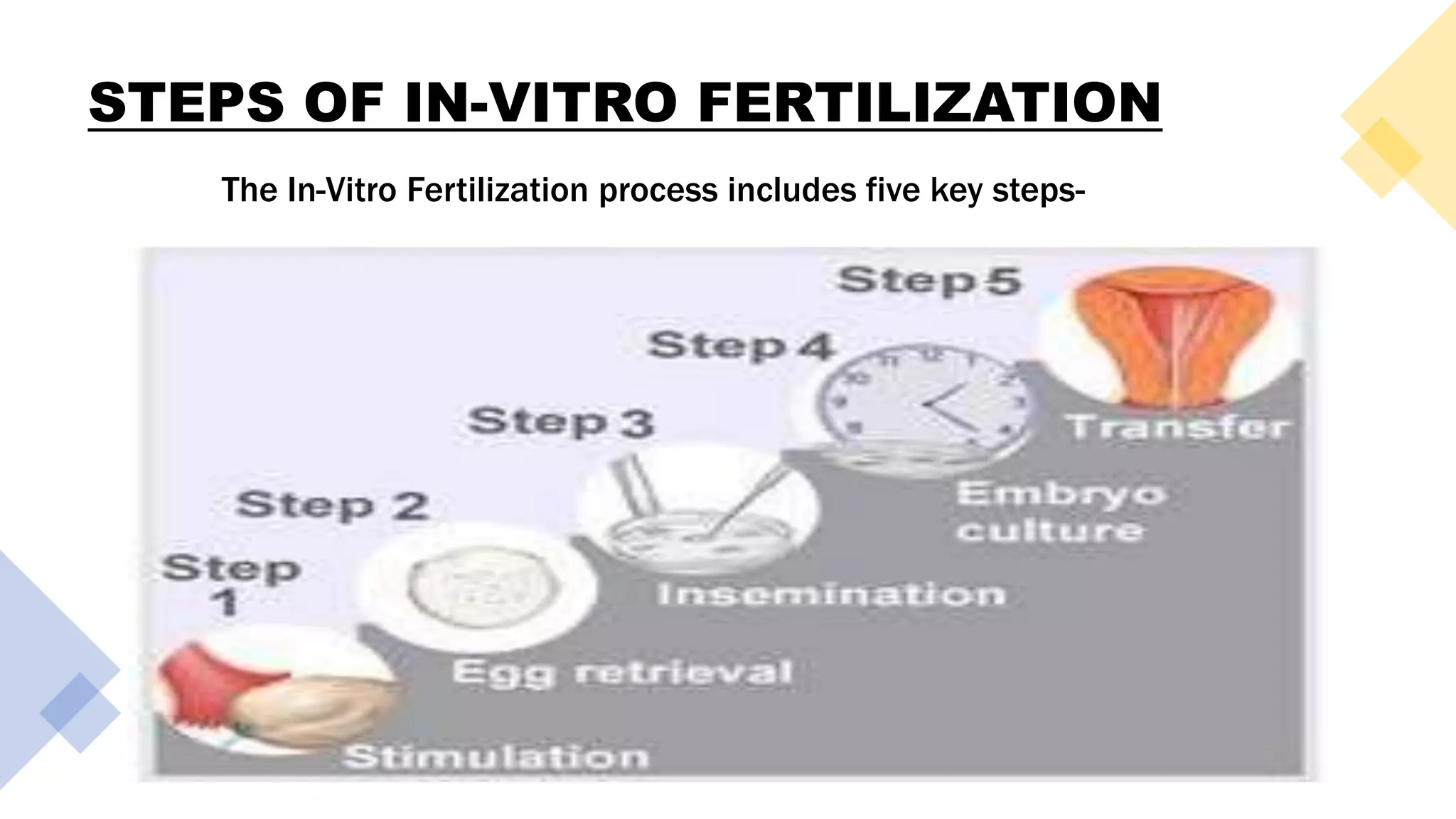
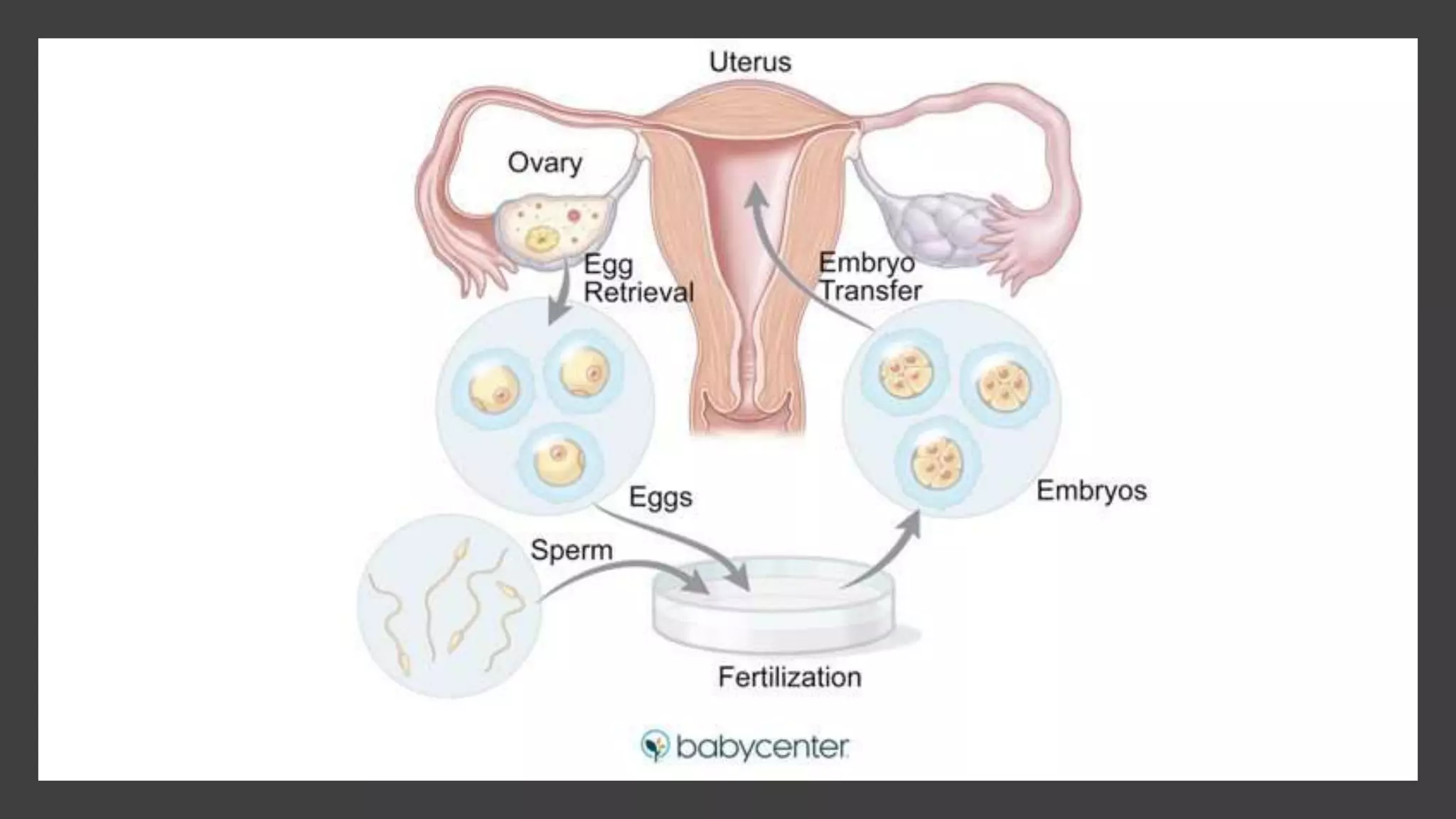
STEPS OF IN-VITRO FERTILIZATION
The In-Vitro Fertilization process includes five key steps-
1- Ovarian
stimulation
• Whether you are using your eggs or an egg donor, doctor will prescribe injectable
hormones or other medications to stimulate the ovaries to produce several eggs
instead of just one egg that normally develops each month (superovulation).
• Different fertility medication like clomiphene to stimulate ovarian follicles ranging
from a follicle-stimulating hormone (FSH), that help eggs mature and prepare the
lining of your uterus to hold the fertilized egg , HCG for preventing the inhibition of
luteinising hormone, etc are used.
• Typically occurs over 10 days before your eggs are ready for collection.
• Regular monitoring should be done.
• ADVANTAGE OF SUPEROVULATION- helps increase the chances of having at least
one viable embryo to use during the IVF procedure.
• DISADVANTAGE- increased risk of abnormal pregnancy.
IVF
procedure
.
This Photo by Unknown author is licensed under CC BY-SA-NC.
2- Egg retrieval/Collection of
oocytes
• Critical to determine the time of ovulation precisely before egg
retrieval.
• Time of ovulation is estimated on the basis of temperature
chart, change in cervical mucus score , level of Oestrogen and
LH in blood or urine and by determination of follicle size.
• Oocytes can be collected by laproscopic equipment that
permits visualization of ovary by monitor, aspiration of follicular
fluid having oocyte and surgical manipulation of ovaries.
• ADVANTAGES OF LAPROSCOPY-
minimum surgical intervention, very little damage to ovary and
is convenient.
This Photo by Unknown author is licensed under CC BY-ND.
3- Insemination/
Collection of
Sperms
• The semen is collected about 60-90 min prior to fertilization,
liquefied and centrifuged.
• The sperm pellet so formed is resuspended in culture medium
and incubated for 30-60 min at 37°C.
• A sample is taken from the surface of medium for fertilization
• The man's sperm is placed together with the best quality eggs.
The mixing of the sperm and egg is called insemination.
• 10,000-50,000 sperms are added to 100 micro litre to 1ml of
culture media.
• In case of oligospermia and azoospermia , sperm may be
collected from donor.
This Photo by Unknown author is licensed under CC BY-ND.
4- In-Vitro Fertilization and Embryo Culture-
This Photo by Unknown author is licensed under CC BY-NC-ND.
5- Embryo Transfer
• In vitro fertilized embryos of 1-16 cells are transferred into uterus
• Best stage for transfer is 2-4 cell stage.
• Embryo is transferred into uterus through cervical canal by teflon catheter.
• Small amount (about 10 microlitre) of culture medium is transferred along with
embryo.
• A prolonged in vitro culture of embryos reduces their survival rate, while younger are
less likely to survive in uterine environment.
• Transfer of multiple embryos in single uterus increases the chances of survival but may
lead to multiple pregnancy.
• In case the uterus of female desiring to have a baby is nonfunctional or
absent , surrogate mother may be used.
This Photo by Unknown author is licensed under CC BY-SA.
Major
points/factors affecting success
rate of IVF-
• The Quality of Egg, Sperm, and Embryo
• Collection of oocyte and embryo transfer should be done
with extreme care to avoid fallopian tube pregnancy and
the expulsion of transferred embryo from uterus.
• Correct stage of menstrual cycle should also be monitored.
• Incubation of oocyte and semen should be done properly.
• Couples who have a high risk of passing a genetic
(hereditary) disorder to a child may consider pre-
implantation genetic diagnosis (PGD).
• Controlled Ovarian Stimulation Protocol
• Uterine or Endometrial Receptivity
This Photo by Unknown author is licensed under CC BY-ND.
ADVANTAGES-
• Can overcome both male and female infertility.
• Assist Women Who Have Had Premature Ovarian Failure
• IVF helps to maximize the chance of conceiving among older patients
• No human intervention in fertilization.
• Safe Track Record
DISADVANTAGES-
• Side Effects and Risks Associated With IVF.
• Women Can Have A Slightly Higher Chance Of Ectopic Pregnancy.
• IVF Is Not Always A Success.
• Costly
• Involves laproscopic surgery.
REFRENCES-
• https://medlineplus.gov/ency/article/00727
9.htm
• www.wikipedia.com
• Biotechnology Expanding Horizons by
B.D.Singh
• https://myfertilitycare.com/
• https://www.webmd.com/infertility-and-
reproduction/guide/in-vitro-fertilization
• https://www.babycenter.com/
• https://infertilityanswers.com/
THANK YOU

In vitro fertilization

  • 1.
    In-vitro fertilization and EmbryoTransfer SUBMITTED BY – Kritika Joshi MSc Biotechnology 3rd Sem Roll no- 201632 This Photo by Unknown author is licensed under CC BY-ND.
  • 2.
    COMMON TERMS 1. FERTILIZATION -defined as the union of two haploid gametes, the spermatozoa and the oocyte, to restore the diploid state and form a zygote through the process of egg activation and a series of mitotic divisions that results in cell differentiation and embryo development. 2. INFERTILITY- a disease of the male or female reproductive system defined by the failure to achieve a pregnancy after 12 months or more of regular unprotected sexual intercourse. 3. IN-VITRO FERTILIZATION- In vitro fertilization (IVF) is the union of a woman's egg and a man's sperm outside the female body, in a laboratory dish or a culture vessel. This Photo by Unknown author is licensed under CC BY-NC-ND.
  • 3.
    Causes of Infertilitythat can be treated by IVF- Endometriosis Low sperm counts (oligospermia) Problems with the uterus or fallopian tubes Problems with ovulation Tubal infertility Lack of motile sperms (azoospermia) Antibody problems that harm sperm or eggs The inability of sperm to penetrate or survive in the cervical mucus Poor egg quality Genetic disease of mother or father This Photo by Unknown author is licensed under CC BY-NC-ND.
  • 4.
    IN-VITRO FERTILIZATION • IVFis a form of assisted reproductive technology (ART). • In this special medical techniques are used to help a woman become pregnant. • IVF, coupled with embryo transfer, in humans is aimed to enable couples suffering from certain types of sterility to have children. • Babies developed from this approach are known as "test- tube babies." • The first Test Tube baby was born on July 25, 1987 and was named as Loise Joy Brown. • Since its introduction in the U.S. in 1981, 1.9% of all babies in the U.S. are born through IVF. This Photo by Unknown author is licensed under CC BY-SA.
  • 5.
    STEPS OF IN-VITROFERTILIZATION The In-Vitro Fertilization process includes five key steps-
  • 6.
    1- Ovarian stimulation • Whetheryou are using your eggs or an egg donor, doctor will prescribe injectable hormones or other medications to stimulate the ovaries to produce several eggs instead of just one egg that normally develops each month (superovulation). • Different fertility medication like clomiphene to stimulate ovarian follicles ranging from a follicle-stimulating hormone (FSH), that help eggs mature and prepare the lining of your uterus to hold the fertilized egg , HCG for preventing the inhibition of luteinising hormone, etc are used. • Typically occurs over 10 days before your eggs are ready for collection. • Regular monitoring should be done. • ADVANTAGE OF SUPEROVULATION- helps increase the chances of having at least one viable embryo to use during the IVF procedure. • DISADVANTAGE- increased risk of abnormal pregnancy. IVF procedure . This Photo by Unknown author is licensed under CC BY-SA-NC.
  • 7.
    2- Egg retrieval/Collectionof oocytes • Critical to determine the time of ovulation precisely before egg retrieval. • Time of ovulation is estimated on the basis of temperature chart, change in cervical mucus score , level of Oestrogen and LH in blood or urine and by determination of follicle size. • Oocytes can be collected by laproscopic equipment that permits visualization of ovary by monitor, aspiration of follicular fluid having oocyte and surgical manipulation of ovaries. • ADVANTAGES OF LAPROSCOPY- minimum surgical intervention, very little damage to ovary and is convenient. This Photo by Unknown author is licensed under CC BY-ND.
  • 8.
    3- Insemination/ Collection of Sperms •The semen is collected about 60-90 min prior to fertilization, liquefied and centrifuged. • The sperm pellet so formed is resuspended in culture medium and incubated for 30-60 min at 37°C. • A sample is taken from the surface of medium for fertilization • The man's sperm is placed together with the best quality eggs. The mixing of the sperm and egg is called insemination. • 10,000-50,000 sperms are added to 100 micro litre to 1ml of culture media. • In case of oligospermia and azoospermia , sperm may be collected from donor. This Photo by Unknown author is licensed under CC BY-ND.
  • 9.
    4- In-Vitro Fertilizationand Embryo Culture- This Photo by Unknown author is licensed under CC BY-NC-ND.
  • 10.
    5- Embryo Transfer •In vitro fertilized embryos of 1-16 cells are transferred into uterus • Best stage for transfer is 2-4 cell stage. • Embryo is transferred into uterus through cervical canal by teflon catheter. • Small amount (about 10 microlitre) of culture medium is transferred along with embryo. • A prolonged in vitro culture of embryos reduces their survival rate, while younger are less likely to survive in uterine environment. • Transfer of multiple embryos in single uterus increases the chances of survival but may lead to multiple pregnancy. • In case the uterus of female desiring to have a baby is nonfunctional or absent , surrogate mother may be used. This Photo by Unknown author is licensed under CC BY-SA.
  • 12.
    Major points/factors affecting success rateof IVF- • The Quality of Egg, Sperm, and Embryo • Collection of oocyte and embryo transfer should be done with extreme care to avoid fallopian tube pregnancy and the expulsion of transferred embryo from uterus. • Correct stage of menstrual cycle should also be monitored. • Incubation of oocyte and semen should be done properly. • Couples who have a high risk of passing a genetic (hereditary) disorder to a child may consider pre- implantation genetic diagnosis (PGD). • Controlled Ovarian Stimulation Protocol • Uterine or Endometrial Receptivity This Photo by Unknown author is licensed under CC BY-ND.
  • 13.
    ADVANTAGES- • Can overcomeboth male and female infertility. • Assist Women Who Have Had Premature Ovarian Failure • IVF helps to maximize the chance of conceiving among older patients • No human intervention in fertilization. • Safe Track Record DISADVANTAGES- • Side Effects and Risks Associated With IVF. • Women Can Have A Slightly Higher Chance Of Ectopic Pregnancy. • IVF Is Not Always A Success. • Costly • Involves laproscopic surgery.
  • 14.
    REFRENCES- • https://medlineplus.gov/ency/article/00727 9.htm • www.wikipedia.com •Biotechnology Expanding Horizons by B.D.Singh • https://myfertilitycare.com/ • https://www.webmd.com/infertility-and- reproduction/guide/in-vitro-fertilization • https://www.babycenter.com/ • https://infertilityanswers.com/
  • 15.